
创新集群

Search documents
全球百强创新集群:中国这个集群第一,前15中国有5个
第一财经· 2025-09-02 03:09
Core Insights - The 2025 Global Innovation Index (GII) highlights the importance of venture capital in driving innovation activities, with the Shenzhen-Hong Kong-Guangzhou cluster surpassing the Tokyo-Yokohama cluster to claim the top position [3][6] - The introduction of venture capital transactions as a new metric in the GII methodology has significantly influenced the rankings, emphasizing the role of startup activities and innovation financing [6][7] Group 1: Rankings and Performance - The top three innovation clusters in the 2025 GII are Shenzhen-Hong Kong-Guangzhou (1st), Tokyo-Yokohama (2nd), and San Jose-Sunnyvale-Santa Clara (3rd) [4][6] - China leads with the most clusters (24) in the top 100, while the United States follows with 22 clusters [6][7] - The clusters of Beijing (4th), Seoul (5th), and Shanghai-Suzhou (6th) also rank highly, showcasing China's strong innovation ecosystem [6][7] Group 2: Methodology and Metrics - The GII 2025 employs three key indicators: the location of inventors in published PCT patent applications, the authorship of published scientific papers, and the volume of venture capital transactions [7] - The new methodology has narrowed the gap between China and the U.S. in terms of innovation strength, with Shenzhen-Hong Kong-Guangzhou showing superior performance in venture capital transactions [7][8] Group 3: Scientific Contributions - The top three clusters for scientific paper publications are Beijing (4% of global total), Shanghai-Suzhou (2.5%), and Shenzhen-Hong Kong-Guangzhou (2.4%) [7] - The highest PCT application contributions come from Tokyo-Yokohama (10.3%), Shenzhen-Hong Kong-Guangzhou (9%), and Seoul (5.4%) [7] Group 4: Venture Capital Activity - From 2019 to 2023, the top 100 clusters attracted nearly 169,000 venture capital transactions, with San Jose-Sunnyvale-Santa Clara (6.9%), New York City (4.5%), and London (4.4%) leading the way [8] - The data indicates a strong correlation between venture capital activity and innovation density, particularly in leading clusters [8] Group 5: Innovation Density - In terms of innovation density, the top clusters are San Jose-Sunnyvale-Santa Clara (1st), Cambridge (2nd), and Boston-Cambridge (3rd), with Ningde (China) ranking 4th due to a surge in patent applications from CATL [10]


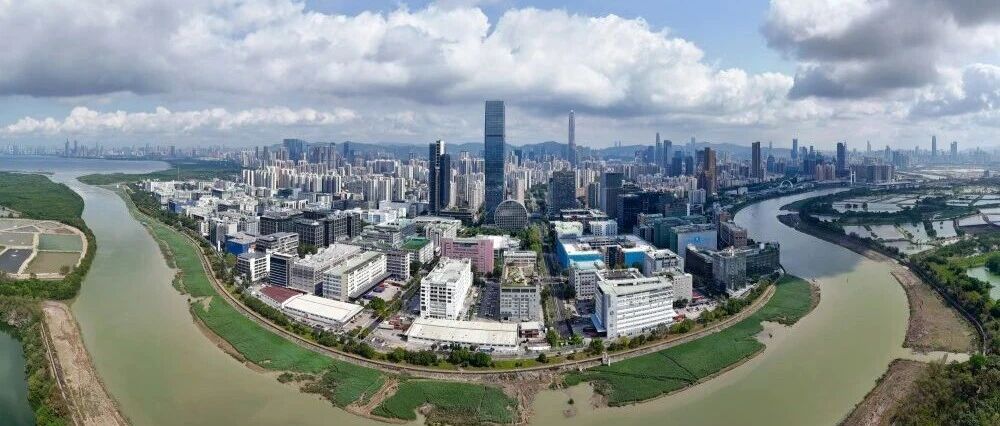
世界知识产权组织发布“世界百强创新集群” 深圳—香港—广州集群首登榜首
Shen Zhen Shang Bao· 2025-09-01 23:45
Group 1 - The Shenzhen-Hong Kong-Guangzhou innovation cluster has ranked first in the "World's Top 100 Innovation Clusters" for the first time, surpassing the Tokyo-Yokohama cluster [1] - The cluster has maintained a position in the top two for five consecutive years since 2020, indicating a strong and consistent performance in global innovation [1] - The global top 100 innovation clusters are distributed across 33 economies, with China having the highest number of clusters at 24, followed by the United States with 22 [1] Group 2 - Guangdong province ranks first in China for high-value invention patents, with 367,700 patents, and has a cumulative PCT international patent application volume of 304,700 [2] - The province has been focusing on building a world-class intellectual property strong province, with significant efforts in cities like Guangzhou and Shenzhen [2] - The global innovation index cluster ranking was established in 2017 and evaluates the concentration of world-class innovation activities based on three core indicators: international patent applications, research paper publications, and venture capital transaction volumes [2][3]
深圳—香港—广州集群,登顶!
Shang Hai Zheng Quan Bao· 2025-09-01 14:23
Core Insights - The latest Global Innovation Index (GII) report reveals that the Shenzhen-Hong Kong-Guangzhou cluster has surpassed the Tokyo-Yokohama cluster to become the top innovation cluster globally [1][4] - The San Jose-San Francisco cluster has risen three places to rank third, while Beijing, Seoul, and Shanghai-Suzhou follow in the rankings [4] Rankings and Performance - The Shenzhen-Hong Kong-Guangzhou cluster leads with a global share of 2.4% in scientific publications, 9.0% in PCT applications, and 2.9% in venture capital transactions [2][6] - The Tokyo-Yokohama cluster holds a global share of 1.4% in publications, 10.3% in PCT applications, and 2.2% in venture capital [2][4] - The San Jose-San Francisco cluster has a global share of 0.7% in publications, 3.9% in PCT applications, and 6.9% in venture capital [2][6] - London has improved its overall ranking from 21st to 8th, primarily due to its strong performance in venture capital transactions [4] Global Distribution - The top 100 innovation clusters are distributed across 33 economies, with China having the most clusters (24), followed by the United States (22), Germany (7), India (4), and Canada, Japan, and South Korea (3 each) [4][5] Venture Capital Activity - From 2019 to 2023, the top 100 clusters attracted nearly 169,000 venture capital transactions, with San Jose-San Francisco (6.9%), New York City (4.5%), and London (4.4%) leading the way [5][7] - The inclusion of venture capital transactions in the GII methodology has recalibrated the understanding of innovation strength, highlighting the role of clusters in converting scientific research into economic outcomes [7]
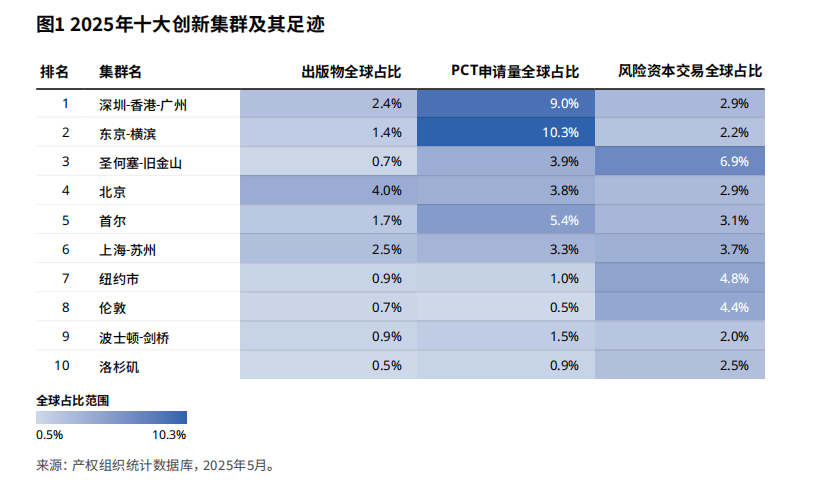
“深圳—香港—广州” 跃居全球创新集群首位
2 1 Shi Ji Jing Ji Bao Dao· 2025-09-01 09:00
Core Viewpoint - The "Shenzhen-Hong Kong-Guangzhou" innovation cluster has surpassed the "Tokyo-Yokohama" cluster to become the top global innovation cluster according to the Global Innovation Index (GII) released by the World Intellectual Property Organization (WIPO) [1] Group 1: Innovation Cluster Rankings - The GII cluster ranking was established in 2017 and is based on three core indicators: international patent applications via the Patent Cooperation Treaty (PCT), scientific publications, and the newly added venture capital (VC) transaction volume [1] - The "Shenzhen-Hong Kong-Guangzhou" cluster has ranked second globally for five consecutive years before this year, when the inclusion of VC transactions reshaped the rankings [1] - In 2025, the "Shenzhen-Hong Kong-Guangzhou" cluster is projected to account for 2.9% of global VC transactions, compared to 2.2% for the "Tokyo-Yokohama" cluster [1] Group 2: Performance Metrics - The "Shenzhen-Hong Kong-Guangzhou" cluster holds a global share of 9.0% in PCT applications, ranking second, with Huawei being the top applicant [2][4] - The cluster also has a global share of 2.4% in scientific publications, totaling 194,000 papers, with Sun Yat-sen University being the leading institution [4] - Shenzhen has maintained the highest PCT international patent application volume in China for 21 consecutive years, with 16,300 applications projected for 2024 [4] Group 3: Human Capital and Innovation Ecosystem - The region has successfully transitioned its development engine to focus on high-quality human capital, referred to as the "engineer dividend," to effectively address the "Lewis Turning Point" [4] - The accumulation of large-scale, high-quality human capital, combined with an effective corporate innovation ecosystem, is expected to unleash greater innovation momentum and economic value [4] - Hong Kong's innovation and technology development has seen significant progress, with Huawei's research team in Hong Kong growing to over 700 members [5]
深圳–香港–广州”集群跃居全球创新排名榜第一
Zhi Tong Cai Jing· 2025-09-01 07:39
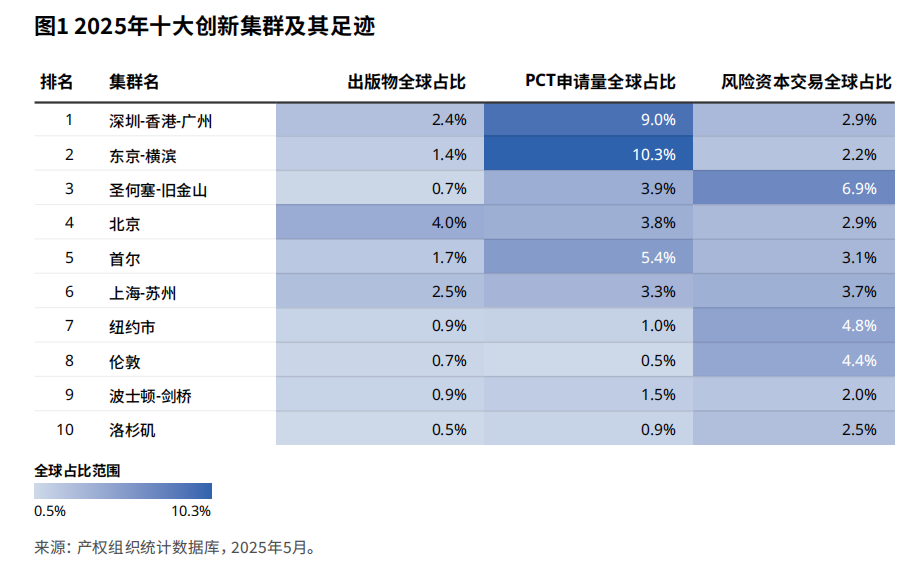
Group 1 - The "Shenzhen-Hong Kong-Guangzhou" cluster has surpassed the "Tokyo-Yokohama" cluster to become the top-ranked innovation cluster according to the Global Innovation Index (GII) released by WIPO [1][2] - The GII rankings have been reshaped this year by incorporating venture capital (VC) transaction activities as a new indicator, which has significantly influenced the rankings of various clusters [1][3] - The top three clusters in terms of VC transactions are "San Jose-Sunnyvale-Santa Clara" (6.9%), New York City (4.5%), and London (4.4%) [2] Group 2 - The top three clusters for scientific paper publications are Beijing (4% of global total), "Shanghai-Suzhou" (2.5%), and "Shenzhen-Hong Kong-Guangzhou" (2.4%) [2] - The highest PCT application share is held by "Tokyo-Yokohama" (10.3%), followed by "Shenzhen-Hong Kong-Guangzhou" (9%) and Seoul (5.4%) [2] - The Global Innovation Index identifies world-class innovation activities based on three core indicators: international patent applications via WIPO's PCT, scientific paper publications, and the newly added venture capital transaction volume [2][3]
王一鸣:大湾区要加快构建同科技创新相适应的科技金融体制
2 1 Shi Ji Jing Ji Bao Dao· 2025-08-30 05:57
Core Insights - The Greater Bay Area (GBA) is experiencing a surge in technological innovation investment, but its original innovation capability remains weak, necessitating a shift from collaborative innovation to innovation clusters [1][2] - The GBA has become a significant source of innovation in China, with R&D expenditure intensity surpassing 4%, ranking second only to Beijing and Shanghai, and leading the nation in patent authorizations [1] - Despite high R&D investment in Guangdong, it still lags behind developed countries, indicating a need for improvement in core technology control and collaborative innovation among the three regions [1] Summary by Sections Technological Innovation - The GBA is entering an active phase of technological innovation with substantial increases in investment [1] - The region's original innovation capability is still not strong, with a need to enhance original innovation momentum to support international competitiveness [1] R&D Investment - The GBA's R&D expenditure intensity has exceeded 4%, making it a crucial innovation driver in the country [1] - Patent authorization in the GBA has reached the highest level nationwide, indicating a robust innovation environment [1] Challenges and Recommendations - The GBA faces new challenges in building an international technology innovation center, particularly in enhancing original innovation capabilities and achieving significant original results [1] - It is recommended that the GBA transition from a following model to leading in specific advantageous fields and construct a technology finance system that aligns with technological innovation needs [2]