
增值税法

Search documents
这些新规,今起施行
Xin Lang Cai Jing· 2026-01-01 10:32
Tax Regulations - The new Value-Added Tax (VAT) Law and its implementation regulations will take effect on January 1, 2026, consisting of six chapters that clarify taxpayer obligations and tax rates [3] - Individuals selling residential properties purchased for less than two years will be subject to a 3% VAT, while those selling properties held for two years or more will be exempt from VAT [5] - The VAT law will also enhance tax incentives and clarify the standards for various VAT exemptions, requiring timely public disclosure of these policies [5] Credit Repair Policy - A one-time credit repair policy will be implemented starting January 1, 2026, allowing automatic adjustments to credit reports for overdue records that meet specific criteria [7] - Overdue records generated between January 1, 2020, and December 31, 2025, will not appear on credit reports if the overdue amount does not exceed 10,000 yuan and is fully repaid by March 31, 2026 [7] Education and Childcare - New regulations on kindergarten fees will be enforced from January 1, 2026, requiring public and non-profit private kindergartens to follow government-guided pricing, while for-profit kindergartens will have market-regulated fees [9] - A clear fee directory will be established, and any charges not listed or publicly disclosed will be prohibited [9] Electric Vehicles - A new national standard for electric vehicle energy consumption will be implemented on January 1, 2026, mandating that new passenger vehicles must not exceed 15.1 kWh per 100 km [15] - This standard is expected to improve the average driving range of electric vehicles by approximately 7% without increasing battery capacity [15] Cybersecurity and AI - The revised Cybersecurity Law will take effect on January 1, 2026, addressing the need for AI governance and development, including risk monitoring and safety regulation [19] - The law will support AI research and infrastructure development while enhancing ethical standards in AI applications [19] Legal Framework for Virtual Assets - The updated Civil Case Categories Regulation will come into effect on January 1, 2026, adding categories related to data and virtual property disputes [21] - This revision aims to refine intellectual property categories and address emerging issues in new employment forms and elder rights protection [21]


2026年新规今起施行
Xin Lang Cai Jing· 2026-01-01 01:18
Group 1 - New regulations will be implemented starting January 1, 2026, aimed at addressing public concerns and enhancing development vitality [1] - New behaviors affecting social security, such as exam cheating and unauthorized drone flights, will be subject to management and penalties [3] - A notification on improving kindergarten charging policies will establish a directory management system for service and tuition fees, requiring public disclosure of fees [4] Group 2 - Electric vehicle energy consumption limits will require manufacturers to upgrade technology, resulting in an average increase of approximately 7% in driving range for vehicles weighing around 2 tons, improving driver experience [5] Group 3 - The revised National Common Language and Writing Law will impose new regulations on online language usage, designating the third week of September each year as National Common Language Promotion Week [9] Group 4 - The People's Bank of China has introduced a one-time credit repair policy, allowing automatic adjustments of overdue records based on repayment situations, which will no longer appear on personal credit reports [10][11] Group 5 - The revised National Park Law encourages public participation in national park protection and promotes various forms of environmental education, including establishing free open days for the public [13][14] Group 6 - The amended Cybersecurity Law supports research in artificial intelligence fundamentals and key technologies, while enhancing ethical standards and risk monitoring [15] Group 7 - The revised civil case cause regulations have added causes related to data and virtual property, refining intellectual property causes, and addressing urgent public concerns such as new employment forms and elderly rights protection, bringing the total to 1,055 causes [16][17][18]

明天起,这些新规将影响你我生活
财联社· 2025-12-31 04:11
Group 1 - The new Value-Added Tax (VAT) Law and its implementation regulations will take effect on January 1, 2026, clarifying taxpayer obligations and tax scope [4] - The VAT Law specifies applicable tax rates, including zero tax rates for exports [5] - It establishes methods for calculating taxable amounts and details on VAT deduction certificates and input tax deduction methods [6] - The law enhances tax incentives by defining specific standards for VAT exemption projects and mandates timely public disclosure of these policies [6] - Comprehensive regulations on tax administration measures, including tax payment timelines, invoice issuance, and refund management, will be implemented [7] Group 2 - From January 1, 2026, individuals selling homes purchased for less than two years will be subject to a 3% VAT, while those selling homes held for two years or more will be exempt from VAT [10] - A one-time credit repair policy will be enacted, allowing automatic adjustments to credit reports for overdue records generated between January 1, 2020, and December 31, 2025, under certain conditions [13][14][15] Group 3 - The new regulations on kindergarten fees will take effect on January 1, 2026, establishing government-guided pricing for public and non-profit kindergartens, while for-profit kindergartens will have market-regulated fees [18] Group 4 - The new national standard for electric vehicle energy consumption will be implemented on January 1, 2026, requiring technical upgrades for new vehicles, resulting in an average increase of approximately 7% in driving range [27] Group 5 - The revised Cybersecurity Law will take effect on January 1, 2026, addressing the governance of artificial intelligence and enhancing risk monitoring and safety regulation [33] Group 6 - The revised Civil Case Cause Regulations will come into effect on January 1, 2026, adding causes related to data and virtual property disputes, and refining various other legal categories [36]

【热点问答】增值税法将实施,利好哪些行业?
Sou Hu Cai Jing· 2025-12-31 02:48
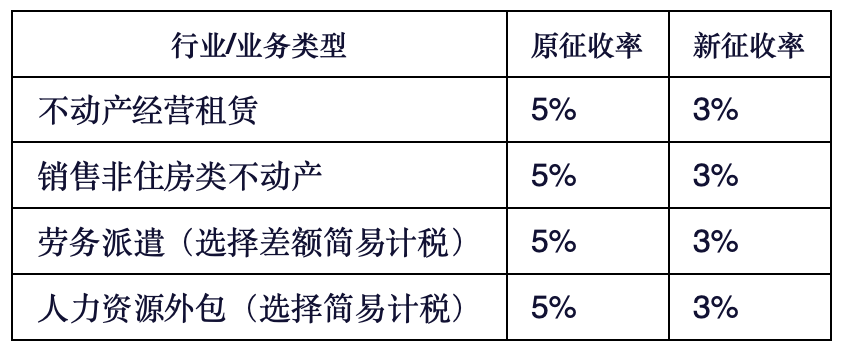
Core Viewpoint - The implementation of the new Value-Added Tax (VAT) Law in China on January 1, 2026, introduces significant changes aimed at streamlining the VAT system and improving cash flow for businesses. Group 1: Changes in VAT Law - The VAT Law does not fundamentally change taxpayers, tax rates, or calculation methods compared to the previous VAT Provisional Regulations, but it does reduce the circumstances of deemed sales and standardizes mixed sales [2] - The VAT Law significantly simplifies the scope of deemed sales, formalizes the refund of input tax credits, lowers the collection rate for simplified tax calculation methods, and expands the scope of input tax deductions [2] Group 2: Impact of Simplified Tax Calculation Rate - The new simplified tax calculation rate is set at 3%, benefiting various business types [3] - The following business types will see a reduction in the tax rate from 5% to 3% under the new law: - Real estate leasing - Sale of non-residential real estate - Labor dispatch (choosing differential simplified taxation) - Human resource outsourcing (choosing simplified taxation) [4] Group 3: Input Tax Credit Refund System - The VAT Law allows taxpayers to choose to carry forward or apply for a refund of input tax credits when the input tax exceeds the output tax for the period, which can improve cash flow for businesses [5] - Industries that will benefit from the optimized input tax credit refund measures include manufacturing, scientific research and technical services, software and information technology services, ecological protection and environmental governance, transportation, warehousing and postal services, and the energy sector, as these industries often have significant upfront investments leading to higher input tax credits [5]
这些新规,2026年1月1日起施行
Xin Hua She· 2025-12-31 02:16
Group 1: Social Security and Education - New regulations on social security, education, and public safety will take effect on January 1, 2026, addressing issues such as exam cheating and drone misuse [1] - The revised law on kindergarten fees mandates public and non-profit kindergartens to follow government-guided pricing, while for-profit kindergartens will have market-regulated fees [2] Group 2: Electric Vehicles - A mandatory standard for electric vehicle energy consumption will be implemented, requiring necessary technical upgrades for new products, with a target of not exceeding 15.1 kWh per 100 km for vehicles weighing around 2 tons, leading to an average range increase of approximately 7% [3] Group 3: Taxation - The new VAT law will come into effect, marking a significant step in establishing legal frameworks for taxation in China, with 14 out of 18 tax types now having legal statutes [4] Group 4: Language and Technology - The revised national language law will enhance the education and development of the national language, including regulations for online language use [5] - The new cybersecurity law will address artificial intelligence risks, promoting research and infrastructure development while enhancing risk monitoring and safety regulations [9] Group 5: Personal Credit - A one-time credit repair policy will be introduced, allowing for the automatic adjustment of overdue records based on specific repayment conditions, effective from January 1, 2026 [6] Group 6: Environmental Protection - The National Park Law will prioritize hiring local residents for ecological management positions and encourage public participation in environmental protection [7] Group 7: Civil Law - The revised civil case regulations will include disputes related to data and virtual property, expanding the total number of case types to 1,055 [10]
与你息息相关!2026年一批新规将施行
Yang Shi Xin Wen· 2025-12-30 23:12
Group 1: VAT Law Implementation - The new VAT Law of the People's Republic of China will take effect on January 1, 2026, consisting of six chapters that clarify taxpayer obligations and tax scope [1] - The law specifies applicable tax rates, including zero tax rates for exports, and outlines methods for calculating tax liabilities under different circumstances [1] - It enhances tax incentives by detailing the standards for VAT exemptions and mandates timely public disclosure of these policies [1] - The law also improves tax administration measures, standardizing processes for tax payment, invoice issuance, and tax refund management [1] Group 2: Housing Tax Policy - Starting January 1, 2026, individuals selling homes purchased for less than two years will be subject to a 3% VAT, while those selling homes held for two years or more will be exempt from VAT [5] - This policy allows individuals to apply the new regulations for any VAT not yet declared before January 1, 2026 [5] Group 3: Credit Repair Policy - The People's Bank of China will implement a one-time credit repair policy starting January 1, 2026, which will automatically adjust credit records for overdue payments made between January 1, 2020, and December 31, 2025 [7] - To qualify for this adjustment, individuals must repay overdue debts of no more than 10,000 yuan by March 31, 2026 [7] Group 4: Kindergarten Fee Regulation - A new notification regarding kindergarten fee policies will take effect on January 1, 2026, establishing government-guided pricing for public and non-profit private kindergartens, while for-profit kindergartens will follow market pricing [10] - The policy mandates a clear fee list and public disclosure of all charges, prohibiting any fees not listed or publicly announced [10] Group 5: Electric Vehicle Standards - A new national standard for electric vehicle energy consumption will be implemented on January 1, 2026, requiring that new passenger vehicles not exceed 15.1 kWh per 100 km [16] - This standard is expected to improve the average driving range of electric vehicles by approximately 7% without increasing battery capacity [16] Group 6: Second-Hand Vehicle Export Management - A joint notice from the Ministry of Commerce and other departments will enforce stricter controls on the export of new vehicles labeled as second-hand, effective January 1, 2026 [18] - The notice requires additional documentation for vehicles registered for less than 180 days to ensure compliance with export regulations [18] Group 7: Cybersecurity Law Amendments - The revised cybersecurity law will take effect on January 1, 2026, addressing the governance of artificial intelligence and enhancing risk monitoring and safety regulations [20] - The law supports research in AI foundational theories and key technologies, promoting the development of necessary infrastructure [20] Group 8: Civil Case Regulations - The updated regulations for civil case categories will be effective from January 1, 2026, adding provisions for data and virtual property disputes, and refining categories related to intellectual property and commercial disputes [22] - The total number of civil case categories will reach 1,055, reflecting the evolving legal landscape [22]

个人出售购买两年及以上的住房免增值税
Xin Lang Cai Jing· 2025-12-30 18:07
Core Viewpoint - The new VAT policy effective from January 1, 2026, will impose a 3% VAT on individuals selling homes purchased for less than two years, while those selling homes purchased for two years or more will be exempt from VAT, reflecting a significant tax reform aimed at simplifying the tax system and promoting a healthier real estate market [1][2]. Group 1 - The VAT rate for individuals selling homes purchased for less than two years will be reduced from 5% to 3% [1]. - The exemption of VAT for individuals selling homes purchased for two years or more maintains legislative consistency following the implementation of the VAT law [1]. - The new policy is expected to provide a direct reduction in tax burden for individuals, positively impacting the development of the real estate market [2]. Group 2 - The VAT law aims to simplify and standardize the tax system by reducing the number of applicable tax rates for small-scale taxpayers [1]. - Prior to the new VAT law, small-scale taxpayers faced VAT rates of either 3% or 5%, with the 5% rate being a carryover from previous business tax policies [1]. - The legislative changes reflect the spirit of tax law and the need for a more streamlined tax structure [1].
下调个人销售住房增值税有何意义?专家解读
Xin Lang Cai Jing· 2025-12-30 15:02
转自:北京日报客户端 个人销售住房增值税政策明年起调整 新华社北京12月30日电财政部、国家税务总局12月30日对外发布公告,明确自2026年1月1日起,个人 (不含个体工商户中的一般纳税人)将购买不足2年的住房对外销售的,按照3%的征收率全额缴纳增值 税;个人将购买2年以上(含2年)的住房对外销售的,免征增值税。 中国政法大学财税法研究中心主任施正文介绍,2026年1月1日起增值税法施行后,继续对个人销售购买 2年以上的住房免征增值税,很好地保持了立法后的税制连贯性。同时,将个人销售购买不足2年的住房 的增值税征收率,从5%下调到3%,是落实增值税法的重要举措,体现了税收法定和简化税制的立法精 神。 据介绍,在增值税法施行前,我国小规模纳税人适用的增值税征收率主要包括3%和5%两档,5%征收率 主要是"营改增"时平移的原营业税政策,个人销售购买不足2年的住房适用5%征收率就是这种情况。增 值税完成立法后,进一步简化和规范了税制,减少征收率档次。根据增值税法及其实施条例的规定,小 规模纳税人适用3%的征收率。 施正文表示,明年起,个人销售购买不足2年的住房,可充分享受立法红利,其增值税税负有较为直观 的下降, ...
个人销售住房增值税政策明年起调整
Xin Hua Wang· 2025-12-30 14:14
Core Viewpoint - The Ministry of Finance and the State Taxation Administration of China announced that starting from January 1, 2026, individuals selling residential properties purchased for less than two years will be subject to a 3% value-added tax (VAT), while those selling properties held for two years or more will be exempt from VAT [1] Group 1: Tax Policy Changes - From January 1, 2026, individuals (excluding general taxpayers among individual businesses) will pay a 3% VAT on the sale of residential properties purchased for less than two years [1] - Individuals selling residential properties purchased for two years or more will be exempt from VAT, maintaining legislative consistency after the implementation of the VAT law [1] - The VAT rate for individuals selling properties purchased for less than two years is reduced from 5% to 3%, reflecting the legislative spirit of tax law and simplification of the tax system [1] Group 2: Implications for the Real Estate Market - The reduction in VAT burden for individuals selling properties purchased for less than two years is expected to positively impact the healthy development of the real estate market [1] - The simplification and standardization of the tax system, along with the reduction of tax rate tiers, are seen as beneficial for the overall tax environment [1]
《中华人民共和国增值税法实施条例》自2026年1月1日起施行
Xin Lang Cai Jing· 2025-12-30 11:04
新华社北京12月30日电国务院总理李强日前签署国务院令,公布《中华人民共和国增值税法实施条例》 (以下简称《条例》),自2026年1月1日起施行。《条例》旨在贯彻落实《中华人民共和国增值税 法》,共6章54条,主要规定了以下内容。 一是细化纳税人和征税范围。细化增值税法规定的应税交易货物、服务、无形资产、不动产的范围;进 一步明确纳税人中的单位和个人、一般纳税人和小规模纳税人的标准,以及服务、无形资产在境内消费 的具体情形。 二是明确税率适用。进一步明确适用零税率的出口货物范围,以及跨境销售服务、无形资产适用零税率 的具体情形;明确一项应税交易涉及两个以上税率、征收率时适用税率和征收率的原则。 三是确定不同情形应纳税额计算方法。对增值税扣税凭证的具体种类和进项税额具体抵扣办法作出规 定;细化税务机关核定纳税人销售额的方法,并对特殊情形下进项税额的抵扣规则予以明确。 四是完善税收优惠。明确增值税法中各类免征增值税项目的具体标准,并规定增值税优惠政策的适用范 围、标准、条件等应当依法及时向社会公开,同时要求国务院财政、税务主管部门适时评估增值税优惠 政策执行效果,及时报请国务院予以调整完善。 五是健全征管措施。进 ...