定位理论

Search documents
李显红讲透117年的全球营销发展史
Sou Hu Cai Jing· 2025-07-18 12:17
Core Insights - The article serves as a sequel to the history of marketing over the past 117 years, focusing on the theories of advertising masters from perspectives of communication, semiotics, and advertising [1] - It emphasizes that understanding these theories requires contextualizing them within the specific economic conditions of the time they were proposed, particularly in the United States [2][4] Group 1: Historical Context and Theoretical Development - The advertising industry has evolved significantly since Claude Hopkins entered it in 1908, with American advertising figures addressing issues like product surplus and changing consumer preferences [2] - The theories proposed by advertising masters are fundamentally methods of communication aimed at enhancing efficiency and reducing costs, ultimately to drive sales [4] - Hopkins advocated for scientific advertising, emphasizing that the primary goal of advertising is to sell products rather than to entertain or please consumers [4][5] Group 2: Key Advertising Theories - The Unique Selling Proposition (USP) introduced by Rosser Reeves focuses on having a clear and unique sales message, which is essential for effective communication and cost-efficient marketing [6][8] - David Ogilvy's concept of image advertising highlights the importance of visual symbols in product packaging to enhance communication efficiency and reduce marketing costs [10] - Jerome McCarthy's 4P theory (Product, Price, Place, Promotion) is presented as a comprehensive framework for marketing, relevant across various industries [11][13] Group 3: Evolution of Marketing Concepts - The positioning theory introduced by Trout and Ries addresses the challenges of product variety and high promotional costs, although it is critiqued for lacking theoretical rigor [15] - Integrated Marketing Communication, proposed by Don Schultz, aims to enhance two-way communication with consumers, although it is also critiqued for its ambiguity [17] - The article concludes that all these advertising methodologies fundamentally aim to lower marketing communication costs and improve the efficiency of information exchange between products and consumers [22]

魏建军,依然不迂回
3 6 Ke· 2025-07-07 09:18
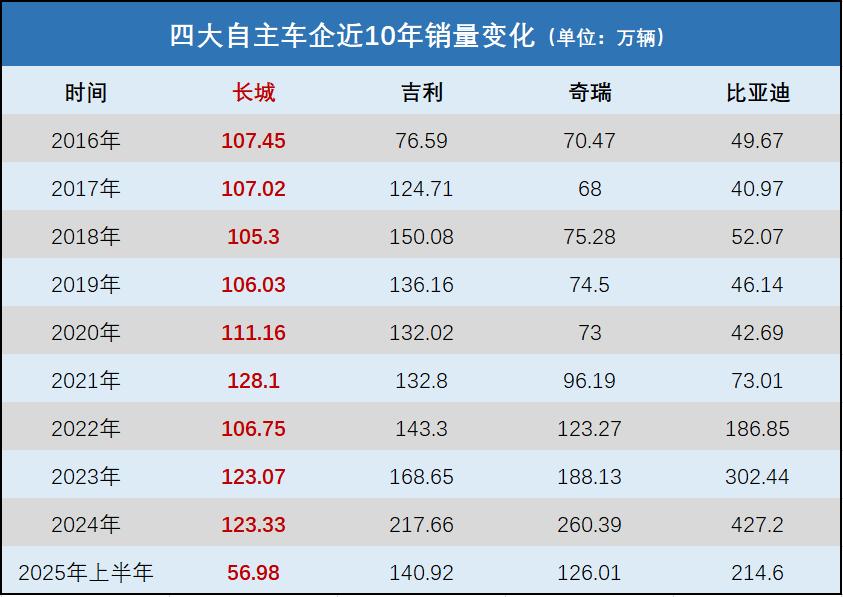
Core Viewpoint - Great Wall Motors is at a critical juncture five years after its 30th anniversary, facing significant changes in the automotive market and its own performance compared to competitors [1] Group 1: Market Position and Sales Performance - Five years ago, joint venture brands held a market share of 64.3%, while Great Wall was the only domestic brand with increasing sales [1] - As of July 1, Great Wall's sales for the first half of the year showed a year-on-year increase, but there is a noticeable gap compared to former peers [1] - In the last decade, Great Wall's sales have fluctuated, with 2023 sales at 123.07 million units, while competitors like BYD reached 302.44 million units [2] Group 2: Leadership and Strategy - Chairman Wei Jianjun has been a controversial figure, facing scrutiny and criticism, particularly after reporting BYD for alleged violations [3][4] - Wei's approach to competition is characterized by a straightforward, no-nonsense attitude, focusing on technical innovation rather than shortcuts [4][6] - Great Wall's strategy has been to maintain a multi-technology approach, even as competitors rapidly embrace electric vehicles [4][8] Group 3: Product Development and Market Adaptation - Great Wall has been criticized for a slow transition to electric vehicles, but its growth in sales has been driven by new energy models [4][10] - The company has recently made strategic adjustments, including the appointment of a new general manager for the Ora brand and a return to the sub-10 million yuan price range for new models [13][14] - Great Wall is set to launch several new products in the second half of the year, including the Tank 800 and new Ora electric models, indicating a renewed focus on product development [16]

深度:如何构建品牌稀缺性?
Hu Xiu· 2025-06-12 01:42
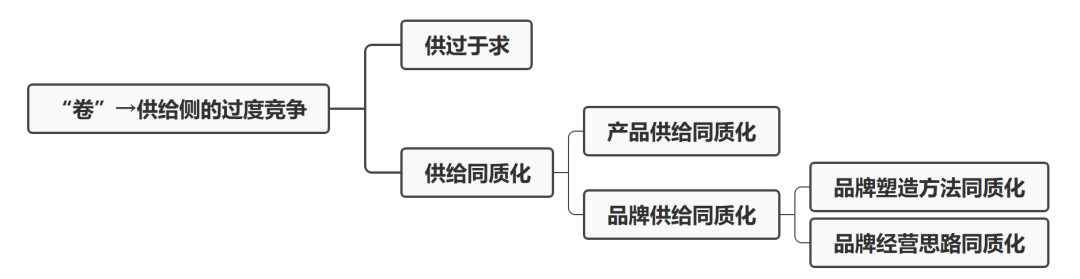
Core Viewpoint - The concept of "competition" in the consumer goods sector has intensified, evolving from mere growth to a survival mode, affecting even niche categories that were previously less competitive [1][4]. Group 1: Nature of Competition - The essence of "competition" is characterized by oversupply and supply homogenization, driven by excessive competition on the supply side [4]. - Two main factors contribute to this phenomenon: oversupply due to a high number of competitors and the homogenization of supply, where many brands follow similar paths, leading to a crowded market [4][6]. Group 2: Brand Homogenization - The trend of brand homogenization has become more pronounced in recent years, with brands increasingly adopting similar strategies and methods, resulting in a lack of differentiation [8][9]. - The rise of e-commerce has lowered the barriers for brand creation, leading to an explosion of brands and consequently, a homogenization of brand offerings [8][9]. Group 3: Building Brand Scarcity - To escape the cycle of homogenization, brands need to focus on creating scarcity through unique brand positioning and innovative strategies [10][11]. - The differentiation of brands can be achieved by understanding the dual nature of branding: as a tool for business strategy and as a result of consumer perception [12][14]. Group 4: Positioning Theory - The essence of consumer goods business is rooted in "concept" and the competition for consumer mindshare through effective positioning [20]. - Many brands tend to adopt a simplistic approach to positioning, focusing solely on product categories, which can lead to a lack of differentiation in a saturated market [21][22]. Group 5: Multi-Dimensional Brand Image - A multi-dimensional brand image is more difficult to replicate and can provide a competitive edge, as seen in successful brands like Apple [37][38]. - Building a multi-dimensional brand requires a cohesive narrative and alignment with business strategies to create a strong brand identity [38].
全球销量第一,这家杭州脱毛仪品牌如何成功打入海外市场
3 6 Ke· 2025-05-20 03:25
Core Insights - Ulike has established itself as the leading brand in the home hair removal device market in China within three years of its inception, leveraging social media marketing and e-commerce promotions to maintain its top position [1][2][3] - The global home hair removal device market is projected to grow from $4.397 billion in 2023 to $12.86 billion by 2030, with a CAGR of 15.7% from 2024 to 2030, indicating significant growth potential for Ulike in overseas markets [2][3] - Ulike's strategy for international expansion involves replicating its successful domestic model while making localized adjustments to products, channels, and marketing strategies to cater to different regional preferences [4][8] Group 1: Company Overview - Ulike, founded in 2013 and part of Hangzhou Youlai Technology Co., Ltd., specializes in home electric hair removal devices and has achieved over 70% market share in China [2][3] - The brand has sold over 6 million units globally and has established more than 1,000 offline stores in 49 countries as of August 2024 [3][4] Group 2: Market Strategy - Ulike's overseas strategy focuses on "replicating domestic success and localized operations," which includes concentrating marketing resources on 1-2 core products and utilizing social media for promotion [4][5][8] - The company has successfully entered major markets such as the US, UK, France, Malaysia, and Vietnam, building local marketing teams to adapt product strategies and sales channels [8][12] Group 3: Product Strategy - Ulike's product strategy emphasizes a few core products, with specific adaptations for different markets, such as color preferences in Japan and the introduction of a male hair removal device [11][12] - The brand highlights its patented sapphire ice point technology to differentiate itself from competitors, addressing common skin irritation issues associated with hair removal devices [12] Group 4: Channel Strategy - Ulike has adopted a multi-platform approach for sales, focusing on major local e-commerce platforms and achieving significant market share, such as 11.3% on Amazon in the US [15][18] - The pricing strategy positions Ulike products competitively against established brands, with prices around $350 in the US and 40,000 yen in Japan, which are lower than many competitors [15][18] Group 5: Marketing Strategy - Ulike employs a KOL and KOC matrix to enhance brand awareness, utilizing social media platforms like Facebook and YouTube to engage with a younger audience [21][24] - The brand has collaborated with high-profile influencers, such as Kim Kardashian, to increase visibility and drive sales through social media engagement [26][27]
盘点陆家嘴四大品牌战略咨询公司
Sou Hu Cai Jing· 2025-03-25 18:32
Core Insights - The article highlights the rapid development of the brand strategy consulting industry in Lujiazui, positioning it as a national center for strategic consulting in China [1][2]. Group 1: Overview of Lujiazui - Lujiazui is recognized as China's Wall Street and a national financial center, with an economic output exceeding 500 billion yuan in 2020 [1]. - Over 340 Fortune 500 companies have established offices in Lujiazui, with 115 multinational companies setting up regional headquarters [1]. Group 2: Major Consulting Firms - **Junzhi**: Founded in 2010 by Xie Weishan, Junzhi integrates Eastern wisdom with Western business theories, focusing on large enterprises. Notable clients include Feihe Dairy and Yadea [3][4]. - **Zhuopu**: Established by Liu Feng, Zhuopu is known for its low profile but has a strong reputation in the fast-moving consumer goods sector, serving clients like Zhou Hei Ya and Shanghai Disney [5][7]. - **Traut**: The Chinese branch of the American firm, founded by Deng Delong, gained fame through successful strategic positioning consulting. However, it has faced challenges due to the rise of local consulting firms [8][10]. - **Ries**: Founded by Al Ries, the firm entered China in 2007 and focuses on global Fortune 500 companies. It is known for its strategic positioning concepts [11][13]. Group 3: Additional Consulting Firms - Other notable consulting firms in Lujiazui include Dongji and Zhizhan Strategy, contributing to the area's reputation as a strategic consulting hub [14].