平台经济监管

Search documents
市场监管总局:加力推进全国统一大市场建设
Zheng Quan Shi Bao Wang· 2025-12-18 14:50
Core Viewpoint - The meeting led by Luo Wen emphasized the need to align thoughts and actions with the Central Committee's scientific judgment on the economic situation, focusing on both opportunities and challenges in the market regulation sector [1] Group 1: Market Regulation and Economic Development - The meeting called for enhanced efforts to promote the construction of a unified national market, reinforcing fair competition governance and facilitating smooth economic circulation [1] - There is a focus on comprehensive rectification of "involution" competition to foster a market order characterized by quality and fair pricing [1] - Continuous optimization of the business environment is essential to stimulate the vitality of various business entities and enhance the endogenous power of the market [1] Group 2: Platform Economy and Safety Regulations - The meeting highlighted the need to improve the regulatory capacity for the platform economy on a regular basis, promoting innovation and healthy development within this sector [1] - It is crucial to maintain safety standards for food, pharmaceuticals, industrial products, and special equipment, while proactively preventing and mitigating major risk hazards [1] - The meeting also stressed the importance of ensuring safety in production and maintaining stable prices and quality for essential consumer goods as the year-end approaches [1]
牛市早报|中央财办:投资和消费增速明年有望恢复
Xin Lang Cai Jing· 2025-12-17 00:13
Market Overview - On December 16, the Shanghai Composite Index fell by 1.11% to 3824.81 points, while the ChiNext Index dropped by 2.1% to 3071.76 points [1] - In the U.S. market, the Dow Jones decreased by 0.62% to 48114.26 points, and the S&P 500 fell by 0.24% to 6800.26 points, whereas the Nasdaq rose by 0.23% to 23111.46 points [1] Economic Insights - The Central Economic Work Conference indicated that the global economy is expected to maintain moderate growth, but uncertainties remain. Domestic challenges persist, yet the long-term positive trends and advantages of the Chinese economy are unchanged [2] - The advantages highlighted include the socialist system, large market size, complete industrial system, and rich talent resources, which are expected to become more prominent [2] - Active flows of factors and innovation are anticipated to inject new momentum into development, with investment and consumption growth expected to recover next year [2] Regulatory Developments - The State Administration for Market Regulation plans to introduce new regulations for platform economy, including the "Live E-commerce Supervision Management Measures" and "Network Trading Platform Rules Supervision Management Measures" [3] - The China Securities Association has established a mechanism for collecting complaints regarding unfair competition among information technology service providers in the securities industry [3] IPO and Market Activity - The Hong Kong Stock Exchange has welcomed over 100 new listings since 2025, raising more than 270 billion HKD, with over 300 listing applications currently being processed for 2026 [4] - Nasdaq plans to extend trading hours to 23 hours per week, marking a step towards all-day trading [6] Corporate Governance - Douyin Group has introduced a trial "Community Finance Industry Convention" aimed at regulating financial content creators and ensuring professional qualifications [5] - 360 Group has issued a statement addressing malicious defamation against its founder, asserting compliance with legal and regulatory standards [8]
事关直播电商、食品安全 这些市场监管新规将发布
Yang Shi Xin Wen· 2025-12-16 09:35
Core Viewpoint - A series of new regulations will be implemented to enhance the supervision of platform economy and ensure food safety, as well as to strengthen anti-monopoly and fair competition practices in the market [1]. Group 1: Platform Economy Regulations - Two new regulations, the "Live E-commerce Supervision Management Measures" and the "Network Trading Platform Rules Supervision Management Measures," will be introduced to provide a more structured regulatory framework for the platform economy [1]. Group 2: Food Safety Regulations - Two new systems, the "Food Commissioned Production Supervision Management Measures" and the "Food Sales Chain Enterprises Implementing Food Safety Main Responsibility Supervision Regulations," are set to be released to enhance food safety oversight [1]. Group 3: Anti-Monopoly and Competition Regulations - The revised "Prohibition of Monopoly Agreements Regulations" will be published, along with the introduction of the "Regulations on Stopping the Abuse of Administrative Power to Exclude or Restrict Competition," aimed at strengthening anti-monopoly and unfair competition efforts [1]. Group 4: Fiber Product Quality Regulations - The revised "Fiber Product Quality Supervision Management Measures" will be released to better align with industry development and regulatory needs, ensuring the quality and safety of fiber products [1].
个别平台内经营者未如实申报收入,国家税务总局提示偷逃税款风险
Xin Jing Bao· 2025-11-28 04:31
Core Viewpoint - The National Taxation Administration has reported that since October 1, over 7,000 domestic and foreign platform enterprises have complied with tax information reporting obligations, but some operators still engage in false reporting and income concealment, posing tax evasion risks [1][2]. Group 1: Tax Information Reporting - More than 7,000 platform enterprises have actively reported tax information since October 1 [1] - Most platform operators have completed market entity registration, but some engaged in online sales without proper registration [1] - Individuals conducting online transactions exceeding 100,000 yuan annually must register as market entities according to the Electronic Commerce Law [1] Group 2: Compliance and Risks - Some operators have registered but failed to confirm tax information with tax authorities, affecting fair competition [2] - Tax authorities have identified operators with self-reported income significantly lower than reported platform income and have prompted corrections [2] - Operators are advised to accurately report all income from various platforms and face legal consequences for non-compliance [2] Group 3: Future Actions - The tax department will continue to promote collaborative governance and enforce laws against unlicensed operations, non-reporting, and false reporting [3] - Efforts will be made to enhance the regulatory framework for platform economies to support high-quality development [3]
星瞰IPO | 货拉拉上市卡壳超900天,周胜馥的“赌局”胜负未定
Sou Hu Cai Jing· 2025-11-14 10:10
Core Insights - The article discusses the ongoing challenges faced by Huolala, a logistics platform founded by Zhou Shengfu, as it attempts to go public on the Hong Kong Stock Exchange after multiple failed attempts [1][3]. Group 1: Company Overview - Huolala, founded in 2013, has become a leading logistics trading platform in China, with projections indicating it will be the largest global closed-loop GTV logistics platform by mid-2025 [3]. - The company has submitted its IPO application to the Hong Kong Stock Exchange six times but has not yet received the necessary approval from the China Securities Regulatory Commission [3][4]. Group 2: Regulatory Challenges - The regulatory environment has become more stringent following the scrutiny of Didi in 2021, which has impacted Huolala's ability to secure the required approvals for its IPO [3][4]. - Since 2021, Huolala has faced 18 public reprimands related to issues such as driver rights and illegal passenger transport, indicating increased regulatory focus on compliance and antitrust measures [4][11]. Group 3: Financial Performance - Huolala's revenue has grown from $1.036 billion in 2022 to an estimated $1.593 billion in 2024, with a 31.9% year-on-year increase in the first half of 2025, reaching $945 million [7][10]. - Despite revenue growth, the company's profitability has been inconsistent, with net profit fluctuating significantly due to non-recurring items, such as a $606 million gain from the fair value change of redeemable convertible preferred shares in 2023 [9][12]. Group 4: Business Model and Challenges - The company's revenue heavily relies on its freight platform services, which account for over half of its income, but the monetization rate has declined from 10.3% in 2023 to an expected 9.2% in 2025 [9][10]. - Huolala's overall gross margin has decreased from 61.2% in 2023 to 52.3% in the first half of 2025, indicating pressure on profitability [11]. Group 5: Funding and Valuation - Since 2014, Huolala has raised a total of $2.662 billion across 11 funding rounds, with notable investors including Sequoia China and Tencent [12]. - The fair value of Huolala's redeemable convertible preferred shares has increased from $4.673 billion in 2023 to $4.738 billion in the first half of 2025, contributing to high liabilities on its balance sheet [12][14]. - As of mid-2025, Huolala's current liabilities reached approximately $5.46 billion, leading to a debt ratio of about 164%, indicating a state of insolvency [14].


美的否认罚款传闻背后:社媒平台内容与商业边界待厘清
Xin Lang Cai Jing· 2025-10-30 09:32
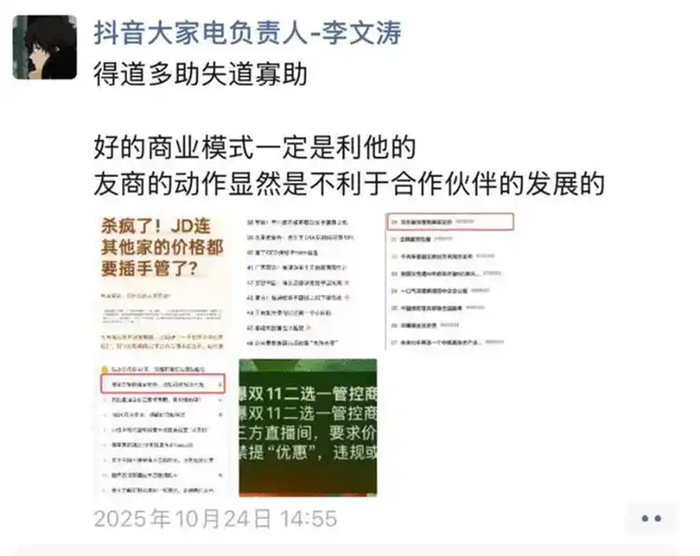
Core Viewpoint - The ongoing controversy surrounding e-commerce platform competition rules during this year's Double Eleven shopping festival highlights the intense competition in the e-commerce industry and raises concerns about the dual identity of super platforms as both content and commercial entities [1][4]. Group 1: Incident Overview - The controversy began around October 20, with claims that JD.com intensified price comparison checks and imposed penalties on merchants for pricing higher than on other platforms, leading to allegations of "forced exclusivity" [1][3]. - Following these claims, topics related to JD.com's alleged practices trended on social media platforms, prompting criticism from industry figures [1][3]. - On October 28, rumors circulated that Midea was fined 5 million yuan for violating JD.com's exclusivity requirements, which again gained traction on social media [3][4]. Group 2: Responses from Involved Parties - JD.com employees clarified that their price comparison practices aimed to secure fair prices for consumers and were unrelated to the alleged exclusivity [3][4]. - Midea publicly denied the claims regarding the fine, stating that the information circulating online was false, which undermined the credibility of the rumors [3][4]. Group 3: Implications for Competition and Regulation - The incident underscores the complex dynamics of competition between JD.com and Douyin, a platform that combines e-commerce and content, raising questions about the influence of platform algorithms and content-commercial boundaries [4][5]. - Media commentary suggests that the use of content platforms for commercial competition could disrupt fair market practices, highlighting the need for clear separation between content and commercial activities [5][6]. - There are calls for proactive regulatory mechanisms to address the evolving competition landscape, including transparency in algorithm rules and stronger governance against misinformation [6][7].


超95%平台已报送涉税信息 少数平台内经营者收合规申报提醒
Bei Ke Cai Jing· 2025-10-27 05:41
Core Points - The State Council's regulations require platform enterprises to report identity and income information of operators and employees starting from October 1 [1] - Over 6,500 platform enterprises have reported tax-related information, exceeding 95% compliance of the total platforms required to report [1] - The majority of operators on these platforms are small and micro enterprises, benefiting from tax incentives that reduce their tax liabilities [1] Group 1 - The tax authority is providing compliance reminders to a small number of platform operators whose self-reported income is significantly lower than the income reported by the platform [1] - Operators receiving compliance reminders should verify their income from various platforms and correct any underreporting to avoid penalties [1] - The tax authority aims to enhance the regulatory framework for the platform economy to promote fair competition and support the construction of a unified national market [2]
给平台定价立规矩
Jing Ji Ri Bao· 2025-10-22 22:10
Core Viewpoint - The regulatory authority in Zhengzhou has conducted an administrative interview with an online travel platform, highlighting unreasonable restrictions on transaction and pricing imposed on platform operators, and mandating revisions to contract terms and pricing tools to ensure compliance with e-commerce laws [1] Group 1: Regulatory Actions - The Zhengzhou Market Supervision Administration has ordered the online travel platform to revise its service agreements and optimize pricing tools within a specified timeframe [1] - The platform's actions were found to violate relevant provisions of the E-commerce Law, indicating a trend of regularized oversight of price manipulation by internet platforms [1][3] - The recent joint release of the "Internet Platform Pricing Behavior Rules (Draft for Comments)" by multiple regulatory bodies aims to standardize pricing-related business behaviors among platform operators and their partners [3] Group 2: Market Dynamics - Online travel platforms have become a primary choice for consumers, with many merchants relying on platform traffic to enhance profitability [1] - Some dominant platforms impose high commissions while simultaneously forcing merchants to lower prices, disrupting normal market pricing order and violating legal boundaries [1][2] - The interference in pricing by platforms can distort price signals, leading to mismatches between merchants' income and costs, ultimately affecting service quality and consumer experience [2] Group 3: Recommendations for Platforms - Platforms are encouraged to strengthen self-regulatory awareness and establish compliance management systems for pricing behavior [4] - The use of algorithms should be transparent, with clear negotiation mechanisms for price adjustments between platforms and merchants [4] - Platforms should also create complaint channels for pricing issues and maintain transaction information to ensure accountability in compliance management [4]
破“内卷”困局 网约车行业开启“深调整”
Xin Hua Wang· 2025-10-19 23:38
Core Insights - The ride-hailing industry is facing significant challenges, including poor driver-passenger experiences, high commission rates, and increasing competition leading to a vicious cycle of low earnings for drivers and high costs for passengers [1][2][4] Industry Overview - Complaints from consumers about ride-hailing services have surged, highlighting issues such as poor vehicle conditions, lack of air conditioning, and driver fatigue [1] - The number of ride-hailing vehicles in China increased from 2.792 million to 3.206 million in 2024, while the number of licensed drivers rose from 6.572 million to 7.483 million, indicating a saturated market [2] Financial Dynamics - The average hourly income for ride-hailing drivers in 2024 was 27 yuan, a decrease of approximately 12.9% from 31 yuan in 2023, reflecting the financial strain on drivers [2] - High commission rates imposed by platforms are a significant factor contributing to the low profitability for drivers, with many working long hours to make ends meet [1][2] Regulatory Responses - Various local governments have issued warnings about the risks in the ride-hailing market and have temporarily halted the issuance of operating licenses in some cities [3] - Ride-hailing platforms are beginning to lower their commission rates, with T3 Mobility capping its commission at a maximum of 27% and other platforms following suit to share more revenue with drivers [3][5] Market Competition - The introduction of fixed-price and promotional orders has led to increased working hours for drivers, exacerbating the competition and reducing overall income [2][6] - The "one-price" and "promotional orders" models are under scrutiny, with new regulations aimed at curbing these practices to restore fair competition in the market [6][7] Future Outlook - Industry experts suggest that ride-hailing platforms need to explore new growth avenues, such as international markets or niche travel segments, to escape the reliance on domestic market competition [4] - The recent regulatory actions against low-price competition may set a precedent for broader platform economy regulations, emphasizing the need for companies to focus on service quality and innovation rather than price wars [8]
货拉拉再遭约谈 IPO生变 货运O2O行业集体面临“合规性”大考
Sou Hu Cai Jing· 2025-09-24 12:37
Core Viewpoint - The recent regulatory interview with Huolala signifies a shift in the freight O2O industry, marking the end of its rapid, unregulated growth and the beginning of a compliance-focused era, emphasizing safety, profitability, and regulatory adherence [1][5][17]. Regulatory Storm Upgrade: Normalization of Industry Interviews - The freight O2O industry has faced significant challenges, including opaque pricing mechanisms, inadequate driver rights protection, and safety regulation gaps, leading to increased scrutiny from regulators [1][2]. - Huolala was interviewed by the State Administration for Market Regulation on September 23, 2025, for allegedly violating antitrust laws and was required to uphold the rights of truck drivers and consumers. This marks the eighth time Huolala has been named by regulatory bodies in 2023 [1][2]. - Other platforms, such as Manbang Group, have also faced similar scrutiny, indicating widespread issues within the industry regarding pricing mechanisms and operational fairness [1]. Systemic Challenges Awaiting Resolution: Safety, Pricing, and Rights Protection - Safety remains a critical issue, with past incidents highlighting significant shortcomings in journey monitoring and safety measures [7]. - Pricing mechanisms are criticized for being non-transparent, with users frequently facing unexpected additional charges, complicating the dispute resolution process [10]. - Driver rights protection is inadequate, with platforms often adjusting pricing rules and fees in ways that undermine drivers' earnings and working conditions [10]. Capital and Valuation: Repeated IPO Failures and Market Concerns - Huolala's ongoing safety controversies and trust issues have severely impacted its capital-raising efforts, marking its fifth attempt to go public on the Hong Kong Stock Exchange [11][12]. - The company has faced repeated rejections due to concerns over its business model's sustainability, high commission rates, and compliance issues in its financial operations [12][14]. - Huolala's valuation has significantly decreased from 90 billion RMB in 2023 to 65 billion RMB in 2024, reflecting market skepticism about its business model and ability to balance interests among drivers, users, and the platform [16]. Conclusion - The regulatory interview serves as both a challenge and an opportunity for Huolala, emphasizing the need for the company to address compliance issues before pursuing capital opportunities [14][17]. - The freight O2O industry is entering a new phase characterized by stringent regulations, where efficiency must not come at the expense of fairness, necessitating a shift from a "traffic-driven" to a "value-driven" operational model [17].