强省会战略

Search documents
二线城市,起势这么猛
投资界· 2025-05-03 07:38
Core Viewpoint - The article discusses the significant rise of second-tier cities in China, highlighting their potential to challenge first-tier cities in various aspects, including real estate, population growth, and economic development [3][34]. Group 1: Chengdu's Real Estate Boom - Chengdu has emerged as a leading city in China's real estate market, surpassing major cities like Shanghai and Beijing in both transaction volume and price, with new home prices reaching 16.98 million yuan per square meter [7][8]. - The city's land auction prices have rapidly increased, indicating strong demand and potential for future price growth [8]. - Chengdu's real estate market is driven by product quality, with successful projects like Luhui setting new standards and attracting significant external purchasing power [10][12]. Group 2: Population Growth in Hefei and Guiyang - Hefei and Guiyang are experiencing population growth amidst a national trend of population decline in many cities, with Hefei's population growth rate at 1.51% and Guiyang showing similar trends [13][15]. - Both cities have successfully attracted talent and investment, with Hefei benefiting from its educational institutions and Guiyang focusing on big data development [16][17]. Group 3: Chongqing's Economic Ascendancy - Chongqing has surpassed Shanghai in social retail sales, becoming the top consumer city in China, with a retail total of 28.31 billion yuan in early 2024 [20][22]. - The city's strong county-level economies have contributed significantly to its retail growth, showcasing a robust consumer market [22][23]. Group 4: Wuhan's Strategic Advantage - Wuhan is benefiting from the migration of businesses from coastal cities, with a net migration of 296 companies in early 2025, primarily to its optical valley industrial park [25][30]. - The city's strategic location and improved business environment have made it an attractive destination for enterprises seeking to relocate [30]. Group 5: Ningbo's Underestimated Potential - Ningbo, as Zhejiang's second city, has a GDP exceeding one trillion yuan and is home to the world's largest port, showcasing its economic strength [31][32]. - The city has a high concentration of manufacturing enterprises with significant global market shares, indicating its robust industrial base [32][33]. Group 6: The Rise of Second-Tier Cities - The article emphasizes that many second-tier cities are not merely competing with first-tier cities but are establishing their unique identities and strengths, leading to a shift in population preferences towards these cities [34].


以大担当实现大作为
Jing Ji Ri Bao· 2025-04-28 22:13
Core Viewpoint - The economic primacy of provincial capitals is a significant topic of discussion, emphasizing the need for tailored development strategies rather than relying solely on a single economic indicator [1][2]. Group 1: Economic Development Strategies - Provinces are increasingly supporting the high-quality development of their capitals, with Ningxia implementing a "strong capital" strategy to enhance regional competitiveness and ecological protection [2]. - Continuous improvement in the economic quality and reasonable growth of provincial capitals requires a dual approach of scaling up and strategic direction, focusing on reform and innovation rather than merely increasing size [3]. Group 2: Challenges and Opportunities - Western provinces face challenges such as weak development foundations and economic structures, necessitating strong economic platforms in provincial capitals to compete nationally and globally [1]. - Provincial capitals should adopt a broader perspective, balancing short-term tasks with long-term goals, and contribute to regional coordination while avoiding negative effects like resource siphoning [3].
4年前立下“千万人口”FLAG的昆明:今年别提了
Sou Hu Cai Jing· 2025-04-23 01:55
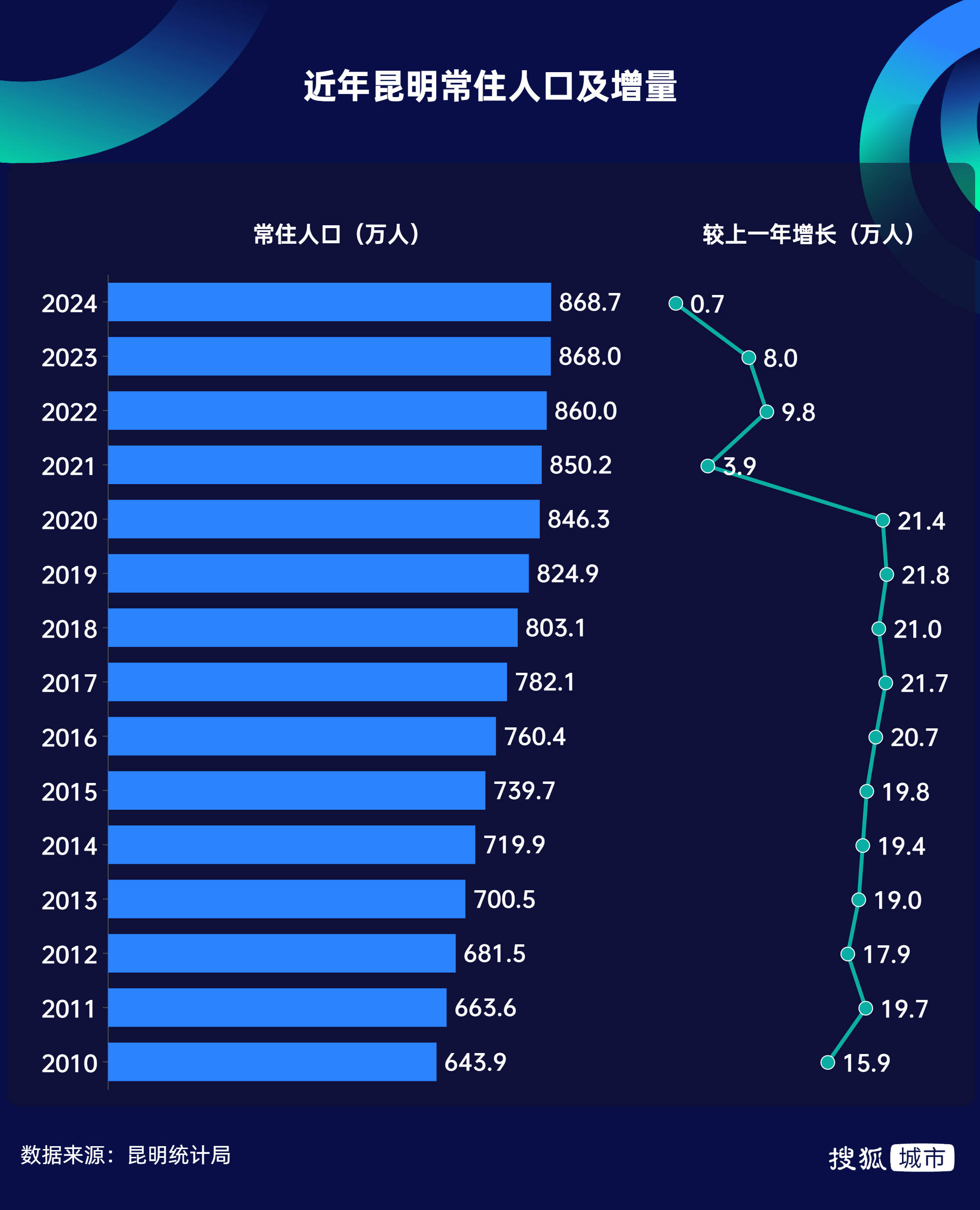
2021年,昆明在"十四五"规划中立下了一个FLAG:到2025年,全市常住人口达到1000万人左右,经济总量跃上万亿台阶。 就在许下"豪言壮语"的这一年,昆明经济增速在全国50强城市中排名垫底,人口增量也被甩出全国前30。第二年年初,昆明被省长喊话:"要从感觉良好中 惊醒起来"。 时至今日,昆明不但没达成"双万"目标,还结束了连续20年的人口高增长。去年,昆明人口增量仅有0.7万,一脚踏上零增长的边缘。 这两年,昆明政府工作报告中也不再提及"双万"目标了。昆明,这下"惊醒"了吗? -01- 一再推迟的千万人口目标 一直以宜居著称的春城昆明,人口吸引力也曾位居省会城市前列。 七普数据显示,2010-2020年,昆明常住人口增长202.8万,高于如今的"人气选手"贵阳(166.3万)。2022年,昆明人口增量9.8万,首度跻身全国前 十。 2023年也有8万,保持稳定增长水平。 但2024年,昆明人口增长形势放缓,仅增长0.7万。其中除去0.24万的自然增长,来源于人口迁移的增长仅有0.46万。这是昆明自2005年采用常住人口统计口 径以来,首次逼近零增长。 在已公布数据的省会城市中,昆明的成绩排名倒数第二。而 ...
一年减少近100万人!中部六省,东北化了
城市财经· 2025-04-08 03:43
Core Viewpoint - The article discusses the significant population decline in various regions of China, particularly focusing on the Northeast and Central provinces, highlighting the demographic shifts and their implications for economic and social dynamics [1][18]. Group 1: Population Decline in Northeast and Central Provinces - The Northeast region has experienced the most severe population loss in China, with a total decrease of 10.99 million people from 2010 to 2020, including 6.46 million in Heilongjiang, 3.38 million in Jilin, and 1.15 million in Liaoning [3][4]. - In 2021, the Northeast provinces collectively lost over 1 million people, and in 2022, the loss was 864,000 [5]. - The Central provinces, including Henan, Hubei, Hunan, Jiangxi, Anhui, and Shanxi, also faced negative population growth in 2023, with a total decline of 1.33 million [9][10]. - The population decline in the Central provinces is projected to be 940,300 in 2024, with some provinces showing slight improvements while others continue to see increased losses [11][15]. Group 2: Factors Behind Population Decline - The overall national population peaked in 2021 and has been declining since, primarily due to a continuous drop in birth rates, which fell below death rates [19][20]. - In 2024, the birth rate is expected to be 9.54 million, while deaths are projected at 10.93 million, indicating a worsening demographic situation [21]. - The article notes a "compensatory marriage wave" in 2023, leading to an increase in marriage rates, but the subsequent decline in marriage rates in 2024 is likely to result in a further drop in birth rates in 2025 [23][24]. - Natural population decrease is a significant factor in the population decline of Central provinces, with regions like Hunan experiencing a natural population decrease of 203,000 in 2023 [25][26]. Group 3: Migration Patterns and Economic Implications - The article highlights that regions like Henan, Shanxi, and Jiangxi are experiencing net population outflows due to insufficient population competitiveness [27][28]. - Hubei and Anhui are exceptions, showing net population inflows, with Hubei gaining 124,000 and Anhui gaining 157,000 in 2023 [33][37]. - Anhui's strong population growth is attributed to its "strong provincial capital strategy," which has significantly enhanced its economic competitiveness, particularly in cities like Hefei [42][44]. - The automotive industry in Anhui has seen substantial growth, with a reported revenue of 549.19 billion yuan in 2024, contributing to the province's economic strength and population attraction [53][67].

人口争夺战!合肥、长沙、南昌,虹吸全省!
城市财经· 2025-03-25 03:36
Core Viewpoint - The article discusses the population growth trends in key cities in China, particularly focusing on the strong provincial capitals of Changsha, Nanchang, and Hefei, which are attracting population from their respective provinces due to various economic and policy factors [3][80]. Group 1: Population Data of Key Cities - Twelve key cities have released their permanent population data, with Shenzhen leading in growth with an increase of 199,400 people, followed by Hefei, Changsha, and Nanchang, all exceeding 100,000 in growth [4][7]. - Beijing and Tianjin experienced zero growth, with Beijing losing 26,000 residents [5][6]. - The overall trend shows that after the seventh national census, cities like Shenzhen regained their population competitiveness post-pandemic [8][10]. Group 2: Factors Contributing to Population Growth - Hefei's population growth is attributed to its strong industrial base, particularly in the display and semiconductor industries, which have attracted significant investment and talent [14][31]. - Changsha benefits from relatively low housing prices, which have kept the cost of living manageable, leading to a population increase that topped the nation in 2022 [34][39]. - Nanchang's population growth has been more volatile, closely tied to its economic performance, with a notable rebound in 2024 linked to rising prices in the non-ferrous metals sector [44][56]. Group 3: Strong Provincial Capital Strategy - The article emphasizes the "strong provincial capital" strategy, where provincial capitals like Hefei, Changsha, and Nanchang are absorbing population from surrounding areas, leading to a decline in overall provincial populations [80][91]. - This strategy is seen as a necessary response to the economic dynamics between coastal and inland regions, where strong capitals can attract resources and talent [86][100]. - The phenomenon of population siphoning is evident, with cities like Hefei and Changsha showing significant growth while their respective provinces experience overall population declines [96][99].