
极端天气

Search documents
“特朗普全天都在听简报”!超级风暴来袭 覆盖大半个美国 气温或低至-46℃ 华盛顿进入紧急状态!民众狂囤物资 超市货架被抢空
Mei Ri Jing Ji Xin Wen· 2026-01-24 06:09
气温最低将降至-46℃ 超5000架次航班被取消 据央视新闻报道,美国国家气象局22日说,一场特大冬季风暴正逼近该国三分之二地区,预计将给多地带来严寒及降雪天气。当前,全美约1.6亿人处于 极端天气警报覆盖范围内。 据悉,这场风暴的影响范围将横跨美国逾3000公里,或将是美国多年来规模最大的冬季风暴之一。 据了解,预计风暴23日起袭击新墨西哥州、得克萨斯州和俄克拉何马州,然后向东移动至美国南方腹地,继而沿海岸线北上,给东北部新英格兰地区带去 强降雪。 风暴预计将给得州等南部地区带来暴雪,从俄克拉何马州至首都华盛顿、纽约市及波士顿市的沿线区域降雪量可达300毫米,随后的极寒空气或使明尼苏 达州和北达科他州部分地区气温降至零下46摄氏度左右。 气象预报人员介绍,风暴可能比飓风造成更大破坏。美国约1.6亿人已接到冬季风暴或严寒天气警报,多地同时面临双重警报。 总台记者当地时间1月23日获悉,航班追踪网站FlightAware的数据显示,截至美国东部时间18时25分,1月25日已有超过2900架次航班被取消,而且这一数 字还在继续攀升。1月25日将成为自2025以来美国航班取消最严重的一天。据悉,24日已有超过270 ...

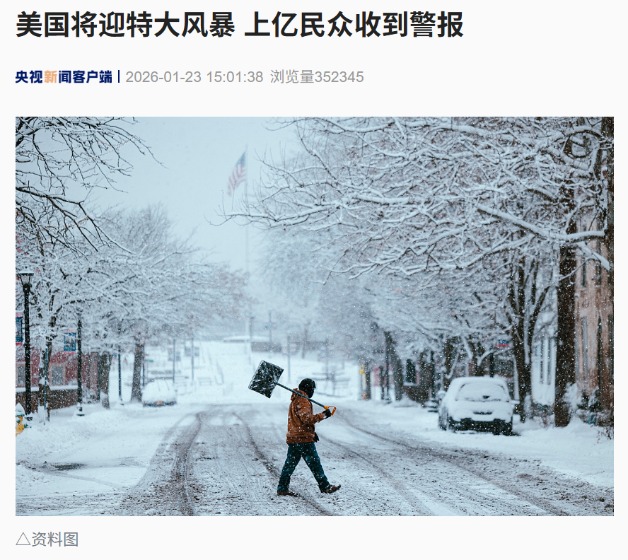
“特朗普全天都在听简报”!超级风暴来袭,覆盖大半个美国,气温或低至-46℃,华盛顿进入紧急状态!
Xin Lang Cai Jing· 2026-01-24 04:58
"特朗普全天都在听简报"!超级风暴来袭,覆盖大半个美国,气温或低至-46℃,华盛顿进入紧急状 态!民众狂囤物资,超市货架被抢空 每经编辑|段炼 据央视新闻报道,美国国家气象局22日说,一场特大冬季风暴正逼近该国三分之二地区,预计将给多地 带来严寒及降雪天气。当前,全美约1.6亿人处于极端天气警报覆盖范围内。 据悉,这场风暴的影响范围将横跨美国逾3000公里,或将是美国多年来规模最大的冬季风暴之一。 气温最低将降至-46℃ 超5000架次航班被取消 据了解,预计风暴23日起袭击新墨西哥州、得克萨斯州和俄克拉何马州,然后向东移动至美国南方腹 地,继而沿海岸线北上,给东北部新英格兰地区带去强降雪。 风暴预计将给得州等南部地区带来暴雪,从俄克拉何马州至首都华盛顿、纽约市及波士顿市的沿线区域 降雪量可达300毫米,随后的极寒空气或使明尼苏达州和北达科他州部分地区气温降至零下46摄氏度左 右。 气象预报人员介绍,风暴可能比飓风造成更大破坏。美国约1.6亿人已接到冬季风暴或严寒天气警报, 多地同时面临双重警报。 总台记者当地时间1月23日获悉,航班追踪网站FlightAware的数据显示,截至美国东部时间18时25分,1 ...
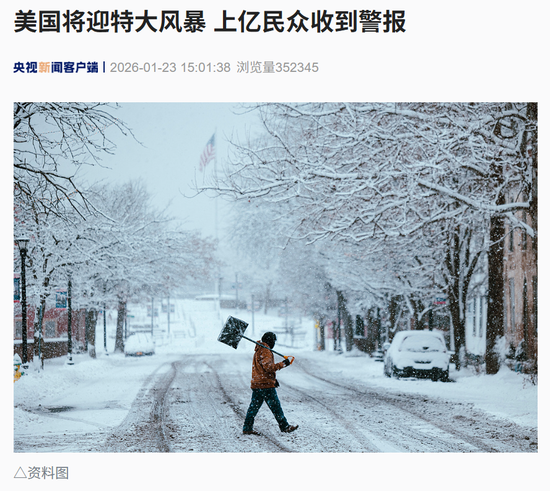
“特朗普全天都在听简报”!超级风暴来袭,覆盖大半个美国,气温或低至-46℃,华盛顿进入紧急状态!民众狂囤物资,超市货架被抢空
Mei Ri Jing Ji Xin Wen· 2026-01-24 04:17
每经编辑|段炼 据央视新闻报道,美国国家气象局22日说,一场特大冬季风暴正逼近该国三分之二地区,预计将给多地带来严寒及降雪天气。当前,全美约1.6亿人处于 极端天气警报覆盖范围内。 据悉,这场风暴的影响范围将横跨美国逾3000公里,或将是美国多年来规模最大的冬季风暴之一。 气温最低将降至-46℃ 超5000架次航班被取消 据了解,预计风暴23日起袭击新墨西哥州、得克萨斯州和俄克拉何马州,然后向东移动至美国南方腹地,继而沿海岸线北上,给东北部新英格兰地区带去 强降雪。 风暴预计将给得州等南部地区带来暴雪,从俄克拉何马州至首都华盛顿、纽约市及波士顿市的沿线区域降雪量可达300毫米,随后的极寒空气或使明尼苏 达州和北达科他州部分地区气温降至零下46摄氏度左右。 气象预报人员介绍,风暴可能比飓风造成更大破坏。美国约1.6亿人已接到冬季风暴或严寒天气警报,多地同时面临双重警报。 总台记者当地时间1月23日获悉,航班追踪网站FlightAware的数据显示,截至美国东部时间18时25分,1月25日已有超过2900架次航班被取消,而且这一数 字还在继续攀升。1月25日将成为自2025以来美国航班取消最严重的一天。据悉,24 ...
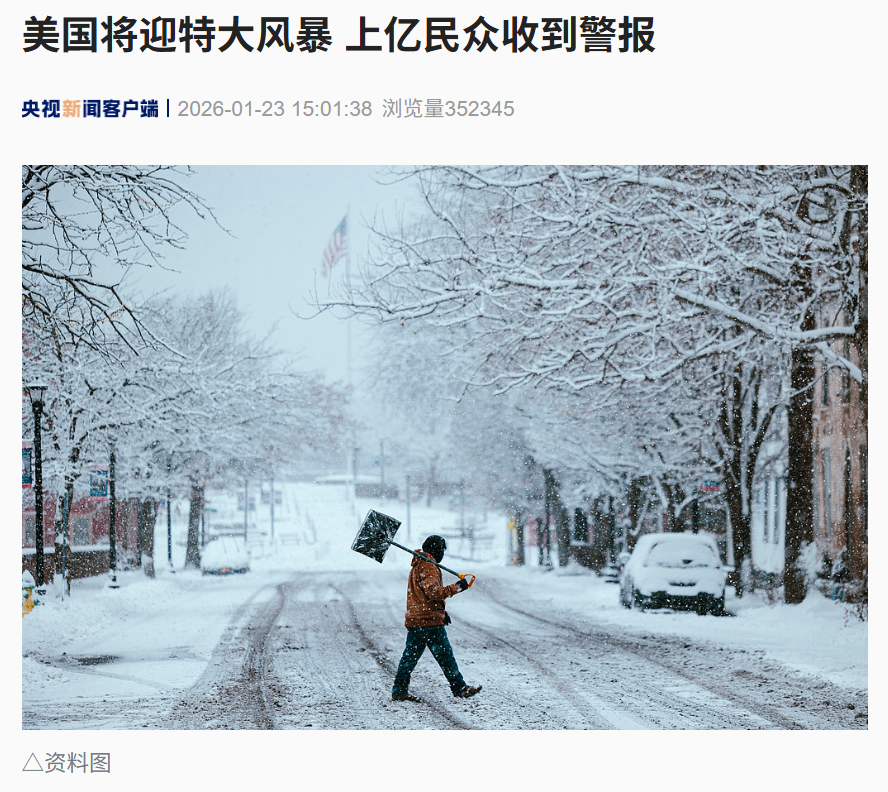
美国大范围冬季风暴来袭 或引发停电与交通瘫痪
Xin Lang Cai Jing· 2026-01-23 17:03
美国一大片区域正面临持续数日的冬季风暴预警,受影响范围从南落基山脉延伸至新英格兰地区,此次 风暴或将扰乱交通出行,并引发停电风险。 预计冻雨和降雪混合天气将于周五晚间侵袭得克萨斯州,冰层堆积可能导致大范围停电,而此时正值居 民取暖用电需求攀升的时段。风暴还将向美国东北部推进,得克萨斯州与纽约州州长已宣布进入紧急状 态。 本周,受风暴来临的预期影响,电力及天然气价格大幅飙升,且目前仍处于高位。天然气不仅是发电厂 的头号燃料,还被广泛用于家庭供暖。 纽约市或将在周日凌晨迎来强降雪,截至周一晚间风暴减弱前,整个纽约都会区的降雪量可能超过 14 英寸(约 36 厘米)。道路积雪结冰将导致出行风险陡增,桥梁和高架路段情况尤为严重;同时,降雪 和吹雪天气会使能见度降至不足 0.25 英里。 得克萨斯州州长格雷格・阿博特已向该州大部分县发布灾难声明。这是该州自近五年前那场致命冬季风 暴及后续大范围停电事件以来,面临的最严峻考验。 得克萨斯州电力可靠性委员会的数据显示,该州此次面临的最大挑战可能出现在周一早间,届时电力供 需平衡将处于最紧张状态。预计当地时间当天早上 7 点至 8 点,得州主电网的用电需求将突破 84 吉 瓦 ...
美国将迎特大风暴:上亿民众收到警报,已有数百架次航班取消
Xin Lang Cai Jing· 2026-01-23 08:43
美国国家气象局22日说,一场特大冬季风暴正逼近该国三分之二地区,预计将给多地带来严寒及降雪天 气。当前,全美约1.6亿人处于极端天气警报覆盖范围内,已有数百架次航班被取消。 据悉,这场风暴的影响范围将横跨美国逾3000公里,或将是美国多年来规模最大的冬季风暴之一。 据了解,预计风暴23日起袭击新墨西哥州、得克萨斯州和俄克拉何马州,然后向东移动至美国南方腹 地,继而沿海岸线北上,给东北部新英格兰地区带去强降雪。 风暴预计将给得州等南部地区带来暴雪,从俄克拉何马州至首都华盛顿、纽约市及波士顿市的沿线区域 降雪量可达300毫米,随后的极寒空气或使明尼苏达州和北达科他州部分地区气温降至零下46摄氏度左 右。 气象预报人员介绍,风暴可能比飓风造成更大破坏。美国约1.6亿人已接到冬季风暴或严寒天气警报, 多地同时面临双重警报。 多家航空公司已取消23日约250架次国内航班。此外,24日还将有400架次航班取消。 美国国家气象局22日说,一场特大冬季风暴正逼近该国三分之二地区,预计将给多地带来严寒及降雪天 气。当前,全美约1.6亿人处于极端天气警报覆盖范围内,已有数百架次航班被取消。 据悉,这场风暴的影响范围将横跨美国逾3 ...
极端天气导致减产 西红柿身价同比上涨超80%
经济观察报· 2026-01-22 07:28
Core Viewpoint - The price of tomatoes has surged over 80% year-on-year due to significant production declines caused by extreme weather events in 2025, affecting supply and leading to a market imbalance [1][2][4]. Price Trends - As of January 20, 2026, the average price of tomatoes reached 7.56 yuan/kg, a 77% increase from 4.27 yuan/kg in the same period of 2025 [2]. - From January 1 to 16, 2026, the average wholesale price was 8.61 yuan/kg, up 80.9% from 4.76 yuan/kg in January 2025 [2]. Production Challenges - Tomato production has faced significant declines due to extreme weather, with reductions varying by region and management practices [3][4]. - Farmers reported a production decrease of approximately one-third due to adverse weather conditions, with some areas experiencing losses of up to two-thirds [7][16]. Cost Implications - The cost of tomato cultivation has increased significantly, with additional expenses for pest control and protective measures due to weather-related challenges, raising total costs from around 4,000 yuan to over 6,000 yuan per greenhouse [7][8]. - In 2025, the cost of pesticides alone increased by over 30%, from approximately 2,000 yuan/acre to nearly 3,000 yuan/acre [8]. Market Segmentation - The market has shown a clear segmentation, with high-end brands maintaining stable prices while traditional farmers struggle with fluctuating prices [11][13]. - For example, the "Cui Xi Yi Pin" brand maintains a purchase price of 20 yuan/kg, targeting quality-sensitive consumers [11][12]. Supply Chain Dynamics - The supply chain has been affected by increased costs associated with high-quality production methods and the need for advanced agricultural technology [11][12]. - The overall vegetable market in China, with over 3 billion acres and more than 800 million tons of production, has a strong self-regulating capacity, which may help stabilize prices in the long term [17].

莫桑比克因极端天气启动“红色警报”
Xin Hua She· 2026-01-17 07:31
近期,受持续强降雨和极端天气影响,莫桑比克多地发生洪水,部分城市出现内涝。政府已下令紧 急撤离高风险地区居民。 新华社马普托1月16日电 (记者 刘杰)莫桑比克政府16日宣布在全国范围内启动"红色警报",以应 对极端天气引发的洪灾。 莫桑比克政府发言人伊姆皮萨表示,启动"红色警报"旨在确保灾害应对中的集中统一指挥,加强各 层级应急资源的调动,并灵活调整管理机制,以便迅速落实应对措施。伊姆皮萨说,自16日起,政府将 派出多部门联合救援队前往受灾地区,为受影响民众提供援助。 ...
极端天气来袭!山东将迎暴雪与持续极寒,对交通能源供应影响重大
Qi Lu Wan Bao· 2026-01-16 03:47
齐鲁晚报.齐鲁壹点记者赵清华 此次大范围雨雪过程有利于改善土壤墒情,降低森林火险气象等级,但积雪和道路结冰对交通运输、城 市运行和设施农业等有较大不利影响。低温天气持续时间长,对能源供应、人体健康和农业生产等影响 较大,偏北大风对海上交通运输和沿海养殖等有不利影响。请加强防范。 寒潮黄色预警和低温黄色预警:16日起山东气温持续下降,过程降温幅度:10~12℃,局部地区超过 14℃。20日早晨最低气温:鲁西北和鲁中山区-16~-14℃,局部低于-18℃,沿海地区-8~-6℃,其他地 区-10~-8℃。21—25日仍有低于-12℃的低温天气。 继续发布海上大风黄色预警:18—19日将出现偏北大风,渤海、渤海海峡、黄海北部和中部7~8级阵风 9~10级;另外,滨州、东营、潍坊、日照、内陆湖面和半岛地区5~6级阵风7~8级,其他内陆地区4~ 5级阵风6~7级。 1月16日10时30分,山东省气象台发布暴雪蓝色预警、道路结冰橙色预警、寒潮黄色预警、低温黄色预 警,继续发布海上大风黄色预警:受强冷空气和暖湿气流共同影响,预计17日夜间至19日夜间山东将出 现寒潮、雨雪冰冻和大风降温天气。20—25日有低于-12℃的持续低 ...
【环球财经】世界经济论坛报告:地缘经济对抗是2026年首要风险
Xin Hua She· 2026-01-14 22:44
Core Insights - The World Economic Forum's "Global Risks Report 2026" identifies geopolitical and economic risks as escalating in a new competitive era, with geopolitical economic confrontation being the primary risk for 2026 [1][2] - Other significant risks for 2026 include armed conflict between nations, extreme weather, social polarization, and misinformation, with economic risks rising the fastest [1] - The report highlights worsening debt issues and potential asset bubbles, compounded by geopolitical economic conflicts, which could trigger a new wave of turmoil [1] Short to Medium-Term Risk Outlook - Geopolitical economic confrontation is deemed the most severe risk in the short to medium term (next two years) [2] - The World Economic Forum's Executive Director, Sadia Zahidi, states that the world has entered a new competitive era, impacting all subsequent global risks [2] - The President and CEO of the World Economic Forum, Borge Brende, emphasizes that the changing competitive landscape has altered the global cooperation dynamic, underscoring the importance of collaborative pathways and dialogue [2] Expert Contributions - The report consolidates insights from over 1,300 global experts, analyzing current, short-term, and long-term risks faced worldwide [3]
江苏发布2025年十大天气气候事件
Xin Lang Cai Jing· 2026-01-12 18:01
Core Viewpoint - The Jiangsu Provincial Climate Center has reported significant climate anomalies for 2025, highlighting record-high average temperatures, reduced precipitation, and the prevalence of extreme weather events impacting agriculture, ecology, and public life [1][2]. Summary by Sections Temperature and Precipitation - The average annual temperature in Jiangsu reached 17.4°C in 2025, surpassing the previous record of 16.9°C set in 2024, marking a 1.7°C increase from the norm and establishing a new historical high since 1961 [1]. - The average annual precipitation was 1011.4 mm, which is 22.3% lower than in 2024 and 4.9% below the long-term average, with uneven distribution across the region [1]. Extreme Weather Events - The winter of 2024-2025 recorded only 20.5 mm of precipitation from December to February, representing just 17% of the normal winter amount, the lowest since 1961, leading to severe drought conditions [2]. - From December 2024 to April 2025, total precipitation was 66% below the historical average, with 43% of monitoring stations experiencing severe drought for over 40 days [2]. High Temperature Trends - The average number of high-temperature days in 2025 was 31, nearly double the normal of 11 days, tying for the third-highest on record, with a notable heatwave occurring from August 12 to 31 [3]. - The summer of 2025 was characterized by an extended duration, with the average start date of summer recorded on May 21 and the end on October 9, resulting in a summer length of 141 days, the longest since 1961 [3]. Typhoon Impact - Typhoon "Zhu Jie Cao" affected Jiangsu from July 30 to August 3, bringing significant rainfall of 150-350 mm in southern regions, while Typhoon "Hua Jia Sha" caused record rainfall in Baoying [4]. - The autumn of 2025 saw excessive rainfall, with average precipitation doubling the norm, adversely affecting autumn crop production [4]. Monsoon Characteristics - The 2025 plum rain season was atypical, starting on June 11 and ending on July 1, with rainfall intensity significantly lower than average, at 132.2 mm, nearly 50% less than normal [5]. - A notable cold snap occurred on March 2, with temperature drops exceeding 12°C in many areas, setting historical records for temperature declines [5]. Future Implications - The report aims to enhance public understanding of climate conditions and provide scientific references for disaster prevention, agricultural planning, and ecological protection, with ongoing efforts to improve climate monitoring and response capabilities [5].