
消费者价格指数

Search documents
欧元区10月消费者价格指数初值升2.1%,预期2.1%,前值2.20%
Mei Ri Jing Ji Xin Wen· 2025-10-31 10:10
Group 1 - The Eurozone's preliminary Consumer Price Index (CPI) for October increased by 2.1%, matching expectations and slightly down from the previous value of 2.2% [1]
德国10月消费者价格指数初值同比增长2.3%,预估为2.2%,前值为2.4%
Mei Ri Jing Ji Xin Wen· 2025-10-30 13:06
Group 1 - The initial consumer price index (CPI) for Germany in October shows a year-on-year increase of 2.3%, which is above the forecast of 2.2% but below the previous value of 2.4% [1]
9月波黑消费者价格指数同比上涨4.2%
Shang Wu Bu Wang Zhan· 2025-10-29 16:03
Core Insights - The consumer price index in Bosnia and Herzegovina increased by an average of 4.2% year-on-year and 0.2% month-on-month as of September 2025 [1] Price Changes by Category - Month-on-month price changes include: - Alcoholic beverages and tobacco: +0.2% - Clothing and footwear: +0.6% - Housing and utilities: +1.2% - Healthcare services: +0.2% - Communications: +1.3% - Education services: +1.3% - Restaurants and hotels: +0.7% - Food and non-alcoholic beverages: -0.2% - Transport services: -0.4% - Other goods and services: -0.2% [1] - Year-on-year price changes include: - Food and non-alcoholic beverages: +7.8% - Alcoholic beverages and tobacco: +3.9% - Housing and utilities: +2.3% - Furniture, household appliances, and routine household maintenance: +1.3% - Healthcare services: +5.9% - Communications: +1.7% - Recreation and culture: +4.8% - Education services: +3.6% - Restaurants and hotels: +8.0% - Other goods and services: +3.0% - Clothing and footwear: -7.5% - Transport services: -0.8% [1]
加拿大9月份消费者价格指数升至2.4%
Yang Shi Xin Wen Ke Hu Duan· 2025-10-21 23:13
Core Insights - The Consumer Price Index (CPI) in Canada rose to 2.4% in September, driven by increases in grocery prices and rent [1] - Excluding the impact of falling gasoline prices, the CPI would have reached 2.6% [1] - The Bank of Canada typically aims to maintain an inflation rate around 2% [1] - A monetary policy meeting is scheduled for October 29, with the inflation data serving as a significant indicator [1]
Stock Futures Rise Ahead of Major Week of Earnings
Barrons· 2025-10-19 22:30
Core Insights - The economic highlight of the week will be the September consumer price index, which is scheduled for release on Friday [1] Economic Indicators - The September consumer price index is anticipated to provide significant insights into inflation trends [1]
美国政府停摆 将加大力度裁员
Bei Jing Shang Bao· 2025-10-13 15:33
Group 1 - The U.S. government shutdown has entered its 12th day, with increasing uncertainty for hundreds of thousands of federal workers already on unpaid leave, as bipartisan negotiations remain stalled [1][2] - The shutdown began on October 1, leading to temporary layoffs in various departments, including Education, Treasury, and Homeland Security, with significant layoffs expected if the situation continues [1][3] - The previous shutdown from late 2018 to early 2019 lasted 35 days and resulted in an estimated $3 billion loss to the U.S. GDP, highlighting the economic impact of prolonged government closures [2][3] Group 2 - Prolonged shutdowns could lead to significant job losses in key sectors reliant on government funding, such as research, education, and infrastructure, causing long-term damage to the labor market [3][4] - The shutdown is expected to delay or cancel the release of critical economic data, affecting foreign businesses operating in the U.S. and complicating the Federal Reserve's economic assessments [4][6] - Standard & Poor's Global estimates that each week of the shutdown could reduce U.S. GDP by 0.1% to 0.2%, with potential long-term repercussions on market stability and investor confidence [4][5] Group 3 - The shutdown's impact is expected to extend beyond the U.S., with the European economy potentially losing €4 billion after two weeks and €16 billion after eight weeks, indicating a nonlinear effect on global markets [5][6] - Analysts predict that a prolonged shutdown could lead to a decline in the U.S. dollar index and increased volatility in dollar-denominated assets, creating negative ripple effects in global markets [6]
2025年8月澳大利亚通胀率升至3%
Xin Hua Cai Jing· 2025-09-24 07:07
Core Insights - Australia's overall consumer price index (CPI) year-on-year increase for August 2025 is 3%, up from 2.8% in July, aligning with market expectations [1] - The monthly inflation rate, excluding volatile items like fruits, vegetables, and automotive fuel, is 3.4%, an increase from 3.2% in July [1] - The trimmed mean inflation rate, a key indicator of core inflation, decreased from 2.7% to 2.6% [1] Price Changes - Food and non-alcoholic beverage prices increased by 3% year-on-year, unchanged from the previous month [1] - Alcohol and tobacco prices decreased from a 6.5% increase to 6% [1] - Clothing and footwear prices rose from 2.3% to 3% [1] - Housing prices increased from 3.6% to 4.5%, with rent prices decreasing from 3.9% to 3.7% and new housing prices rising from 0.4% to 0.7% [1] - Electricity prices surged from a 13.6% increase to 24.6% [1] - Furniture, household equipment, and services prices remained stable at a 0.9% increase [1] - Healthcare prices remained unchanged at a 4.1% increase [1] - Transportation prices shifted from a 1% decrease to a 0.4% increase, with automotive fuel prices changing from a 5.5% decrease to a 1.7% decrease [1] - Communication prices rose from 0.8% to 1.9% [1] - Entertainment prices decreased from 2.6% to 1.4% [1] - Education prices slightly decreased from 5.6% to 5.5% [1] - Insurance and financial services prices decreased from 3.1% to 3% [1] Inflation Commentary - The overall inflation rate in Australia for August has reached its highest level since July 2024, primarily driven by high increases in housing, food, and non-alcoholic beverage prices [2] - The trimmed mean inflation rate, which better reflects inflation trends, decreased by 0.1 percentage points in August [2]
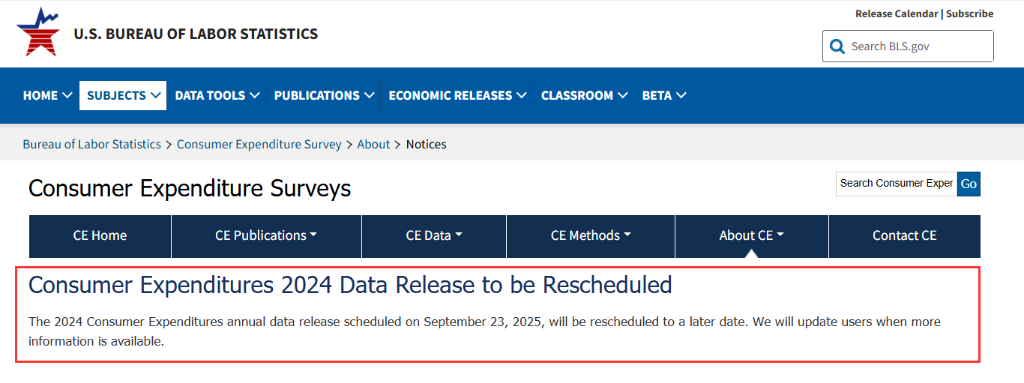
美国关键通胀报告罕见延迟,原因成谜
Hu Xiu· 2025-09-20 03:51
Core Viewpoint - The U.S. Bureau of Labor Statistics (BLS) has postponed the release of the annual consumer spending data, raising concerns about the accuracy and politicization of key economic data in the U.S. [1][2] Group 1: Delay Announcement - The BLS announced that the 2024 annual consumer spending data, originally scheduled for release next week, will be "rescheduled to a later date" without providing a reason or new timeline [2][6] - This annual report is crucial as it provides the only comprehensive household survey data on consumer spending and income, which is used to determine the weights of specific goods and services in the Consumer Price Index (CPI) for the following year [4][9] Group 2: Context of the Delay - The unusual silence surrounding this delay has drawn market attention, contrasting with last year's situation where a delay was accompanied by an explanation and a new release date [5][8] - Analysts suggest that if the annual data can be finalized by the end of the year, there should be sufficient time to incorporate the new weights into the CPI by mid-February 2026 [9] Group 3: Political and Operational Challenges - The BLS is facing political pressure, staff shortages, and limited resources, which may contribute to the delay [10][14] - Recent events include the dismissal of the BLS director following significant revisions to employment data, and the nomination of a new director has been criticized as politically motivated [11][12] - An internal investigation has been launched into the BLS's economic data collection processes, highlighting challenges in collecting and reporting critical economic data [13]

【环球财经】吉尔吉斯斯坦前8月GDP同比增长11% 服务业占比超五成
Xin Hua Cai Jing· 2025-09-15 14:48
Economic Growth - Kyrgyzstan's GDP for January to August is estimated at 1.0421 trillion som (approximately 11.9 billion USD), reflecting a year-on-year growth of 11% [1] - The service sector accounts for 50.8% of the economy, while goods production industries represent 33.4%, and product taxes make up 15.8% [1] Sector Performance - Industrial output increased by 11.5% year-on-year, with mining growing by 15.5% and manufacturing by 10.8% [1] - The construction sector showed significant growth with a 34.8% increase in output [1] - Wholesale and retail trade grew by 11.6%, while the hotel and restaurant services sector saw a 25.4% increase [1] - Agricultural, forestry, and fishing sectors grew by 2.4%, and freight volume increased by 9.8% [1] - The telecommunications services sector experienced a growth of 6.6% compared to the same period last year [1] Consumer Prices and Trade - The consumer price index in Kyrgyzstan rose by 5.1% from December of the previous year [1] - The foreign trade volume from January to July was 8.6644 billion USD, showing a year-on-year decline of 6.4% [1] - Exports amounted to 1.4931 billion USD, down 13.3% year-on-year, while imports totaled 7.1713 billion USD, a decrease of 4.8% [1]
美国经济学家:约2/3关税相关成本将转嫁给消费者
Zhong Guo Xin Wen Wang· 2025-09-15 07:49
Core Points - The high tariffs imposed by the Trump administration are causing panic among businesses and consumers in the U.S., leading to increased prices and a slowdown in economic activity [1][2] - Approximately two-thirds of the costs associated with the new tariffs are expected to be passed on to consumers, resulting in a gradual increase in prices over the coming months [2] Group 1: Economic Impact - The implementation of tariffs has begun to affect prices, with the Consumer Price Index (CPI) in August showing a year-on-year increase of 2.9% [1] - The delay in the economic impact of tariffs is attributed to businesses stockpiling inventory before the tariffs took effect and some companies initially absorbing the costs [1] Group 2: Consumer Price Increases - Consumers are expected to feel the impact of rising prices, particularly in imported goods such as coffee, audio equipment, and furniture, which have seen significant price increases [2] - Coffee prices are particularly affected as domestic production cannot meet demand, leading to further price hikes as inventory from before the tariffs is depleted [2]