稀土价格上涨

Search documents
正海磁材:Q3净利同比增189.72% 主要系稀土价格上涨所致
Ge Long Hui A P P· 2025-10-26 08:53
Core Insights - The company reported a significant increase in revenue and net profit for Q3 2025, with revenue reaching 1.916 billion yuan, a year-on-year growth of 50.76%, and net profit attributable to shareholders amounting to 115 million yuan, reflecting a year-on-year increase of 189.72% [1] - For the year-to-date period, the company achieved a total revenue of 4.973 billion yuan, representing a year-on-year growth of 30.54%, while the net profit attributable to shareholders was 228 million yuan, marking a year-on-year increase of 20.46% [1] - The growth in revenue and profit is primarily attributed to an increase in sales volume of the main business and a rise in rare earth prices during the reporting period [1]

正海磁材:第三季度净利润同比增长189.72% 主要系稀土价格上涨所致
Mei Ri Jing Ji Xin Wen· 2025-10-26 08:47
Core Insights - The company reported a significant increase in revenue and net profit for Q3 2025, with revenue reaching 1.916 billion yuan, a year-on-year growth of 50.76%, and net profit attributable to shareholders amounting to 115 million yuan, reflecting a year-on-year increase of 189.72% [1] - For the year-to-date period, the company achieved a total revenue of 4.973 billion yuan, representing a year-on-year growth of 30.54%, while the net profit attributable to shareholders was 228 million yuan, marking a year-on-year increase of 20.46% [1] - The growth in revenue and profit is primarily attributed to an increase in sales volume of the main business and a rise in rare earth prices during the reporting period [1]
稀土精矿价格实现“五连涨” 涨幅达37.13%
Zhi Tong Cai Jing· 2025-10-17 09:29
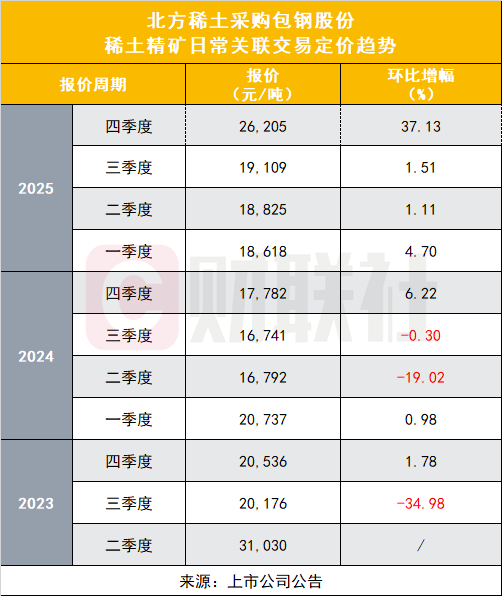
Core Viewpoint - The price of rare earth concentrate has increased for five consecutive quarters, with a rise of 37.13% for the fourth quarter of 2025, as announced by Baogang Co. and Northern Rare Earth [1][4]. Price Adjustment Summary - Baogang Co. has adjusted the rare earth concentrate transaction price for the fourth quarter of 2025 to 26,205 yuan/ton (excluding tax, REO=50%), with a price change of 524.10 yuan/ton for every 1% change in REO [1][2]. - The price for the third quarter of 2023 was set at 19,109 yuan/ton, indicating a quarter-on-quarter increase of 37.13% for the fourth quarter [2][4]. - The price adjustment mechanism between Northern Rare Earth and Baogang Co. has been in place since April 1, 2023, allowing for quarterly price calculations based on a fixed pricing formula [2][4]. Historical Price Trends - The price of rare earth concentrate has seen significant fluctuations, with a high of 31,030 yuan/ton in the second quarter of 2023, dropping to 16,741 yuan/ton by the third quarter of 2024, representing a decline of 46.05% [5]. - The current price adjustment marks the largest increase since the second quarter of 2023, following a period of price stabilization starting from the fourth quarter of 2024 [4][5]. Company Performance - Northern Rare Earth has projected a net profit of 1.51 billion to 1.57 billion yuan for the first three quarters, reflecting a year-on-year increase of 272.54% to 287.34% [5]. - The company has focused on market changes, budget management, cost reduction, and production organization, leading to significant growth in product sales and overall performance [5]. - Since the third quarter of this year, Northern Rare Earth's stock price has surged by 110.8%, closing at 52.48 yuan per share, with a total market capitalization of 189.7 billion yuan [5].


稀土价格指数年内大涨43% 盛和资源预计前三季度盈利增7倍
2 1 Shi Ji Jing Ji Bao Dao· 2025-10-15 23:04
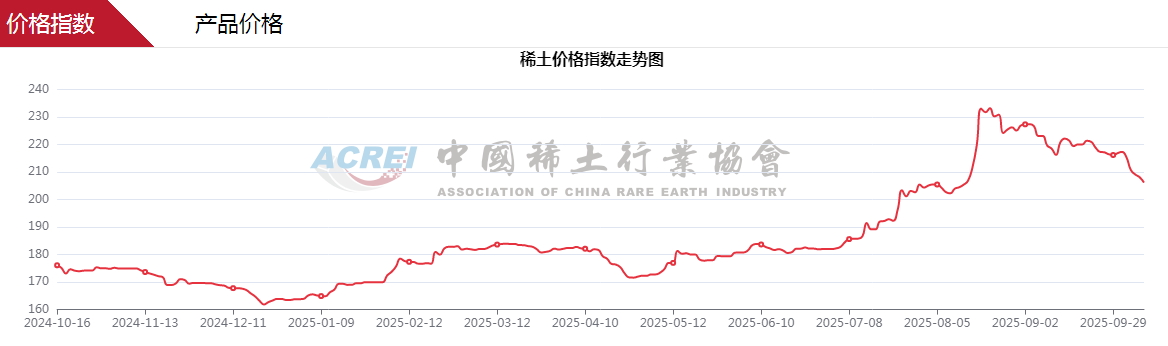
Core Viewpoint - The significant increase in profits for Shenghe Resources in Q3 is attributed to the rise in rare earth prices, with net profit expected to reach between 740 million to 820 million yuan, marking an increase of 696.82% to 782.96% year-on-year [1] Group 1: Profit Forecast and Performance - Shenghe Resources anticipates a net profit of 740 million to 820 million yuan for the first three quarters, exceeding most institutional expectations [1][5] - The company's Q3 net profit is projected to be around 400 million yuan, a 100% increase from the previous quarter [4] - The overall profit trend is closely linked to the fluctuations in rare earth prices, which have shown a significant upward trend since July [4] Group 2: Rare Earth Price Dynamics - The rare earth price index, tracked by the China Rare Earth Industry Association, rose sharply from 160-180 points in the first half of the year to a peak of 233 points in mid-August [3] - The increase in demand and prices for rare earth products is driven by changes in market supply and demand dynamics [1] Group 3: Business Structure and Revenue Contribution - Shenghe Resources operates a complete industrial chain in rare earths, covering mining, smelting, separation, and deep processing, with rare earth metals and oxides accounting for approximately 83% of total revenue [4] - The company has a diversified product range, including rare earth concentrates, oxides, and salts, which contributes to its profitability [4] Group 4: Future Outlook and Valuation - Despite a recent decline in the rare earth price index, it remains at a relatively high level, suggesting potential for upward adjustments in profit forecasts for 2025 [6] - The company's stock price as of October 15 is 26.26 yuan per share, with a projected annualized valuation of around 65 times earnings based on a 700 million yuan profit forecast for 2025 [7] - The acquisition of Peak Rare Earths Limited is expected to provide a strong performance boost in the coming years, with significant resources in the Ngualla rare earth project [7][8] Group 5: Acquisition Details - The acquisition of Peak Rare Earths Limited was completed with a revised purchase price of approximately 920 million yuan, reflecting the rising market prices for rare earth products [7] - The Ngualla rare earth project is noted for its high quality and low cost, with expected production starting in Q1 2027 [8] - The project is projected to generate a total net profit of approximately 390 million yuan, with potential for further improvements in production and cost efficiency [8]

稀土巨头,前三季度盈利预增7倍
2 1 Shi Ji Jing Ji Bao Dao· 2025-10-15 13:15
Core Viewpoint - The significant increase in rare earth prices has led to a substantial rise in Shenghe Resources' profits for the third quarter, with net profit expected to reach between 740 million to 820 million yuan, marking an increase of 696.82% to 782.96% year-on-year [1][5]. Group 1: Profit Forecast and Market Dynamics - Shenghe Resources anticipates a net profit of 740 million to 820 million yuan for the first three quarters, exceeding most institutional expectations [1][5]. - The rise in rare earth prices is attributed to changes in market supply and demand, with the rare earth price index reaching a peak of 233 points in mid-August, a 43% increase compared to the end of 2024 [1][3]. - The third quarter is projected to be the most profitable for Shenghe Resources, with a net profit of approximately 400 million yuan, a 100% increase from the previous quarter [5][7]. Group 2: Business Structure and Revenue Contribution - Shenghe Resources operates in both rare earth and zirconium-titanium sectors, covering a complete industrial chain from mining to deep processing, with rare earth products accounting for 83% of total revenue [5][12]. - The company's profit trend is closely linked to rare earth price movements, with net profits of 168 million yuan and 209 million yuan in the first two quarters of the year [5][12]. Group 3: Market Valuation and Future Expectations - As of October 15, the stock price of Shenghe Resources was 26.26 yuan per share, with a projected annualized valuation of around 65 times based on a profit expectation of 700 million yuan for 2025 [9][10]. - If profits exceed 1 billion yuan, the annualized valuation could decrease to approximately 45 times [9][10]. - The company has seen a significant stock price increase of 157.32% this year, although it faces valuation pressures similar to its peers in the rare earth sector [10][11]. Group 4: Acquisition and Future Projects - Shenghe Resources completed the acquisition of Peak Rare Earths Limited for approximately 920 million yuan, reflecting the rising market prices for rare earth products [11][12]. - The core asset of Peak is the Ngualla rare earth project in Tanzania, which is expected to start production in the first quarter of 2027, potentially generating a net profit of 390 million yuan [12].

稀土价格指数年内大涨43%,盛和资源预计前三季度盈利暴增7倍
2 1 Shi Ji Jing Ji Bao Dao· 2025-10-15 10:34
Core Viewpoint - Shenghe Resources (600392) has reported a significant increase in profits for the third quarter, driven by rising rare earth prices, with net profit expected to be between 740 million to 820 million yuan, representing a year-on-year increase of 696.82% to 782.96% [1][2]. Group 1: Financial Performance - The company anticipates that the third quarter will be its most profitable, with a total net profit of 800 million yuan for the first three quarters, exceeding most institutional expectations [2][4]. - The rare earth price index, tracked by the China Rare Earth Industry Association, saw a notable increase, reaching a peak of 233 points in mid-August, up nearly 43% from the end of 2024 [2][7]. - Shenghe Resources' net profit for the third quarter is projected to be around 400 million yuan, a 100% increase from the previous quarter [11]. Group 2: Market Dynamics - The demand for rare earth products has improved due to changes in market supply and demand dynamics, leading to higher product prices compared to the previous year [1][5]. - The company's business structure, which includes both light and heavy rare earth operations, allows it to benefit significantly from the price trends of rare earth products [9]. Group 3: Future Outlook - Analysts expect that as the company has already met its profit expectations, there may be upward adjustments to its annual profit forecasts by institutions [4][14]. - The company has completed a significant acquisition of Peak Rare Earths Limited, which is expected to enhance its future earnings, with the Ngualla rare earth project projected to contribute significantly to profits starting in 2027 [19][20]. - If the project achieves higher resource recovery rates, there is potential for further improvements in production and cost [21].
招商证券:继续看涨稀土价格
Xin Lang Cai Jing· 2025-10-13 08:09
Core Viewpoint - The rare earth industry chain control has been upgraded, expanding the regulatory scope both horizontally and vertically, which enhances the strategic position of the rare earth industry and is expected to improve the valuation of listed companies in this sector [1] Group 1: Industry Insights - The significant increase in rare earth prices during the third quarter is noted, with expectations for substantial profit improvements for rare earth and magnetic material companies in the third and fourth quarters [1] - The outlook remains bullish for rare earth prices, indicating a positive trend for the industry [1]

再再推稀土磁材:第三波启动
2025-10-13 01:00
Summary of Key Points from the Conference Call Industry Overview - The rare earth market has experienced three major price surges in 2025, driven by various factors including policy changes and market dynamics [1][2] - The Ministry of Industry and Information Technology (MIIT) has strengthened control policies, expanding export restrictions to 12 types of heavy rare earth products, which may lead to short-term price corrections but is expected to drive prices up to 700,000-900,000 yuan/ton in the medium to long term [1][4] Core Insights and Arguments - **First Wave (Q2 2025)**: Initiated by heavy rare earth export controls, leading to a temporary price drop followed by a significant price increase due to overseas stockpiling and rising trade costs. Companies like Guangsheng Nonferrous, Zhong Rare Earth, and Northern Rare Earth benefited the most [2] - **Second Wave (Q3 2025)**: Driven by rising rare earth prices reflecting supply tightening and increased exports. Northern Rare Earth emerged as a market leader during this period [2] - **Third Wave (Starting October 9, 2025)**: Triggered by MIIT's new control policies and strong performance forecasts from leading companies like Jinli Permanent Magnet, indicating robust profitability in the current supply reform context [2][5] Performance Highlights - Jinli Permanent Magnet reported a 53% quarter-on-quarter growth and a 190% year-on-year increase, exceeding market expectations and boosting investor confidence in the sector [3][5][6] - The new MIIT policies are expected to create significant uncertainty and cost pressures in the supply chain, potentially leading to price increases following a short-term dip [4] Supply and Demand Dynamics - The implementation of the "Interim Management Measures" is expected to reduce illegal production capacity by approximately 30% for heavy rare earths and 10% for light rare earths, thereby tightening supply and increasing industry concentration [7] - The anticipated shutdown of rare earth mining in Myanmar's Kachin region by the end of 2025, which accounts for 40% of global medium-heavy rare earth supply, is expected to exacerbate supply shortages and drive prices higher [2][11] Market Catalysts - Several catalysts are expected to drive further price increases in Q4, including stricter compliance checks leading to potential shutdowns of non-compliant smelting plants and a significant rise in processing fees from 1,500 yuan/ton to 23,000 yuan/ton [7][8] - The acceleration of heavy rare earth smelting clearances is likely to lead to increased processing fees and further price hikes for both heavy and light rare earths [8][9] Corporate Focus - Companies to watch include China System, Guangsheng Nonferrous, and Baogang Group, which are expected to benefit from central enterprise consolidation and market adjustments, with potential performance growth of 50% to 100% [12][13] - Baogang Group is anticipated to raise transaction prices in Q4, with its valuation significantly below peers, indicating substantial upside potential [12] Conclusion - The rare earth sector is poised for significant growth driven by policy changes, supply constraints, and strong performances from leading companies, creating a favorable investment landscape [1][6][10]
稀土精矿价格,连续5个季度上调
财联社· 2025-10-11 09:01
Core Viewpoint - The rare earth market is experiencing a recovery, with the prices of associated transactions between two major domestic rare earth companies, Baotou Steel (包钢股份) and Northern Rare Earth (北方稀土), increasing significantly in the fourth quarter of this year, marking the fifth consecutive quarter of price hikes [1][2]. Price Adjustments - The associated transaction price for rare earth concentrate has been adjusted to 26,205 CNY/ton (excluding tax, dry weight, REO=50%) for Q4, reflecting a 37.13% increase from the previous quarter's price of 19,109 CNY/ton [1][2]. - The price adjustments are based on the pricing method established in 2022 and the market prices of rare earth oxides projected for Q3 2025 [1]. Market Trends - The price of praseodymium-neodymium oxide has risen significantly, with an average price of 562,000 CNY/ton on September 30, up 26.43% from 444,500 CNY/ton on June 30 [2]. - The current transaction prices for rare earth concentrates have returned to levels comparable to early 2022, where the price was 26,887.2 CNY/ton [2]. Supply and Demand Dynamics - The continuous increase in rare earth concentrate prices may be linked to tightening upstream raw material supplies and stimulating policies for downstream consumption [3]. - Northern Rare Earth reported a substantial increase in net profit for the first three quarters of the year, projecting a net profit of 1.51 to 1.57 billion CNY, representing a year-on-year growth of 272.54% to 287.34% [3]. Future Outlook - Despite the positive performance, the overall demand for metals remains weak due to stagnant orders from magnetic material companies, which may lead to a downward trend in the rare earth market prices in the short term [3].
两大稀土巨头宣布提价,释放出什么信号?
Ge Long Hui· 2025-10-11 03:05
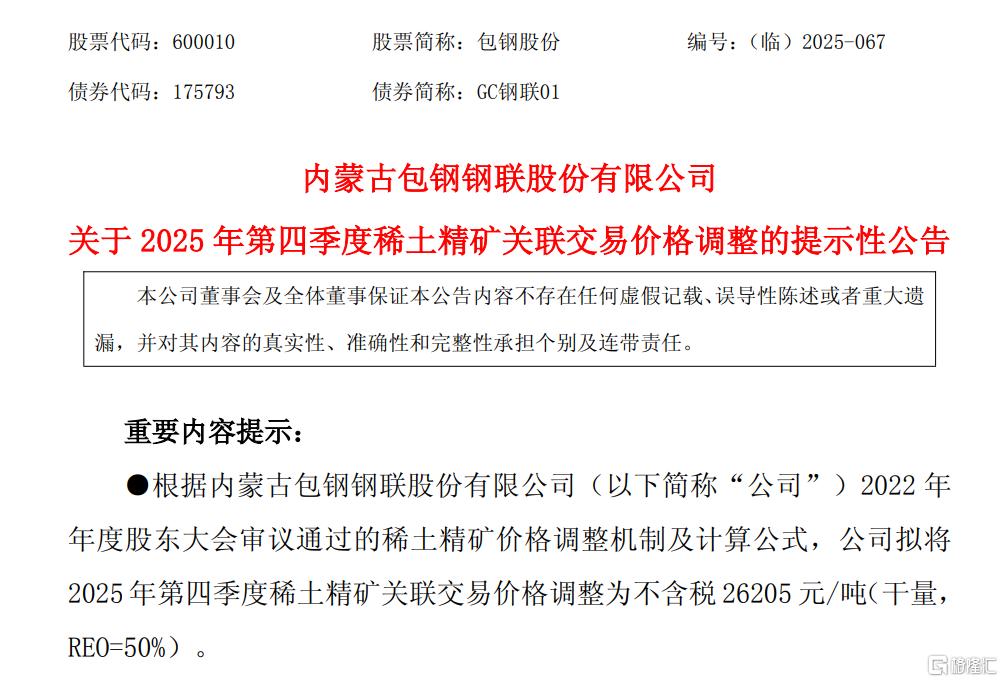
10月10日晚间,一则消息在资本市场和稀土行业激起千层浪。 | 股票代码:600010 债券代码:175793 | | | --- | --- | | 股票简称:包钢股份 债券简称:GC钢联01 | 编号:(临)2025-067 | 北方稀土、包钢股份同日发布公告,上调2025年第四季度稀土精矿关联交易价格。两家公司拟将2025年第四季度稀土精矿关联交易价格调整为 不含税26205元/吨(干量,REO=50%)。REO每增减1%,不含税价格增减524.10元/吨。 根据此前公告,近一年以来,稀土精矿交易价格持续上调。其中,第三季度稀土精矿交易价格调整为不含税19109元/吨。由此测算,第四季度 的稀土价格环比上涨了37.13%。 稀土精矿价格大幅上调 包钢股份发布公告称,根据2022年年度股东大会审议通过的稀土精矿价格调整机制及计算公式,公司拟将2025年第四季度稀土精矿关联交易价 格调整为不含税26205元/吨(干量,REO=50%)。REO每增减1%,不含税价格增减524.10元/吨。 同日,北方稀土也公告称,根据稀土精矿定价方法及2025年第三季度稀土氧化物价格,经测算并经公司总经理办公会审议通过,20 ...