金融五篇大文章

Search documents
深入做好金融“五篇大文章”
Xin Lang Cai Jing· 2026-01-06 22:38
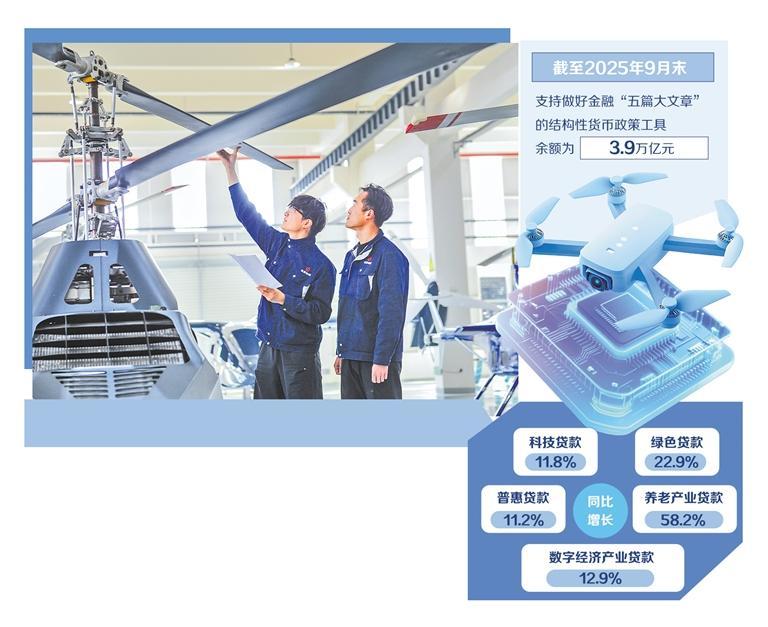
Core Viewpoint - The article emphasizes the importance of developing various financial sectors, including technology finance, green finance, inclusive finance, pension finance, and digital finance, to support the construction of a strong financial nation and facilitate economic development [2][3]. Financial "Five Articles" - The "Five Articles" focus on enhancing financial support for achieving high-level technological self-reliance, promoting green transformation, improving the inclusive financial system, developing a pension financial system, and advancing high-quality digital finance [3][4]. - The implementation of digital technology in financial services is highlighted, with eight key areas identified for development, including the establishment of big data collections for tech enterprises and optimizing green finance service models [3][4]. Low-altitude Economy - The low-altitude economy is identified as a new industry with high growth potential but also high risks, necessitating a comprehensive financial service system that caters to its unique characteristics [5][6]. - Guangdong Province has seen its low-altitude economy output exceed 100 billion yuan, prompting the introduction of the "Twelve Articles" to support the development of this sector through various financing channels [5][6]. Financial Products and Services - The "Twelve Articles" encourage the development of financial products that cover the entire lifecycle of low-altitude economy enterprises, including differentiated cash flow valuation models and support for venture capital in "hard tech" projects [6][7]. - Financial institutions are urged to create specialized service teams and innovative financial products tailored to the needs of the low-altitude economy [7][8]. Policy Coordination - The article stresses the need for coordinated efforts among various financial policies to create a conducive environment for the "Five Articles," with a focus on optimizing risk-sharing mechanisms and enhancing financial support for key economic strategies [8][9]. - As of September 2025, structural monetary policy tools supporting the "Five Articles" amounted to 3.9 trillion yuan, with significant growth in technology and green loans [9].

AIC双子星、反内卷!十个关键词解码广东银行业2025
Nan Fang Du Shi Bao· 2026-01-06 15:22
Core Insights - The Guangdong banking industry is focusing on serving the real economy and has made significant strides in 2025, marking it as a pivotal year for financial development in the region [1] Group 1: AIC "Twin Stars" in the Greater Bay Area - In November 2025, two financial asset investment companies (AIC) from China CITIC Bank and China Merchants Bank were approved to operate in the Greater Bay Area, with registered capitals of 10 billion yuan and 15 billion yuan respectively [2] - These AICs aim to leverage local market advantages and provide comprehensive financial services to local enterprises, particularly in technology innovation and market-oriented debt-to-equity swaps [2] Group 2: Addressing "Involution" in Competition - The Guangdong banking sector is actively combating "involution" in competition, which has led to unhealthy practices such as price wars and resource misallocation [3][4] - Regulatory bodies have introduced a negative list for involutionary competition and established self-regulatory agreements to promote fair competition within the industry [3] Group 3: Risk Management for Small Financial Institutions - The Guangdong Financial Regulatory Bureau has prioritized the risk management of small financial institutions, focusing on restructuring and governance to mitigate risks [5] - In 2025, 12 village banks were approved for dissolution, and 11 were merged, indicating a significant restructuring effort in the sector [6] Group 4: Loan Subsidy Policies - In August 2025, the Ministry of Finance introduced loan subsidy policies aimed at supporting consumer loans and service industry operators, which have been rapidly adopted by banks in Guangdong [7] - By the end of the first month of implementation, over 5,800 new clients had benefited from the subsidy, with more than 100 million yuan in loans disbursed [7] Group 5: Inclusive Finance Innovations - The "China Inclusive Finance Tour" initiated in July 2025 highlighted innovative practices in inclusive finance across various regions, with Guangdong's efforts receiving significant attention [9][10] - A total of 139 effective cases were collected during the inclusive finance innovation practice conference, showcasing advancements in digital transformation and supply chain finance [10] Group 6: Financial Empowerment of the "Hundred Counties, Thousand Towns, and Ten Thousand Villages" Project - The Guangdong government has implemented a financial support plan for the "Hundred Counties, Thousand Towns, and Ten Thousand Villages" project, aiming to enhance financial services in rural areas [14] - By September 2025, loans in the Guangdong region had increased by 6.5% year-on-year, with agricultural loans growing by 10.6%, demonstrating the effectiveness of financial support in rural development [15] Group 7: Financial Services for the National Games - The 15th National Games held in Guangdong, Hong Kong, and Macau in November 2025 saw banks providing comprehensive financial services throughout the event lifecycle [16][17] - Financial institutions facilitated seamless payment experiences and provided credit support for infrastructure projects related to the Games, amounting to over 70 billion yuan [17] Group 8: Strengthening Regulatory Oversight - The Guangdong Financial Regulatory Bureau emphasized a strong regulatory framework, with 515 penalties issued to banking institutions in 2025, reflecting a commitment to compliance and risk management [18] - The region's regulatory actions are among the highest in the country, indicating a proactive approach to maintaining industry standards [18] Group 9: Consumer Protection Initiatives - The Guangdong Financial Regulatory Bureau has been enhancing consumer protection measures, embedding consumer rights into all business processes of financial institutions [19] - Initiatives include comprehensive evaluations of consumer protection practices and addressing complaints to improve service quality [19][20]
银行业2026年度策略:新起点下的结构性机遇
China Post Securities· 2026-01-06 08:23
Core Insights - The report maintains a strong market rating for the banking sector, highlighting structural opportunities amid a new economic starting point in 2026 [3][5] - The macroeconomic environment is expected to support credit growth, with fiscal policies becoming more proactive and monetary policies remaining moderately accommodative [3][4] - The banking sector is anticipated to experience a stabilization in net interest margins, with a narrowing space of less than 5 basis points expected in 2026 [4][40] Macroeconomic Fundamentals - The GDP growth target for 2026 is projected to remain stable at around 5%, supported by structural improvements in financing demand from enterprises and households [12][14] - The fiscal deficit rate is expected to increase from 4% in 2025, with proactive fiscal policies aimed at stabilizing growth and expectations [14][16] - Monetary policy will continue to be moderately accommodative, with social financing growth expected to maintain above 8% [16][17] Industry Core Policy Guidance - Regulatory bodies are focusing on protecting net interest margins, with measures in place to guide banks in pricing management and alleviate margin pressures [25][26] - New supportive policies, including interest subsidies for personal consumption loans, are expected to create favorable asset deployment scenarios for banks [27][28] - Capital supplementation policies are being optimized to enhance banks' credit expansion capabilities and risk resilience [28][29] 2026 Profitability Outlook - Corporate loan growth is expected to be a key driver of credit expansion, while retail credit improvements will depend on policy support for income and consumption [4][34] - The net interest margin is projected to stabilize, with a potential bottoming out in 2026, supported by regulatory measures and market conditions [40][41] - Fee income is anticipated to recover, particularly for city commercial banks, as market sentiment improves [42][43] 2026 Asset Quality Outlook - The overall asset quality of the banking sector is expected to stabilize, with non-performing loan ratios remaining low for corporate lines, while retail lines may still face risks [4][20] - The trend of provisioning coverage is expected to improve, providing banks with more flexibility in managing their asset quality [20][21] 2026 Industry Landscape Outlook - Differentiation among banks is likely to become a dominant theme, with larger banks expected to see more stable revenue growth compared to smaller banks facing complex operating environments [4][5] - Regional economic vitality will significantly influence the performance of local banks, with areas of strong economic growth presenting better investment opportunities [5][6] Investment Recommendations - The insurance sector is projected to see over 2 trillion yuan in new market funds in 2026, increasing demand for high-dividend assets [5] - Focus on state-owned banks with stable operations, such as Industrial and Commercial Bank of China and China Construction Bank, as attractive investment targets [5] - Attention should be given to regional banks in economically vibrant areas, such as Jiangsu Bank and Chongqing Bank, which are expected to perform well [5][6]



中信银行坚定服务实体经济 奋力书写金融“五篇大文章”优异答卷
Jin Rong Jie· 2025-12-31 02:42
Core Viewpoint - CITIC Bank is committed to serving the real economy and has implemented the "Five Major Articles" as a key strategy to fulfill its responsibilities as a state-owned financial enterprise, achieving both economic and social benefits while contributing to China's modernization [1] Group 1: Strategic Implementation - CITIC Bank integrates the "Five Major Articles" into its planning and operational framework, establishing a comprehensive "1+5" implementation system to align with national policies [1] - The bank enhances process management and monitoring of key indicators related to the "Five Major Articles," ensuring effective execution and resource allocation [1] Group 2: Technological Financial Empowerment - CITIC Bank has established a specialized service system for technology finance, with over 270 branches designated as technology finance pioneers, supporting innovation and productivity [1] - The bank launched the "启航计划" (Sailing Plan) to facilitate technology achievement transformation, introducing a service matrix that includes specialized financial products and collaborative platforms [1] - CITIC Bank actively participates in innovative projects, such as the first pilot project for technology achievement transformation loans, creating a comprehensive support system for technology enterprises [1] Group 3: Green Finance Development - CITIC Bank is focused on building a green finance system to support low-carbon economic transformation, establishing over 300 green finance demonstration institutions [3] - The bank has developed a comprehensive service system for green financing, including a carbon emission measurement service platform, to assist clients in managing their carbon footprints [3][4] Group 4: Inclusive Finance Innovations - CITIC Bank has implemented a specialized operating model for inclusive finance, enhancing service delivery to small and micro enterprises and supporting rural revitalization [6] - The bank's inclusive finance loans for small and micro enterprises exceeded 630 billion yuan, reflecting a positive trend in loan volume and quality [7] Group 5: Pension Finance Enhancement - CITIC Bank is expanding its pension finance services, focusing on the three pillars of pension support and enhancing customer experience through improved service models [8] - The bank has developed a comprehensive pension financial service system, including innovative products and community-based services to meet diverse customer needs [9] Group 6: Digital Finance Transformation - CITIC Bank is advancing its digital transformation to support the digital economy, establishing a digital transformation office and developing various technological systems [10] - The bank's digital economy loans exceeded 270 billion yuan, demonstrating significant growth in this sector [11] Group 7: Recognition and Awards - CITIC Bank has received multiple accolades, including the "2025 China Bank of the Year" award, highlighting its achievements in high-quality development and brand value [12]

进一步践行“金融五篇大文章”,助力区域上市公司脱困转型
Jin Rong Jie· 2025-12-29 04:04
Core Viewpoint - The successful completion of a rescue project for a listed company by China Great Wall Asset Management Corporation Beijing Branch demonstrates the company's professional capabilities and commitment to serving the real economy and mitigating financial risks [1] Group 1: Company Challenges - A listed company, once a star in its industry, faced liquidity crises and debt repayment pressures due to macroeconomic conditions and industry adjustments, necessitating an urgent resolution to its financial difficulties [2] Group 2: Risk Mitigation Strategies - The company implemented a comprehensive rescue plan focusing on optimizing debt structure, alleviating repayment pressures, and enhancing operational efficiency through various measures, including the establishment of a special rescue plan and the acquisition of long-term receivables [3] - A local state-owned capital management platform was introduced as a key partner to support the rescue plan, ensuring smooth project progression and risk control [3] Group 3: Outcomes and Benefits - The rescue plan significantly improved the company's financial situation by optimizing debt maturity structure and shedding inefficient assets, thereby enhancing liquidity and operational sustainability [4] - The funds from the rescue and asset recovery provided the company with resources for strategic transformation, allowing it to explore new areas such as renewable energy and green economy [4] - The project exemplified a successful practice of a "debt + equity" and "financing + intelligence" comprehensive rescue model, accumulating valuable experience for future similar initiatives [4] Group 4: Commitment to National Strategy - The company remains committed to its primary responsibility in non-performing asset disposal, aiming to enhance professional capabilities and innovate business models while contributing to the prevention and resolution of financial risks and supporting high-quality development of the real economy [5]
延续适度宽松基调 护航经济高质量发展
Jin Rong Shi Bao· 2025-12-29 02:22
12月18日,中国人民银行货币政策委员会召开2025年第四季度例会。 会议认为,今年以来,宏观调控力度加大,货币政策适度宽松,持续发力、适时加力,强化逆周期调 节,综合运用多种货币政策工具,服务实体经济高质量发展,为经济稳中向好创造适宜的货币金融环 境。 对于下一阶段货币政策主要思路,会议认为,要继续实施适度宽松的货币政策,加大逆周期和跨周期调 节力度,更好发挥货币政策工具的总量和结构双重功能,加强货币财政政策协同配合,促进经济稳定增 长和物价合理回升。"这与中央经济工作会议确定的货币政策基调保持高度一致,显示2026年货币政策 会延续支持性立场,在稳增长方向上进一步发力。"东方金诚首席宏观分析师王青如是分析。 更好发挥货币政策工具的总量 和结构双重功能 畅通货币政策传导机制 本次会议提到,强化央行政策利率引导,完善市场化利率形成传导机制,发挥市场利率定价自律机制作 用,加强利率政策执行和监督,并提出要"畅通货币政策传导机制,提高资金使用效率"。 此前,央行在三季度货币政策执行报告中也详细介绍了央行政策利率通过金融体系传导至不同细分市场 的利率传导机制。在业内专家看来,保持合理的利率关系,正是未来畅通利率传导 ...
供应链金融如何超越行业周期
Jin Rong Shi Bao· 2025-12-29 01:32
Core Viewpoint - The article emphasizes the necessity for a paradigm shift in supply chain finance, moving from an industry-focused perspective to a commodity-centric approach, which is essential for enhancing the effectiveness of financial services to the real economy [1][2][6]. Group 1: Shift in Perspective - The traditional supply chain finance model relies heavily on macroeconomic cycles and industry conditions, which limits its ability to accurately assess individual companies' resilience and risks [1][3]. - A refined focus on commodities allows for a more precise analysis framework that penetrates industry appearances to reveal the underlying value of businesses [2][3]. Group 2: Credit Assessment Transformation - Credit evaluation under the commodity perspective shifts from static financial data analysis to dynamic management of commodity price risks and hedging effectiveness, providing deeper insights into a company's operational health [4][6]. - This transformation supports the implementation of the central financial work meeting's directives, enabling financial resources to reach the core risk and value nodes of enterprises [4][6]. Group 3: Financial Ecosystem Restructuring - The integration of a commodity perspective is reshaping supply chain finance, leading to a new financial service ecosystem that aligns closely with industry dynamics [11][12]. - Financial institutions are encouraged to develop comprehensive risk management and financing solutions that encompass the entire supply chain cycle, enhancing operational efficiency and reducing credit friction [12][14]. Group 4: Role of Futures Market - A mature and efficient futures market is crucial for establishing a commodity perspective, as it provides essential infrastructure for price discovery, risk management, and resource allocation [7][9]. - The growth of China's futures market, with a significant increase in trading volume and product variety, reflects its alignment with national strategies to enhance capital market functions and support the real economy [9][10]. Group 5: Digital Transformation and Innovation - The adoption of digital technologies, such as blockchain and IoT, is transforming commodities into clear, traceable digital assets, facilitating better credit flow and risk management [5][13]. - The establishment of a digital credit infrastructure is essential for overcoming traditional barriers in financing and regulatory challenges associated with physical commodities [13][18]. Group 6: National Resource Security - The commodity perspective is not only a financial innovation but also a strategic necessity for ensuring national supply chain and resource security amid global geopolitical changes [15][23]. - The active participation of private enterprises in hedging activities demonstrates the effectiveness of the commodity-based supply chain finance model in managing price risks and stabilizing operations [16][19]. Group 7: Future Outlook - The future of supply chain finance is expected to evolve into a deeply integrated ecosystem that leverages technology and data across institutions and markets, enhancing the efficiency and safety of financial resource allocation to the real economy [24][25]. - This evolution is crucial for achieving the fundamental goal of improving financial services to the real economy, thereby supporting China's economic stability and growth [25][27].
货币政策下一步如何干?重要会议释放信号!
Jin Rong Shi Bao· 2025-12-25 02:48
Core Viewpoint - The People's Bank of China (PBOC) is committed to maintaining a moderately loose monetary policy to support high-quality economic development and stabilize growth, aligning with the central economic work conference's guidelines for 2026 [1][2]. Monetary Policy Implementation - The PBOC plans to enhance counter-cyclical and cross-cyclical adjustments, utilizing various monetary policy tools to support the real economy [1][2]. - From January to November, a total of 15.4 trillion yuan (approximately 2.3 trillion USD) in credit was issued, with a growth rate of 6.4% [2]. - The focus will be on supporting key strategic areas and improving the quality of financial supply for green transformation and technological independence [2][3]. Economic Signals and Market Outlook - Recent economic indicators show positive trends, with the manufacturing activity expectation index at 52.8% in October, indicating a recovery in business confidence [3]. - The government has allocated 500 billion yuan (approximately 76 billion USD) in new local special bond quotas for 2026, with total project investments around 7 trillion yuan (approximately 1 trillion USD) [3]. Coordination of Monetary and Fiscal Policies - The collaboration between monetary and fiscal policies is crucial for economic stability and transformation, with both policies working in tandem to support growth [6][7]. - The issuance of special government bonds and the PBOC's liquidity support have stabilized market expectations and provided funding for major projects [7]. - The integration of fiscal tools with monetary policy, such as interest subsidies and guarantees, has enhanced the effectiveness of financial support for the real economy [6][8]. Future Directions - Experts anticipate that the PBOC will continue to use various liquidity tools to inject short- and medium-term liquidity into the market, maintaining a supportive stance [3]. - There is a call for innovation in policy tools to further enhance the synergy between fiscal spending and credit allocation, particularly for small and medium-sized enterprises and technological innovation [8].
消费金融2025:于变局中开创新局
Jin Rong Shi Bao· 2025-12-24 02:35
Core Insights - The consumer finance industry in China has undergone significant transformation and quality upgrades since the establishment of the first pilot consumer finance companies in 2010, with 31 licensed companies currently operating. The year 2025 will focus on "boosting consumption," "compliance development," "technology empowerment," and the "five major financial themes" as key drivers for the industry [1] Group 1: Boosting Consumption - Multiple consumption-boosting policies implemented this year provide clear guidance for the development of the consumer finance industry through 2025 and beyond. The challenge for consumer finance companies is to adapt to regulatory changes and convert policy benefits into consumption potential [2] - Companies like Zhongyou Consumer Finance and Mengshang Consumer Finance are actively implementing national consumption-boosting policies, focusing on expanding services to key demographics such as new citizens and enhancing consumer experiences through partnerships with platforms like Ele.me and Guangdong UnionPay [3][4] - The policies have provided a solid foundation and market confidence for the consumer finance industry, guiding financial resources towards essential consumer and emerging sectors [5] Group 2: Compliance Development - Regulatory policies have injected stronger momentum into boosting consumption while providing clear directions for the standardized development of consumer finance companies, promoting a more transparent and healthy industry [8] - Companies view compliance as a core competitive advantage, with strict regulations helping to eliminate poor industry participants and create a fairer competitive environment [11] - The focus on compliance is also seen as a means to enhance risk management and protect consumer rights, ensuring that companies can effectively support the real economy and boost consumption [11] Group 3: Technology Empowerment - Technology remains a core competitive advantage for the consumer finance industry, with companies accelerating their digital transformation to provide more convenient and inclusive financial services [12] - Companies are leveraging advanced technologies such as AI and big data to enhance operational efficiency and customer service, with significant investments in technology development and application [13][16] - The integration of technology into business processes has led to improved risk control and customer service capabilities, with companies developing intelligent management platforms and automated response systems [13][14] Group 4: Financial "Five Major Themes" - The consumer finance industry aims to integrate the "five major financial themes" of technology finance, green finance, inclusive finance, pension finance, and digital finance into consumer scenarios and public services [17] - Companies are actively exploring opportunities in green finance and digital finance, with initiatives such as personal carbon accounts and fully online service processes to enhance accessibility [18][20] - The focus on inclusive finance is evident in efforts to tailor products to different customer segments, ensuring that financial services meet the diverse needs of the population [19]
交银施罗德基金完成董事会换届,新一届董事会名单公布
Xin Lang Cai Jing· 2025-12-22 04:21
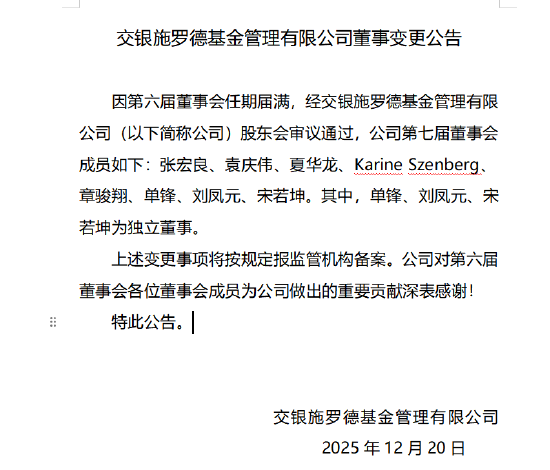
交银施罗德基金刚刚完成了公司治理的一次重要更迭,这家管理着近五千亿资产的老牌银行系基金公 司,在新领导班子的带领下开启了新的发展阶段。 近期,交银施罗德基金发布董事变更公告,因第六届董事会任期届满,经公司股东会审议通过,选举产 生了第七届董事会成员。公司第七届董事会由八名成员组成,分别为张宏良、袁庆伟、夏华龙、Karine Szenberg、章骏翔、单锋、刘凤元、宋若坤。其中,单锋、刘凤元、宋若坤为公司独立董事。此次变更 是由于第六届董事会任期届满而引起的正常换届。 此次变更事项将按规定报监管机构备案。公司对第六届董事会成员为公司做出的重要贡献表示感谢 公司近期治理变动脉络 关键董事成员背景 张宏良作为公司董事长,有着丰富的金融机构管理经验。他历任中国太平洋人寿保险公司多个分公司党 委书记、总经理,交银人寿保险有限公司党委书记、董事长、总裁,并曾兼任交银康联资产管理有限公 司董事长,交银理财有限责任公司党委书记、董事长。 袁庆伟同时担任公司董事和总经理。她于1995年3月加入交通银行,有长达三十年的银行从业经历。历 任乌鲁木齐分行财务会计处副处长、会计结算部高级经理,总行资产托管业务中心(资产托管部)副总 裁 ...