
银行资本补充

Search documents
“白衣骑士”频登场、多数仍陷转股难 银行可转债背后“冰火两重天”
Bei Jing Shang Bao· 2025-10-16 14:47
Core Viewpoint - The convertible bond market for banks in October is experiencing a significant divergence, with some banks like Shanghai Pudong Development Bank achieving a high conversion rate due to support from institutional investors, while many others are struggling with near-zero conversion rates [1][2][4] Group 1: Performance of Convertible Bonds - Shanghai Pudong Development Bank has achieved a conversion rate of 76.50%, with a total conversion amount of 38.25 billion yuan, alleviating repayment pressure ahead of its 50 billion yuan convertible bond maturity [2][4] - The market shows a stark contrast, with over half of the existing bank convertible bonds having conversion rates close to zero, indicating a significant disparity in performance [1][4] - Five banks have successfully exited the market through forced redemption, with a total issuance amount of 56 billion yuan involved [4][5] Group 2: Role of Institutional Investors - Institutional investors, referred to as "white knights," have played a crucial role in supporting the conversion of bonds into stocks, enhancing market confidence and improving the financing environment for banks [2][3] - Notable investors include China Mobile and Dongfang Asset, which have increased their holdings in Shanghai Pudong Development Bank through bond conversions [2][3] Group 3: Challenges for Smaller Banks - Smaller banks are facing challenges due to their stock prices being below the conversion price, leading to a lack of motivation for investors to convert bonds [6][7] - The low conversion rates directly limit banks' ability to supplement their core tier one capital, which is essential for risk management [6][7] Group 4: Future Outlook and Strategies - Analysts predict that the divergence in conversion rates will continue, with larger banks likely to achieve higher rates through stock price recovery or strategic investor involvement, while smaller banks may struggle [8][9] - Banks are encouraged to explore diversified capital-raising strategies beyond relying solely on convertible bonds to address core tier one capital pressures [8][9]

多家银行赎回“二永债” 银行业资本补充仍迫切
Zheng Quan Ri Bao· 2025-09-23 00:52
Core Viewpoint - Recent announcements from multiple banks regarding the redemption of subordinated capital bonds and perpetual bonds indicate a strategic response to changing interest rates, regulatory requirements, and capital management needs. The "perpetual bonds" will continue to be an important tool for capital replenishment in the banking sector [1][2]. Group 1: Reasons for Redemption - Several banks, including China Construction Bank and Qilu Bank, have recently redeemed their "perpetual bonds" due to three main reasons: lowering capital costs, enhancing market reputation, and specific bond terms that allow for redemption after five years [2][3]. - The decline in interest rates allows banks to redeem high-cost old bonds and issue new ones at lower rates, effectively reducing interest expenses and alleviating net interest margin pressure [3]. Group 2: Capital Management and Regulatory Compliance - The implementation of new capital management regulations has led to stricter counter-cyclical capital supervision, particularly for globally systemically important banks, necessitating the replacement of old bonds to optimize capital structure and improve capital tool adaptability [3][6]. - Redemption of old bonds may temporarily decrease a bank's capital scale, but if new bonds are issued simultaneously, it can enhance capital replenishment efficiency [3][4]. Group 3: Market Dynamics and Future Trends - The demand for capital replenishment in the banking sector remains urgent due to significant credit needs during economic transformation and the necessity for capital buffers in dealing with non-performing assets [5]. - The issuance of "perpetual bonds" is expected to show a divergence trend, with large banks and quality joint-stock banks likely to continue leveraging the interest rate decline to accelerate the redemption and issuance of new bonds, while smaller banks may face increased challenges in issuing new bonds [6].


光大银行(601818.SH):无固定期限资本债券发行完毕
Ge Long Hui A P P· 2025-09-19 08:12
Core Viewpoint - Everbright Bank has successfully issued a capital bond in the interbank bond market, which will enhance its Tier 1 capital base [1] Group 1: Bond Issuance Details - The bond is titled "China Everbright Bank Co., Ltd. 2025 Perpetual Capital Bond (First Phase)" [1] - The issuance was recorded on September 16, 2025, and completed on September 18, 2025 [1] - The total issuance size is RMB 40 billion [1] Group 2: Financial Terms - The coupon rate for the first five years is set at 2.29%, with adjustments every five years thereafter [1] - The issuer has a conditional redemption right on each interest payment date starting from the fifth year [1] Group 3: Use of Proceeds - The funds raised will be used to supplement the bank's other Tier 1 capital, subject to applicable laws and regulatory approvals [1]

银行“二永债”发行再加速 7月来新发规模近3000亿
2 1 Shi Ji Jing Ji Bao Dao· 2025-08-28 10:48
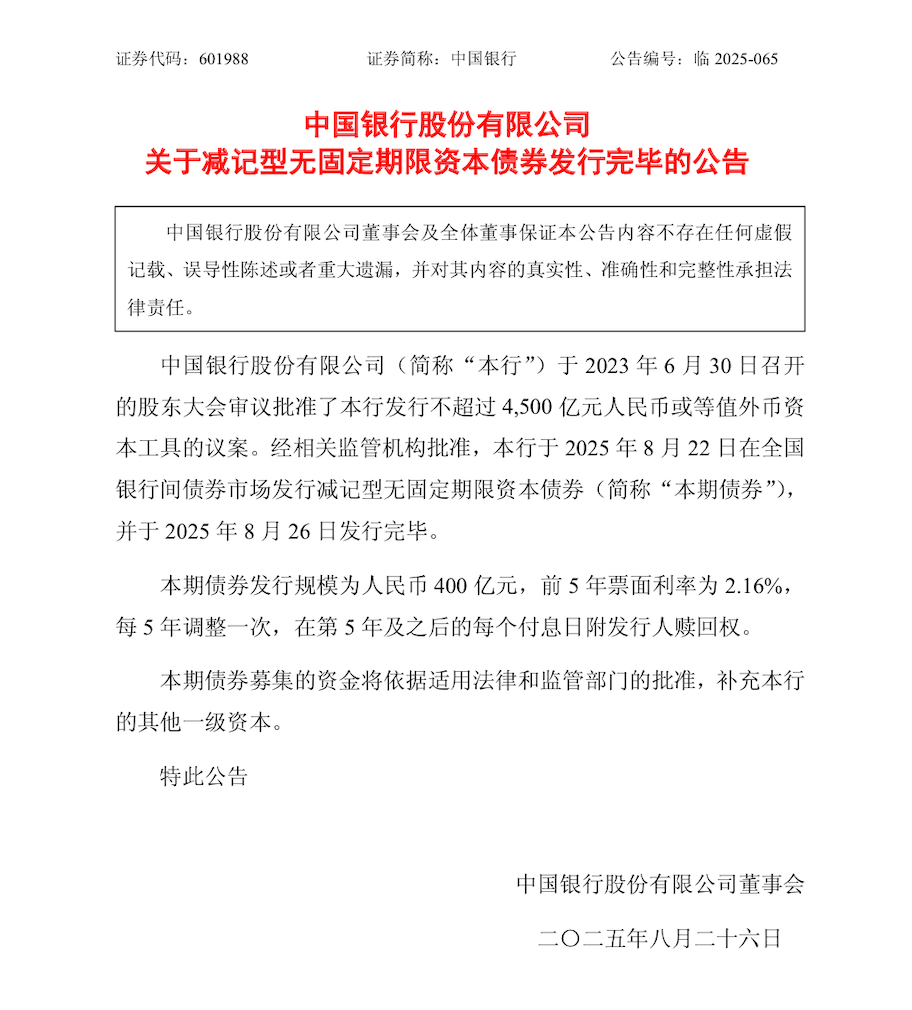
Core Viewpoint - The issuance of "perpetual bonds" and "subordinated bonds" (collectively referred to as "perpetual bonds") has accelerated in the second half of the year, with a total issuance of 297.2 billion yuan since July, driven by the capital replenishment needs of banks, particularly smaller banks [1][2][3] Group 1: Issuance Trends - Over 22 commercial banks have issued perpetual bonds in the last two months, with a notable increase in issuance from smaller banks [1][2] - In August, China Bank completed a 40 billion yuan issuance of perpetual bonds, following a 30 billion yuan issuance in the previous month [2] - Nine small and medium-sized banks successfully issued perpetual bonds in August, indicating a strong willingness to issue [2] Group 2: Capital Adequacy - The overall capital adequacy ratio of commercial banks has improved, with the average capital adequacy ratio rising to 15.58% in the first half of the year, an increase of 0.30 percentage points [4] - Some smaller banks still have relatively low capital adequacy ratios, necessitating further capital replenishment through perpetual bonds [4][5] - The capital adequacy ratios for Chengdu Bank, Ningbo Tongshang Bank, and Chouzhou Commercial Bank are below the industry average, highlighting their urgent need for capital [4] Group 3: Market Dynamics - The interest rates for perpetual bonds have shown a downward trend, reflecting a favorable financing cost environment for banks [3][5] - The issuance of perpetual bonds is expected to remain high, particularly among smaller banks, as they face ongoing capital pressures [5][6] - The market is likely to see a concentration of perpetual bond issuances from smaller banks as larger banks' capital replenishment needs stabilize [5][6]
中国银行、农业银行,同日发布最新公告!
Jin Rong Shi Bao· 2025-08-27 10:28
Core Points - Agricultural Bank of China has fully redeemed its perpetual bond issued on August 20, 2020, with a scale of 35 billion yuan in the interbank bond market [2] - The issuance of perpetual bonds and subordinated capital bonds is a strategy for commercial banks to enhance capital sources and improve operational stability amid profit pressure [4] - Major state-owned banks have significantly strengthened their capital positions this year, with a total of 520 billion yuan in core tier one capital supplemented through special government bonds and direct injections [5] Industry Trends - There has been a noticeable increase in the issuance of "perpetual bonds" and subordinated capital bonds among banks, with at least 12 banks issuing these instruments since July [5] - The overall issuance scale of "perpetual bonds" is expected to maintain steady growth in the second half of the year due to various factors [5] - As of March 31, 2025, the core tier one capital adequacy ratio for China Bank is 11.82%, while Agricultural Bank's ratios are 17.79% for total capital adequacy, 13.36% for tier one capital, and 11.23% for core tier one capital [5]



甘肃银行拟开展转股协议存款业务补充其他一级资本,额度不超30亿元
Xin Lang Cai Jing· 2025-08-26 09:23
Core Viewpoint - Gansu Bank plans to launch a convertible deposit agreement business to enhance its capital strength and improve risk resilience, with a maximum deposit amount of 3 billion yuan [1][2]. Group 1: Convertible Deposit Agreement - The convertible deposit agreement is an innovative capital tool for small and medium-sized banks, allowing local government bond funds to be injected as deposits to supplement the bank's capital [1]. - The agreement stipulates that the deposit will convert into ordinary shares upon meeting certain conditions or will be repaid with interest upon maturity [1][2]. - Gansu Bank intends to sign an agreement with the Gansu Provincial Finance Department or its designated entity to facilitate this capital injection [1]. Group 2: Capital Adequacy and Financial Performance - The bank's core tier 1 capital adequacy ratio must remain above 5.125%, or it must face a confirmed survival-threatening event for the conversion to occur [2]. - For the first half of 2025, Gansu Bank reported an operating income of 2.717 billion yuan, a year-on-year decrease of 13.9%, while profit attributable to shareholders was 398 million yuan, a year-on-year increase of 1.1% [2]. - As of June 30, 2025, Gansu Bank's total assets amounted to 427.482 billion yuan, with a non-performing loan ratio of 1.85% and capital adequacy ratios of 10.65% for total capital, tier 1 capital, and core tier 1 capital [2]. Group 3: Company Background - Gansu Bank is a provincial-level urban commercial bank directly managed by the provincial government, established through the merger of former Pingliang City Commercial Bank and Baiyin City Commercial Bank [3]. - The bank officially opened on November 19, 2011, and was listed on the Hong Kong Stock Exchange on January 18, 2018 [3].
中小银行 积极发债补充资本
Xin Hua Wang· 2025-08-12 06:20
Group 1 - The core viewpoint of the articles highlights the ongoing trend of capital replenishment among banks, with a significant increase in bond issuance to strengthen capital adequacy and support lending to the real economy [1][2][3] Group 2 - As of July 18, the total bond issuance by commercial banks reached 1.141 trillion yuan, with subordinated debt issuance being the highest at 389.1 billion yuan, a 254% increase compared to the same period in 2021 [1] - The issuance of financial bonds amounted to 279.3 billion yuan, while special financial bonds for small and micro enterprises reached 214.5 billion yuan [1] - Eight subordinated bonds exceeded 10 billion yuan in issuance, compared to only three in the same period last year, with major state-owned banks being the primary issuers [1] Group 3 - The need for capital replenishment is driven by the requirement to maintain capital adequacy ratios, which slightly decreased to 15.02% at the end of Q1 this year [2] - Regulatory bodies are supporting banks in capital replenishment through various channels, including the issuance of special bonds by local governments, with 103 billion yuan already allocated to four provinces [2][3] - The expectation is for continued active capital replenishment by banks, with a focus on enhancing support for the real economy and mitigating potential risks [3]
非上市银行陆续披露上半年业绩 首批银行盈利表现整体稳定
Xin Hua Wang· 2025-08-12 06:20
Core Viewpoint - The performance of non-listed banks in China for the first half of 2022 shows overall stability, with several banks reporting significant profit growth despite varying results among them [1][2][6]. Group 1: Performance Overview - As of July 20, six non-listed banks have disclosed their performance for the first half of 2022, with four banks reporting year-on-year profit growth [1][2]. - Hebei Zhengding Rural Commercial Bank achieved the highest profit growth, with a net profit of 145 million yuan, representing a year-on-year increase of 40.76% [2]. - Other banks such as Xinjiang Changji Rural Commercial Bank, Ningbo Beilun Rural Commercial Bank, and Anhui Suixi Rural Commercial Bank reported year-on-year profit growth rates of 16.79%, 12.34%, and 5.52%, respectively [2]. Group 2: Asset Scale and Growth - The disclosed banks are all local small and medium-sized banks, with asset scales around 100 billion yuan [3]. - Ningbo Beilun Rural Commercial Bank has the highest asset scale at 41.254 billion yuan as of the end of June [3]. - All banks reported asset scale growth in the first half of the year, with Hebei Zhengding, Ningbo Beilun, and Hunan Lianyuan Rural Commercial Banks seeing increases of over 10% compared to the beginning of the year [3]. Group 3: Capital Adequacy and Asset Quality - The capital adequacy ratios of the disclosed banks remained stable, with all meeting regulatory requirements and exceeding 12% [5]. - Ningbo Beilun Rural Commercial Bank reported the highest capital adequacy ratio at 13.33% as of the end of June [5]. - The average non-performing loan (NPL) rate for rural commercial banks was reported at 3.37%, significantly higher than other types of banks, with only two banks disclosing their NPL rates [4].
银行资本补充热度延续 多元化渠道加快打通
Xin Hua Wang· 2025-08-12 06:19
Group 1 - The core viewpoint of the articles highlights the increased capital-raising activities by commercial banks in China, driven by supportive growth policies and enhanced credit capabilities [1][2] - As of August 4, 2023, the issuance of various types of bonds by commercial banks, including subordinated bonds, convertible bonds, and perpetual bonds, exceeded 1.2 trillion yuan, marking a 38% increase compared to the same period last year [1] - The issuance of subordinated capital bonds saw a significant rise, increasing approximately 2.4 times year-on-year [1] Group 2 - The issuance of special financial bonds, particularly for small and micro enterprises, accounted for 31% of the total, while green financial bonds made up 23% [1] - Banks are also utilizing initial public offerings (IPOs), private placements, and share placements to supplement their capital, with notable examples including Lanzhou Bank raising 2.033 billion yuan and Qingdao Bank raising 2.502 billion yuan through share placements [1] - Regulatory bodies are encouraging commercial banks to explore diversified and external capital-raising channels, with a focus on supporting local governments in issuing special bonds to bolster the capital of small and medium-sized banks [2]
银行“补血”热情升温 更多渠道加速打通
Xin Hua Wang· 2025-08-12 06:19
Group 1 - The issuance of secondary capital bonds by commercial banks has significantly increased, with a total of 554.3 billion yuan issued as of September 7, representing a 98.8% increase compared to the same period last year [1][2] - Major banks like Agricultural Bank, Construction Bank, and Industrial and Commercial Bank have collectively issued 250 billion yuan in secondary capital bonds this year, indicating that large commercial banks remain the primary issuers [2][3] - Smaller banks are increasingly participating in bond issuance to supplement their capital, with many issuing bonds in smaller amounts [2][3] Group 2 - The financing channels for small and medium-sized banks have expanded, with the introduction of special bonds as a new tool for capital supplementation, supported by government policies [3][4] - A notable example includes the issuance of 30 billion yuan in special bonds by Gansu Province to support 11 small financial institutions, marking an innovative approach to capital injection [3][4] - In the first half of the year, four provinces have secured a total of 103 billion yuan in special bond quotas for small banks, with plans to reach a total of 320 billion yuan by the end of the year [3][4] Group 3 - The asset quality of small and medium-sized banks has remained stable despite economic pressures, with a slight decrease in non-performing loan ratios [5] - However, there are ongoing concerns regarding the future asset quality of these banks, with estimates suggesting a net issuance demand of approximately 2.9 trillion yuan for capital tools from 2022 to 2024 [6] - Recommendations have been made to further expand the capital-raising channels for small banks, particularly through the issuance of secondary capital bonds [6]