
ETF基金

Search documents
ETF基金周度跟踪:港股TMT领涨,资金流入券商、港股TMTETF-20250920
CMS· 2025-09-20 13:43
1. Report Industry Investment Rating No relevant content provided. 2. Core Viewpoints of the Report The report focuses on the performance of the ETF fund market, summarizing the past week's performance and fund - flow of the overall ETF market, different popular sub - type ETF funds, and innovative theme and sub - industry ETF funds for investors' reference [1]. 3. Summary by Related Catalogs 3.1 ETF Market Overall Performance - Market performance: From September 15th to 19th, stock ETFs showed a differentiated trend. Hong Kong TMT ETFs and Hong Kong mid - stream manufacturing ETFs had relatively high gains, with an average increase of 3.67% and 3.55% for funds above a certain scale. Conversely, Shanghai - Hong Kong - Shenzhen theme ETFs and Hong Kong financial and real estate ETFs had relatively deep declines, with an average decrease of 4.69% and 4.48% for funds above a certain scale [2][5]. - Fund - flow: Funds flowed significantly into Hong Kong TMT ETFs and financial and real estate ETFs, with net inflows of 11.82 billion yuan and 11.294 billion yuan throughout the week. In contrast, A - share large - cap ETFs and A - share STAR Market and ChiNext Innovation ETFs had significant outflows, with net outflows of 6.3 billion yuan and 5.12 billion yuan throughout the week [3][8]. 3.2 Different Popular Sub - type ETF Funds Market Performance - A - share ETFs: Include various categories such as broad - based indices (full - market, large - cap/super - large - cap, small - and medium - cap, STAR Market/ChiNext), industries (TMT, new energy, consumption, pharmaceutical and biological, cyclical, financial and real estate), SmartBeta (value, growth, dividend, free cash flow), themes, etc. Each category shows different performance in terms of weekly fund - flow, weekly returns, recent one - month returns, and year - to - date returns [16][17][18]. - Hong Kong ETFs: Include broad - based indices, industries (TMT, mid - stream manufacturing, consumption, pharmaceutical and biological, financial and real estate), SmartBeta (dividend), themes, etc. Each category also shows different performance in terms of weekly fund - flow, weekly returns, recent one - month returns, and year - to - date returns [31][32][33]. - Shanghai - Hong Kong - Shenzhen ETFs: Include industries and themes, with different performance in terms of weekly fund - flow, weekly returns, recent one - month returns, and year - to - date returns [36][37]. - US ETFs: Include broad - based indices and industries, with different performance in terms of weekly fund - flow, weekly returns, recent one - month returns, and year - to - date returns [38][39]. - Other QDII - ETFs (excluding Hong Kong and US): Show different performance in terms of weekly fund - flow, weekly returns, recent one - month returns, and year - to - date returns [40]. - Bond ETFs and commodity ETFs: Bond ETFs and commodity ETFs also show different performance in terms of weekly fund - flow, weekly returns, recent one - month returns, and year - to - date returns [41][42]. 3.3 Innovative Theme and Sub - industry ETF Funds Market Performance - TMT innovative themes: Include anime and games, smart cars, semiconductor chips, etc. Each theme shows different weekly returns and year - to - date returns [45]. - Consumption sub - industries: Include tourism, household appliances, grain, livestock breeding, etc. Each sub - industry shows different weekly returns and year - to - date returns [46]. - Pharmaceutical sub - industries: Include medical care, biomedicine, innovative drugs, etc. Each sub - industry shows different weekly returns and year - to - date returns [47]. - New energy themes: Include smart electric vehicles, new energy vehicles, new energy vehicle batteries, etc. Each theme shows different weekly returns and year - to - date returns [48]. - Central and state - owned enterprise themes: Include central enterprise technology leadership, Shanghai state - owned enterprises, etc. Each theme shows different weekly returns and year - to - date returns [49]. - Steady - growth themes: Include coal, real estate, infrastructure projects, etc. Each theme shows different weekly returns and year - to - date returns [50]. - Shanghai - Hong Kong - Shenzhen/Hong Kong Stock Connect sub - industries: Include Hong Kong Stock Connect technology, Hong Kong Stock Connect Internet, etc. Each sub - industry shows different weekly returns and year - to - date returns [51]. - Dividend/dividend low - volatility index families: Include Shenzhen Dividend, CSI Dividend, Shanghai Dividend, etc. Each index shows different weekly returns and year - to - date returns [52]. - STAR Market/ChiNext index families: Include STAR Market chips, ChiNext 50, etc. Each index shows different weekly returns and year - to - date returns [53].
9月以来公告上市股票型ETF平均仓位23.77%
Zheng Quan Shi Bao Wang· 2025-09-17 10:25
Group 1 - Three stock ETFs have released listing announcements, with the latest stock positions being 9.97% for the Fuguo Growth Enterprise Software ETF, 12.67% for the Southern National Index Hong Kong Stock Connect Innovative Drug ETF, and 19.81% for the E Fund Shanghai Stock Exchange Science and Technology Innovation Board New Energy ETF [1] - Since September, a total of 19 stock ETFs have announced listings, with an average position of only 23.77%. The highest position is 69.33% for the E Fund Shanghai Stock Exchange Science and Technology Innovation Board Comprehensive Enhanced Strategy ETF [1] - The ETFs with the highest positions also include the Jianxin Shanghai Stock Exchange Science and Technology Innovation Board 200 ETF at 54.12%, the Huatai-PB Shanghai Stock Exchange Science and Technology Innovation Board Artificial Intelligence ETF at 47.98%, and the Huatai-PB CSI Financial Technology Theme ETF at 40.87% [1] Group 2 - The average number of shares raised by the ETFs announced since September is 640 million, with the largest being 2.344 billion shares for the Fuguo National Index Robotics Industry ETF [2] - Institutional investors hold an average of 11.20% of the shares, with the highest being 98.93% for the Guolian An CSI A500 Dividend Low Volatility ETF [2] - The ETFs with the lowest institutional ownership include the Penghua Growth Enterprise Comprehensive ETF at 1.52% and the E Fund CSI Financial Technology Theme ETF at 1.70% [2]

二季度末险资对交通运输板块大幅加仓,交通运输ETF(159666)连续四日净流入1299万元
Mei Ri Jing Ji Xin Wen· 2025-09-05 05:58
Group 1 - The A-share market showed mixed performance on September 5, with over 3,000 stocks declining, while sectors such as electric equipment, non-ferrous metals, and basic chemicals led the gains, and retail, comprehensive, and beauty care sectors lagged [1] - As of the end of Q2, insurance capital significantly increased holdings in industries such as transportation, communication, and public utilities, with notable increases in shares of CITIC Bank, Beijing-Shanghai High-Speed Railway, and China Telecom, each exceeding 200 million shares [1] - According to招商证券, by the end of Q2 2025, the top five industries by insurance capital holdings in A-shares will be banking, transportation, communication, real estate, and electric and public utilities, indicating a stable growth outlook for highway enterprises and their low volatility dividend attributes [1] Group 2 - The Transportation ETF (159666) and its linked funds are the only ETFs tracking the CSI All-Transportation Index, which includes logistics, railways, highways, shipping ports, and airports, reflecting the overall performance of A-share transportation industry listed companies [2]
“专业买手”最新重仓基金曝光,这些基金涨超100%
2 1 Shi Ji Jing Ji Bao Dao· 2025-09-04 07:37
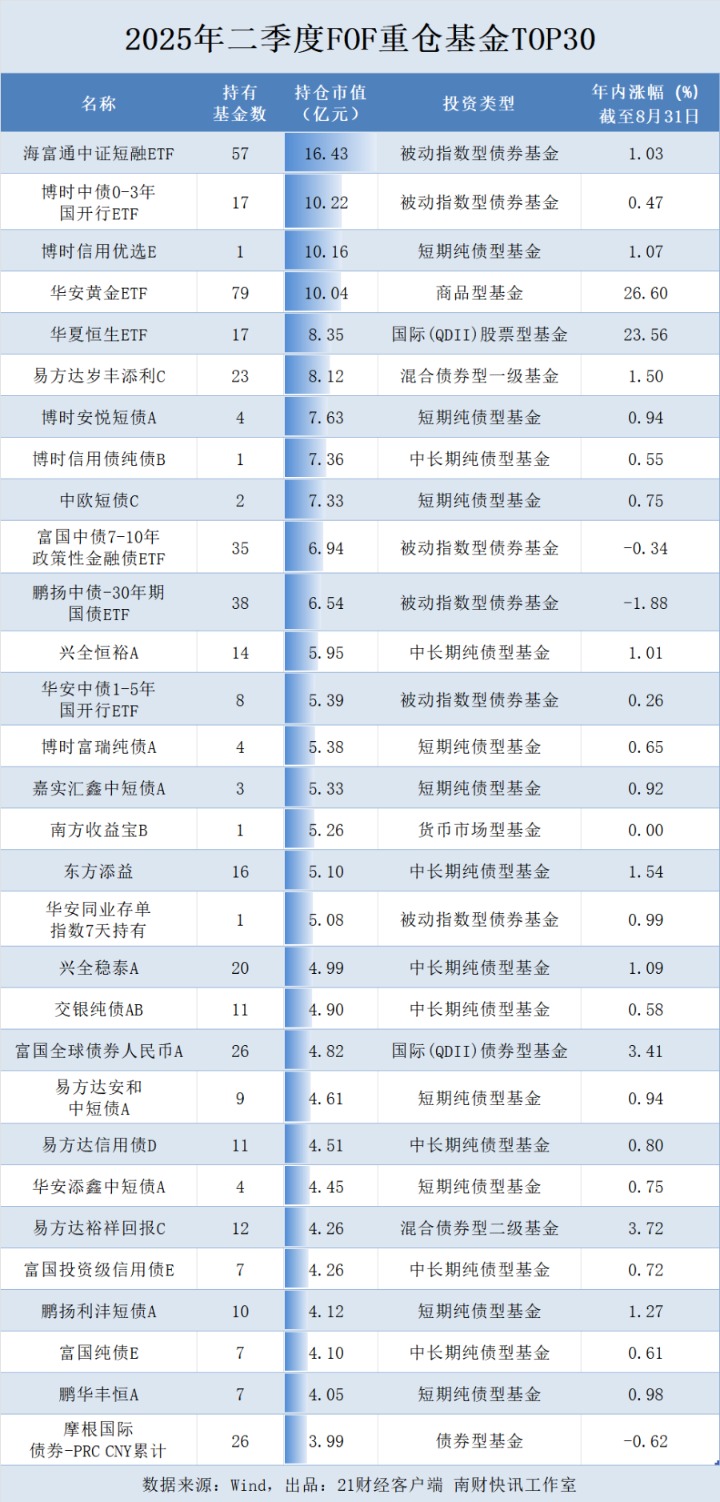
Summary of Key Points Core Viewpoint - The latest FOF (Fund of Funds) report reveals a strong preference for bond funds, with significant interest in various ETF, actively managed equity funds, and QDII funds as the capital market shows signs of recovery [1][3]. Group 1: FOF Holdings and Performance - In Q2, bond funds remained the primary focus for FOF, with the highest market value held in Hai Fu Tong Zhong Zheng Short Bond ETF, exceeding 1.643 billion yuan [3][4]. - The top 30 actively managed equity funds held by FOF saw 21 funds yielding over 20% returns, while two QDII funds exceeded 100% returns [1][19]. - The top three funds with the most significant increase in holdings were all bond funds, with Bo Shi Credit Preferred E seeing an increase of over 800 million shares [6][7]. Group 2: ETF Performance - The total scale of ETFs surpassed 4.31 trillion yuan, marking a 15.57% increase from the previous year [10]. - The top five ETFs by market value held by FOF include Hai Fu Tong Zhong Zheng Short Bond ETF and Bo Shi Zhong Dai 0-3 Year National Development Bank ETF [10][12]. - The best-performing ETFs focused on the technology sector, with returns ranging from 35.98% to 49.30% [11]. Group 3: QDII Fund Insights - The highest market value QDII fund held by FOF was Hua Xia Hang Seng ETF, with over 800 million yuan in holdings [19][20]. - Two QDII funds, Hui Tian Fu Hong Kong Advantage Selected A and Guang Fa Zhong Zheng Hong Kong Innovative Medicine ETF, reported returns exceeding 100% [19][20]. Group 4: Market Outlook - FOF managers express optimism for the market's continuation, emphasizing the need for cautious investment strategies amid rapid industry rotations [23]. - The anticipated economic stabilization and potential overseas capital inflows are expected to benefit the Chinese capital market [23].
“专业买手”最新重仓基金曝光,这些基金涨超100%
21世纪经济报道· 2025-09-04 03:36
Core Viewpoint - The article highlights the investment preferences of Fund of Funds (FOF) in the second quarter of 2023, indicating a strong preference for bond funds, while also noting significant interest in ETFs, actively managed equity funds, and QDII funds as the capital market recovers [1][2]. Summary by Sections FOF Investment Preferences - In the second quarter, bond funds remained the primary focus for FOFs, with the highest market value held in the Hai Fu Tong Zhong Zheng Short Bond ETF, exceeding 1.643 billion yuan [3][4]. - The top three bond funds held by FOFs include: - Hai Fu Tong Zhong Zheng Short Bond ETF: 1.643 billion yuan, with a year-to-date increase of 1.03% - Bo Shi Zhong Dai 0-3 Year National Development Bank ETF: 1.022 billion yuan, with a year-to-date increase of 0.47% - Bo Shi Credit Preferred E: 1.016 billion yuan, with a year-to-date increase of 1.07% [4][5]. Active Equity Funds - The article notes that among the top 30 actively managed equity funds held by FOFs, 21 funds achieved returns exceeding 20% in the year-to-date period [1][15]. - The highest market value for an actively managed equity fund held by FOFs is the Yi Fang Da Ke Rong, valued at 384 million yuan, despite a reduction of over 380,000 shares [15][17]. QDII Funds - QDII funds have also gained traction, with the highest market value held in the Hua Xia Hang Seng ETF, totaling over 800 million yuan [20][21]. - Notably, two QDII funds, the Hui Tian Fu Hong Kong Advantage Selected A and the Guang Fa Zhong Zheng Hong Kong Innovation Drug ETF, reported returns exceeding 100% [20][21]. ETF Performance - The total scale of ETFs surpassed 4.31 trillion yuan, marking a 15.57% increase from the end of the previous year [10]. - The top five ETFs held by FOFs in terms of market value include: - Hai Fu Tong Zhong Zheng Short Bond ETF: 1.643 billion yuan - Bo Shi Zhong Dai 0-3 Year National Development Bank ETF: 1.022 billion yuan - Hua An Gold ETF: 1.004 billion yuan, with a year-to-date increase of 26.60% - Hua Xia Hang Seng ETF: 835 million yuan, with a year-to-date increase of 23.56% [10][12]. Market Outlook - FOF managers express optimism about the market's future, emphasizing the need for cautious investment strategies amid rapid industry rotations [24]. - The article suggests that the market's liquidity is relatively abundant, which may lead to faster value discovery compared to previous years [24].

“专业买手”最新重仓基金曝光!这些基金涨超100%
2 1 Shi Ji Jing Ji Bao Dao· 2025-09-04 01:16
Core Viewpoint - The latest FOF (Fund of Funds) report reveals a strong preference for bond funds among FOF managers, with significant interest also in ETFs, actively managed equity funds, and QDII funds as the capital market recovers [1][2][8]. Summary by Category FOF Holdings Overview - In Q2, bond funds remained the primary focus for FOFs, with the highest market value held in Hai Fu Tong Zhong Zheng Short Bond ETF, exceeding 1.643 billion yuan [2][3]. - The top 30 actively managed equity funds held by FOFs saw 21 funds yielding over 20% returns, while two QDII funds achieved returns exceeding 100% [1][12]. Top Bond Funds Held by FOFs - The top bond funds held by FOFs include: - Hai Fu Tong Zhong Zheng Short Bond ETF: 1.643 billion yuan, 1.03% YTD return [3][9]. - Bo Shi Zhong Dai 0-3 Year National Development Bank ETF: 1.022 billion yuan, 0.47% YTD return [3][9]. - Bo Shi Credit Preferred E: 1.016 billion yuan, 1.07% YTD return [3][5]. Changes in Holdings - The most increased holdings in Q2 were primarily in bond funds, with Bo Shi Credit Preferred E seeing an increase of over 800 million shares [4][5]. - Other notable increases included South Fund Income Treasure B and Bo Shi Fu Rui Pure Bond A, both exceeding 400 million shares [4][5]. Performance of ETFs - The total scale of ETFs surpassed 4.31 trillion yuan, marking a 15.57% increase from the end of last year [8]. - The top five ETFs by market value held by FOFs include Hai Fu Tong Zhong Zheng Short Bond ETF and Bo Shi Zhong Dai 0-3 Year National Development Bank ETF, with significant interest in tech-focused ETFs showing strong performance [8][9]. Active Equity Funds - The highest valued actively managed equity fund held by FOFs was Yi Fang Da Ke Rong, with a market value of 384 million yuan, despite a reduction of over 380,000 shares [11][12]. - The top 30 actively managed equity funds had a positive performance, with two funds exceeding 80% returns [12][13]. QDII Funds Performance - The highest valued QDII fund held by FOFs was Hua Xia Hang Seng ETF, with a market value exceeding 800 million yuan [16]. - Two QDII funds, Huatai Fuhua Hong Kong Advantage Selection A and Guangfa Zhong Zheng Hong Kong Innovative Medicine ETF, achieved returns over 100% [16]. Market Outlook - FOF managers express optimism for future market performance, emphasizing the need for cautious investment strategies amid rapid industry rotations [17][18]. - The anticipated economic stabilization and potential dual easing of fiscal and monetary policies in developed economies could favor the Chinese capital market [17].
易方达中证A500增强策略ETF今日起发售,募集上限20亿元
Zheng Quan Shi Bao Wang· 2025-09-01 01:41
Group 1 - The E Fund CSI A500 Enhanced Strategy ETF (563603) will be launched from September 1 to September 5, 2025, with a maximum initial fundraising scale of 2 billion yuan [1] - The fund will be managed by E Fund Management, with Huang Haodong serving as the fund manager [1] - The performance benchmark for the fund is the return rate of the CSI A500 Index [1]
石化ETF: 华夏中证石化产业交易型开放式指数证券投资基金2025年中期报告
Zheng Quan Zhi Xing· 2025-08-29 10:11
Fund Overview - The fund is named "Huaxia CSI Petrochemical Industry Exchange-Traded Fund" and was established on December 2, 2021 [2] - The fund aims to closely track the CSI Petrochemical Industry Index with a target tracking deviation of no more than 0.2% on a daily basis and an annual tracking error of no more than 2% [2][8] - The fund's total shares at the end of the reporting period were 51,375,802 [2] Financial Performance - The fund reported a realized loss of 621,734.05 RMB and a total profit of -1,060,453.44 RMB for the first half of 2025 [3][4] - The net asset value at the end of the reporting period was 34,531,168.33 RMB, with a net asset value per share of 0.6721 RMB [3][4] - The cumulative net value growth rate since the fund's inception is -32.79% [3][4] Investment Strategy - The fund employs a full replication strategy and appropriate alternative strategies to track the underlying index effectively [8] - The investment strategy includes various approaches such as stock index futures, bond investments, and asset-backed securities [2][8] Market Environment - The A-share market experienced a range-bound trend in the first half of 2025, with rapid sector rotation and a focus on "dividend + technology" strategies [9][10] - The overall economic environment remains stable, with ongoing structural adjustments and a focus on high-quality development in China [9][10] Management and Compliance - The fund management strictly adheres to relevant laws and regulations, ensuring fair treatment of all funds under management [7] - The fund has not engaged in any abnormal trading activities during the reporting period [7] Future Outlook - The fund will continue to focus on closely tracking the underlying index while managing investor subscriptions and redemptions [9][10] - The market's attention will be on the potential impacts of tariffs on inflation and the direction of monetary policy adjustments by the Federal Reserve [10]

中小100ETF: 中小企业100交易型开放式指数基金2025年中期报告
Zheng Quan Zhi Xing· 2025-08-29 09:23
Core Viewpoint - The report provides an overview of the performance and management of the Small and Medium Enterprises 100 Exchange-Traded Fund (ETF) for the first half of 2025, highlighting its investment strategy, financial performance, and market conditions affecting the fund [1][2]. Fund Overview - Fund Name: Small and Medium Enterprises 100 ETF - Fund Manager: China Asset Management Co., Ltd. - Fund Custodian: China Construction Bank Co., Ltd. - Total Fund Shares at Period End: 175,954,340.57 shares [3]. - Fund's Investment Objective: To closely track the underlying index and minimize tracking deviation and error [3]. Financial Performance - Realized Income for the Period: CNY 21,867,972.50 - Profit for the Period: CNY 21,802,471.19 - Weighted Average Fund Share Profit for the Period: 0.1182 - Net Asset Value at Period End: CNY 604,534,430.92 - Fund Share Net Value at Period End: 3.4357 [4][20]. - Fund Share Net Value Growth Rate for the Period: 3.21% [15]. Market Conditions - The report indicates that the global economic environment remains complex, with trade disputes and geopolitical tensions contributing to uncertainty. However, domestic macroeconomic policies are supportive of growth, with GDP increasing by 5.3% year-on-year [14][15]. - The A-share market experienced volatility, with small-cap stocks outperforming large-cap stocks during the reporting period [14][15]. Investment Strategy - The fund primarily employs a full replication strategy, constructing its stock portfolio according to the composition and weight of the underlying index. Adjustments are made based on changes in the index's constituent stocks [13][14]. - The fund's performance is benchmarked against the Small and Medium Enterprises 100 Index, which reflects the core index of the original SME board market [13][14]. Management Report - The fund manager, China Asset Management Co., Ltd., emphasizes its commitment to managing the fund with integrity and diligence, aiming to maximize returns for fund shareholders [16]. - The report highlights the importance of maintaining liquidity and stability in fund operations, with designated liquidity service providers to enhance market liquidity [15][19].

ETF周报(20250818-20250822)-20250825
Mai Gao Zheng Quan· 2025-08-25 07:12
Group 1: Report Industry Investment Rating - Not provided in the content Group 2: Core Viewpoints of the Report - In the secondary market, during the sample period from August 18 - 22, 2025, the top - performing A - share and overseas major broad - based indices were科创50, ChiNext Index, and CSI 300, with weekly returns of 13.31%, 5.85%, and 4.18% respectively. Among Shenwan primary industries, communication, electronics, and comprehensive had the highest returns at 10.84%, 8.95%, and 8.25%, while real estate, coal, and pharmaceutical biology had lower returns at 0.50%, 0.92%, and 1.05% respectively [1][10][17]. - Regarding ETF product performance, during the sample period, broad - based ETFs had the best average performance with a weighted average return of 5.12%, while QDII ETFs had the worst with - 0.61%. In terms of the listing board, ETFs related to the Science and Technology Innovation Board and the Science and Technology Innovation and Entrepreneurship 50 had better performance, with weighted average returns of 13.01% and 10.85% respectively. US and Japanese stock ETFs had poor performance, with - 2.78% and - 2.65% respectively [21]. - For ETF fund flows, industry - themed ETFs had the largest net capital inflow of 254.09 billion yuan, and broad - based ETFs had the smallest at - 161.16 billion yuan. From the perspective of the listing board, Hong Kong stock ETFs had the largest net inflow of 214.47 billion yuan, and Science and Technology Innovation Board - related ETFs had the smallest at - 144.18 billion yuan [2][25]. Group 3: Summary by Relevant Catalogs 1. Secondary Market Overview - Index returns: During the sample period,科创50, ChiNext Index, and CSI 300 had the highest weekly returns at 13.31%, 5.85%, and 4.18% respectively. The PE valuation quantile of CSI 300 was the highest at 100.00%, and that of the Nikkei 225 was the lowest at 73.36% [10]. - Industry returns: Among Shenwan primary industries, communication, electronics, and comprehensive had the highest returns at 10.84%, 8.95%, and 8.25%, while real estate, coal, and pharmaceutical biology had lower returns at 0.50%, 0.92%, and 1.05% respectively. In terms of valuation, social services, light manufacturing, and building materials had the highest valuation quantiles at 100.00%, and agriculture, forestry, animal husbandry and fishery, household appliances, and comprehensive had lower quantiles at 35.12%, 55.37%, and 62.81% respectively [17]. 2. ETF Product Overview 2.1 ETF Market Performance - By product type: Broad - based ETFs had the best average performance with a weighted average return of 5.12%, and QDII ETFs had the worst with - 0.61%. - By listing board: ETFs related to the Science and Technology Innovation Board and the Science and Technology Innovation and Entrepreneurship 50 had better performance, with weighted average returns of 13.01% and 10.85% respectively. US and Japanese stock ETFs had poor performance, with - 2.78% and - 2.65% respectively. - By industry sector: Technology sector ETFs had the best average performance with a weighted average return of 12.53%, and biomedical sector ETFs had the worst with 1.55%. - By theme: Chip semiconductor and artificial intelligence ETFs had better performance, with weighted average returns of 15.09% and 14.57% respectively. Bank and dividend ETFs had relatively poor performance, with 0.91% and 1.10% respectively [21][23]. 2.2 ETF Fund Flows - By category: Industry - themed ETFs had the largest net capital inflow of 254.09 billion yuan, and broad - based ETFs had the smallest at - 161.16 billion yuan. - By listing board: Hong Kong stock ETFs had the largest net inflow of 214.47 billion yuan, and Science and Technology Innovation Board - related ETFs had the smallest at - 144.18 billion yuan. - By industry sector: Financial and real estate sector ETFs had the largest net inflow of 141.32 billion yuan, and technology sector ETFs had the smallest at - 53.84 billion yuan. - By theme: Non - bank and innovative drug ETFs had the largest net inflows of 142.21 billion yuan and 31.74 billion yuan respectively. Chip semiconductor and military - industry ETFs had the smallest at - 78.85 billion yuan and - 5.73 billion yuan respectively [2][25][28]. 2.3 ETF Trading Volume - By category: Broad - based ETFs had the largest increase in the average daily trading volume change rate at 27.34%, and commodity ETFs had the largest decrease at - 28.91%. - By listing board: CSI 500 ETFs had the largest increase in the average daily trading volume change rate at 76.67%, and Japanese stock ETFs had the largest decrease at - 15.32%. - By industry sector: The consumer sector had the largest increase in the average daily trading volume change rate at 48.26%, and the biomedical sector had the largest decrease at - 5.57%. - By theme: Non - bank and innovative drug ETFs had the highest average daily trading volumes in the past 5 days at 367.55 billion yuan and 104.62 billion yuan respectively. Consumer electronics and artificial intelligence ETFs had the largest increases in the average daily trading volume change rate at 52.58% and 38.65% respectively. Central state - owned enterprises and innovative drug ETFs had the largest decreases at - 8.12% and - 7.01% respectively [34][37][40][43]. 2.4 ETF Margin Trading - During the sample period, the net margin purchase of all equity ETFs was - 2.48 billion yuan, and the net short - selling was 2.32 billion yuan. Southern CSI 500 ETF had the largest net margin purchase, and Southern CSI 1000 ETF had the largest net short - selling [2][48]. 2.5 ETF New Issuance and Listing - During the sample period, 9 funds were established and 8 funds were listed [3][50].