
氢能

Search documents
【倒计时1天·赴未来】力源科技硬核新品 驱动氢能未来
势银能链· 2025-08-26 03:16
Core Viewpoint - The article emphasizes the upcoming launch of new products in the hydrogen energy sector, specifically focusing on the third-generation PPS composite membrane and square electrolyzer from Liyuan Technology, aimed at reducing import dependency and overcoming technological gaps in the industry [5]. Group 1: Event Information - The 2025 TrendBank Green Hydrogen Industry Conference is scheduled for August 27-28, 2025, in Wuxi, Jiangsu [2][7]. - A countdown indicates that there is only 1 day left until the product launch event [4][6]. Group 2: Product Launch - Liyuan Technology is set to unveil two new products: the third-generation PPS composite membrane and a square electrolyzer, which are expected to drive the future of hydrogen energy [5]. - The launch event will be broadcasted live on the TrendBank energy chain platform, providing more insights into the products [8]. Group 3: Company Information - Ningbo Membrane Intelligence Information Technology Co., Ltd. serves as the sole registered entity and payment account for TrendBank [1]. Group 4: Additional Services - TrendBank offers various services including monthly analysis reports on the hydrogen energy and fuel cell industry, research services, data products, and consulting services [14].


致远新能: 2025年半年度报告
Zheng Quan Zhi Xing· 2025-08-25 16:08
Core Viewpoint - Changchun Zhiyuan New Energy Equipment Co., Ltd. reported a slight increase in revenue for the first half of 2025, but significant declines in net profit and earnings per share, indicating challenges in profitability despite revenue growth [6][7]. Financial Performance - Revenue for the first half of 2025 was approximately 815.21 million yuan, a 1.09% increase compared to 806.45 million yuan in the same period of 2024 [6]. - Net profit attributable to shareholders decreased by 66.77% to approximately 19.73 million yuan from 59.39 million yuan year-on-year [6]. - Basic earnings per share fell by 54.84% to 0.1596 yuan from 0.3534 yuan in the previous year [6]. - The net cash flow from operating activities improved by 57.13%, reaching approximately -191.06 million yuan compared to -445.64 million yuan in the previous year [6]. Business Overview - The company focuses on high-end equipment manufacturing in the new energy sector and the processing of lithium battery anode materials [7]. - Main products include vehicle LNG supply systems and LNG power ship fuel systems, which are essential for heavy-duty trucks and engineering vehicles [7][8]. - The company operates within the metal products industry, specifically in the manufacturing of low-temperature insulated pressure vessels for LNG [7]. Industry Trends - The LNG heavy-duty truck market is growing due to its environmental benefits, including reduced emissions compared to traditional diesel trucks [8][9]. - Recent policies from the National Development and Reform Commission and other governmental bodies have prioritized LNG vehicles, providing subsidies and support for the replacement of older vehicles with LNG models [9][10]. - The LNG supply chain, including infrastructure for refueling stations, is expanding, enhancing the competitiveness of LNG trucks in long-haul logistics [12][14]. Product Details - The company's main products include various types of LNG supply systems, which are designed for different vehicle capacities and applications [11][20]. - The LNG supply systems are critical for reducing pollution and meeting modern environmental standards, aligning with national low-carbon energy goals [8][9].
铂钯期货白皮书:铂、钯基础知识介绍
Hua Tai Qi Huo· 2025-08-25 11:02
1. Report Industry Investment Rating No relevant content provided. 2. Core Viewpoints of the Report - In 2025, the supply of platinum and palladium is expected to decline, with platinum's mineral supply dropping by 4% to 529.5 million ounces and palladium's by 5% to 616.5 million ounces. However, the global palladium recycling volume is expected to rise to 270.5 million ounces [21][24]. - The demand for platinum is expected to slightly increase to 720.5 million ounces in 2025, while the demand for palladium is expected to decline to 862.5 million ounces, mainly due to the decline in automotive industry demand [41]. - In 2025, the supply - demand pattern of platinum and palladium is expected to show a differentiated trend, mainly due to the relative low price of platinum compared to palladium and the impact of the Russia - Ukraine conflict on palladium circulation [48]. 3. Summary by Relevant Catalogs 3.1 Platinum and Palladium Industry Chain Introduction - Platinum group metals include six elements: ruthenium (Ru), rhodium (Rh), palladium (Pd), osmium (Os), iridium (Ir), and platinum (Pt). Platinum and palladium are important industrial precious metals with wide applications in industry and jewelry [3][5]. - The mining and purification of platinum and palladium are complex. They are often symbiotic with copper - nickel sulfides and chromite, and the average grade of primary ore is only 2 - 10 g/t. Recycling accounts for about 30% of platinum supply and 20% of palladium supply. After refining, they are mainly used in automotive exhaust catalysts, as well as in chemical, electronic, glass, petroleum, medical, and other fields [12]. 3.2 Platinum and Palladium Supply Situation 3.2.1 Reserve Distribution and Major Production Enterprises - In 2024, the total proven reserves of platinum - group metals globally exceeded 81,000 tons, concentrated in southern Africa, North America, and the Far East of Europe. China's reserves are less than 1% of the global total [18]. - The top 10 global suppliers of platinum and palladium are mainly concentrated in South Africa, Russia, and North America [18]. 3.2.2 Platinum Supply - In 2025, the platinum mineral supply is expected to decline by 4% to 529.5 million ounces, with South Africa's supply expected to decrease by 170,000 ounces. The recycling supply in 2025 is expected to slightly recover [21]. 3.2.3 Palladium Supply - In 2025, the palladium mineral supply is expected to decline by 5% to 616.5 million ounces, mainly affected by the production decline in South Africa and North America. The global palladium recycling volume is expected to rise to 270.5 million ounces [24]. 3.2.4 Introduction of Major Supply Enterprises - Anglo American Platinum Ltd. is the world's largest platinum producer, with 80% of its assets in South Africa's Bushveld Complex. In 2025, its production is expected to be 3.8 million ounces, accounting for 30% of the global supply [29]. - OJSC MMC Norilsk Nickel is a leading global mining and metallurgy group. Its palladium production accounts for nearly 40% of the global total. In the first three quarters of 2024, its palladium production was 2.156 million ounces and platinum production was 521,000 ounces [29]. - Impala Platinum Holdings Ltd is a major global producer of platinum - group metals, with mines in South Africa, Zimbabwe, and Canada. In 2024, its total production of platinum - group metals was 3.65 million ounces, accounting for over 30% of the global supply [30]. - Stillwater Mining Co. is a leading global producer of platinum - group metals. In 2023, its annual production of platinum and palladium was about 408,000 ounces, accounting for about 7% of the global supply [30]. 3.3 Platinum and Palladium Downstream Applications 3.3.1 Automotive Catalysts - Platinum, palladium, and rhodium are key components of automotive catalysts. In the long - term, the demand for platinum and palladium in automotive catalysts is not optimistic due to the development of new energy vehicles. In the short - term, the sales increase of second - hand gasoline vehicles may boost the demand. In 2024, the demand for platinum and palladium in automotive catalysts accounted for 48% and 83% respectively [33]. 3.3.2 Jewelry - Platinum is regarded as a high - end jewelry representative, while palladium is rarely used in jewelry due to its discoloration. In the future, the application of platinum and palladium in jewelry faces a downward risk. In 2024, the demand for platinum and palladium in jewelry accounted for 19% and 1% respectively [34]. 3.3.3 Industry - Platinum's industrial demand is concentrated in glass manufacturing, chemical catalysis, and electronics. Palladium's industrial use is mainly in the chemical and electronic industries. In 2024, the demand for platinum and palladium in industry accounted for 32% and 15% respectively [35]. 3.3.4 Hydrogen Energy - Platinum - group metals play a crucial role in hydrogen energy development. The development of hydrogen energy is in its infancy, and the demand for platinum and palladium may increase in the future. In 2024, the demand for platinum and palladium in hydrogen energy accounted for 1% and 0.3% respectively [38]. 3.4 Price and Futures 3.4.1 Global Platinum and Palladium Supply - Demand Balance - In 2020, the prices of platinum and palladium rose significantly due to the shutdown of mining and smelting in South Africa. In 2021, the supply surplus intensified. In 2025, the supply - demand pattern of platinum and palladium is expected to show a differentiated trend [48]. 3.4.2 Global Platinum and Palladium Futures Market - The Guangzhou Futures Exchange is expected to launch platinum and palladium futures contracts this year. The London Platinum and Palladium Market (LPPM) is the most important global spot trading market, and the New York Mercantile Exchange (NYMEX) is the largest global platinum futures trading market [56][60].
绿能智创 驱动未来|2025第三届零碳技术专精特新创业大赛京津冀预选赛北京站议程公布
势银能链· 2025-08-25 04:04
Core Viewpoint - The article highlights the advancements and opportunities in the hydrogen energy sector, focusing on various companies and their innovative technologies in hydrogen production, storage, and safety management [3][4][5][6][8]. Group 1: Company Innovations - Suzhou Zhiqing Bo Materials Technology Co., Ltd. specializes in the research and industrialization of anion exchange membranes, achieving stable production of 10 kg of resin and a product matrix of differentiated AEM products [3]. - Beijing Jiatai New Energy Technology Co., Ltd. is developing a new compressed gas energy storage project aimed at large-scale, long-duration, and environmentally friendly energy storage solutions [4]. - Fan Hydrogen Technology (Beijing) Co., Ltd. integrates hydrogen-sensitive color-changing materials with smart sensing technology for hydrogen leak detection, addressing challenges in leak detection [5]. Group 2: Market Trends - The article emphasizes the growing importance of hydrogen energy in the context of green transformation and sustainable development, with various companies focusing on innovative solutions to enhance hydrogen production and safety [8][10][12]. - The distributed green hydrogen supply model introduced by Beijing Hydrogen Ring Energy Technology Co., Ltd. utilizes local biogas resources for hydrogen production, addressing the industry's challenges of gas shortages and insufficient refueling stations [6]. Group 3: Investment Opportunities - The article mentions several investment managers and funds focusing on green energy, particularly in hydrogen and related technologies, indicating a robust interest in financing innovative projects in this sector [8][10][12][14][18][20].

国际观察|打破惯例先访日后访美 李在明释放什么信号
Xin Hua She· 2025-08-24 12:43
Core Viewpoint - South Korean President Lee Jae-myung's visit to Japan before the United States marks a significant shift in diplomatic protocol, indicating a need for closer cooperation between South Korea and Japan in the face of external pressures, particularly from the United States [1][3]. Group 1: Change in Attitude Towards Japan - Lee Jae-myung's meeting with Japanese Prime Minister Kishida Fumio resulted in agreements on enhancing security communication and cooperation in hydrogen energy and artificial intelligence, marking the first joint statement from a South Korean and Japanese leader in 17 years [2]. - Lee's previous strong criticisms of Japan regarding historical issues have softened since taking office, as he emphasizes the need for mutual benefits and cooperation rather than dwelling on past grievances [2]. - The shift in Lee's stance reflects a broader political strategy to demonstrate inclusivity and pragmatism in governance, moving away from the confrontational approach he adopted while in opposition [2]. Group 2: Joint Response to U.S. Pressure - Lee's decision to visit Japan first is seen as a strategic move to better prepare for discussions with U.S. President Trump, amid ongoing U.S. pressures on both countries regarding trade and defense spending [3]. - Analysts suggest that coordinated positions between South Korea and Japan could enhance their negotiating power with the U.S., particularly in light of Trump's administration's demands for increased defense spending and tariffs [3]. - The meeting also serves as a platform for Lee to align with Japan on how to navigate the uncertainties posed by the Trump administration, with both leaders recognizing the importance of a united front [3]. Group 3: Historical Issues Remain a Challenge - Despite the current diplomatic thaw, historical grievances between South Korea and Japan are expected to continue to pose challenges to their relationship, as Lee acknowledges the historical issues as a significant hurdle [5]. - The rise of right-wing political forces in Japan complicates the potential for reconciliation, as these groups often resist acknowledging historical wrongs, which could exacerbate tensions with South Korea [5]. - The political landscape in Japan, characterized by increasing nationalism, may hinder future efforts to address historical disputes, potentially reigniting conflicts over issues such as wartime labor and the "comfort women" controversy [5].
先见石破茂后见特朗普!李在明赴美前先学日美“关税”咋谈的?
Di Yi Cai Jing· 2025-08-24 04:29
Core Points - The core focus of the news is on South Korean President Lee Jae-myung's diplomatic visits to Japan and the United States, aiming to strengthen bilateral relations and enhance cooperation in various sectors, particularly in light of the evolving geopolitical landscape [1][2]. Group 1: Diplomatic Visits - Lee Jae-myung's first foreign visit as President was to Japan, breaking the tradition of South Korean presidents visiting the U.S. first [1]. - The visit to Japan included discussions with Japanese Prime Minister Kishida Fumio, marking the second face-to-face meeting since the G7 summit in June [1]. - The visit is seen as a strategic move to improve South Korea-Japan relations, which have been historically strained [1][3]. Group 2: Bilateral Cooperation - The leaders agreed to enhance strategic communication in security, and collaborate in areas such as hydrogen energy and artificial intelligence [3]. - There is a focus on establishing a discussion framework for common issues like local revitalization and aging populations [3]. - The expansion of working holiday visa programs was also discussed to promote personnel exchanges [3]. Group 3: U.S. Relations - Lee's visit to Japan is intended to send a message to the U.S. about the importance of improving South Korea-Japan relations for trilateral cooperation [2]. - The main agenda for Lee's upcoming visit to the U.S. includes tariff negotiations, reflecting concerns similar to those faced by Japan [2]. - There is apprehension regarding the unpredictability of the Trump administration, which raises concerns about South Korea's position in U.S. foreign policy [2]. Group 4: Political Context - The visit is seen as a supportive gesture towards the Japanese government, particularly in light of Prime Minister Kishida's declining approval ratings [3][4]. - Lee's approach is characterized as "pragmatic," aiming to foster a positive image and counter any preconceived notions about his administration's stance towards Japan [4]. - The stability of Kishida's government is crucial for the continuation of improved South Korea-Japan relations, as a shift to a more right-wing leadership in Japan could complicate diplomatic efforts [4].
17年来首次!韩日领导人会谈后发表联合新闻公报
Guo Ji Jin Rong Bao· 2025-08-24 02:15
Group 1 - The meeting between South Korean President Lee Jae-myung and Japanese Prime Minister Kishida Fumio marks the first joint press release after a summit in 17 years, indicating a significant diplomatic milestone [1][3] - The meeting lasted 113 minutes, and it is noted that this is the first time since the normalization of diplomatic relations in 1965 that a South Korean president has chosen Japan as the first visit after taking office [3] - Both leaders expressed a commitment to revitalizing bilateral relations, with Lee Jae-myung hoping for a new model of "shuttle diplomacy" between the two countries [3] Group 2 - The joint statement highlighted agreements to enhance strategic communication in security, promote cooperation in hydrogen energy and artificial intelligence, and establish a discussion framework on common issues such as local revitalization and aging population [3] - There is an intention to expand the working holiday visa system to further promote people-to-people exchanges between South Korea and Japan [3]
重庆燃气2025年中报简析:增收不增利,公司应收账款体量较大
Zheng Quan Zhi Xing· 2025-08-23 22:57
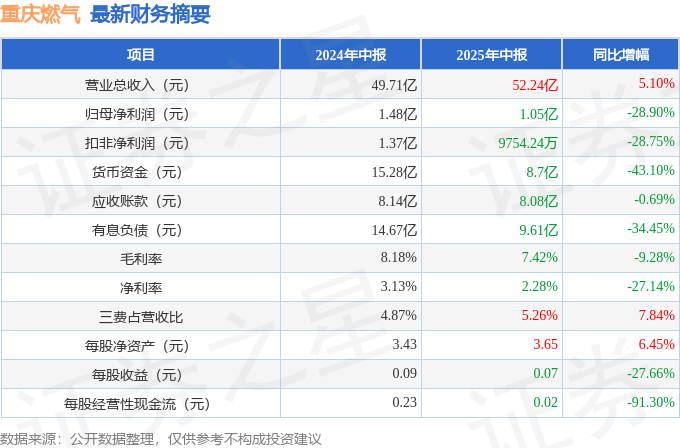
Financial Performance - The company reported a total revenue of 5.224 billion yuan for the first half of 2025, an increase of 5.1% year-on-year, while the net profit attributable to shareholders was 105 million yuan, a decrease of 28.9% [1] - In Q2 2025, the total revenue was 2.473 billion yuan, up 9.04% year-on-year, but the net profit attributable to shareholders fell by 20.13% to 159 million yuan [1] - The gross margin decreased to 7.42%, down 9.28% year-on-year, and the net margin was 2.28%, a decline of 27.14% [1] - The company’s accounts receivable accounted for 211.1% of the latest annual net profit, indicating a significant amount of outstanding payments [1][4] Cash Flow and Financial Ratios - The operating cash flow per share dropped to 0.02 yuan, a decrease of 91.3% year-on-year, reflecting cash flow challenges [1] - The company’s total financial expenses increased by 636.3%, primarily due to a decline in foreign exchange gains from yen loans [3] - The company’s cash flow from operating activities decreased by 91.36%, attributed to adjustments in salary payment timing and settling due payables [3] Business Strategy and Operations - The company focuses on its core business of urban gas supply while actively exploring new sectors such as hydrogen energy and smart gas [7] - The company has initiated 41 integrated energy projects, including distributed energy and photovoltaic projects, enhancing operational synergies [9] - The company is currently in the research and market survey phase for hydrogen energy applications, leveraging local industrial by-products [8] Dividend Policy - The company has disclosed a three-year dividend plan, committing to distribute at least 30% of the distributable profits in cash after reserving for statutory surplus [11] - The company plans to implement mid-term dividends starting from 2024, with future distributions subject to financial conditions [11]

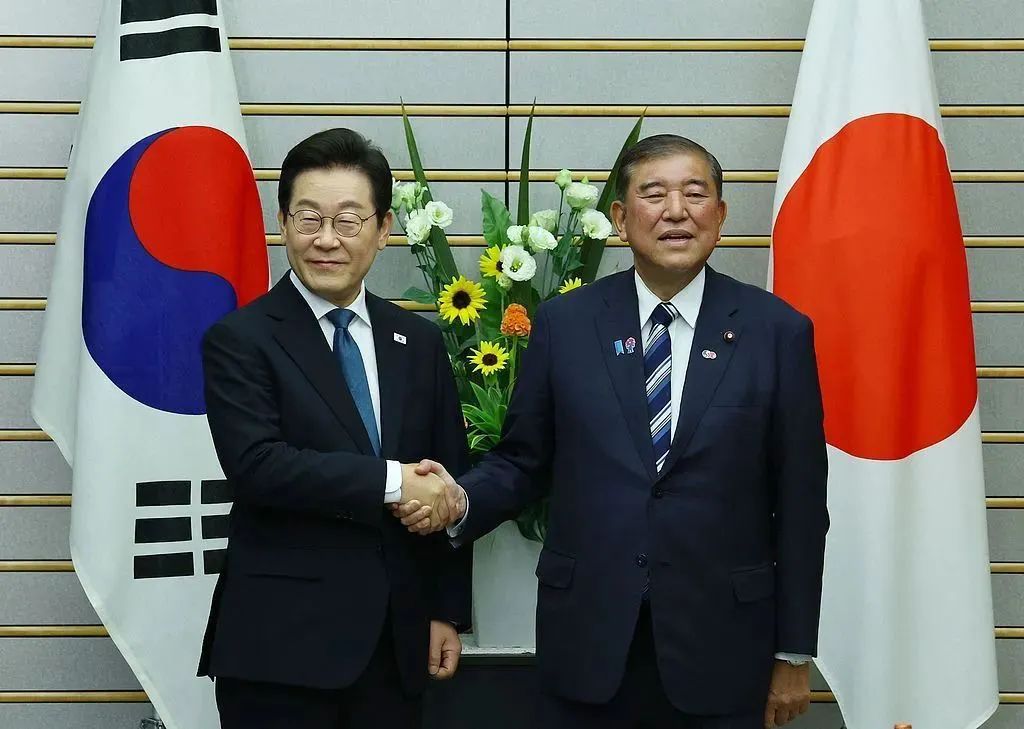
韩日领导人发表联合新闻公报 强调稳步推进双边关系
Yang Shi Xin Wen· 2025-08-23 16:14
Core Points - The meeting between South Korean President Lee Jae-myung and Japanese Prime Minister Kishida Fumio marks the first joint press release after a summit between the two countries in 17 years [1] - This meeting is significant as it is the first time since the normalization of diplomatic relations in 1965 that a South Korean president has chosen Japan as the first country to visit after taking office [1] - Both leaders expressed a commitment to revitalizing bilateral relations and establishing a new diplomatic model through "shuttle diplomacy" [1] Summary by Categories Bilateral Relations - The leaders agreed to stabilize and develop friendly relations based on the 1965 Korea-Japan normalization talks [1] - They emphasized the importance of strategic communication in security matters [1] Areas of Cooperation - The two countries plan to enhance collaboration in hydrogen energy and artificial intelligence [1] - They will establish a discussion framework for common issues such as local revitalization, aging population, and disaster prevention [1] People-to-People Exchange - There is an agreement to expand the working holiday visa system to promote further exchanges between the two nations [1]
韩国总统李在明访问日本
Xin Hua She· 2025-08-23 13:55
Core Viewpoint - The meeting between South Korean President Yoon Suk-yeol and Japanese Prime Minister Kishida Fumio marks a significant step in enhancing bilateral relations, focusing on strategic communication in security and cooperation in various sectors [1] Group 1: Bilateral Relations - Both leaders agreed to steadily advance bilateral relations, emphasizing the importance of security cooperation and strategic communication [1] - The discussions included collaboration in hydrogen energy and artificial intelligence, indicating a focus on technological and energy sectors [1] Group 2: Common Issues - The establishment of a discussion framework between the two governments on common issues such as local revitalization, aging population, and disaster prevention was agreed upon [1] Group 3: Personnel Exchange - The expansion of the working holiday visa system was highlighted as a means to further promote personnel exchanges between the two countries [1] Group 4: Upcoming Engagements - This visit is significant as it is President Yoon's first visit to Japan since taking office in June, and he is scheduled to meet with U.S. President Trump following his visit to Japan [1]