共同富裕

Search documents
加大保障和改善民生力度
Ren Min Ri Bao· 2025-11-17 23:57
习近平总书记指出,中国式现代化,民生为大。党和政府的一切工作,都是为了老百姓过上更加幸福的 生活。党的二十届四中全会通过的《中共中央关于制定国民经济和社会发展第十五个五年规划的建议》 (以下简称《建议》),对保障和改善民生作出一系列新的重大部署。我们要始终把保障和改善民生紧 紧抓在手上,不断实现人民对美好生活的向往。 一、深入学习贯彻习近平总书记关于保障和改善民生的重要论述,坚决把思想和行动统一到党中央决策 部署上来 党的十八大以来,习近平总书记对加大保障和改善民生力度、增强人民群众获得感幸福感安全感作出一 系列重要论述,科学回答了社会民生领域的重大理论和实践问题,为我们指明了前进方向、提供了根本 遵循。 一是坚持和加强党的全面领导。习近平总书记强调中国共产党领导是中国特色社会主义最本质的特征, 是中国特色社会主义制度的最大优势。要把尊重民意、汇集民智、凝聚民力、改善民生贯穿党治国理政 全部工作之中,巩固党执政的阶级基础,厚植党执政的群众基础。二是坚持以人民为中心的发展思想。 强调江山就是人民,人民就是江山。民生工作离老百姓最近,同老百姓生活最密切。人民对美好生活的 向往,就是我们的奋斗目标。我们要坚守人民至 ...
推动卫生健康和人口高质量发展——访国家卫生健康委党组书记、主任雷海潮
Ren Min Ri Bao· 2025-11-17 23:19
记者:在中国式现代化的战略全局中,如何找准卫生健康工作的定位? 雷海潮:在实现"两个一百年"奋斗目标的历史进程中,发展卫生健康事业始终处于基础性地位,发挥着 重要支撑作用。"十五五"时期是夯实基础、全面发力的关键时期。要准确把握当前的历史阶段,结合自 身定位,锚定2035年建成健康中国的战略目标,聚焦高质量发展这一主题,夯实中国特色基本医疗卫生 制度和人口高质量发展基础,不断健全维护公益性的医疗卫生服务,健全覆盖全人群、全生命周期的人 口发展服务体系,健全相关的运行保障、治理机制,巩固拓展优势、破除瓶颈制约、补强短板弱项,确 保各项举措与整体目标保持同向而行、取向一致。 科学认识形势,主动服务大局。"十五五"时期我国发展处于战略机遇和风险挑战并存、不确定难预料因 素增多的时期。我国经济基础稳、优势多、韧性强、潜能大,长期向好的支撑条件和基本趋势没有变。 我们要坚定信心信念,坚定不移办好自己的事,以卫生健康的优质服务、安全保障能力、高效治理水 平,响应人民群众的需求,应对国际环境变化,为中国式现代化提供有力支撑。 牢牢把握共同富裕的本质要求。为人民群众提供公平可及、系统连续、优质高效的医疗卫生服务,是共 同富裕 ...
加大保障和改善民生力度(学习贯彻党的二十届四中全会精神)
Ren Min Ri Bao· 2025-11-17 22:20
Core Points - The core message emphasizes the importance of improving and safeguarding people's livelihoods as a fundamental aspect of China's modernization efforts [1][4]. Group 1: Leadership and Development Philosophy - The leadership of the Communist Party of China is highlighted as a key characteristic of socialism with Chinese characteristics, emphasizing the need to respect public opinion and improve people's livelihoods [3]. - The development philosophy is centered around the people, with the goal of achieving a better life for the populace being the ultimate aim of modernization [3][4]. Group 2: Achievements in Livelihood Improvement - Significant progress has been made in enhancing the quality of life, with the establishment of the world's largest education, social security, healthcare, and urban housing systems [5]. - Employment has remained stable, with over 12 million new urban jobs created annually since the 14th Five-Year Plan, and the urban unemployment rate kept below expected targets [5]. - The per capita disposable income of residents increased from 35,100 yuan in 2021 to 41,300 yuan in 2024, with the urban-rural income ratio narrowing to 2.34:1 [5]. - The education system has seen improvements, with gross enrollment rates for preschool and high school education reaching 92% by 2024 [5]. - The social security system has expanded, with over 1 billion people covered by basic pension insurance and 1.327 billion by basic medical insurance by the end of 2024 [5]. - Housing security has improved, with over 11 million units of various types of affordable housing constructed during the 14th Five-Year Plan [5]. - Health services have improved, with the number of practicing (assistant) physicians and registered nurses per 1,000 people reaching 3.61 and 4.16, respectively, by 2024 [5][6]. Group 3: Key Tasks for Livelihood Improvement - The focus is on promoting high-quality and full employment as a fundamental aspect of people's livelihoods, with strategies to enhance employment support and public service systems [8]. - The income distribution system is to be improved to promote common prosperity, with mechanisms to ensure fair compensation based on contributions [9]. - Education is prioritized, with plans to enhance resource allocation and expand free education [10]. - The social security system is to be refined, ensuring comprehensive coverage and sustainability [11]. - Real estate development is to be guided towards high quality, addressing housing needs through various measures [12]. - Health initiatives are to be accelerated, focusing on equitable access to healthcare services [13]. - Population development strategies are to be implemented, addressing aging and promoting a supportive environment for families [14]. - Public service equalization is to be advanced, ensuring services reach rural and underserved areas [15].
AW3C公链丨以“共同富裕”为核心
Sou Hu Cai Jing· 2025-11-17 12:10
Core Insights - AW3C blockchain aims to address the pain points of centralized e-commerce platforms, focusing on "common prosperity" and creating a decentralized economic ecosystem that benefits users, developers, and partners [1][3] Group 1: Key Objectives - AW3C targets three main issues: resolving the "overpriced" problem for consumers, generating income from consumption, and promoting global economic circulation [3] - The decentralized price comparison mall allows users to quickly access the best global product prices, with each consumption action contributing to the ecosystem [3] Group 2: Incentive Mechanism - AW3C follows the principle of "contribution equals rights," establishing a multi-layered incentive system where AI nodes earn PoI consensus rewards, users sharing consumption data receive dividend points, developers involved in ecosystem construction gain DAO governance rewards, and long-term token holders enjoy deflationary benefits [3] - This design prevents "first-mover monopoly," enabling all participants to share in the growth dividends of the ecosystem [3] Group 3: Roadmap and Deployment - AW3C has a clear four-phase roadmap: deploying AI embedded mainnet by 2025, launching the decentralized price comparison mall from 2026 to 2027, integrating global supply chains from 2027 to 2028, and introducing personal intelligent economic assistants post-2029 [3] - The project has initiated global node deployment, aiming to cover 100 countries within three years and attract over 5,000 developers, with a target of 500,000 daily active wallets [3] Group 4: Transparency and Collaboration - The AW3C Foundation, established in Singapore, operates with complete transparency, releasing on-chain audit reports quarterly [4] - Through strategic partnerships with logistics giants, AI companies, and financial institutions, along with the establishment of three international node centers, AW3C is transitioning from a technical concept to industrial practice, embedding the ideas of "consumption entrepreneurship" and "common prosperity" into the global digital economy [4]


江苏省慈善总会发布20周年“民生成绩单”
Xin Hua Ri Bao· 2025-11-15 23:29
Core Insights - The Jiangsu Provincial Charity Association has raised a total of 2.63 billion yuan in donations, with over 2.32 billion yuan spent on aid, implementing 381 major charity projects that benefited 6.2 million people in need [1][5] Fundraising Sources - The charity efforts are supported by various stakeholders, including government leaders, enterprises, and public organizations, which collectively contribute to the charity ecosystem [3] - Jiangsu was the first province in China to implement a local charity law in 2010, establishing a framework for charity culture, financial support, and transparency [3][4] - The government has also introduced tax incentives for charitable donations, further encouraging public participation [4] Allocation of Aid - The charity projects focus on key areas and vulnerable groups, with significant funds directed towards initiatives like the "Protecting Seedlings Action" for children's serious illness aid and the "Warm Jiangsu" project for families in need [5][6] - Emergency response efforts have been mobilized during natural disasters, showcasing the charity system's ability to act swiftly and effectively [6] Community Engagement - Local initiatives, such as the "Walking for Love" event, have successfully raised funds and engaged large numbers of participants, highlighting the community's commitment to charity [7] - The establishment of a five-tier charity organization network across the province has enhanced the reach and impact of charitable activities [6] Future Development - The 20th National Congress has emphasized the need for high-quality development in the charity sector, prompting discussions on how to enhance and regulate charity efforts in Jiangsu [8] - Experts suggest diversifying fundraising channels and embracing digital transformation to improve donor engagement and participation [8][9] - Continuous innovation in charity project management and transparency is essential for addressing future challenges and enhancing the effectiveness of charitable initiatives [9]
焦点访谈|未来五年如何实现人民生活品质要不断提高?权威解答
Yang Shi Wang· 2025-11-15 13:27
Core Viewpoint - The article emphasizes that the modernization of China is centered around improving the quality of life for its citizens, with a focus on ensuring common prosperity and enhancing social welfare during the 14th and 15th Five-Year Plans [1][20]. Employment - The employment situation in China remains stable, with 60.32 million new urban jobs created by the end of September, exceeding the target of 55 million [3][4]. - The government aims to promote high-quality and sufficient employment, focusing on job creation in digital economy, high-end manufacturing, and modern services [4]. - There is a need for targeted skills training to enhance job readiness and match labor market demands [4]. Social Security - The 14th Five-Year Plan marks a significant period for social security reforms, with over 1.074 billion people covered by basic pension insurance, achieving a coverage rate of over 95% [6]. - The total scale of pension, unemployment, and work injury insurance funds reached 7.08 trillion yuan, with a cumulative surplus of 980 billion yuan [6]. - The government plans to address social security gaps for flexible workers and migrant workers, aiming to improve coverage and benefits [6]. Income Distribution - The article highlights the importance of improving the income distribution system, emphasizing labor remuneration and increasing the share of residents' income in national income distribution [8]. - The government intends to enhance the income of low-income groups and expand the middle-income population while ensuring a fair wage distribution [8]. Education - Education equity is identified as a crucial foundation for social fairness, with a focus on optimizing educational resources in response to demographic changes [10][11]. - The government plans to expand free education and explore extending compulsory education duration [10]. - There is an emphasis on integrating education with national economic and social development, enhancing innovation capabilities [13][15]. Health - The article states that significant progress has been made in health and population development, with an aim to increase the average life expectancy to around 80 years by 2030 [17][20]. - The government plans to enhance public health services, ensuring equitable access to quality healthcare, especially in rural and underserved areas [18][20]. - A comprehensive population service system will be established to support high-quality population development [20].
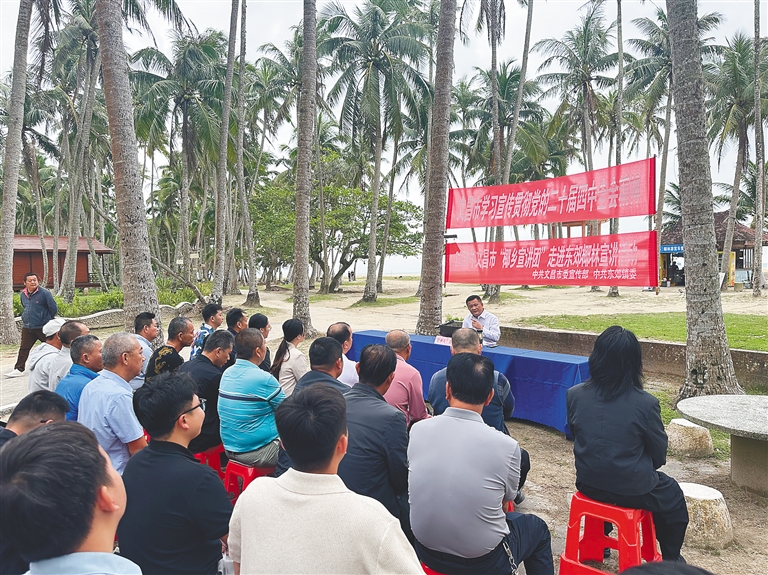
文昌东郊镇建华山村开展党的二十届四中全会精神宣讲活动
Hai Nan Ri Bao· 2025-11-15 01:34
Core Viewpoint - The article discusses a宣讲活动 (propaganda activity) held in Jianhua Mountain Village, Wenchang, focusing on the spirit of the 20th Central Committee's Fourth Plenary Session, emphasizing the opportunities for local development through the "14th Five-Year Plan" [3][4]. Group 1: Development Opportunities - The "14th Five-Year Plan" is presented as a significant opportunity for local development, particularly for Wenchang and Dongjiao Town [3]. - The plan emphasizes the construction of a modern industrial system and the practical blueprint for rural revitalization, aiming for common prosperity [3][4]. Group 2: Local Industry Focus - The宣讲人 (speaker) highlights the need to optimize and upgrade traditional industries, using the local coconut industry as an example, suggesting diversification into tourism and handicrafts [4]. - The speaker also mentions the importance of upgrading traditional manufacturing, such as coconut processing and fishing equipment, to achieve both foundational upgrades and innovative growth [4]. Group 3: Youth Engagement and Green Development - Young members of the rural revitalization team express their commitment to leveraging new media to promote local resources and the aerospace elements of Wenchang [5]. - The concept of "green development" is highlighted as a key principle, with an emphasis on integrating ecological wealth with local industries to enhance the quality of life for villagers [5].
省委常委会召开会议学习习近平总书记重要讲话重要指示精神 部署清理拖欠企业账款生态环境保护和作风建设等工作
Shan Xi Ri Bao· 2025-11-14 22:55
Core Points - The meeting emphasized the importance of aligning thoughts and actions with the decisions of the Central Committee, enhancing consensus, confidence, and motivation among officials and the public [2] - The focus is on developing new productive forces through technological and industrial innovation, upgrading traditional industries, and fostering emerging and future industries to build a modern industrial system with Shaanxi characteristics [2] - There is a commitment to promoting coordinated urban-rural development and improving public service systems to ensure the implementation of various benefit policies, advancing common prosperity [2] - The meeting highlighted the need for high-level internal and external openness, strengthening cooperation with the Guangdong-Hong Kong-Macau Greater Bay Area, and integrating into the high-quality Belt and Road Initiative [2] - A strong emphasis was placed on the comprehensive and strict governance of the Party, ensuring a clean political environment to foster a good development atmosphere [2] - The meeting called for efforts to stabilize employment, businesses, markets, and expectations to achieve the annual economic and social development goals [2] Group 1 - The meeting stressed the need to accelerate the clearance of overdue payments to enterprises, ensuring the quality of repayments and addressing complaints regarding overdue payments [3] - A long-term supervision mechanism will be established to prevent new overdue payments through source governance and penalties for dishonesty [3] - The meeting reiterated the importance of adhering to the concept of "lucid waters and lush mountains are invaluable assets," focusing on rectifying issues raised by the central ecological and environmental protection inspection [3] Group 2 - The meeting discussed the need to consolidate and expand the educational outcomes of the central eight regulations, promoting a correct view of achievements and enforcing frugality [3] - There is a call for party and government agencies to adopt tighter financial practices [3]
持续扩大中等收入群体规模 扎实推进共同富裕
Ren Min Ri Bao· 2025-11-14 02:22
Core Viewpoint - The expansion of the middle-income group is a crucial policy goal for achieving common prosperity in China, as emphasized by President Xi Jinping. The focus is on optimizing income distribution and increasing the size of the middle-income group as part of the 15th Five-Year Plan [1][2][9]. Group 1: Importance of Expanding the Middle-Income Group - Expanding the middle-income group is essential for maintaining social harmony and stability, reflecting a country's economic strength and social conditions [2][3]. - A larger middle-income group contributes to a more stable society, as this demographic typically enjoys stable jobs and decent incomes, leading to a higher sense of security and satisfaction [3][4]. - The transition from a middle-income to a high-income country is facilitated by the expansion of the middle-income group, which can stimulate domestic demand and promote sustained economic growth [4][5]. Group 2: Achievements and Current Status - China has over 400 million people in the middle-income group, supported by continuous economic growth and improvements in income distribution [5][7]. - The country aims to increase the middle-income group to over 800 million within the next 15 years, which presents significant challenges, particularly in rural areas where income levels remain low [8][9]. Group 3: Policy Measures and Strategies - The government is implementing various policies to enhance the income distribution system, ensuring that economic growth benefits all citizens more equitably [12][14]. - Emphasis is placed on improving public services and employment opportunities, particularly for vulnerable groups such as recent graduates and migrant workers [11][13]. - The development of the private economy is crucial for job creation and income growth, with policies aimed at fostering a fair and transparent business environment [14].
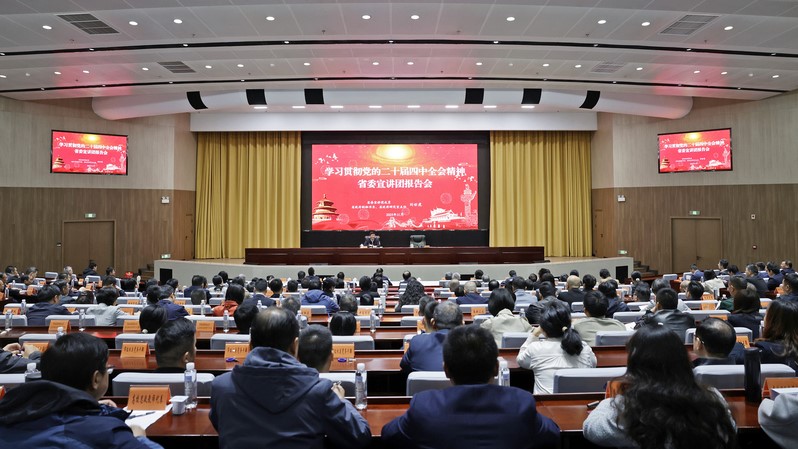
学习贯彻党的二十届四中全会精神 省委宣讲团报告会在苏州举行
Su Zhou Ri Bao· 2025-11-13 22:47
Core Points - The report meeting on the spirit of the 20th Central Committee of the Communist Party was held in Suzhou, emphasizing the importance of understanding and implementing the conference's directives [1][4] - Liu Shihu, a member of the provincial propaganda team, highlighted the significant achievements during the "14th Five-Year Plan" and the complex changes in the development environment for the "15th Five-Year Plan" [4] - The meeting stressed the need for Suzhou to enhance regional competitiveness and work towards common prosperity during the "15th Five-Year Plan" [4][5] Summary by Sections Achievements and Challenges - Liu Shihu discussed the major achievements during the "14th Five-Year Plan" and the challenges faced in the upcoming "15th Five-Year Plan" [4] - The focus will be on developing new productive forces and integrating domestic and international dual circulation [4] Political Responsibilities - Wu Qingwen emphasized the importance of learning and implementing the spirit of the 20th Central Committee as a major political task [4] - There is a call for increased political awareness and responsibility among all levels of government [4] Development Goals and Strategies - The meeting outlined the need to deepen the understanding of the "15th Five-Year Plan" development goals, strategic tasks, and major initiatives [4] - Key areas of focus include project construction, boosting consumption, stabilizing foreign trade, and ensuring people's livelihoods [4] Community Engagement - Post-meeting, Liu Shihu engaged with community representatives to discuss community construction and social services [5] - The "15th Five-Year Plan" emphasizes improving and safeguarding people's livelihoods, with a focus on community services such as elderly care and property management [5]