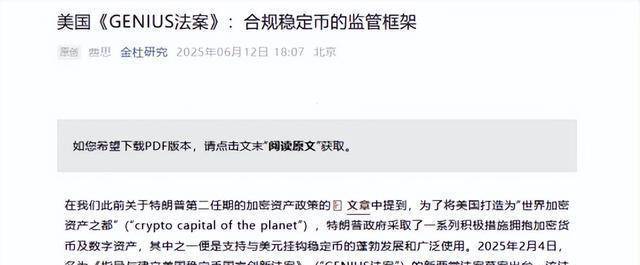
稳定币

Search documents
日韩宣布推出与本国货币挂钩的稳定币
Huan Qiu Wang· 2025-10-29 01:09
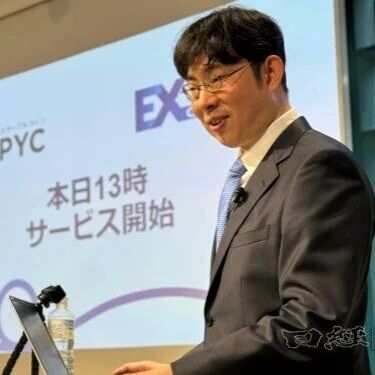
Group 1 - The Bank of Korea has indicated that stablecoins should be issued through traditional banks under national regulation due to various risk factors associated with them [1] - The South Korean government is considering the launch of a stablecoin pegged to the Korean won to modernize the financial system and curb capital outflow [1] - Japanese startup JPYC has officially launched Japan's first stablecoin, "JPYC," which is fully convertible to yen and backed by domestic savings and Japanese government bonds [1] Group 2 - FXC Intelligence has reported that industry leaders expect a faster and more complex future, with stablecoins driving significant changes in global capital flows [1] - Daniel Weber, CEO of FXC Intelligence, stated that 80% of industry participants believe interoperability is crucial, and the winners in this new era will be those companies that master API-driven connections and collaboration to seamlessly integrate traditional, real-time, and stablecoin tracks [3]

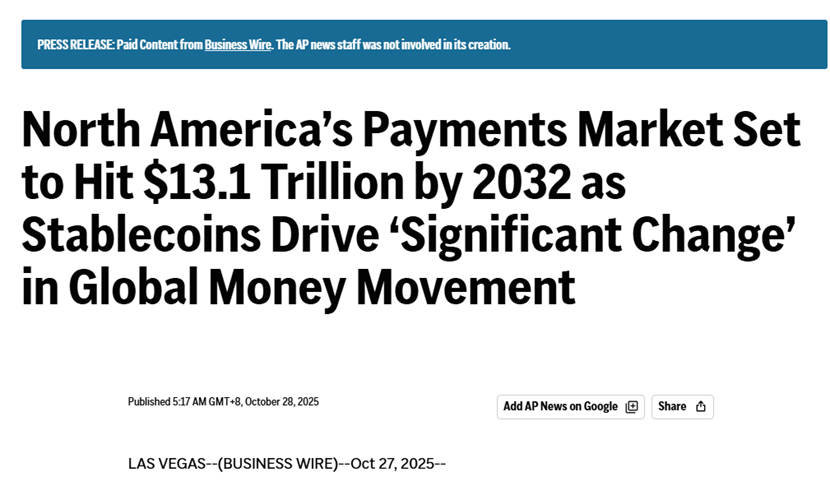
格林大华期货早盘提示-20251029
Ge Lin Qi Huo· 2025-10-28 23:33
Report Industry Investment Rating - There is no information about the report industry investment rating in the provided content. Core Viewpoints - Betting on AI is still correct as the current AI boom's spread speed, low leverage, and valuation levels are fundamentally different from historical bubbles, with a two - thirds probability of a prosperous scenario and long - term strong fundamentals [1][2] - Chinese stocks are expected to have a more sustained upward trend, and the structural migration of Chinese capital to stocks may have begun [2] - The global economy is entering the top region due to the U.S.'s continuous wrong policies [2] Summary by Related Information AI - related - Analysts expect large tech companies' total capital expenditure to grow 24% to nearly $550 billion next year as they are competing to build AI super - computing centers [1] - Qualcomm is entering the AI data center market with new chip products to challenge Nvidia's dominance, offering up to 768GB memory and focusing on energy efficiency and AI reasoning [1] - AI has driven the South Korean Kospi index to soar over 66% this year, with strong demand for chip giants like Samsung and SK Hynix and government reform measures attracting foreign capital [1] - DeepSeek has launched a revolutionary OCR model to solve the computing power problem of AI in processing long documents [2] - The huge demand for energy by AI and the current global power supply have a large gap that may not be filled in our lifetime [2] Company - specific - Amazon plans to cut up to 30,000 employees, about 10% of its white - collar workforce, to cut costs and focus on AI [1] - Samsung Electronics will offer a 30% price cut on 12 - layer HBM3E to gain market share due to slow product yield improvement [1] - German industry is facing an outflow crisis, with over 200 billion euros of annual investment flowing overseas in the past five years and 70% of energy - intensive enterprises transferring production capacity [1] Payment - related - U.S. stablecoin payment volume soared, with the August transaction volume exceeding $10 billion, and corporate transfers accounting for nearly two - thirds. The annual payment scale is expected to reach $122 billion [1][2]
消费者支出强劲助力Visa(V.US)Q4业绩!营收、EPS双双超预期
智通财经网· 2025-10-28 23:16
Core Insights - Visa's Q4 earnings exceeded market expectations, indicating continued consumer reliance on credit card payments [1] - The company reported a nearly 12% year-over-year revenue growth, reaching $10.7 billion, surpassing the expected $10.6 billion [1] - Adjusted net income was $5.8 billion, with adjusted earnings per share at $2.98, slightly above the anticipated $2.97 [1] Financial Performance - Visa's Q4 revenue growth of nearly 12% reflects strong consumer spending on both luxury and essential goods [1] - The company anticipates a strong performance in the upcoming holiday quarter, contingent on active travel and e-commerce spending [1] Strategic Initiatives - Visa's CEO highlighted the integration of AI-driven technologies, real-time fund flows, tokenization, and stablecoins as key areas for innovation and product development [1] - The company has ended its open banking operations in the U.S. due to increased regulatory uncertainty and changes in the competitive landscape [1] Technological Advancements - Visa is currently supporting "agentic" transactions, where AI-driven agents can complete checkout processes on behalf of users [2] - The company has introduced a framework to help merchants verify the identities of these agents to prevent malicious use [2] - The ultimate goal is to enable AI agents to perform shopping tasks without human intervention, with ongoing collaborations with major platforms to achieve this [2]

Visa(V) - 2025 Q4 - Earnings Call Transcript
2025-10-28 22:00
Financial Data and Key Metrics Changes - Fiscal fourth quarter net revenue grew 12% year over year to $10.7 billion, with EPS up 10%, resulting in full-year net revenue and EPS growth of 11% and 14% respectively [4][26] - Total full-year payments volume reached $14 trillion, up 8% year over year in constant dollars, and processed transactions totaled $258 billion, up 10% year over year [4][26] - Full year 2025 net revenue grew 11% to $40 billion, and EPS grew 14% to $11.47 [32] Business Line Data and Key Metrics Changes - Consumer payments revenue was driven by strong payments volume, cross-border volume, and processed transaction growth [30] - Commercial and money movement solutions revenue grew 14% year over year in constant dollars, with commercial payments volume growing 10% [30] - Value-added services revenue grew 25% in constant dollars to $3 billion, driven by issuing solutions and advisory services [31] Market Data and Key Metrics Changes - Total international payments volume was up 10% year over year in constant dollars in Q4, with U.S. payments volume up 8% [26][27] - Cross-border volume, excluding intra-Europe, was up 11%, with e-commerce up 13% and travel improving to 10% [26][28] - In Latin America, there was a slight deceleration in volume growth due to moderating inflation in Argentina, but the region remains high-growth overall [72] Company Strategy and Development Direction - The company is focused on innovation and building the future of payments through the Visa-as-a-Service stack, which includes foundation, services, solutions, and access layers [5][24] - Visa is enhancing its capabilities in agentic commerce, aiming to set standards and lead product development in this emerging area [50][66] - Significant investments are planned for FY26 across consumer payments, commercial solutions, and value-added services, with a focus on AI and product development [37][38] Management's Comments on Operating Environment and Future Outlook - Management expressed confidence in the resilience of consumer spending and the strength of Visa's diversified business model as it enters FY26 [45][46] - The company anticipates continued strong performance in FY26, with adjusted net revenue growth expected in the low double digits [34][40] - Management highlighted the importance of collaboration within the ecosystem to drive the success of agentic commerce and other innovations [66][78] Other Important Information - The company bought back approximately $4.9 billion in stock and distributed $1.1 billion in dividends to shareholders in Q4 [32] - Visa's tokenization efforts have resulted in over 16 billion tokens, which are critical for secure transactions in the agentic commerce ecosystem [8][76] Q&A Session Summary Question: Concerns about macroeconomic stability and consumer spending habits - Management noted strong momentum exiting FY25 and emphasized the diversification of Visa's business, which supports resilience in consumer spending [45][46] Question: Role of Visa in agentic commerce and expected milestones - Visa is taking a leadership role in agentic commerce, establishing standards and capabilities to facilitate transactions through agents [50][66] Question: Differences between Visa's Trusted Agent Protocol and competitors - Visa's Trusted Agent Protocol is designed to be open and easy to integrate, serving as a foundational layer for the agentic commerce ecosystem [78] Question: Holiday sales growth expectations - Management acknowledged expectations of weaker holiday sales growth but emphasized the overall strength of Visa's business model [81]
香港特别行政区政府律政司司长林定国:在香港发行法币稳定币必须向金融管理专员申领牌照
Qi Huo Ri Bao Wang· 2025-10-28 14:14
Group 1 - The 2025 Financial Street Forum Annual Conference focused on advancing financial development through legal frameworks, emphasizing the need for a multi-faceted enforcement mechanism in Hong Kong to address various risks and violations [1] - The Hong Kong government has implemented a licensing system for virtual asset trading platforms (VATP) to protect investors and mitigate risks to the traditional financial system, effective from June 2023 [1] Group 2 - The rise of stablecoins has prompted the introduction of the "Stablecoin Ordinance" in August 2023, requiring anyone issuing fiat-backed stablecoins in Hong Kong to obtain a license from the Financial Management Commissioner [2] - The Stablecoin Ordinance aims to enhance the regulatory framework for digital asset activities in Hong Kong, ensuring monetary and financial stability while reinforcing Hong Kong's status as an international financial center [2] - A joint consultation by the Financial Services and the Treasury Bureau and the Securities and Futures Commission was initiated to empower the SFC to regulate virtual asset service providers and custodians, with plans to revise laws to prevent misleading titles that may confuse investors [2]
CFO Peer Audit: What soft skills are becoming more relevant to the CFO role?
Yahoo Finance· 2025-10-28 09:42
Core Insights - The evolving role of CFOs emphasizes the importance of soft skills alongside technical expertise, particularly in communication and empathy [4][5][10] - Adaptability is crucial for CFOs in navigating changes driven by technology, AI, and geopolitical factors [3][9] - CFOs are increasingly seen as "chief translators of uncertainty," needing to align various stakeholders with differing perspectives and information [9][10] Group 1: Importance of Soft Skills - Empathy and emotional intelligence are highlighted as essential skills for CFOs to foster engaged teams and manage change effectively [5][7] - Communication is critical for CFOs to convey financial narratives and align teams, requiring an understanding of diverse audience backgrounds [10][11] - Collaboration across departments is necessary for achieving organizational goals, emphasizing the need for compromise and understanding [6][7] Group 2: Adaptability and Technology - The rapid advancement of technology, including AI and automation, necessitates that CFOs remain adaptable and continuously learn [3][4] - CFOs must explain the implications of new technologies to employees, ensuring clarity on how these changes affect their roles [4][8] - The demand for CFOs to be adaptable is underscored by the need to respond to external pressures and internal changes [3][9] Group 3: Navigating Uncertainty - CFOs are tasked with translating complex financial data into understandable narratives for various stakeholders [10][12] - The ability to maintain composure and focus during challenging times is essential for effective leadership [14] - Building trust and maintaining open communication are vital for keeping teams aligned and motivated during periods of uncertainty [14]
首个日元稳定币上线,3小时发行1500万日元
日经中文网· 2025-10-28 08:00
Core Viewpoint - The launch of the JPYC stablecoin, pegged to the Japanese yen, marks a significant milestone in Japan's monetary history and is seen as a test for the penetration of yen-based stablecoins in society [4]. Group 1: Launch and Initial Performance - JPYC began issuing its stablecoin on October 27, with an issuance amount reaching 15 million yen within the first three hours [2]. - The global stablecoin market has expanded rapidly, with a total market size of approximately $300 billion, predominantly driven by USD-pegged stablecoins [2][4]. Group 2: Market Context and Trends - The issuance of JPYC is part of a broader global trend where major financial institutions in Europe and the U.S. are developing and issuing stablecoins for various applications, including international remittances and asset management [4]. - Stablecoins are designed to maintain a 1:1 value with fiat currencies, with JPYC effectively equating to 1 yen, despite minor price fluctuations [5]. Group 3: Technological Foundation - JPYC, like other stablecoins, is based on blockchain technology, which allows for low-cost and rapid remittance capabilities [5].
申银万国期货早间策略-20251028
Shen Yin Wan Guo Qi Huo· 2025-10-28 02:46
Report Industry Investment Rating - No information provided Core Views of the Report - After the high - level oscillation in September, the stock index is expected to enter a phase of direction selection again. The domestic liquidity environment is expected to remain loose, and residents may increase their allocation of equity assets. With the Fed's interest rate cuts and RMB appreciation, external funds are also expected to flow into the domestic market. In terms of market style, although technology growth has been the core theme of the current upward market trend, considering the possible intensification of Q4 growth - stabilization policies and the potential resonance of global monetary and fiscal policies, the market style in Q4 may shift towards value and become more balanced compared to Q3 [2] Summary by Relevant Catalogs 1. Stock Index Futures Market - **IF Contracts**: The previous day's closing prices of IF contracts (current month, next month, next quarter, and far - quarter) were 4648.40, 4634.80, 4604.00, and 4567.40 respectively, with increases of 68.60, 68.00, 62.40, and 66.80, and increases of 1.50%, 1.49%, 1.37%, and 1.48% respectively. The trading volumes were 24392.00, 74172.00, 14177.00, and 3440.00, and the open interests were 40441.00, 153415.00, 55843.00, and 5714.00 respectively, with changes of - 2317.00, - 6793.00, - 1216.00, and 1074.00 [1] - **IH Contracts**: The previous day's closing prices of IH contracts were 3067.40, 3066.80, 3069.20, and 3067.40 respectively, with increases of 23.40, 22.40, 23.60, and 24.40, and increases of 0.77%, 0.74%, 0.77%, and 0.80% respectively. The trading volumes were 11960.00, 37476.00, 5043.00, and 1819.00, and the open interests were 15335.00, 65887.00, 14472.00, and 2468.00 respectively, with changes of 218.00, 1268.00, 850.00, and 497.00 [1] - **IC Contracts**: The previous day's closing prices of IC contracts were 7310.40, 7254.40, 7083.00, and 6903.40 respectively, with increases of 125.00, 125.20, 121.20, and 126.40, and increases of 1.74%, 1.76%, 1.74%, and 1.87% respectively. The trading volumes were 27275.00, 87202.00, 16929.00, and 5288.00, and the open interests were 49174.00, 140233.00, 51880.00, and 11298.00 respectively, with changes of 1344.00, 5789.00, 409.00, and 1439.00 [1] - **IM Contracts**: The previous day's closing prices of IM contracts were 7399.40, 7322.60, 7105.20, and 6891.60 respectively, with increases of 55.80, 54.80, 54.80, and 58.60, and increases of 0.76%, 0.75%, 0.78%, and 0.86% respectively. The trading volumes were 45173.00, 137585.00, 23471.00, and 8513.00, and the open interests were 72266.00, 187588.00, 78846.00, and 20144.00 respectively, with changes of 2184.00, 4103.00, 2254.00, and 1214.00 [1] - **Inter - month Spreads**: The current values of IF next month - IF current month, IH next month - IH current month, IC next month - IC current month, and IM next month - IM current month were - 13.60, - 0.60, - 56.00, and - 76.80 respectively, compared with previous values of - 12.80, 0.20, - 52.00, and - 71.20 [1] 2. Stock Index Spot Market - **Major Indexes**: The previous values of the CSI 300, SSE 50, CSI 500, and CSI 1000 indexes were 4716.02, 3045.82, 7258.53, and 7495.38 respectively, with increases of 1.19%, 0.62%, 1.62%, and 1.03% respectively. The trading volumes (in billions of shares) were 6726.70, 1554.40, 3660.62, and 4581.70 respectively [1] - **Industry Indexes**: Among different industries, the raw materials, telecommunications services, and information technology industries had relatively high increases of 2.24%, 3.72%, and 2.63% respectively, while the major consumer industry had a slight decline of - 0.03% [1] 3. Futures - Spot Basis - The previous values of IF current month - CSI 300, IF next month - CSI 300, IF next quarter - CSI 300, and IF far - quarter - CSI 300 were - 12.28, - 25.88, - 56.68, and - 93.28 respectively; those of IH current month - SSE 50, IH next month - SSE 50, IH next quarter - SSE 50, and IH far - quarter - SSE 50 were 2.58, 2.78, 4.18, and 5.98 respectively; those of IC current month - CSI 500, IC next month - CSI 500, IC next quarter - CSI 500, and IC far - quarter - CSI 500 were - 68.99, - 124.99, - 296.39, and - 475.99 respectively; and those of IM current month - CSI 1000, IM next month - CSI 1000, IM next quarter - CSI 1000, and IM far - quarter - CSI 1000 were - 95.98, - 172.78, - 390.18, and - 603.78 respectively [1] 4. Other Domestic and Overseas Indexes - **Domestic Indexes**: The previous values of the Shanghai Composite Index, Shenzhen Component Index, Small and Medium - sized Board Index, and ChiNext Index were 3996.94, 13489.40, 8272.63, and 3234.45 respectively, with increases of 1.18%, 1.51%, 1.63%, and 1.98% respectively [1] - **Overseas Indexes**: The previous values of the Hang Seng Index, Nikkei 225, S&P 500, and DAX Index were 26433.70, 49299.65, 6875.16, and 24308.78 respectively, with increases of 1.05%, 1.35%, 1.23%, and 0.28% respectively [1] 5. Macroeconomic Information - Diplomatic Minister Wang Yi had a phone call with US Secretary of State Rubio, expressing the hope that both sides would work towards each other to prepare for high - level interactions and create conditions for bilateral relations. Spokesperson Guo Jiakun said that China and the US were in close communication regarding the possible meeting of the two heads of state [2] - The 2025 Financial Street Forum Annual Conference opened. Central Bank Governor Pan Gongsheng stated that the central bank would maintain a supportive monetary policy stance, resume open - market treasury bond trading, and take other measures. Financial Regulatory Administration Director Li Yunze said that a financial service model emphasizing both investment in things and people would be constructed. CSRC Chairman Wu Qing said that reforms of the ChiNext would be deepened [2] - Premier Li Qiang attended the 5th RCEP Leaders' Meeting, calling on all parties to collaborate more closely to address challenges and support the accession of applicants such as Hong Kong, China. Vice - Premier He Lifeng emphasized that the financial system should prevent risks, strengthen supervision, and promote high - quality development and opening - up [2] 6. Industry Information - Domestic gasoline and diesel prices were lowered on October 27th. The prices per ton were reduced by 265 yuan and 255 yuan respectively [2] - Relevant authorities were considering a new document to standardize the naming of "semi - solid - state batteries" as "solid - liquid batteries" [2] - Shandong Province issued the first provincial - level special plan for low - altitude information infrastructure, aiming to build a low - altitude communication network infrastructure in ten years [2] - The Bank of Korea stated that stablecoins should be issued by traditional banks under national supervision, and the South Korean government was considering launching a won - linked stablecoin [2]
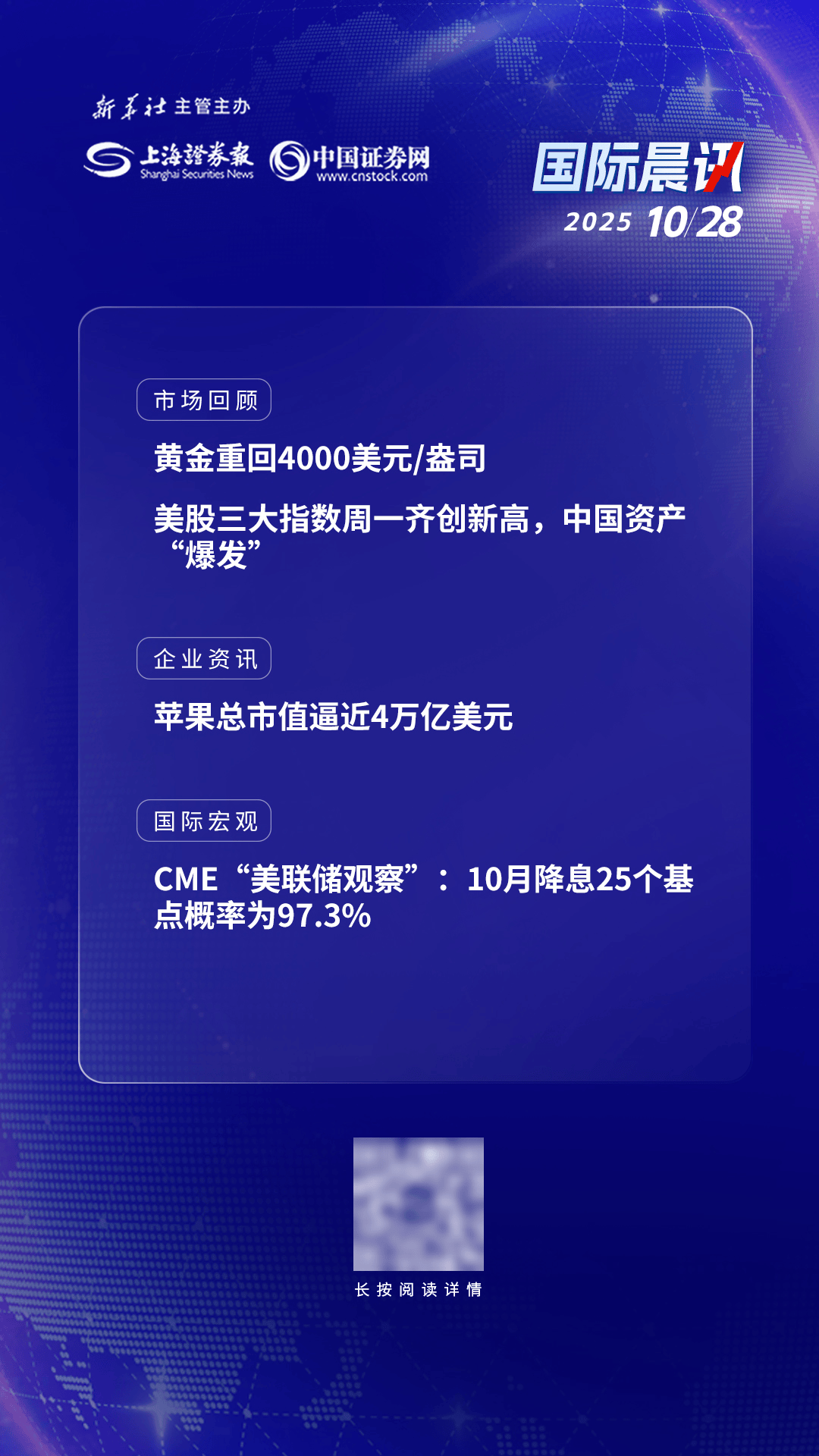
10月28日国际晨讯丨黄金重回4000美元/盎司 苹果市值逼近4万亿美元
Sou Hu Cai Jing· 2025-10-28 01:36
Market Overview - International gold prices have rebounded, with London spot gold returning to the $4000 per ounce mark after a previous drop to $3970 per ounce [5] - The U.S. stock market indices reached new highs, with the Dow Jones up 0.71% to 47,544.59 points, the Nasdaq up 1.86% to 23,637.46 points, and the S&P 500 up 1.23% to 6,875.16 points [6] - Chinese assets experienced a surge, with the Nasdaq China Golden Dragon Index rising by 1.59% [6] Corporate News - Qualcomm's stock rose over 11%, reaching a new high since July 2024, following the announcement of its AI chips, AI200 and AI250, expected to launch in 2026 and 2027, respectively, competing with Nvidia in the data center market [7] - Apple's market capitalization is approaching $4 trillion, with its stock also reaching new highs [7] - Amazon plans to cut up to 30,000 corporate jobs, representing nearly 10% of its corporate workforce, marking the largest layoffs in the company's history [8] - Coinbase has announced a partnership with Citigroup to facilitate easier use of digital assets and stablecoins for Citigroup's clients [8] International Macro - According to CME's "FedWatch," the probability of a 25 basis point rate cut by the Federal Reserve in October is 97.3%, with a 2.7% chance of maintaining the current rate. The probability of a cumulative 50 basis point cut by December is 95.3% [9]

日本三大行发行稳定币,背后暗藏美国策略,中国如何应对变局?
Sou Hu Cai Jing· 2025-10-27 18:00
Core Viewpoint - Three major Japanese banks, Mitsubishi, Mitsui, and Mizuho, have launched a stablecoin, which is a digital currency tied to the value of the yen and the dollar, aimed at facilitating transactions for large corporations, with a significant potential market given their combined client base of over 300,000 companies [1] Group 1: Stablecoin Overview - The most popular stablecoins in the market are fiat-collateralized, such as USDT and USDC, which are backed by actual dollars or short-term U.S. Treasury bonds, providing a high level of security [2] - Other models include crypto-collateralized stablecoins, which require a higher collateral value in cryptocurrencies, and algorithmic stablecoins that rely on programming to maintain value, though the latter has seen failures like UST [2] Group 2: U.S. Financial Strategy - Stablecoins account for over 80% of the cryptocurrency market, acting as a hard currency and facilitating a system where users must buy U.S. debt, effectively creating a cycle that returns money to the U.S. [4] - The U.S. faces a dilemma known as the Triffin Paradox, where to maintain the dollar's status as a global reserve currency, it must circulate widely, necessitating continuous purchases of U.S. debt by foreign holders of dollars [4] Group 3: Impact on U.S. Debt and Global Finance - As confidence in U.S. debt wanes and buyers decrease, stablecoins are seen as a lifeline, with legislation like the GENIUS Act mandating that companies issuing dollar-pegged stablecoins must use user funds to purchase cash or short-term U.S. Treasury bonds [6] - This creates a new cycle where global users' investments in dollar stablecoins ultimately support U.S. debt, despite their primary interest being in the convenience of digital transactions [6] Group 4: China's Position - China is cautious about the rise of dollar stablecoins, recognizing that if they surpass the efficiency of the yuan in cross-border payments, it could hinder the internationalization of the yuan [10] - The challenge for China in creating a globally accepted yuan stablecoin is compounded by capital account restrictions and the nature of its trade surplus, which limits the yuan's global circulation [12] - Hong Kong's recent legislation on stablecoins positions it as a potential bridge for China to engage in the global stablecoin market while navigating the associated risks [12] Group 5: Public Perception and Regulatory Landscape - Public sentiment reflects skepticism towards stablecoins, with some viewing them as a means for the U.S. to leverage foreign investments to support its debt [14] - Regulatory measures are being developed to address the rapid flow of money and associated risks, indicating a growing recognition of the need for oversight in the stablecoin market [16] - Individuals are advised to be cautious and informed, focusing on reliable platforms and understanding the underlying collateral of stablecoins to avoid being misled by high returns [18]