长三角一体化

Search documents
城乡融合、协同创新双提速
Xin Hua Ri Bao· 2025-10-13 22:40
Core Insights - The article highlights the transformation of the Yangtze River Delta region into a hotspot for urban-rural integration and collaborative innovation, driven by the removal of administrative barriers and the enhancement of institutional frameworks [1][2][4]. Group 1: Urban-Rural Integration - The establishment of the "Two Provinces and One Street" police service in the border area between Anhui and Jiangsu has become a model for cross-province integration and efficient governance [2]. - The collaboration between Shanghai and Zhejiang in the "Mingyue Shantang" scenic area has unified architectural styles and shared tourism resources, effectively eliminating provincial boundaries for visitors [2][3]. - The integration efforts have led to significant improvements in development levels in neighboring areas, as seen in the collaboration between Shanghai's Jinshan District and Zhejiang's Pinghu City [3]. Group 2: Innovation and Collaboration - The relocation of Huizhi Kang (Zhejiang) Intelligent Technology Co., Ltd. from Shanghai to Huzhou demonstrates the benefits of breaking down administrative barriers, facilitating the flow of talent and technology [4]. - The establishment of the "Yangtze River Delta Language Computing Innovation Alliance" aims to tackle challenges in voice recognition technology, showcasing successful collaboration among various institutions [4]. - The launch of the first local legislation promoting collaborative technological innovation in the Yangtze River Delta marks a significant step towards institutional innovation and comprehensive collaboration [5]. Group 3: High-Quality Development - The agricultural service company in Jiaxing has cultivated 30,000 acres of farmland in the Yangtze River Delta, leveraging technological advancements to enhance productivity [6]. - The integration of advanced technologies such as 5G in agricultural monitoring is exemplified by the smart monitoring stations in Suzhou, which optimize rice harvesting [6]. - Major innovations, including the world's first 8-inch silicon-based gallium nitride production line and the first domestically produced 200kV field emission transmission electron microscope, highlight the new momentum generated by urban-rural integration and collaborative innovation [6].
城乡融合、协同创新双提速——长三角一体化涌动发展新活力
Xin Hua She· 2025-10-13 13:51
Core Insights - The Yangtze River Delta is transforming into a hotspot for urban-rural integration and collaborative innovation, driven by the removal of administrative barriers and improved systems [1][2][4] Group 1: Urban-Rural Integration - The establishment of the "Two Provinces and One Street" police station has facilitated cross-province governance, exemplified by a resident obtaining a residence permit across provincial lines [2] - The "Mingyue Shantang" scenic area project has unified architectural styles and shared tourism resources, enhancing cross-border tourism experiences [2] - Urban-rural integration is creating development benefits and reducing disparities, as seen in the collaboration between Shanghai's Jinshan District and Zhejiang's Pinghu City [3] Group 2: Innovation and Collaboration - The relocation of Huizhi Kang (Zhejiang) Intelligent Technology Co., Ltd. to the Yangtze River Delta's talent innovation base highlights the benefits of breaking administrative barriers for talent and technology flow [4] - The establishment of the "Yangtze River Delta Language Computing Innovation Alliance" aims to tackle challenges in voice recognition technology, showcasing collaborative innovation among regional entities [4] - The Fudan-Opp Global Smart Lighting Joint Laboratory is advancing research on adaptive lighting environments, demonstrating the integration of academic and industrial resources [5] Group 3: High-Quality Development - The agricultural service company in Jiaxing is leveraging technology to provide comprehensive farming services across the Yangtze River Delta, having cultivated 30,000 acres of farmland [6] - Advanced technologies like 5G are being utilized for real-time monitoring of agricultural conditions, enhancing productivity and product quality [6] - Significant innovations, such as the world's first 8-inch silicon-based gallium nitride production line, are being implemented in the Yangtze River Delta, reflecting the region's growth in urban-rural integration and collaborative innovation [7]
决胜“十四五” 打好收官战丨城乡融合、协同创新双提速——长三角一体化涌动发展新活力
Xin Hua She· 2025-10-13 13:47
Core Viewpoint - The article highlights the rapid development of urban-rural integration and collaborative innovation in the Yangtze River Delta, emphasizing the breaking down of administrative barriers and the enhancement of regional cooperation as key drivers for high-quality development [1][6]. Group 1: Urban-Rural Integration - The Yangtze River Delta is transforming from a "non-governed" neighboring area into a hotspot for urban-rural integration, with significant improvements in governance and regional development levels [2][3]. - The establishment of cross-province governance models, such as the "Two Provinces and One Street" police service, exemplifies effective integration and service delivery across administrative boundaries [2]. - The collaboration between Shanghai and Zhejiang in tourism and commerce has led to a seamless experience for visitors, showcasing the benefits of administrative integration [2]. Group 2: Collaborative Innovation - The removal of administrative barriers has facilitated the flow of talent and technology, as seen in the case of Huizhi Kang (Zhejiang) Intelligent Technology Co., which moved its R&D operations closer to manufacturing bases [4]. - The establishment of the "Yangtze River Delta Language Computing Innovation Alliance" demonstrates successful collaborative efforts in tackling complex technological challenges, resulting in practical applications in the automotive industry [4]. - Legislative measures, such as the recent approval of regulations promoting collaborative technological innovation, signify a commitment to fostering an integrated innovation ecosystem across the region [6]. Group 3: High-Quality Development - Agricultural enterprises in the region are leveraging technology to enhance productivity, with significant areas of farmland being cultivated, showcasing the integration of technology in traditional sectors [7][8]. - The use of advanced monitoring technologies in agriculture, such as 5G, is enhancing crop management and quality, exemplified by the premium pricing of local rice products [8]. - Major innovations, including the production lines for advanced semiconductor and robotics technologies, highlight the new momentum generated by urban-rural integration and collaborative innovation [8].
决胜“十四五” 打好收官战|城乡融合、协同创新双提速——长三角一体化涌动发展新活力
Xin Hua She· 2025-10-13 13:45
Core Viewpoint - The integration of urban and rural areas, along with collaborative innovation, is accelerating in the Yangtze River Delta, driving high-quality development through the removal of administrative barriers and the enhancement of institutional frameworks [1][6]. Group 1: Urban-Rural Integration - The Yangtze River Delta is transforming previously neglected neighboring areas into hotspots for urban-rural integration, exemplified by the establishment of cross-province governance models like the "Two Provinces and One Street" police service [2][3]. - The collaboration between Anhui and Jiangsu provinces has led to significant improvements in development levels through talent exchange and regional coordination mechanisms [2][3]. - The integration has also facilitated seamless travel and commerce across provincial borders, enhancing the overall experience for residents and tourists alike [2][3]. Group 2: Collaborative Innovation - The removal of administrative barriers has enabled companies like Huizhi Kang to relocate and benefit from the flow of talent, technology, and manufacturing resources within the Yangtze River Delta [4][5]. - The establishment of innovation alliances, such as the "Yangtze River Delta Language Computing Innovation Alliance," is fostering technological advancements in voice recognition and other fields, with practical applications in the automotive industry [4][5]. - Legislative measures, such as the recent collaborative laws passed by local governments, aim to promote coordinated technological innovation across the region [6]. Group 3: High-Quality Development - Agricultural enterprises in the region are leveraging technology to provide comprehensive services, with significant land cultivated across the Yangtze River Delta, showcasing the synergy between technological innovation and urban-rural integration [7]. - Advanced monitoring systems for agriculture, utilizing 5G technology, are enhancing productivity and quality, exemplified by the premium pricing of local rice varieties [7]. - Major innovations, including the world's first 8-inch silicon-based gallium nitride production line and advanced robotics, are being realized in the Yangtze River Delta, highlighting the new momentum generated by accelerated urban-rural integration and collaborative innovation [7].
安徽建工(600502):动态点评:高股息优质建筑国企,受益长三角一体化建设
East Money Securities· 2025-10-13 12:20
Investment Rating - The report assigns an "Accumulate" rating for the company, marking its first coverage [7]. Core Insights - The company is positioned to benefit from the high investment intensity in Anhui Province's 14th Five-Year Plan, particularly in highway and municipal construction, with a projected average annual increase in highway operational mileage of 363 kilometers, a 21% increase from the previous plan [6]. - The company has shown resilience with a year-on-year increase of 2.68% in new orders to 75.086 billion yuan in the first half of 2025, despite industry headwinds [6]. - The company is expanding its geographical reach and operational capabilities, establishing 18 branches outside Anhui and focusing on key markets such as Beijing-Tianjin-Hebei, the Yangtze River Delta, and the Greater Bay Area [6]. - The company has a strong dividend profile, with a cash dividend of 463 million yuan in 2024, a payout ratio of 34.46%, and a dividend yield of 5.9% as of September 30 [6]. Financial Projections - The projected net profit attributable to the parent company for 2025-2027 is 1.338 billion, 1.439 billion, and 1.538 billion yuan, respectively, with corresponding P/E ratios of 5.99, 5.57, and 5.21 [7]. - Revenue forecasts for 2024-2027 are 96.502 billion, 92.332 billion, 94.614 billion, and 96.997 billion yuan, with growth rates of 5.76%, -4.32%, 2.47%, and 2.52% [8].

宁淮城际铁路跨淮河入江水道段连续梁全部合龙
Xin Hua She· 2025-10-13 07:14
Core Points - The successful completion of the continuous beams for the Hongze to Jinhu double-line bridge marks a significant breakthrough in the construction of the Ninghuai Intercity Railway, which is crucial for the project's timely operation [1] - The Ninghuai Intercity Railway spans approximately 179 kilometers with a design speed of 350 kilometers per hour, connecting key cities in Jiangsu and Anhui provinces [1] - The bridge, measuring about 31.7 kilometers in length, is a critical control project for the railway, featuring the largest water area crossing and the longest span of continuous beam bridges along the route [1] - Once completed, the railway will enhance connectivity within the Yangtze River Delta intercity rail transit network, enabling a one-hour direct travel time between Huai'an and Nanjing, thus promoting regional integration and high-quality development [1]
新澳股份跌2.06%,成交额2.89亿元,主力资金净流入380.38万元
Xin Lang Cai Jing· 2025-10-13 05:30
Core Viewpoint - New Ao Co., Ltd. has experienced a significant increase in stock price this year, with a notable rise in recent trading days, indicating strong market interest and potential growth in the textile industry [2]. Group 1: Stock Performance - As of October 13, New Ao's stock price decreased by 2.06% to 7.60 CNY per share, with a trading volume of 289 million CNY and a turnover rate of 5.15%, resulting in a total market capitalization of 5.55 billion CNY [1]. - Year-to-date, New Ao's stock price has increased by 13.26%, with a 20.44% rise over the last five trading days, 23.78% over the last 20 days, and 30.14% over the last 60 days [2]. - The company has appeared on the "Dragon and Tiger List" once this year, with the most recent appearance on October 10, where it recorded a net buy of -50.87 million CNY, with total buy transactions of 112 million CNY, accounting for 27.48% of total trading volume [2]. Group 2: Company Overview - New Ao Co., Ltd. was established on September 8, 1995, and was listed on December 31, 2014. The company specializes in the research, production, and sales of wool yarn, wool tops, and cashmere yarn [2]. - The main revenue composition includes: fine wool yarn (56.11%), cashmere (30.77%), wool tops (11.87%), modified processing, dyeing, and cashmere processing (0.78%), and others (0.48%) [2]. - The company is classified under the Shenwan industry as textile and apparel - textile manufacturing - other textiles, and is associated with concepts such as Yangtze River Delta integration, small-cap stocks, and antibacterial fabrics [2]. Group 3: Financial Performance - For the first half of 2025, New Ao achieved a revenue of 2.554 billion CNY, a slight decrease of 0.08% year-on-year, while the net profit attributable to shareholders was 271 million CNY, reflecting a year-on-year increase of 1.67% [2]. - Since its A-share listing, New Ao has distributed a total of 1.372 billion CNY in dividends, with 643 million CNY distributed over the past three years [3]. - As of June 30, 2025, the number of shareholders increased by 2.22% to 14,700, with an average of 48,921 circulating shares per person, a decrease of 2.17% [2].

上海银行涨2.07%,成交额8.06亿元,主力资金净流入2186.02万元
Xin Lang Zheng Quan· 2025-10-13 03:12
Core Viewpoint - Shanghai Bank's stock price has shown a mixed performance in recent trading sessions, with a year-to-date increase of 5.04% and a notable decline of 14.02% over the past 60 days [1] Group 1: Stock Performance - On October 13, Shanghai Bank's stock rose by 2.07%, reaching a price of 9.38 CNY per share, with a trading volume of 8.06 billion CNY and a turnover rate of 0.61% [1] - The net inflow of main funds was 21.86 million CNY, with large orders accounting for 26.43% of purchases and 27.02% of sales [1] - Over the last five trading days, the stock increased by 3.76%, while it experienced a slight decline of 0.21% over the past 20 days [1] Group 2: Financial Performance - For the first half of 2025, Shanghai Bank reported a net profit attributable to shareholders of 13.23 billion CNY, reflecting a year-on-year growth of 2.02% [1] - The bank has distributed a total of 52.45 billion CNY in dividends since its A-share listing, with 23.58 billion CNY distributed over the past three years [2] Group 3: Shareholder Information - As of June 30, 2025, the number of shareholders of Shanghai Bank reached 98,000, an increase of 8.35% from the previous period [1] - The average number of circulating shares per shareholder was 144,983, which decreased by 7.69% compared to the previous period [1] - Hong Kong Central Clearing Limited is the sixth-largest circulating shareholder, holding 650 million shares, an increase of 3.73 million shares from the previous period [2]

江苏长三角一体化示范区投资基金登记成立
Sou Hu Cai Jing· 2025-10-13 02:14
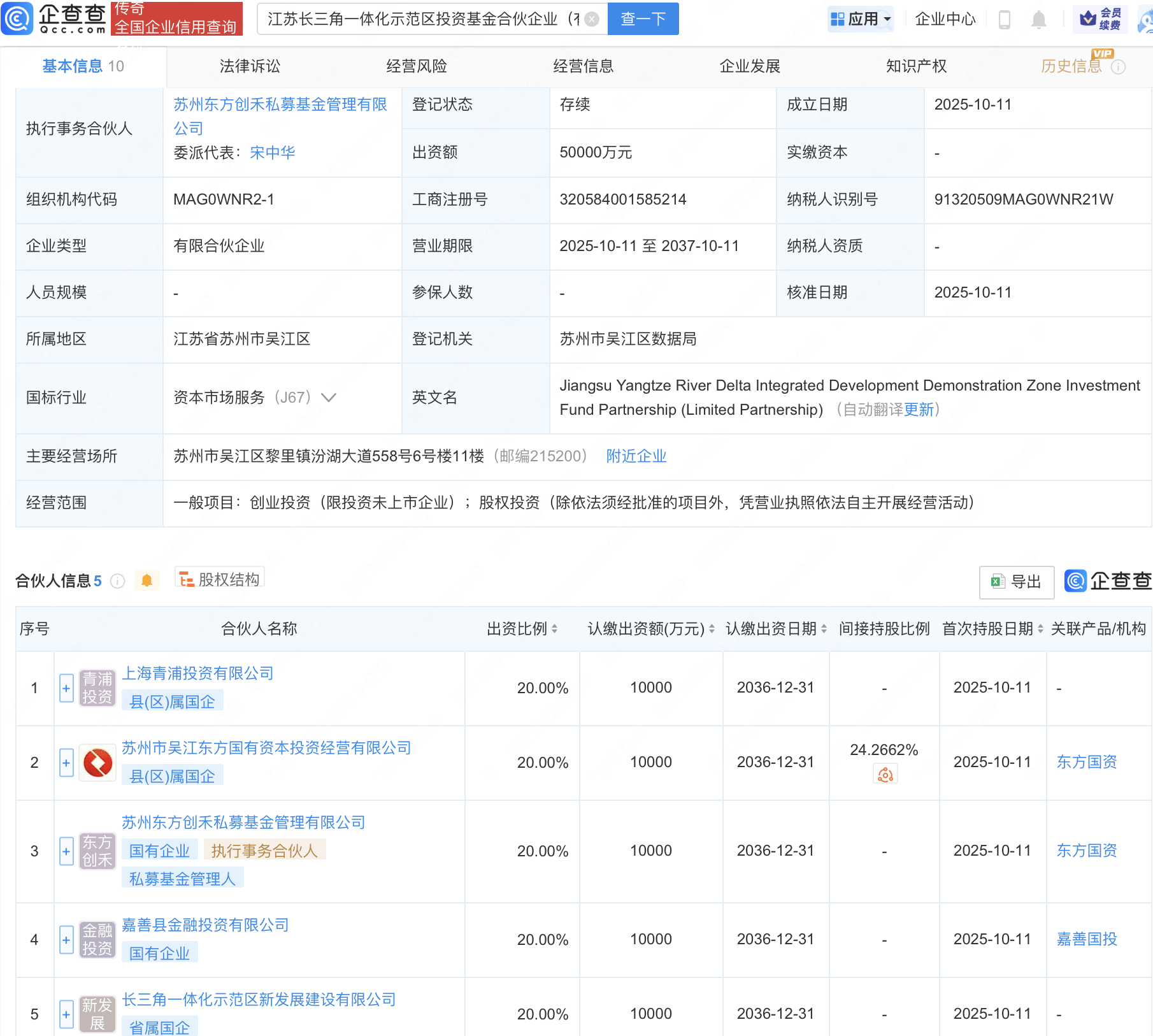
Core Insights - Jiangsu Yangtze River Integration Demonstration Zone Investment Fund Partnership has been established with a total investment of 500 million yuan, focusing on venture capital and equity investment in unlisted companies [1][2]. Group 1: Company Overview - The investment fund is a limited partnership type enterprise registered in Suzhou, Jiangsu Province, with a business scope that includes venture capital limited to unlisted companies and equity investment [2]. - The fund's operational partner is Suzhou Dongfang Chuanghe Private Fund Management Co., Ltd., and it is currently in a state of existence [2]. Group 2: Investment Structure - The total capital contribution of 500 million yuan is divided among several partners, each contributing 100 million yuan, which represents 20% of the total investment [2]. - The partners include Shanghai Qingpu Investment Co., Ltd., Suzhou Wujiang Oriental State-owned Capital Investment Management Co., Ltd., Suzhou Dongfang Chuanghe Private Fund Management Co., Ltd., and Jiashan County Financial Investment Co., Ltd. [2].

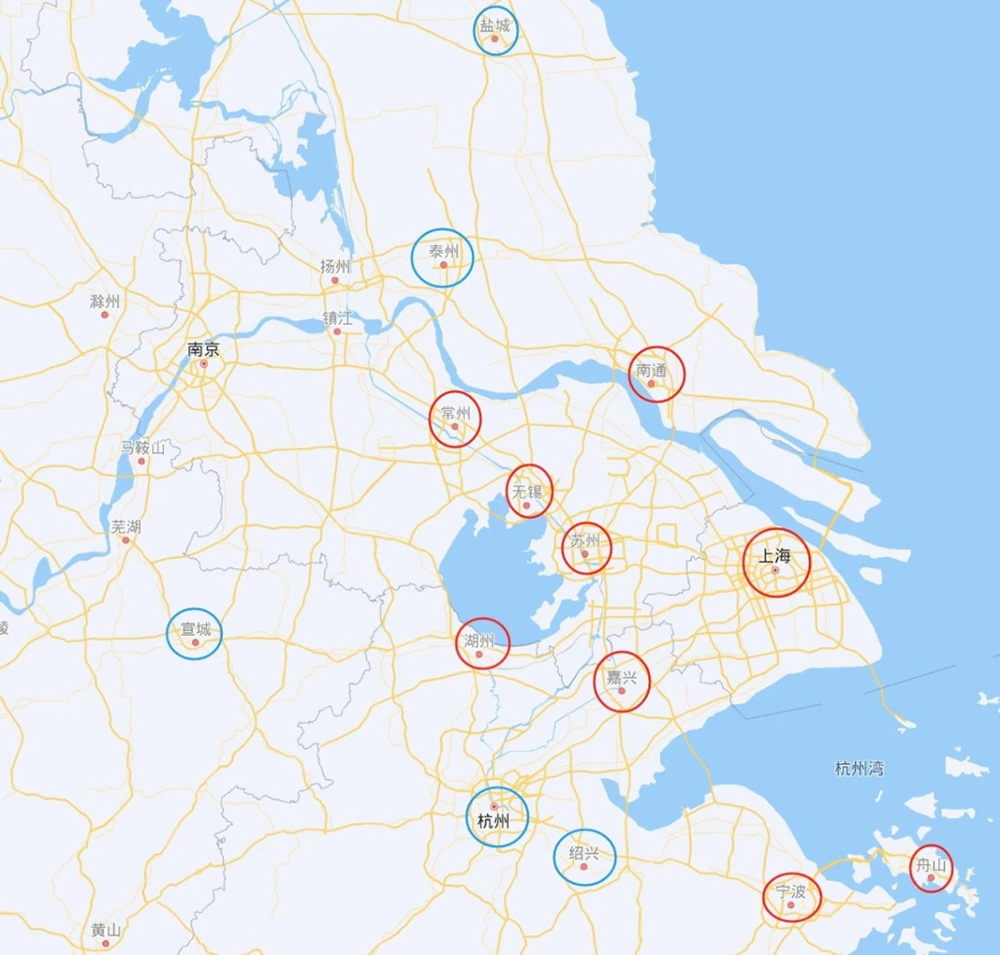
六大都市圈“建群”,长三角一体化如何形神兼备
Yang Shi Wang· 2025-10-11 06:49
Core Insights - The Long Triangle region's integration process has entered a new phase, shifting from hard connectivity of infrastructure to soft alignment of institutional rules, and from urban aggregation to urban circle integration [1][4][9] Group 1: Action Plan and Objectives - The newly issued action plan includes 30 specific tasks aimed at enhancing the integrated development level of the Yangtze River Delta urban agglomeration, focusing on "three focuses" and achieving "seven ones" [1][4] - The "seven ones" include building a cross-regional coordinated development "one group," creating an interconnected infrastructure "one network," fostering technological and industrial innovation "one chain," optimizing the market environment "one-stop service," promoting high-level open cooperation "one chess game," sharing ecological environment protection "one ruler," and facilitating convenient public services "one card" [4][5] Group 2: Economic Impact and Growth - The GDP of the Yangtze River Delta is projected to increase from 23.9% of the national total in 2018 to 24.6% in 2024, contributing approximately 26% of China's economic growth over six years [2] - The number of cities with a GDP exceeding one trillion has risen from six in 2018 to nine, accounting for one-third of the national total [2] Group 3: Infrastructure and Connectivity - Significant achievements have been made in infrastructure connectivity, with 16 "broken roads" completed since the signing of the cooperation framework agreement in 2018, and an expected investment of over 130 billion yuan in rail construction this year [2][4] - The establishment of a unified management company for intercity and regional railways marks a step towards enhanced operational efficiency [2] Group 4: Challenges and Barriers - Existing administrative barriers and institutional differences continue to hinder integrated development, affecting the free flow of resources and optimal allocation [2][6] - The action plan emphasizes the need for unified standards and mutual recognition in key areas such as food safety, environmental protection, and quality inspection to facilitate true urban integration [6][9] Group 5: International Comparisons and Future Outlook - The experience of international urban agglomerations like the Tokyo Metropolitan Area and the Rhine-Ruhr region provides valuable lessons, but the Yangtze River Delta's unique challenge lies in achieving deep integration without altering existing administrative divisions [7][10] - The action plan represents a pragmatic approach to reform, aiming to establish a model for urban integration that can be replicated across the region and contribute to the creation of world-class urban clusters [9][10]