AI医疗

Search documents
计算机ETF(512720)涨超2.5%,技术突破与政策支持提振行业预期
Mei Ri Jing Ji Xin Wen· 2026-01-09 08:18
Group 1 - The Computer ETF (512720) rose over 2.5% due to technological breakthroughs and policy support boosting industry expectations [1] - The computer and software development industry benefits from rapid advancements in new technologies such as AI healthcare and brain-computer interfaces, with increasing innovation and international capabilities [1] - Domestic companies are achieving breakthroughs in technology research and product innovation, with some fields, like brain-computer interface technology, entering clinical trial stages and AI healthcare applications becoming widespread [1] Group 2 - The "14th Five-Year Plan" supports future industries like brain-computer interfaces, which is expected to accelerate technology implementation and commercialization [1] - The long-term growth logic of the industry is expanding from domestic substitution to internationalization, with companies experiencing high growth in overseas orders likely to see their valuations reshaped [1] - The CXO sector is witnessing continuous growth in overseas orders, while domestic demand is gradually recovering, indicating a broad growth space for the industry [1] Group 3 - The Computer ETF (512720) tracks the CS Computer Index (930651), which selects listed companies involved in software development and information technology services to reflect the overall performance of the computer industry [1] - The CS Computer Index focuses on the computer industry, encompassing high-quality enterprises with strong growth and innovation characteristics, effectively representing the overall development trend of China's computer industry [1]
商业航天,盘中突发!
中国基金报· 2026-01-09 07:56
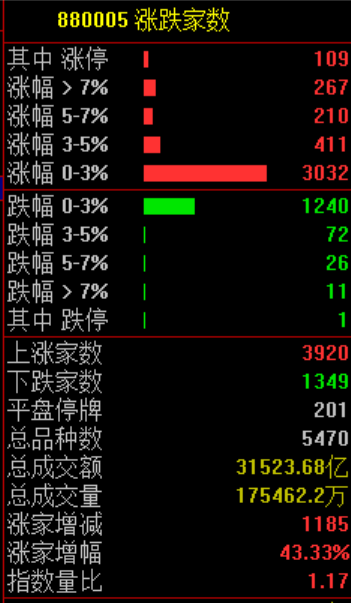
Market Performance - The A-share market showed strong performance with the Shanghai Composite Index stabilizing above 4100 points, closing up 0.92% on January 9, 2023 [2] - Total trading volume exceeded 3 trillion yuan, with 3920 stocks rising and 109 hitting the daily limit [2][3] AI and Healthcare Sector - AI application concept stocks surged, with companies like Yingtai Media and Shengguang Group hitting the daily limit [3] - The healthcare sector also saw significant gains, with stocks like Meinian Health and Guoxin Health reaching the daily limit following the announcement of ChatGPT Health by OpenAI [5][6] Commercial Aerospace Sector - The commercial aerospace sector continued its strong momentum despite a temporary market disturbance caused by rumors of a suspension of satellite ETF subscriptions [6][7] - Major stocks in this sector, such as China Satellite Communications, achieved significant gains, with some stocks hitting the daily limit [7] MiniMax IPO - MiniMax, a large model company, went public on the Hong Kong Stock Exchange, with its stock price soaring over 80% at one point, reaching approximately 300 HKD and a market capitalization exceeding 90 billion HKD [4] Market Sentiment - Despite the "small essay" rumor causing initial market fluctuations, the commercial aerospace sector quickly rebounded, indicating strong investor confidence [7] - Market participants humorously noted that the concept of "jumping water" does not apply to aerospace, reflecting a positive outlook on the sector's future [7]


商业航天,盘中突发!
Zhong Guo Ji Jin Bao· 2026-01-09 07:56
Market Performance - The A-share market showed strong performance with the Shanghai Composite Index stabilizing above 4100 points, closing up 0.92% [1] - The total trading volume exceeded 3 trillion yuan, with 3920 stocks rising and 1349 stocks declining [1][2] Stock Movements - AI application concept stocks surged, with companies like InGravity Media (引力传媒) achieving a 5-day streak of gains and several stocks hitting the daily limit [3] - AI healthcare concept stocks also saw significant increases, with companies like Meinian Health (美年健康) and Guoxin Health (国新健康) reaching their daily limit [6][7] Commercial Aerospace Sector - The commercial aerospace sector continued its strong performance despite a market disturbance caused by a rumor regarding the suspension of satellite ETF subscriptions, which was later refuted by multiple fund companies [8][9] - China Satellite Communications (中国卫通) achieved a new high with a 9-day streak of gains, and nearly 20 stocks in the sector hit their daily limit [9] Other Notable Stocks - The top gainers included Tianlong Group (天龙集团) with a 20.02% increase, and Yidian Tianxia (易点天下) also rising by 20% [5] - The controlled nuclear fusion concept stocks maintained their momentum, with companies like Hongxun Technology (弘讯科技) and China First Heavy Industries (中国一重) achieving consecutive gains [14][15]
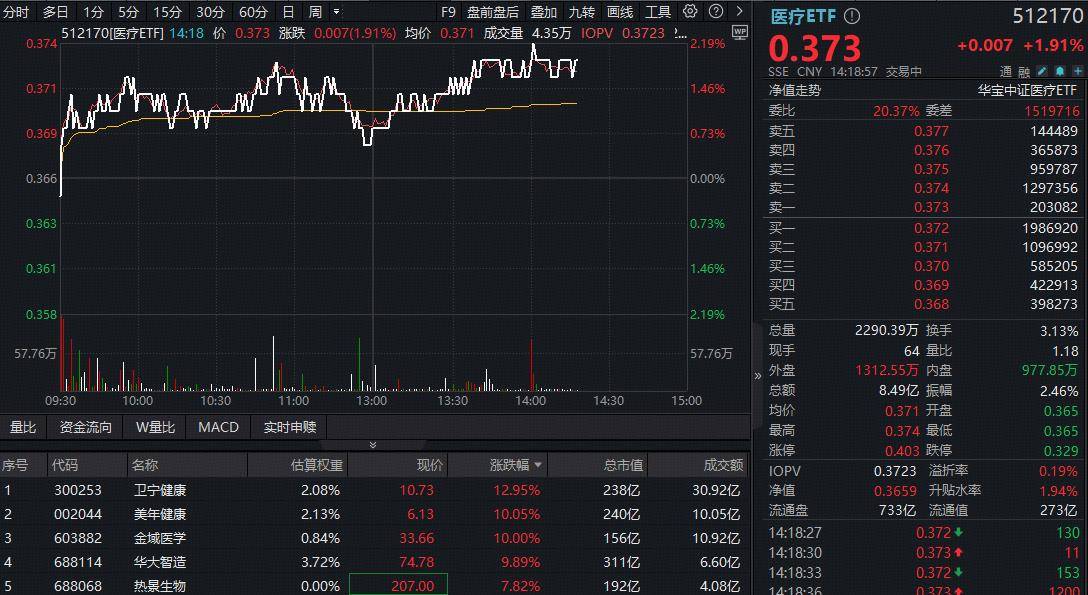
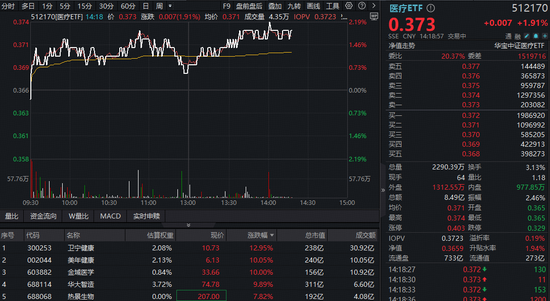
ETF盘中资讯|OpenAI押注万亿AI医疗市场!规模最大医疗ETF(512170)冲涨2%!卫宁健康飙升13%,美年健康、金域医学涨停
Sou Hu Cai Jing· 2026-01-09 06:59
Core Insights - The AI healthcare sector is experiencing significant growth, with major healthcare ETFs, such as 512170, seeing a rise of over 2% in the first week of the year, indicating strong market interest [1] - OpenAI has launched ChatGPTHealth, a dedicated space for health-related conversations that integrates with electronic medical records and health applications, highlighting the increasing integration of AI in healthcare [2] - The global AI healthcare market is projected to grow from approximately $26.65 billion in 2024 to about $505.59 billion by 2033, with a compound annual growth rate (CAGR) of 38.8% [2] Market Performance - The largest healthcare ETF, 512170, recorded a trading volume exceeding 800 million yuan, reflecting robust investor engagement [1] - AI healthcare stocks led the market, with notable gains including a 13% increase in Weining Health and limit-up performances from Meinian Health and Kingmed Diagnostics [1] Investment Opportunities - Investors are encouraged to consider the healthcare ETF (512170) and its associated fund (012323), which includes 12 AI healthcare and brain-computer interface stocks, collectively accounting for over 36% of the index [2] - The current price-to-earnings ratio of the CSI Healthcare Index stands at 34.74, which is below the 39.22% percentile of the past decade, suggesting potential value for investors [2]


脑机接口+AI诊断火热!全市场规模最大的医疗器械ETF(159883)盘中获资金大幅申购超2.6亿
Sou Hu Cai Jing· 2026-01-09 06:53
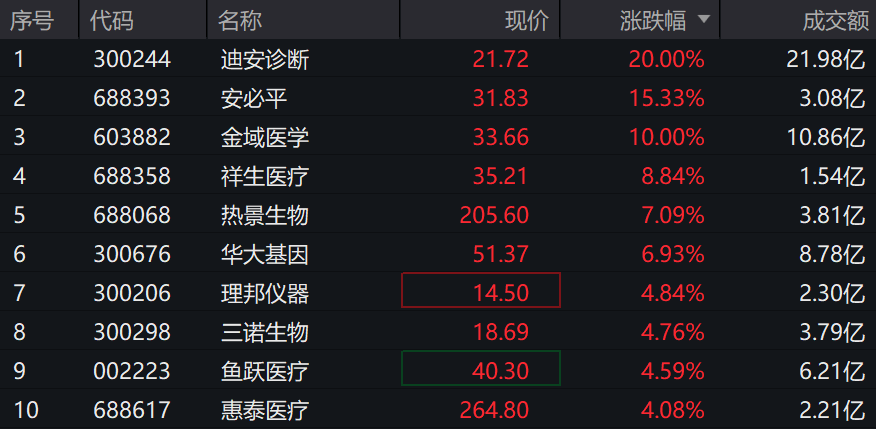
Core Viewpoint - The medical device sector is experiencing significant growth, with key stocks showing strong performance and substantial capital inflow into related ETFs, indicating a bullish market sentiment in this industry [1][4]. Group 1: Market Performance - The CSI All-Medical Device Index (H30217) rose by 1.59%, with notable stocks such as Di'an Diagnostics (300244) hitting a 20% limit up, and Kingmed Diagnostics (603882) reaching a 10% limit up [1]. - The largest medical device ETF (159883) saw a 1.53% increase, with over 260 million yuan in capital inflow during the afternoon session [1]. - Over the past four days, the medical device ETF has experienced continuous net inflows, totaling 1.232 billion yuan, with an average daily net inflow of 308 million yuan [1]. Group 2: Key Stock Movements - Di'an Diagnostics (300244) closed at 21.72 yuan, with a 20% increase and a transaction volume of 2.198 billion yuan [2]. - Anbiping (688393) rose by 15.33% to 31.83 yuan, with a transaction volume of 308 million yuan [2]. - Kingmed Diagnostics (603882) increased by 10% to 33.66 yuan, with a transaction volume of 1.086 billion yuan [2]. Group 3: Technological and Policy Developments - Shenzhen Hanyu Pharmaceutical and Huawei Cloud launched a "Peptide AI Process Optimization Assistant," reducing R&D cycles by 45% and improving decision-making efficiency by 90% [3]. - Guangzhou's new plan emphasizes biomedicine and health as a key emerging industry, aiming to build high-level innovation platforms around cell and gene technology [3]. - The Beijing action plan for 2026-2027 aims for widespread application of AI products in healthcare institutions by 2027 [3]. Group 4: ETF Characteristics - The medical device ETF (159883) has the highest brain-computer interface content in the market, accounting for over 23%, and is the largest ETF focused on the medical device sector [4]. - The ETF includes a strong representation of innovative domestic companies, with over 80% of its components from the Sci-Tech Innovation Board and the Growth Enterprise Market [4]. - The Hong Kong medical ETF (159366) tracks the CSI Hong Kong Stock Connect Medical Theme Index, providing exposure to high-quality assets in the medical sector [4].


OpenAI押注万亿AI医疗市场!规模最大医疗ETF(512170)冲涨2%!卫宁健康飙升13%,美年健康、金域医学涨停
Xin Lang Ji Jin· 2026-01-09 06:30
Group 1 - The AI healthcare sector is experiencing significant growth, with the largest healthcare ETF (512170) rising over 2% in the first week of the year, indicating strong market interest [1][3] - AI healthcare stocks are leading the gains, with notable increases such as Weining Health soaring by 13%, and other companies like Meinian Health and Kingmed Diagnostics hitting the daily limit [1][3] - The global AI healthcare market is projected to grow from approximately $26.65 billion in 2024 to about $505.59 billion by 2033, reflecting a compound annual growth rate (CAGR) of 38.8% [3] Group 2 - The investment opportunity in AI healthcare can be captured through the healthcare ETF (512170) and its associated fund (012323), which includes 12 AI healthcare and brain-computer interface stocks with a combined weight of over 36% [3] - The current price-to-earnings ratio of the CSI Healthcare Index is 34.74, which is below the 39.22% percentile of the past 10 years, suggesting a favorable investment valuation [3]
医渡科技12月通讯:加入上合经贸平台,拓展国际市场再进一步
Sou Hu Cai Jing· 2026-01-09 05:53
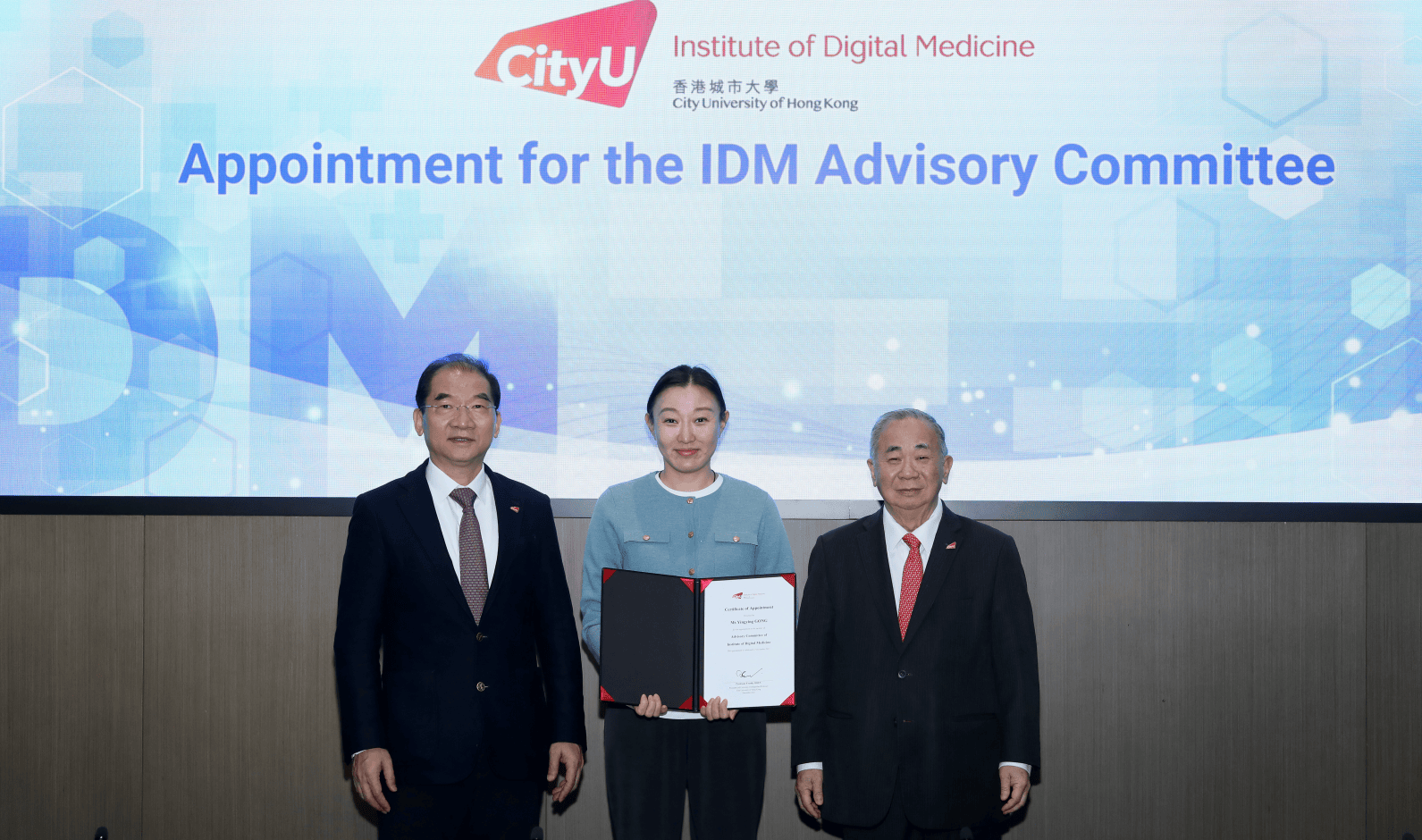
Core Insights - The core focus of the news is on the advancements and recognition of Yidu Technology in the AI healthcare sector, highlighting its participation in international collaborations and contributions to sustainable health development. Group 1: International Collaboration and Recognition - Yidu Technology has joined the Shanghai Cooperation Organization's Economic Platform Health Sustainable Development Working Committee, marking a significant step in international health cooperation [1][6] - CEO Xu Jiming has been elected as the first director of the committee, reflecting the company's technical strength and contributions to the industry [6] - Yidu Technology was appointed as a vice-chair unit of the China Internet Association's Smart Healthcare Working Committee, aiming to promote the development of smart healthcare [9] Group 2: Academic and Research Initiatives - Founder and Chairman Gong Rujing has been appointed as a member of the Advisory Committee of the Hong Kong City University Digital Medicine Research Institute, recognizing her efforts in integrating AI and big data in healthcare [2] - Yidu Technology has established a practice base with Tsinghua University's School of Public Health, resulting in 11 research outputs and advancements in key technologies [17] Group 3: Innovation and Industry Development - At the 2025 China Social Medical New Ecology Conference, CEO Xu Jiming emphasized the need for non-public healthcare to transition from resource competition to value and experience competition, proposing three key areas for enhancing core competitiveness [15] - Yidu Technology shared its experiences in AI-driven clinical trials at the AI + Drug Development Salon, focusing on improving clinical trial efficiency and data quality [16] - The company participated in the China and International Development Forum, discussing innovative digital health cooperation models [11]
盘中必读|OpenAI入局健康赛道,AI医疗概念应声走高,美年健康等涨停
Xin Lang Cai Jing· 2026-01-09 05:23
Core Viewpoint - The AI healthcare sector is experiencing significant activity, with companies like Meinian Health and Guoxin Health reaching their daily price limits following the announcement of OpenAI's ChatGPT Health, indicating a strong market interest in AI-driven healthcare solutions [1][3]. Group 1: Market Performance - On January 9, the Shanghai Composite Index broke the 4100-point mark for the first time in 10 years, with a trading volume of 2.06 trillion yuan, an increase of 296.3 billion yuan compared to the previous trading day [1]. - Meinian Health (002044) reached a limit-up price of 6.13 yuan per share, with a price-to-earnings ratio of 347.01 and a total market capitalization of 23.99 billion yuan [1]. Group 2: Company Overview - Meinian Health is a leading health examination and medical service group in China, focusing on health examination services with brands like "Meinian Health," "Ciming Health Examination," "Ciming Aoya," and "Meizhao Health," establishing a multi-tiered service system [1]. - As of Q3 2025, Meinian Health operates 561 health examination centers across over 300 cities in China, including 300 wholly-owned branches, creating a nationwide service network [1]. Group 3: AI Strategy - Meinian Health's AI strategy encompasses three main areas: product innovation, process optimization, and ecosystem development [3]. - The company has launched several AI medical products, including "Lung Jie Ning," "Nerve Rui Jia," and "AI-MDT Report," covering early screening, diagnosis, and health management [3]. - The "Nerve Rui Jia" product utilizes high-precision brain MRI and deep learning technology to identify early brain lesions, becoming a flagship product for the company [3]. - The "Health Xiao Mei" AI smart health management system has been implemented in 217 health examination centers, generating over 3 million health examination reports and reducing report review time from an average of 2 minutes to 0.7 minutes, improving process efficiency by over 50% [3].

【大涨解读】AI医疗:OpenAI新品发力AI医疗,国内蚂蚁阿福月活也破千万,大模型商业化新途径加速落地
Xuan Gu Bao· 2026-01-09 03:10
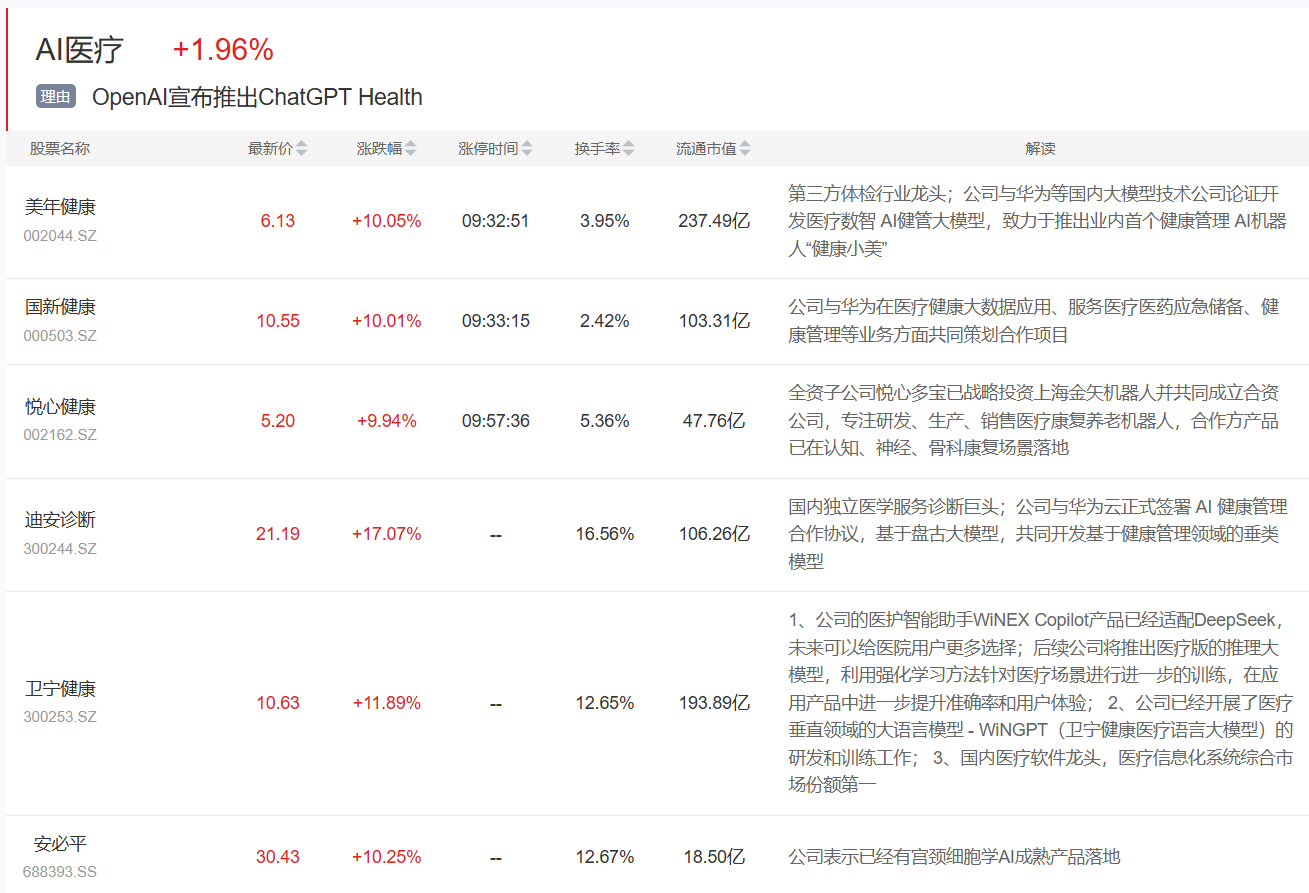
Core Insights - The AI healthcare sector experienced a strong opening on January 9, with significant stock price increases for various companies, indicating a bullish market sentiment in this industry [1]. Group 1: Stock Performance - Meinian Health (002044.SZ) saw a price increase of 10.05% to 6.13, with a market cap of approximately 237.5 million, focusing on AI health management models in collaboration with Huawei [2]. - Guoxin Health (000503.SZ) rose by 10.01% to 10.55, with a market cap of about 10.33 billion, engaging in projects with Huawei in health data applications [2]. - Dian Diagnostics (300244.SZ) surged by 17.07% to 21.19, with a market cap of 106.26 million, collaborating with Huawei to develop AI models for healthcare [2]. - Weining Health (300253.SZ) increased by 11.89% to 10.63, with a market cap of 193.89 million, focusing on AI-driven medical software [2]. - Anbiping (688393.SS) rose by 10.25% to 30.43, with a market cap of approximately 18.5 million, highlighting its AI products in cytology [2]. Group 2: Industry Developments - OpenAI launched "ChatGPT Health" on January 7, 2026, aimed at providing personalized health advice by integrating user health data, developed in collaboration with over 260 practicing doctors [3]. - The Beijing Health Commission announced an action plan on December 30, 2025, to promote AI applications in healthcare, targeting widespread implementation by 2027 [3]. - Ant Group's AI health application "Ant Aifu" upgraded its brand and reached 15 million monthly active users, becoming a leading health management AI app [3]. Group 3: Institutional Analysis - OpenAI reported over 230 million weekly inquiries related to health, indicating a substantial market demand for healthcare solutions [4]. - Major international AI companies are accelerating their investments in the healthcare sector, supported by national and local policies that promote AI integration in medical services [4]. - The explosive growth in global AI healthcare demand is fostering collaboration across the industry, with domestic companies positioned to leverage this trend effectively [4].


医保便捷支付政策加码 德生科技“AI医疗”领跑行业实践
Zheng Quan Shi Bao Wang· 2026-01-09 03:06
1月8日,国家医保局办公室正式发布《关于大力推进刷脸支付、一码支付、移动支付、信用支付等便捷 支付工作的通知》,聚焦群众看病缴费"多次排队""排长队"等堵点痛点,明确用3年左右时间全面建成 医保便捷支付体系。值得关注的是,德生科技(002908)深耕多年的"就医无感支付"服务,其创新实践 与政策导向高度契合,凭借技术实力与服务成效成为医保数字化转型的核心参与者。 技术与服务的双重优势,也为德生科技赢得了权威认可。在刚刚落幕的2025全国智慧医保大赛中,由德 生科技申报的"就医无感支付"项目,从180个决赛项目中脱颖而出,斩获全国总决赛一等奖殊荣。该赛 事由国家医保局和上海市政府联合主办,其奖项含金量彰显了行业对德生科技在医保数字化领域创新能 力与实践成效的高度肯定。 此次医保便捷支付政策的全面推进,为公司业务拓展提供了重要契机。未来,德生科技将持续以"数据 +场景"双轮驱动,依托成熟的技术方案与布局经验,加速"就医无感支付"在更多地区落地,助力医保便 捷支付体系全国建成,推动医疗服务向数字化、智能化深度跃迁。 总体来说,公司在AI医疗应用方面的布局,会以建设全医院数字化底座为基础,通过AI算法提升医疗 机构服 ...