
大模型技术

Search documents
AI 时代的 Super App 之战打响丨周亚辉投资笔记 AI 时代系列之二
Xin Lang Cai Jing· 2026-01-20 03:46
Core Insights - The article posits that Zhang Yiming will likely be the richest person in China and Asia in the next ten to twenty years due to his strong motivation, learning ability, execution power, and the resources of ByteDance [3][4][5] - The number of Super Apps in the AI era is expected to drastically decrease, with only 3-4 apps likely to exceed 500 million MAU, compared to 10 in the mobile internet era [4][14] - The value of Super Apps will significantly increase in the AI era, with DAU/MAU ratios expected to rise, leading to higher user engagement and commercial returns [4][14] Company Strategies - ByteDance is expanding into various sectors, including mobile phones, automotive manufacturing, and potentially space computing, indicating a broad strategic vision [3][4][5] - The resolution of TikTok's issues is anticipated to accelerate ByteDance's international expansion, particularly with its new product, Doubao [4][12] - Alibaba's Qwen is positioned to compete directly with Doubao, with a focus on becoming a Super App that integrates various services [6][17] Market Dynamics - The competition for AI Native Super Apps is heating up, with major players like Tencent, Meituan, Pinduoduo, JD.com, and Baidu vying for a position [17][18] - The article suggests that Meituan's exit from the community group buying market is a strategic move to focus on AI and Super App development [18] - The potential market for AI Super Apps is projected to be worth 1 trillion RMB, emphasizing the urgency for companies to launch their AI applications [18] Competitive Landscape - Tencent is described as a stable player with a strong product matrix, while ByteDance's Doubao is gaining traction among younger users, potentially challenging WeChat's dominance [19][20] - The article highlights that the competition between Zhang Yiming and Jack Ma represents a significant moment in the evolution of Super Apps in China [17][19] - Huawei is not expected to enter the Super App market, focusing instead on becoming a leading automotive group in China [19]

人形机器人的淘汰赛:“一些公司已经不行了”
Di Yi Cai Jing Zi Xun· 2026-01-18 09:51
Core Insights - The humanoid robot industry in China is expected to undergo significant consolidation by 2026, with many companies likely to be eliminated due to a lack of commercialization capabilities and financing [2][8][9] - The current bottleneck for humanoid robots is the "brain" technology, which needs to advance before the industry can experience a breakthrough similar to the "electric vehicle moment" [2][12][14] Group 1: Industry Overview - There are over 100 humanoid robot companies in China, with significant differentiation emerging after three years of development [2][4] - The investment enthusiasm in the robotics sector has been high, with 190 financing events totaling 27 billion RMB in 2025 [4] - The customer base for humanoid robots is shifting from academic institutions to industrial enterprises, indicating a growing acceptance and market expansion [5][12] Group 2: Market Dynamics - By 2025, the global shipment of humanoid robots is projected to reach approximately 13,000 units, with a conservative estimate of 30,000 units by 2026 [11] - The market for humanoid robots could potentially reach between 1.4 trillion to 1.7 trillion USD by 2050, but the industry is still in its early stages [12] - The competition among humanoid robot companies is likened to the "battle of the hundred groups" in the food delivery market, with only a few companies expected to survive [8] Group 3: Company Performance - The first-tier companies, such as Ubiquity Robotics, have received significant orders and are preparing for IPOs, while second-tier companies face more challenges [7][9] - First-tier companies have accumulated orders close to 1 billion, while second-tier companies have orders in the low hundreds of millions [7] - Companies that have not secured commercial orders or have faced financing difficulties are at risk of failing [9] Group 4: Technological Challenges - The development of humanoid robots is hindered by the lack of high-quality data and suitable AI models for their "brains" [13] - Current humanoid robot companies primarily rely on existing models that are not specifically designed for their needs, limiting their development capabilities [13] - The expectation is that the breakthrough in humanoid robot technology will not occur within the next five years, as the "electric vehicle moment" is still distant [14]

诚邀体验 | 中金点睛数字化投研平台
中金点睛· 2026-01-18 01:07
Core Viewpoint - The article emphasizes the establishment of a digital research platform by CICC, aimed at providing efficient, professional, and accurate research services by integrating insights from over 30 specialized teams and covering more than 1800 individual stocks [1]. Group 1: Research Services - CICC's digital research platform, "CICC Insight," offers a one-stop service that includes research reports, conference activities, fundamental databases, and research frameworks [1]. - The platform utilizes advanced model technology to enhance the research experience for clients [1]. Group 2: Research Content - Daily updates on research focus and timely article selections are provided through the "CICC Morning Report" [4]. - The platform features live broadcasts where senior analysts interpret market hotspots [4]. Group 3: Data and Frameworks - CICC Insight includes over 160 industry research frameworks and more than 40 premium databases, offering comprehensive industry data [10]. - The platform also features an AI search function for efficient information retrieval and analysis [10].

智谱盘中涨超8%破顶 GLM-Image登顶Hugging Face Trending榜
Zhi Tong Cai Jing· 2026-01-16 07:42
Core Viewpoint - The stock of Zhiyuan (02513) surged over 8% during trading, reaching a new high of 263 HKD, driven by the successful launch of the GLM-Image model in collaboration with Huawei, which topped the Hugging Face Trending chart shortly after its release [1] Group 1: Stock Performance - Zhiyuan's stock price increased by 5.06% to 253.2 HKD, with a trading volume of 948 million HKD [1] Group 2: Product Development - The GLM-Image model, developed jointly by Zhiyuan and Huawei, achieved state-of-the-art (SOTA) performance and innovative architecture, sparking discussions in the international tech community [1] Group 3: Market Outlook - Dongwu Securities expressed optimism about Zhiyuan's strengths in local large model technology, open-source ecosystem development, and localized implementation capabilities for government and enterprise sectors, suggesting the company is well-positioned to benefit from the long-term trend of transitioning from localized deployment to cloud services in China's large model industry [1]
谷歌推出Agentic AI购物系统,创业板软件ETF华夏(159256)近5日“吸金”6.55亿元
Mei Ri Jing Ji Xin Wen· 2026-01-15 03:47
每日经济新闻 (责任编辑:董萍萍 ) 【免责声明】本文仅代表作者本人观点,与和讯网无关。和讯网站对文中陈述、观点判断保持中立,不对所包含内容 的准确性、可靠性或完整性提供任何明示或暗示的保证。请读者仅作参考,并请自行承担全部责任。邮箱: news_center@staff.hexun.com 在AI产业链中,软件行业主要处于中游技术层和下游应用层,扮演着核心技术支撑和应用落地的 关键角色。具体来看,软件行业在中游技术层主要提供AI框架、开发平台和算法模型,这些技术是AI 应用开发的基础。在下游应用层,软件行业通过将AI技术与各行业结合,推动AI应用的落地。 中金公司指出,人工智能作为新一轮科技革命的核心驱动力,其最大的价值不在于提升效率,而在 于创造新的可能性,推动各行各业向智能化跃迁。大模型技术正深刻重塑全球产业格局,其发展有望为 金融业带来规模达数万亿元的增量商业价值,实现从效率提升到价值创造的范式重构。同时,大模型的 迭代发展需直面技术瓶颈、高投入成本以及与监管框架的平衡等挑战。 相关产品:创业板软件ETF华夏(159256)、创业板200ETF华夏(159573)、人工智能AIETF (515070) ...

云眼视界IPO:毛利率远超同行 多家主要供应商参保人数为0 前五大客户集中度明显偏高
Xin Lang Cai Jing· 2026-01-14 12:59
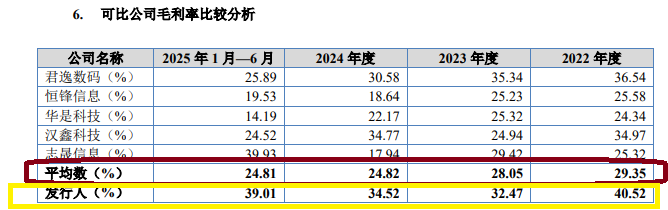
炒股就看金麒麟分析师研报,权威,专业,及时,全面,助您挖掘潜力主题机会! 出品:新浪财经上市公司研究院 作者:IPO再融资组/郑权 近日江西云眼视界科技股份有限公司(以下简称"云眼视界")北交所IPO获受理,保荐机构为南京证券。 2023年、2024年,云眼视界的业绩虽大幅增长,但应收账款也迅速增长,经营活动产生的现金流净额经常为负。与同行公司相比,云眼视界的毛利率显 著高于同行均值。 高毛利率背后,多家前五大供应商的实缴资本为0,参保人数为0。尤其是云眼视界参保人数为0的供应商中,部分成立当年就跻身前五大之列,还有个别 成立次年的上半年成为第一大供应商;有的供应商虽号称人员规模三四十人却没有一人参保;部分0参保供应商的销售十分依赖云眼视界。 毛利率显著高于同行 招股书显示,云眼视界主要从事以视频智能为核心的智慧城市产品及解决方案研发、建设、运维和服务,同时公司紧跟大模型技术发展,积极拓展综合 智算云业务,能够对外提供智能算力及大模型部署、智能算力租赁等相关服务。 2022-2024年、2025年上半年,云眼视界分别实现营收1.40亿元、2.55亿元、3.22亿元、1.16亿元,分别实现归母净利润0.16亿元 ...
充电桩从够用迈向好用
Jing Ji Ri Bao· 2026-01-14 08:13
Core Insights - 2024 is expected to be a year of rapid development for charging infrastructure in China, with over 12 million charging facilities built, and over 95% of highway service areas equipped with charging capabilities [1] - The charging network in China is now the largest and most diverse in the world, with a car-to-charging pile ratio of 1:1 for new electric vehicles in 2024, leading globally [1] - Despite the growth in quantity, challenges remain such as peak demand shortages, low utilization rates, and varying equipment quality, necessitating improvements in both quantity and quality of charging facilities [1] Group 1 - The expansion project for charging piles at highway service areas began operations in September 2024, significantly enhancing service efficiency and capacity [2] - In Jiaxing, the average time for electric vehicle owners to find public charging piles is 4.97 minutes, indicating the formation of a 5-minute charging circle [2] - Advanced digital technologies are being utilized for efficient operation and maintenance of charging facilities, with policies encouraging the integration of solar, storage, and charging systems [2] Group 2 - The new AI-driven charging station in Kunshan, Jiangsu, optimizes the operation of solar, storage, and charging systems, improving energy efficiency and reducing operational costs [3] - The application of predictive models allows for better management of energy resources, increasing solar utilization rates from 96.0% to 99.7% and enhancing overall operational revenue by 14.07% [3] - The future of charging infrastructure will see widespread adoption of smart operation technologies and artificial intelligence, driving the industry towards efficiency, safety, and integration [3]
从“数字化”到“数智化”:制造业如何靠数据智能决胜未来?
Sou Hu Cai Jing· 2026-01-13 10:40
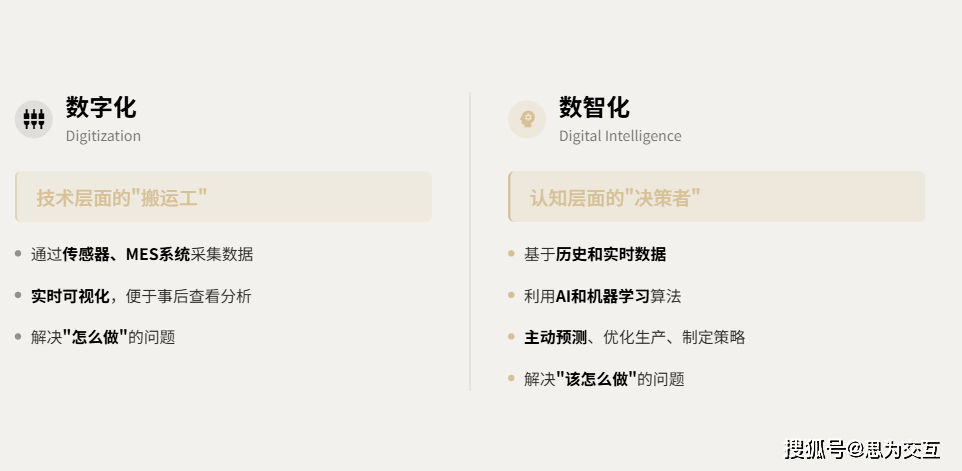
Core Insights - "Digital intelligence" has emerged as a new paradigm in manufacturing, representing a profound transformation in logic and governance structures, moving beyond mere digitization [1][6][17] Group 1: Definition and Distinction - "Digitization" refers to the process of transferring physical processes and data online, addressing the question of "how to do," while "digital intelligence" incorporates algorithms to answer "how to do it better" [3][4] Group 2: Benefits of Digital Intelligence - Cost reduction and efficiency enhancement shift from linear optimization to exponential growth, leveraging algorithmic models for significant improvements [6] - Transition from reactive maintenance to predictive maintenance, utilizing real-time data analysis to forecast equipment failures and optimize production schedules [6][8] - Full lifecycle management extends beyond production to predictive maintenance, reducing repair costs and prolonging equipment lifespan [7] Group 3: Competitive Advantages - Data becomes a new production factor, creating competitive barriers as companies accumulate data and develop algorithmic models, leading to more accurate predictive capabilities [9] Group 4: Technological Evolution - Large model technologies evolve from being mere tools to becoming partners in research, design, process optimization, and decision support [11] - Data governance shifts from isolated data silos to trusted data spaces, ensuring data quality for algorithmic outputs [12] - Ecosystem collaboration moves from independent factories to collaborative networks, fostering innovation across supply chains [13] Group 5: Strategic and Organizational Changes - Companies must update their strategic understanding, recognizing digital intelligence as a comprehensive restructuring process involving organizational flattening and business process reengineering [15] - The transition from traditional IT roles to algorithm engineers and data scientists presents a significant challenge, necessitating cross-departmental data governance [16] - Balancing technology and security is crucial, addressing data safety, intellectual property protection, and ethical concerns arising from algorithms [17]
新开普:未来公司在大模型技术领域将聚焦三大核心布局方向
Zheng Quan Ri Bao Wang· 2026-01-13 10:12
证券日报网1月13日讯,新开普(300248)在接受调研者提问时表示,未来公司在大模型技术领域将聚 焦三大核心布局方向,持续深化技术应用与价值转化:1、深耕校园数据洞察与智能问答场景:持续迭 代优化面向校园场景的自然语言处理(NLP)搜索模型,重点提升"校园问数"系统的意图识别、自然语言 生成及权限计算和隐私计算能力,实现校园数据实时查询、智能追因与洞察预测的高精度响应,为高校 信息化管理决策提供高效支撑。2、发力视觉模型研发与产教融合场景落地:重点推进视觉模型、视频 物体检测模型在产业学院教学、实训场景的应用,同步攻坚模型轻量化技术,将相关模型部署至边缘计 算设备,实现本地化、低延迟的AI辅助教学,助力产教融合模式创新升级。同时,推进AI+教学融合实 践,开展AI出题、智能批阅、个性化学习推荐、AI数字人视频生成等多元应用探索,并布局标准化AI 教学产品对外输出,构建从B端到C端的价值闭环,进一步拓宽盈利边界,提升长期发展韧性。3、强化 技术能力复用与跨场景商业化延伸:将在校园场景中验证成熟的AI技术能力,横向复制拓展至智慧园 区、智慧农业、智慧水务的"物联网+AI、门户+AI、数据治理+AI、终端+AI" ...

新开普:聚焦三大技术方向,推进大模型在校园及多行业场景落地
2 1 Shi Ji Jing Ji Bao Dao· 2026-01-13 01:56
21智讯1月13日电,新开普在投资者关系活动中表示,未来两到三年公司将在大模型技术领域聚焦三大 方向:一是持续优化校园场景NLP搜索模型,提升'校园问数'系统的意图识别、生成能力和隐私计算水 平,支持数据智能查询与决策分析;二是推进视觉模型与视频物体检测模型在产业学院实训中的应用, 攻坚轻量化技术并部署至边缘设备,实现低延迟AI辅助教学;三是将校园验证成熟的'物联网+AI、门 户+AI、数据治理+AI、终端+AI'能力复制至智慧园区、智慧农业、智慧水务等B端行业,构建可复用的 技术中台,推动跨场景商业化落地。 ...