
新型基础设施建设

Search documents
十五五规划建议:适度超前建设新型基础设施 推进信息通信网络、全国一体化算力网、重大科技基础设施等建设和集约高效利用
Ge Long Hui· 2025-10-28 09:03
Core Points - The article discusses the release of the "Suggestions on Formulating the 15th Five-Year Plan for National Economic and Social Development" by the Central Committee of the Communist Party of China, emphasizing the construction of a modern infrastructure system [1] Group 1: Infrastructure Development - The plan calls for strengthening the overall planning of infrastructure, optimizing layout and structure, promoting integration, and enhancing safety resilience and operational sustainability [1] - It advocates for appropriately advanced construction of new-type infrastructure, including information communication networks, a national integrated computing network, and major scientific and technological infrastructure [1] - The plan emphasizes the need for updating traditional infrastructure and implementing digital transformation [1] Group 2: Transportation and Energy - The proposal includes improving the modern comprehensive transportation system, enhancing cross-regional planning, and ensuring connectivity across different transportation modes [1] - It highlights the importance of strengthening coverage and accessibility in underdeveloped areas [1] - The plan also focuses on optimizing the layout of energy backbone channels and accelerating the construction of new energy infrastructure [1] Group 3: Water Management and Urban Infrastructure - There is a push to accelerate the construction of a modern water network to enhance flood disaster prevention, water resource allocation, and urban-rural water supply security [1] - The plan promotes the development of public infrastructure that can be used for both daily and emergency purposes in urban areas [1]
前三季度全社会用电量同比增长4.6% 增速呈逐季回升态势
Ren Min Ri Bao· 2025-10-23 21:54
Core Insights - In September, China's total electricity consumption reached 888.6 billion kWh, marking a year-on-year increase of 4.5% [1] - For the first three quarters, total electricity consumption accumulated to 7,767.5 billion kWh, with a year-on-year growth of 4.6% [1] - The second industry showed a significant recovery in electricity consumption growth in Q3, contributing 51% to the overall increase [1] Group 1: Electricity Consumption by Sector - In September, the first industry consumed 12.9 billion kWh (up 7.3%), the second industry consumed 570.5 billion kWh (up 5.7%), and the third industry consumed 176.5 billion kWh (up 6.3%) [1] - For the first three quarters, the first, second, and third industries saw year-on-year growth in electricity consumption of 10.2%, 3.4%, and 7.5% respectively [1] Group 2: Trends and Drivers - The electricity consumption growth rate showed a quarterly recovery, with increases of 2.5%, 4.9%, and 6.1% in Q1, Q2, and Q3 respectively [1] - High-tech and equipment manufacturing industries experienced a 9.5% increase in electricity consumption in Q3, surpassing the average growth rate of the manufacturing sector by 4.3 percentage points [2] - The service sector's electricity consumption grew by 8.3% in Q3, driven by the rapid development of new infrastructure such as electric vehicles and 5G [2]
专访黄群慧:推进产业基础高级化,加大新基建投资
2 1 Shi Ji Jing Ji Bao Dao· 2025-10-19 12:15
Core Insights - The article discusses the transition from the "14th Five-Year Plan" to the "15th Five-Year Plan" in China, emphasizing the need for economic growth and industrial transformation during this critical period [1][6]. Economic Growth and Modernization - The "15th Five-Year Plan" requires a higher economic growth target compared to the "14th Five-Year Plan," aiming for around 5% growth to achieve a middle-income level by 2035 [6][7]. - As a country approaches modernization, its potential economic growth rate tends to decline, necessitating a focus on high-quality development rather than just quantitative growth [6][7]. Industrial Transformation - Traditional industries must undergo deep transformation, particularly through the integration of artificial intelligence in key sectors such as manufacturing, energy, and consumer goods [2][12]. - The construction of new infrastructure, particularly in computing power, is essential to support the transformation of traditional industries and enhance their competitiveness [2][13]. Technology and Innovation - There is a pressing need to enhance the integration of technological innovation and industrial innovation, focusing on upgrading the industrial foundation and increasing high-quality technological supply [7][8]. - The proportion of basic research funding in overall R&D investment should increase from 8% to around 12% by the end of the "15th Five-Year Plan" to align with international standards [8]. New Infrastructure Investment - Investment in new infrastructure should be accelerated, particularly in areas that support the digital and green transformation of industries [11][13]. - A unified national computing power trading market is proposed to optimize resource allocation and support industrial upgrades [13]. Addressing "Involution" in Emerging Industries - The "15th Five-Year Plan" emphasizes the need to combat "involution" in emerging industries by promoting innovation and limiting subsidies that encourage capacity expansion [15][16]. - A focus on enhancing market regulation and preventing monopolistic practices is crucial to ensure fair competition and protect smaller enterprises [16][17]. Expanding Domestic Demand - Expanding domestic demand is essential to alleviate capacity issues in certain industries, with a shift from investment-driven growth to consumption-driven growth [17]. - The establishment of a unified national market is necessary to facilitate resource integration and collaboration across regions, enhancing overall economic stability [17].


专访黄群慧:推进产业基础高级化,加大新基建投资
21世纪经济报道· 2025-10-19 12:04
Core Viewpoint - The article discusses the transition from the "14th Five-Year Plan" to the "15th Five-Year Plan" in China, emphasizing the need for high-quality economic growth and the transformation of traditional industries while avoiding "involution" in emerging industries [1][5]. Economic Growth and Modernization - The "15th Five-Year Plan" period is crucial for solidifying the foundation for achieving socialist modernization by 2035, requiring an economic growth rate of around 5% to reach the level of moderately developed countries [5]. - As a country approaches modernization, its potential economic growth rate tends to decline, necessitating higher growth expectations for the "15th Five-Year Plan" compared to the "16th Five-Year Plan" [2][5]. Technology and Industry Innovation - There is a pressing need to integrate technological innovation with industrial innovation, focusing on enhancing the modernization of industrial foundations, which includes key components, software, and materials [6]. - The article suggests increasing the proportion of basic research funding from 8% to around 12% by the end of the "15th Five-Year Plan" to enhance high-quality technological supply [6]. Traditional Industry Transformation - The "15th Five-Year Plan" requires a deep transformation of traditional industries, particularly through the empowerment of artificial intelligence, focusing on sectors like equipment manufacturing, electronic information, and energy [10]. - New infrastructure, particularly in computing power, should be prioritized to support the innovation and development of traditional industries [11]. Emerging Industry Development - The article highlights the need for a "反内卷" (anti-involution) approach in emerging industries, emphasizing the importance of directing industrial subsidies towards technological innovation rather than capacity expansion [12][13]. - It advocates for a shift from low-end capacity expansion to creating brand value and enhancing service experiences, thereby fostering a competitive edge based on quality rather than quantity [13]. Market and Regulatory Environment - The establishment of a robust market regulatory framework is essential to prevent monopolistic behaviors in the platform economy and ensure fair competition for small and medium enterprises [14]. - The article calls for a unified national market to facilitate resource integration and collaboration across regions, enhancing the overall business environment for manufacturing companies [14][15].

专访黄群慧:推进产业基础高级化 加大新基建投资丨四中全会预热
2 1 Shi Ji Jing Ji Bao Dao· 2025-10-17 15:32
Core Viewpoint - The transition from the "14th Five-Year Plan" to the "15th Five-Year Plan" marks a critical juncture for China's economic development, emphasizing the need for deep transformation of traditional industries and avoiding "involution" in emerging industries [1][2][3]. Economic Growth Requirements - The "15th Five-Year Plan" period will require higher economic growth expectations compared to the "14th Five-Year Plan," aiming for a growth rate around 5% to achieve a level comparable to that of moderately developed countries [3][4]. - Economic growth must align with high-quality development principles, addressing imbalances and inadequacies in China's development [3]. Industry Transformation - Traditional industries must undergo deep transformation, particularly through the integration of artificial intelligence, focusing on key sectors such as equipment manufacturing, electronic information, and energy [2][8]. - The construction of new infrastructure, particularly in computing power, is essential to support traditional industries' innovation and development [9]. Technology and Innovation - There is a pressing need for the integration of technological innovation and industrial innovation, with a focus on enhancing the modernization of industrial foundations [4][5]. - The proportion of basic research funding in overall R&D investment should increase from 8% at the end of the "14th Five-Year Plan" to around 12% by the end of the "15th Five-Year Plan" [5]. New Infrastructure Investment - Significant investment in new infrastructure is necessary, particularly in information, integration, and innovation infrastructure, to support the digital and green transformation of traditional industries [9]. - A unified national computing power trading market should be established to optimize resource allocation and pricing mechanisms [9]. Addressing Involution in Emerging Industries - The "15th Five-Year Plan" must focus on "anti-involution" strategies, emphasizing technological innovation and limiting subsidies that promote capacity expansion [10][11]. - A collaborative innovation ecosystem should be built, encouraging large state-owned enterprises and research institutions to focus on common technological challenges [11]. Market Regulation and Demand Expansion - A robust market regulation system is needed to prevent monopolistic behaviors in platform economies and ensure fair competition for small and medium enterprises [11][12]. - Expanding domestic demand through improved public services and social security systems is crucial to alleviate capacity issues in certain industries [12].
专访黄群慧:推进产业基础高级化,加大新基建投资丨四中全会预热
2 1 Shi Ji Jing Ji Bao Dao· 2025-10-17 10:56
Core Viewpoint - The article discusses the transition from the "14th Five-Year Plan" to the "15th Five-Year Plan" in China, emphasizing the need for deep transformation of traditional industries and the avoidance of "involution" in emerging industries, while focusing on high-quality economic growth and technological innovation [1][4]. Economic Development Context - The "15th Five-Year Plan" is seen as a critical period for solidifying the foundation for achieving socialist modernization by 2035, requiring an economic growth rate of around 5% to reach the level of middle-developed countries [4]. - As a country approaches modernization, its potential economic growth rate tends to decline, necessitating higher growth expectations for the "15th Five-Year Plan" compared to the "14th" [2][4]. Technological and Industrial Innovation - There is a pressing need to integrate technological innovation with industrial innovation, focusing on enhancing the modernization of industrial foundations, which includes key components, software, and materials [5][6]. - The goal is to increase the proportion of basic research funding from 8% to around 12% of total R&D investment by the end of the "15th Five-Year Plan" [6]. Modern Industrial System Development - The "15th Five-Year Plan" aims to accelerate the construction of a modern industrial system supported by the real economy, emphasizing advanced, digital, green, and integrated development [7]. - The integrity of the industrial system is crucial, with a focus on maintaining key manufacturing capabilities and ensuring a collaborative mechanism for orderly domestic industrial transfer [7]. Traditional Industry Transformation - Traditional industries must undergo deep transformation, particularly through the empowerment of artificial intelligence, focusing on key sectors such as equipment manufacturing and consumer goods [8][9]. - Investment in new infrastructure, particularly in computing power, is essential to support the innovation and development of traditional industries [9][10]. Emerging Industry "Anti-Involution" Strategies - The "15th Five-Year Plan" emphasizes the need for a technology innovation mechanism that shifts enterprise behavior towards value creation, limiting subsidies for capacity expansion and encouraging innovation in standards and branding [11]. - A collaborative innovation ecosystem is encouraged, with large state-owned enterprises and research institutions focusing on key common technologies [11][12]. - The establishment of a market regulatory system is necessary to prevent monopolistic behaviors and ensure fair competition, particularly in the platform economy [12][13].
459.8万个5G基站之后 新基建如何再进阶
2 1 Shi Ji Jing Ji Bao Dao· 2025-10-16 00:47
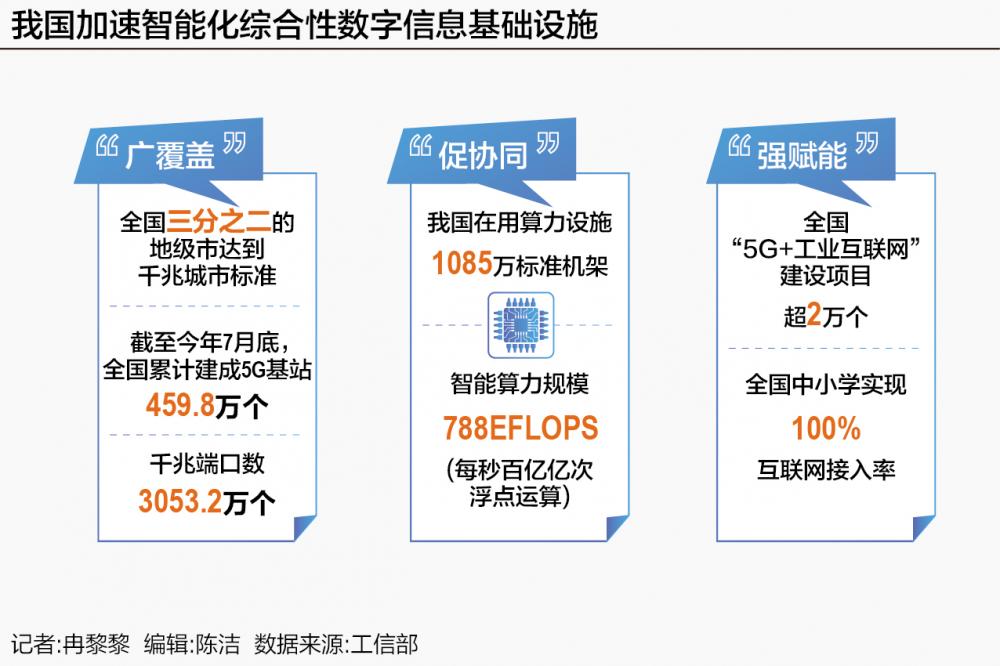
Core Insights - The article emphasizes the significant progress made in the construction of new infrastructure in China during the "14th Five-Year Plan" period, highlighting the completion of 4.598 million 5G base stations and 30.532 million gigabit ports, along with over 20,000 "5G + industrial internet" projects [1][8] - The focus for the upcoming "15th Five-Year Plan" is expected to shift towards artificial intelligence (AI) and intelligent computing infrastructure, which are seen as critical for industrial structure upgrades and sustainable economic development [10][11] New Infrastructure Development - The new infrastructure framework consists of information infrastructure, integrated infrastructure, and innovative infrastructure, with AI, computing power, and 5G being key areas of focus for future development [1][5] - The total computing power in China ranks second globally, with 10.85 million standard racks and an intelligent computing capacity of 788 EFLOPS [8] Policy and Planning - Various policy documents have been released since the "14th Five-Year Plan" to support new infrastructure development, including the "Digital China Construction Overall Layout Plan" and the "Implementation Plan for Promoting Service-Oriented Manufacturing Innovation Development (2025-2028)" [6][12] - Local governments, including those in Jiangsu, Sichuan, and Beijing, have also introduced specific plans to advance new infrastructure construction [7] Future Directions - The "15th Five-Year Plan" is expected to prioritize the balanced distribution of intelligent computing centers across the country, addressing the issue of idle computing resources in the western regions [2][11] - The integration of AI with communication networks, particularly the development of 5G-A and 6G technologies, will be crucial for enhancing network capabilities and supporting new applications [12][13]
459.8万个5G基站之后,新基建如何再进阶
2 1 Shi Ji Jing Ji Bao Dao· 2025-10-15 09:41
Core Insights - The construction of new infrastructure in China has made significant progress during the "14th Five-Year Plan" period, with 4.598 million 5G base stations and 30.532 million gigabit ports established, alongside over 20,000 "5G + industrial internet" projects [1][6] - The focus for the upcoming "15th Five-Year Plan" will likely shift towards artificial intelligence (AI), computing power, and 5G technologies, which are seen as critical for industrial structure transformation and sustainable economic development [8][9] New Infrastructure Framework - The new infrastructure framework consists of three main components: information infrastructure, integrated infrastructure, and innovative infrastructure [3][4] - Information infrastructure includes advanced technologies such as 5G, IoT, data centers, AI, satellite communication, and blockchain [3] - Integrated infrastructure refers to the intelligent transformation of traditional infrastructure using new technologies, exemplified by industrial internet and smart city facilities [3] Policy and Development Trends - Numerous policy documents have been released since the "14th Five-Year Plan," emphasizing the importance of digital infrastructure in China's overall development strategy [4][10] - Local governments, including those in Jiangsu, Sichuan, and Beijing, have introduced specific plans to advance new infrastructure construction [4][5] Computing Power and AI - China's computing power is ranked second globally, with 10.85 million standard racks and an intelligent computing capacity of 788 EFLOPS [6] - The "15th Five-Year Plan" is expected to emphasize the balanced distribution of intelligent computing centers across the country, addressing the underutilization of computing resources in the western regions [2][9] Future Directions - The integration of AI with infrastructure is anticipated to be a key focus, with applications in smart transportation, healthcare, and manufacturing [9][11] - The development of a nationwide high-quality computing network and the enhancement of network support for AI applications are critical objectives for the "15th Five-Year Plan" [10][12]
459.8万个5G基站之后,新基建如何再进阶丨四中全会预热
2 1 Shi Ji Jing Ji Bao Dao· 2025-10-15 09:38
Core Insights - The article emphasizes the significant progress made in the construction of new infrastructure in China during the "14th Five-Year Plan" period, highlighting the importance of this development for industrial structure upgrades and sustainable economic growth [1][5][10]. Infrastructure Development - As of July 2023, China has built 4.598 million 5G base stations and 30.532 million gigabit ports, with over 20,000 "5G + industrial internet" projects initiated [5]. - The total computing power in China ranks second globally, with 10.85 million standard racks and an intelligent computing power of 788 EFLOPS [5]. Policy Framework - The "14th Five-Year Plan" has led to a series of policy documents aimed at promoting new infrastructure, including the "Digital China Construction Overall Layout Plan" and local government initiatives in provinces like Jiangsu and Sichuan [4][10]. - The focus on new infrastructure includes information infrastructure, integrated infrastructure, and innovative infrastructure, which are essential for digital transformation and intelligent upgrades [3][4]. Future Directions - The "15th Five-Year Plan" is expected to prioritize artificial intelligence-related infrastructure, including intelligent computing facilities and data centers [1][7]. - The need for a balanced distribution of intelligent computing centers across regions, particularly addressing the underutilization of computing resources in the western regions, is highlighted [2][8]. Regional Competitiveness - According to the "China New Infrastructure Competitiveness Index (2024)," Beijing ranks first in new infrastructure competitiveness, particularly in information infrastructure, while Jiangsu and Guangdong excel in integrated infrastructure [6]. Technological Integration - The integration of AI with new infrastructure is anticipated to be a key focus, with policies emphasizing the enhancement of foundational capabilities and the establishment of a high-quality computing network [7][8]. - The development of 5G-A and 6G technologies is expected to drive innovation and improve communication networks, with a focus on real-time applications and enhanced data transmission capabilities [9][10].
中国移动互联网用户数突破16亿
Zhong Guo Xin Wen Wang· 2025-09-23 14:01
Core Insights - The Ministry of Industry and Information Technology of China reported that by the end of August 2025, the number of mobile internet users in China is expected to exceed 1.6 billion, with an average monthly data usage of 20.87GB per user [1][2] - In the first eight months of the year, the cumulative mobile internet traffic reached 2,534 billion GB, representing a year-on-year growth of 16.4% [1] - As of the end of August, the total number of mobile phone users among the three major telecom operators and China Broadcasting reached 1.819 billion, with 5G users accounting for 63.4% of this total [1] Mobile Internet Growth - The average monthly mobile internet access traffic (DOU) reached 20.87GB per user in August, marking a year-on-year increase of 14.3% and an increase of 1.17GB compared to the end of the previous year [1] - The total number of 5G base stations reached 4.646 million, which is 36.3% of the total mobile base stations [1] Fixed Broadband Expansion - The number of fixed broadband access users among the three major telecom operators reached 689 million by the end of August, with gigabit and above access users totaling 233 million, accounting for 33.9% of the total [1] Telecom Revenue - The cumulative telecom business revenue for the first eight months reached 1,182.1 billion RMB, reflecting a year-on-year growth of 0.8%. When adjusted for constant prices from the previous year, the telecom business volume grew by 8.8% [1][2] Industry Overview - The Chinese telecommunications industry is experiencing stable operations, with growth in telecom business volume and revenue, and ongoing advancements in new infrastructure such as 5G, gigabit, and IoT user expansion [2]
