服务型制造

Search documents
2025辽宁省服务型制造发展大会在沈阳举行
Liao Ning Ri Bao· 2025-11-13 02:09
Group 1 - Service-oriented manufacturing is becoming an important way for companies to enhance competitiveness, with a focus on integrating advanced manufacturing and modern service industries [1] - The 2025 Liaoning Province Service-oriented Manufacturing Development Conference was held in Shenyang, aiming to accelerate the transformation and upgrading of manufacturing to service-oriented manufacturing [1] - Several cooperation projects were signed during the event, including a strategic cooperation agreement between the Provincial Department of Industry and Information Technology and the Service-oriented Manufacturing Research Institute [1] Group 2 - The mold industry, known as the "mother of industry," is crucial for processing raw materials into complete shapes and precise dimensions, widely used in various sectors such as construction, transportation, automotive, energy, and consumer electronics [2] - The Liaoning mold industry has a solid development foundation and is currently facing new opportunities, emphasizing the need for cultivating new productive forces and promoting digital transformation [2] - Continuous improvement of Liaoning's mold influence in both domestic and international manufacturing is encouraged through international cooperation and standard leadership [2]
陕鼓大象转身:破界“服务型制造”
Mei Ri Jing Ji Xin Wen· 2025-11-11 09:38
Core Insights - The article highlights the transformation of Shaan Gu Group from a traditional equipment manufacturer to a comprehensive solution provider in the green low-carbon energy sector, showcasing its achievements in various awards and recognitions [1][2][8] - The company has successfully integrated its core competencies in compressor technology with emerging fields such as carbon capture, utilization, and storage (CCUS), long-duration energy storage, and industrial data governance [3][4][6] Summary by Sections Recent Achievements - Shaan Gu Group has recently established a joint research institute with Xi'an Jiaotong University, marking a significant collaboration between academia and industry [1] - The company received the "Urban Innovation Award" from the United Nations Industrial Development Organization and was recognized as a "Leader" in industrial data governance and a "Pioneer" in long-duration energy storage [1][2] Technological Advancements - The CCUS technology developed by Shaan Gu has been included in the national directory of advanced green low-carbon technologies, emphasizing its role in reducing carbon emissions [4] - The company has signed a major project with a leading domestic energy enterprise for a million-ton integrated "new energy + coal power + CCUS" initiative, showcasing its expertise in this area [6] Strategic Transformation - Shaan Gu has undergone two significant strategic transformations, evolving from a single equipment manufacturer to a comprehensive service provider in major equipment systems [8][12] - The company has focused on enhancing its core equipment capabilities while expanding into industrial services and energy infrastructure operations [11][12] Future Directions - The company is initiating a third round of transformation, emphasizing service-oriented manufacturing and the integration of advanced technologies with production processes [15][18] - Shaan Gu aims to strengthen its high-end manufacturing capabilities and leverage financial tools to empower its industrial chain, while also developing new technologies for CCUS and energy transition [19]


直通进博会丨克劳斯玛菲:深耕中国市场,以创新与合作挖掘高质量发展潜能
Xin Hua Cai Jing· 2025-11-10 05:29
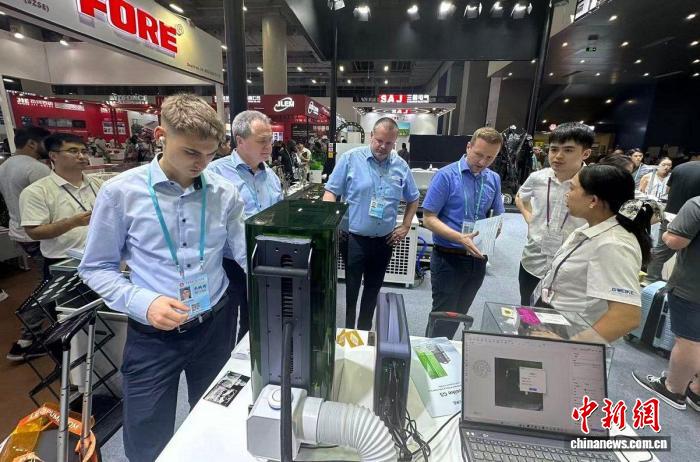
Core Insights - The high popularity of the China International Import Expo (CIIE) and the focus on "intelligent, green, and integrated" development have instilled confidence in the Chinese market for companies like KraussMaffei [1][2] - KraussMaffei is transforming from a manufacturing enterprise to a service-oriented manufacturing company, aiming to tap into the high-quality development potential of the Chinese market while leveraging its platform for global outreach [1][2] Group 1 - The CIIE serves as an important window for China's openness and a barometer for market vitality, with KraussMaffei achieving significant outcomes, including signing agreements with six companies [1] - The collaboration with Sinochem's Aiken Company to explore new scenarios for the integration of silicone and injection molding technology highlights the innovative partnerships being formed [1][2] - The showcased "prefabricated building" products reflect the success of Chinese manufacturing in entering high-end markets like Japan, demonstrating the global competitiveness of "Made in China" [1] Group 2 - The "14th Five-Year Plan" emphasizes the direction of "intelligent, green, and integrated" development in manufacturing, aligning with KraussMaffei's strategic transformation [2] - The company aims to integrate traditional industries with technological empowerment and future scenarios, focusing on collaborative innovation within the industrial chain [2] - The demand for innovation in the Chinese consumer market drives the company to continuously break through, exemplified by the development of the world's first one-piece ultra-quiet pipe product tailored for high-end residential needs [2] Group 3 - KraussMaffei's strategy involves moving from technology introduction to independent innovation, linking China with global markets [3] - The company plans to deepen cooperation with Chinese partners through the CIIE, aiming to meet high-quality market demands while promoting "Made in China" to the world [3] - The potential of the Chinese market remains largely untapped, and the company expresses a desire to grow alongside China [3]
协同推进制造与服务深度融合
Jing Ji Ri Bao· 2025-11-09 21:58
Core Viewpoint - The transition from "selling products" to "selling services + products" is becoming a crucial strategy for the transformation and upgrading of China's manufacturing industry, as highlighted in the recent implementation plan by the Ministry of Industry and Information Technology and six other departments, which sets ambitious goals for service-oriented manufacturing by 2028 [1][2]. Summary by Relevant Sections Service-oriented Manufacturing - Service-oriented manufacturing is defined as a new industrial form that integrates manufacturing and services, driven by customer demand and supported by digital technologies, aiming to optimize production organization, operational management, and business models [2][3]. - The essence of service-oriented manufacturing lies in breaking the limitations of traditional product production by innovating services as a key means for upgrading the manufacturing industry [2][3]. Development Trends - The development level of service-oriented manufacturing in China has shown a continuous upward trend, with an average growth rate of 7.67% from 2018 to 2023, indicating strong momentum in traditional industries and emerging strategic sectors [4][5]. - Typical enterprises in service-oriented manufacturing have reported average revenue growth rates nearly double the industry average, with service revenue contributing significantly to overall income growth [5]. Technological Integration - The integration of advanced technologies such as artificial intelligence, big data, and cloud computing is accelerating the transformation of manufacturing, blurring the boundaries between manufacturing and services [7][8]. - Companies like Lenovo and Black Cat Group are leveraging new technologies to enhance efficiency and reduce costs, demonstrating the practical benefits of adopting service-oriented manufacturing models [7]. Future Directions - The next steps involve enhancing awareness and shifting perspectives to deepen the innovation practices of service-oriented manufacturing, exploring new business models and applications across various industries [8][9]. - Recommendations for enterprises include exploring new business models focused on personalized services, upgrading production lines for flexibility, and developing service platforms that connect the entire production and service chain [9].
“服务型制造”重塑中国外贸竞争新优势
Zhong Guo Xin Wen Wang· 2025-11-05 08:28
Core Insights - The article highlights the emergence of "service-oriented manufacturing" as a new competitive advantage for China's foreign trade, showcased at the 138th Canton Fair, where Chinese companies presented not only quality products but also new technologies and services [1][2]. Group 1: Export Performance - The Canton Fair reported an intended export transaction value of $25.65 billion, indicating a sustained growth trend [1]. - Companies are increasingly focusing on new paths towards intelligent, green development, with keywords such as AI empowerment, innovative manufacturing, green low-carbon solutions, and high-end customization dominating the event [1]. Group 2: Service-Oriented Manufacturing - Chinese manufacturing enterprises are creating a "China solution" brand in the global market by offering comprehensive personalized solutions, which include hardware, advanced technologies, and standards [2]. - The integration of AI technology in companies like Oppein Home Group has led to a complete upgrade in digital operations and intelligent manufacturing, providing customized home solutions that merge manufacturing and services [2]. - Liu Shangwen, a key figure in the service-oriented manufacturing sector, emphasizes that the core of this model is the increased investment and output of service elements, transitioning from merely selling products to offering "products + services" [2]. Group 3: Industry Foundation - China's complete manufacturing categories and robust industrial system, along with its vast market scale and diverse application scenarios, provide a solid foundation for the development of service-oriented manufacturing [3]. - The Industrial and Information Technology Ministry reports that among over 370 selected service-oriented manufacturing demonstration enterprises, service contributions to revenue growth reached 60% [5]. Group 4: Future Directions - The recently announced "14th Five-Year Plan" suggests promoting technological upgrades, facilitating the digital transformation of manufacturing, and accelerating changes in industrial models and corporate structures, with a focus on intelligent, green, and service-oriented manufacturing [5].
AI服装绘图、3D打印鞋广交会吸睛,创新设计成中国出口新力量
Di Yi Cai Jing· 2025-11-04 10:09
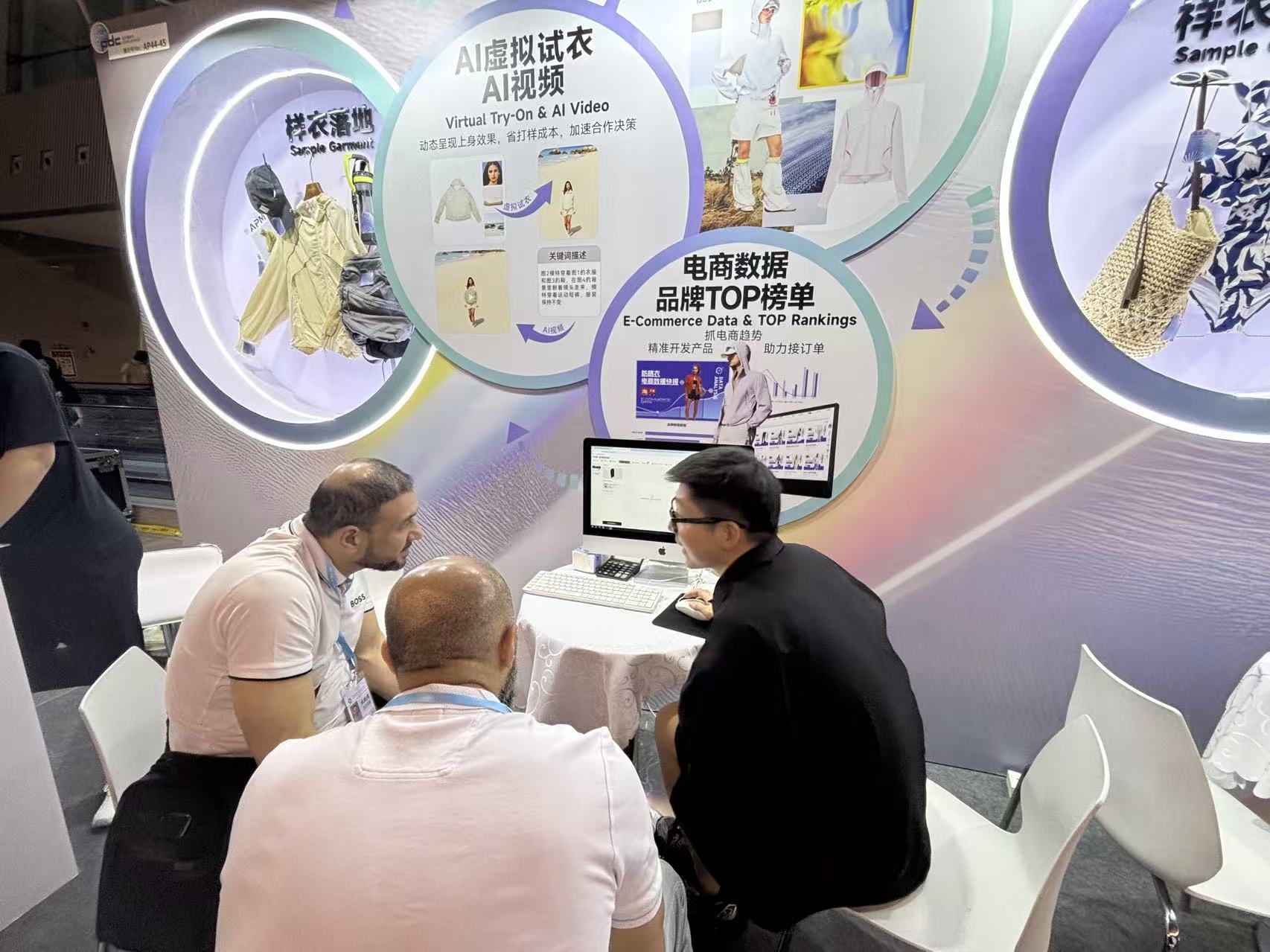
Core Insights - The current strategy for China's apparel and footwear industry in international markets focuses on "new quality productivity + design" [1] - The 138th China Import and Export Fair (Canton Fair) highlights the shift from attracting foreign investment through cheap supply chains to a combination of innovative design and high-quality supply chains [1] Group 1: AI Design Empowerment - AI design platforms showcased at the Canton Fair allow buyers to create multiple clothing samples with just one physical sample, significantly reducing costs [3] - An Arab buyer expressed excitement over the AI technology, noting that for a few thousand dollars, they could access the AI design platform for three years [4] - The AI clothing design company has served around 600,000 domestic clients and continues to see business growth at the fair [4] Group 2: 3D Printing in Footwear - The introduction of 3D printed shoes at the fair attracted significant interest from international buyers, with many expressing a desire to purchase immediately [7] - 3D printed shoes offer unique structural advantages that traditional manufacturing cannot achieve, such as customizable density based on mechanical principles [9] - The production capacity of the 3D printing shoe factory in Suzhou is approximately 2 million pairs annually, with ongoing efforts to reduce costs for broader market appeal [10] Group 3: Strategic Shifts in Manufacturing - The shift in China's export strategy is moving from "selling equipment (products)" to "selling solutions," with service-oriented manufacturing becoming a key pathway [11] - The footwear industry aims to upgrade its manufacturing capabilities and integrate AI into future designs, emphasizing the importance of customized solutions for different markets [10]
中集集团:中集安瑞科在湛江建造华南首个规模5万吨/年的生物绿色甲醇示范工厂,预计今年第四季度投产
Mei Ri Jing Ji Xin Wen· 2025-11-04 01:22
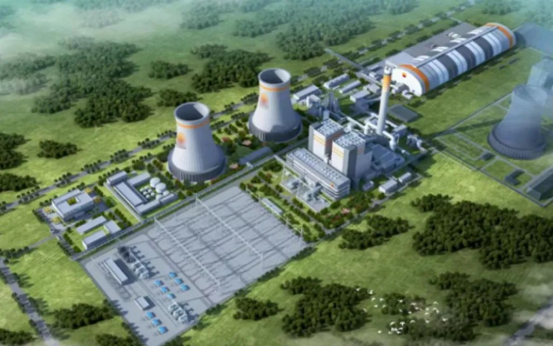
Core Insights - The company has aligned its strategic transformation with the recently approved 14th Five-Year Plan, focusing on smart manufacturing, green manufacturing, and service-oriented manufacturing [1] - In the clean energy sector, the company is well-positioned to capitalize on emerging opportunities, particularly in hydrogen energy and other strategic new industries [1] Group 1: Manufacturing Strategy - The company is advancing its transformation strategy by implementing digital production lines and "lighthouse factories" to enhance smart manufacturing capabilities [1] - It has developed a range of smart manufacturing equipment, including intelligent welding robots and automated guided vehicles [1] - The company is pioneering green manufacturing practices, such as using environmentally friendly water-based paints and modular construction methods to reduce construction waste [1] Group 2: Clean Energy Initiatives - The company’s clean energy business encompasses green methanol, hydrogen, and energy storage, creating a synergistic effect across the clean energy value chain [1] - A significant project includes the construction of a 50,000-ton-per-year bio-green methanol demonstration plant in Zhanjiang, expected to commence production in Q4 of this year [1] - The collaboration with Ansteel on a coke oven gas hydrogen production project aims to produce 15,000 tons of hydrogen and 100,000 tons of LNG annually, reducing carbon emissions by 470,000 tons [1] - The company is enhancing its technological advantages in LNG and hydrogen, developing integrated solutions for production, storage, transportation, and usage [1] - In the energy storage sector, the company’s products cater to various applications, and it has partnered with Denmark's VESTAS to develop the world's first modular containerized wind turbine nacelle [1]

【CGS-NDI跟踪】2025年超长期特别国债发行收官——政策双周报(2025年第7期)
Xin Lang Cai Jing· 2025-10-31 11:37
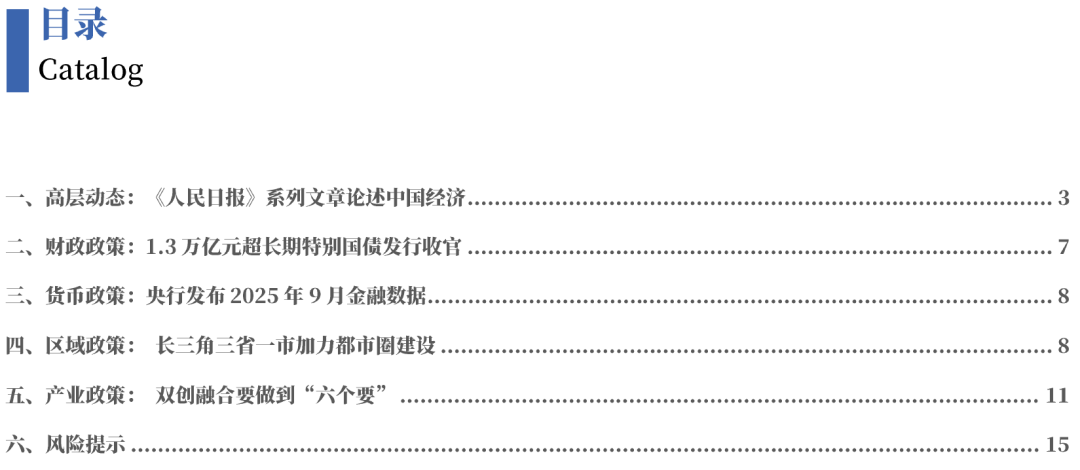
Group 1: High-Level Dynamics - The People's Daily published a series of articles discussing the long-term stability and development logic of the Chinese economy, emphasizing the strong signals for stabilizing expectations and promoting development [1][5] - Xi Jinping attended the Global Women's Summit and delivered a keynote speech, highlighting the importance of women's development and proposing several initiatives to support this cause [10][11] - Premier Li Qiang hosted a State Council study session focused on enhancing standards to promote high-quality economic development [15][16] Group 2: Fiscal Policy - The issuance of 1.3 trillion yuan in ultra-long-term special government bonds was completed, with funds aimed at supporting major national strategies and enhancing safety capabilities in key areas [25][26] - The issuance scale increased by 300 billion yuan compared to 2024, with a faster pace and earlier issuance time to ensure funds are utilized effectively [25][26] Group 3: Monetary Policy - The central bank's financial data for September 2025 showed M1 growth at 7.2% and M2 growth at 8.4%, with a narrowing M2-M1 gap, indicating a shift towards more liquid deposits [31] - New social financing totaled 3.53 trillion yuan, with a year-on-year decrease, reflecting challenges in loan growth for both households and enterprises [31] Group 4: Regional Policy - The Yangtze River Delta region is enhancing urban agglomeration construction, with a focus on coordinated development and infrastructure connectivity [33][39] - A report on global marine city competitiveness highlighted Shanghai's leading position, emphasizing the city's economic vitality and port throughput [34] Group 5: Industrial Policy - Shanghai introduced measures to accelerate the cultivation of future industries, aiming to establish a number of leading enterprises and innovation clusters by 2030 [47][52] - A multi-departmental plan was released to promote service-oriented manufacturing innovation, targeting the establishment of standards and leading brands by 2028 [52][54] - The national industrial and information technology conference emphasized the importance of integrating technological and industrial innovation to enhance competitiveness [54]
“制造+服务”如何实现“1+1>2”
Ke Ji Ri Bao· 2025-10-30 07:18
Core Viewpoint - Service-oriented manufacturing is becoming a crucial direction for the development of the manufacturing industry, emphasizing the integration of advanced manufacturing and modern services [1][2] Group 1: Definition and Characteristics of Service-oriented Manufacturing - Service-oriented manufacturing is a new business model that integrates digital technology and solutions into all lifecycle stages of manufacturing, from R&D to production and after-sales service [2][3] - It features three main characteristics: covering the entire product lifecycle, being user-demand driven, and integrating advanced technologies like industrial internet and artificial intelligence [2][3] Group 2: Advantages Over Traditional Manufacturing - Service-oriented manufacturing shifts the focus from product-centric to user-centric approaches, enhancing value through comprehensive lifecycle services [3] - It allows for higher added value compared to traditional manufacturing, which often relies on scale and low-end products [3] Group 3: Policy and Industry Development - The Ministry of Industry and Information Technology has recognized 372 demonstration enterprises and 157 projects since 2017, indicating significant progress in service-oriented manufacturing [6] - The new implementation plan aims to establish 50 leading brands and 100 innovation development hubs by 2028, promoting widespread adoption of service-oriented manufacturing models [7] Group 4: Case Study and Practical Applications - Lenovo's "Manufacturing as a Service" (MaaS) model supports startups by providing resources for product validation and flexible production, resulting in over 20% efficiency improvement and about 10% cost reduction [5] - The MaaS model connects global manufacturing resources, enabling rapid response to diverse customer needs and facilitating the transition from concept to production [4][5] Group 5: Future Outlook - The integration of manufacturing and services is seen as a key pathway to building a modern industrial system and fostering new productive forces [8]

股市面面观丨时隔十年!新能源板块助推沪指收盘站上4000点
Xin Hua Cai Jing· 2025-10-29 09:51
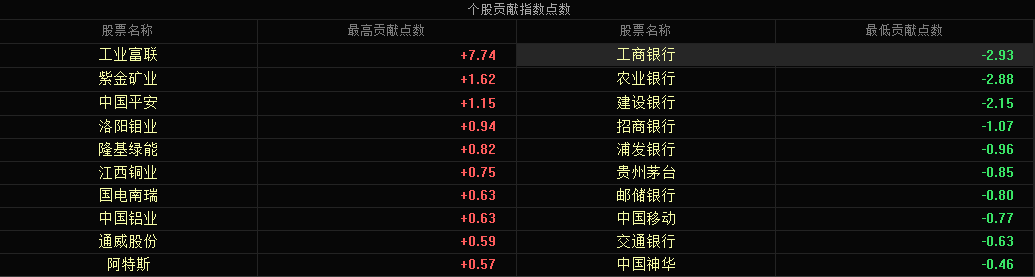
Market Overview - A-shares saw all three major indices rise, with the Shanghai Composite Index closing at 4016.33 points, up 0.7%, marking its first close above 4000 points since July 24, 2015 [1] - The Shenzhen Component Index closed at 13691.38 points, up 1.95%, and the ChiNext Index closed at 3324.27 points, up 2.93%, reaching a new high for the year [1] - Total trading volume exceeded 2.25 trillion yuan, an increase of over 100 billion yuan compared to the previous trading day [1] Individual Stock Contributions - Industrial Fulian was the top contributor to the Shanghai Composite Index, closing up 9.2% and contributing 7.74 points to the index [4] - Other significant contributors included Zijin Mining (+1.62), Ping An Insurance (+1.15), and Longi Green Energy (+0.82) [2][4] - Major banks like Industrial and Commercial Bank of China and Agricultural Bank of China negatively impacted the index, contributing -2.93 and -2.88 points, respectively [2][4] Sector Performance - The technology and resource sectors were the main drivers of the recent index increases, with the new energy sector being the largest contributor on the day [4] - The photovoltaic equipment sector saw an increase of over 8%, while energy metals (primarily lithium and cobalt stocks) rose nearly 5% [4][8] - The strong performance in the photovoltaic sector was largely driven by the impressive Q3 report from leading company Sungrow Power Supply, which reported a 32.95% year-on-year increase in revenue [5] Investment Opportunities - The storage sector, led by Sungrow Power Supply, also experienced significant gains, with analysts noting a turning point in economic viability for domestic storage [6] - The demand for storage is expected to drive lithium demand growth exceeding 30% next year, presenting investment opportunities across materials, batteries, and integration [6] - Strategic emerging industries are projected to surpass real estate in economic contribution starting in 2023, with potential policy support for sectors like new energy and advanced manufacturing [10][11]