橱柜

Search documents
欧派家居(603833):大家居战略纵深推进新周期欧派行稳致远
Guotou Securities· 2026-03-30 09:36
Investment Rating - The report maintains a "Buy-A" investment rating for the company, with a target price of 66.80 CNY [5]. Core Insights - The company is a leading one-stop high-quality home furnishing service provider in China, focusing on whole-house customization and integrated solutions, and has established a multi-brand matrix covering various price ranges [1][13]. - The real estate sector's adjustment is reshaping the home furnishing industry, transitioning from a new housing-driven model to a dual-driven model of new and existing home renovations, with expectations for a recovery in demand supported by policies [2][22]. - The company has integrated its operations into four major marketing divisions, promoting both retail and integrated home furnishing strategies, which has led to a significant reduction in unit costs and improved delivery efficiency [3][19]. Summary by Sections 1. Company Overview - The company has developed a multi-brand platform for the home furnishing industry, offering personalized design, research, production, and sales of various home products [13][14]. - The founder holds a 66.19% stake, indicating a highly concentrated ownership structure, and the company has committed to distributing at least 1.5 billion CNY in cash dividends annually from 2024 to 2026 [1][18]. 2. Industry Dynamics - The home furnishing industry is experiencing a shift due to the real estate sector's deep adjustment, with a growing emphasis on renovation of existing homes alongside new constructions [2][22]. - The market is expected to stabilize in 2024, with a projected 9.5% decline in new housing sales area in 2025, a significant improvement from the previous year's 12.9% drop [2][23]. 3. Strategic Development - The company is advancing its home furnishing strategy through organizational reforms and enhancing internal driving forces, which solidifies its leading position in the industry [3][22]. - The company has achieved a net promoter score of 61% in 2024, significantly higher than the industry benchmark of 38%, indicating strong customer satisfaction [3]. 4. Financial Forecast and Valuation - The company is projected to generate revenues of 182.01 billion CNY, 189.78 billion CNY, and 202.53 billion CNY for the years 2025 to 2027, with corresponding net profits of 24.37 billion CNY, 25.43 billion CNY, and 27.60 billion CNY [3][12].

索菲亚20260316
2026-03-17 02:07
Summary of the Conference Call for Sophia (2026) Company Overview - **Company**: Sophia - **Industry**: Home Furnishing and Custom Furniture Key Points and Arguments 1. Performance Goals and Distribution Strategy - The company aims for overall positive growth in 2026, implementing a "1+N+X" distribution model and plans to open 200-300 community stores to penetrate existing markets [2][3][4] 2. Pricing Strategy - During the 315 promotional event, the price range for promotional products is maintained at 800-1,000 RMB per square meter, while regular products are priced at 1,000-1,300 RMB per square meter. Price competition is becoming more rational, avoiding blind price cuts [2][4] 3. Brand Development - Milan brand plans to open 100 new stores in 2026 after clearing channels in 2025, aiming to stabilize its performance. The brands Simi and Huahwei are expected to maintain a scale of around 100 million RMB each [2][3] 4. Business Structure and Focus - The bulk business is targeted to maintain a 10% share, focusing on state-owned enterprises and high-end real estate projects. The integrated business is expected to see volume release in the second half of 2026 due to the elimination of low-priced projects in 2025 [2][3] 5. Product Bundling and Sales Strategy - The product bundling rate has improved to 30%, with strategies focusing on transparent pricing and product design combinations to enhance sales. The company anticipates further growth in 2026 with the launch of popular products [2][6][7] 6. International Expansion - The overseas business aims for double-digit growth, focusing on brand expansion in the Middle East and Southeast Asia, with plans to open 30-50 new stores [2][4][15] 7. Distributor and Dealer Relations - The company is adjusting its distributor relationships and expanding cooperation with construction companies. The integrated business is expected to stabilize, with a focus on maintaining a healthy business structure [3][11] 8. Cost Control and Efficiency - The company is focusing on cost reduction through refined procurement management and efficiency improvements via smart upgrades. The overall marketing and management expenses are expected to remain stable [12][14] 9. Market Conditions and Consumer Behavior - There has been a significant improvement in market consumption vitality and consumer price sensitivity compared to the second half of 2025. The company expects positive impacts to manifest in the second and third quarters of 2026 [3][4] 10. Challenges in the Second-Hand Market - Approximately 30% of customers are from the second-hand market, which presents challenges due to the additional renovation processes required. The company is working to streamline these services [16][17] 11. Shareholder Influence - The entry of Yingfeng Group as the second-largest shareholder has not changed daily operations or specific demands but is expected to maintain a stable dividend policy [16] 12. Future Outlook - The company is optimistic about maintaining a stable dividend policy due to sufficient cash reserves and no large-scale capital expenditure plans [16] This summary encapsulates the key insights and strategic directions discussed during the conference call, highlighting the company's focus on growth, market adaptation, and operational efficiency.

最高法院裁决并未“击溃”关税,一文看清特朗普多种可选工具及优缺点
Hua Er Jie Jian Wen· 2026-02-20 18:42
Core Viewpoint - The U.S. Supreme Court's ruling does not eliminate the possibility of large-scale tariffs reinstated by former President Trump, who may utilize various legal tools to re-establish a tariff system despite the ruling against the IEEPA-based tariffs [1] Group 1: Legal Tools for Tariffs - The most relied-upon tool during Trump's presidency was the Section 232 of the Trade Expansion Act of 1962, which allows tariffs based on national security reasons without limits on rates or duration [2] - Section 301 of the Trade Act of 1974 enables the U.S. Trade Representative to impose tariffs on countries deemed discriminatory against U.S. businesses, which Trump used to initiate trade tensions with China [3] - Section 122 of the Trade Act of 1974 allows for tariffs up to 15% for significant international balance of payments deficits, but has never been utilized and is limited to 150 days [5] - Section 201 of the Trade Act of 1974 permits tariffs when increased imports threaten U.S. manufacturers, requiring an investigation and public hearings, with a maximum tariff of 50% [6] - The Smoot-Hawley Tariff Act's Section 338 allows for tariffs up to 50% without prior investigation, but has not been used and may face legal challenges if invoked [7] Group 2: Implications of the Ruling - The Supreme Court's decision undermines Trump's core economic policy but does not end the overall tariff policy, as he can still leverage other legal authorities to impose tariffs [1] - Experts suggest that it is challenging to foresee a path to the end of tariffs, indicating that Trump can utilize alternative authorizations to reconstruct the existing tariff framework [1][2]
ESG观察|授权经销商“跑路”,索菲亚“塌房”,谁为消费者兜底?
Xin Lang Cai Jing· 2026-02-14 04:00
Core Viewpoint - The incident involving Sophia's brand Simi cabinets highlights significant risks in social responsibility and corporate governance within the rapidly expanding home furnishing industry, as a licensed dealer in Shenzhen suddenly closed, leaving hundreds of homeowners in financial distress with estimated losses reaching millions [1][16]. Group 1: Incident Overview - The crisis began with collective complaints from consumers on social media and complaint platforms, revealing that a Simi cabinets store in Shenzhen abruptly shut down, leaving customers unable to receive their orders or refunds [2][17]. - Many consumers were directed to the store through official channels, including advertisements and customer service recommendations from Sophia, which led them to trust the legitimacy of the dealer [2][17]. - The closure of the store resulted in significant confusion regarding the contractual obligations, as the signing entity and the actual payment recipient were not aligned, complicating the consumers' efforts to seek redress [8][21]. Group 2: Company Response - On February 5, Simi cabinets confirmed the dealer's issues, attributing the consumer losses to the dealer's financial troubles and unauthorized business practices [8][21]. - The company stated that it was also a victim in this situation, which sparked dissatisfaction among consumers who felt that the brand should take responsibility for the actions of its authorized dealer [8][21]. - As of February 7, Sophia announced that it had initiated delivery processes for valid orders in its system, while advising consumers with unrecorded orders to report to the authorities for legal assistance [9][22]. Group 3: ESG Performance and Implications - Sophia's ESG rating from Refinitiv on January 30 was C-, ranking last among four companies in the home goods sector, with low scores in environmental, social, and governance categories [10][22]. - The incident exposed a gap between Sophia's ESG commitments and actual practices, indicating a lack of effective integration of ESG management into business operations, particularly in high-risk franchise management [11][23]. - The company has recognized the urgency of the situation and plans to conduct comprehensive evaluations of its partners, implement electronic contract systems for traceability, and establish dedicated consumer service channels [11][23]. Group 4: Industry Perspective - The challenges faced by Sophia reflect broader governance issues in the home furnishing industry, particularly regarding franchise models during rapid expansion [12][24]. - Industry leaders are encouraged to establish stricter dealer admission standards and utilize digital technologies to enhance transparency in supply chains and sales processes [12][24]. - The competitive edge of home furnishing companies should extend beyond store numbers and revenue to include responsible management across the entire value chain, embedding ESG principles at every operational level to prevent similar crises in the future [12][24].

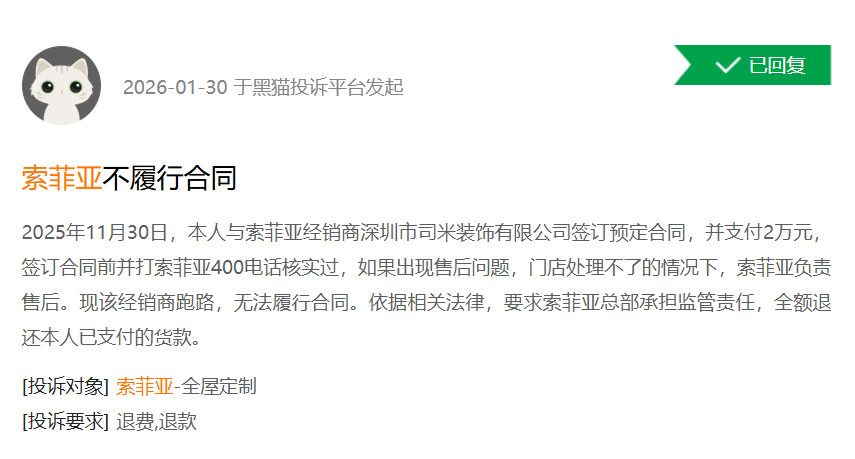
索菲亚,经销商跑了
Xin Lang Cai Jing· 2026-02-10 06:16
Core Viewpoint - The article discusses the issues faced by homeowners in Shenzhen who ordered custom home decoration products from the high-end brand Simi under the leading custom home furnishing company, Sophia, after the dealer suddenly absconded with their payments, affecting over 300 households and involving amounts exceeding ten million yuan [3][36]. Group 1: Incident Overview - Homeowners who ordered custom wardrobes and cabinets made advance payments ranging from tens of thousands to over 300,000 yuan, with some even paying in full [4][38]. - The dealer continued to solicit payments from homeowners just days before absconding, leaving homeowners unaware of the situation until notified by store employees [6][39]. - The dealer's actions have placed pressure on Sophia, as the contracts were signed under the name of Shenzhen Simi Decoration Co., Ltd., while the actual payment was received by another company, Anjia Tianxia [10][42]. Group 2: Company Structure and Dealer Relationship - The dealer, Anjia Tianxia, was established less than three years ago and is controlled by four individual shareholders, while Simi is backed by two natural person shareholders [12][46]. - Sophia's business model heavily relies on franchising, where dealers are responsible for customer acquisition, sales, and payment collection before ordering products from Sophia for installation [47]. - The relationship between the dealer and Sophia is characterized as authorized operation, where the dealer is responsible for selling Simi's products within a limited scope [48]. Group 3: Company Response and Consumer Rights - Sophia has stated that the dealer has not actually absconded but is handling the situation, while acknowledging that the dealer's financial issues have hindered order fulfillment [50]. - The company announced that it would selectively cover orders that can be verified in its system, while orders not recorded would be the responsibility of the dealer, leaving homeowners to pursue legal action [51][52]. - Homeowners are dissatisfied with Sophia's response, arguing that the brand's endorsement of the dealer implies a responsibility to vet and manage dealer risks [54]. Group 4: Industry Context and Challenges - The custom home furnishing industry is facing significant challenges due to a downturn in the real estate market, with Sophia experiencing an 8% decline in revenue and a 26% drop in net profit in the first three quarters of the previous year [24][57]. - Sophia is attempting to transition its business strategy from a single product focus to a comprehensive home solution approach, termed "full-case customization," to enhance consumer experience [30][62]. - The reliance on dealers, particularly those with complex ownership structures and diverse business operations, poses risks for Sophia, as evidenced by the recent incident with the dealer in Shenzhen [65].

募投项目4年未竣工,欧派家居靠闲钱理财月赚24万
Guo Ji Jin Rong Bao· 2026-02-09 15:46
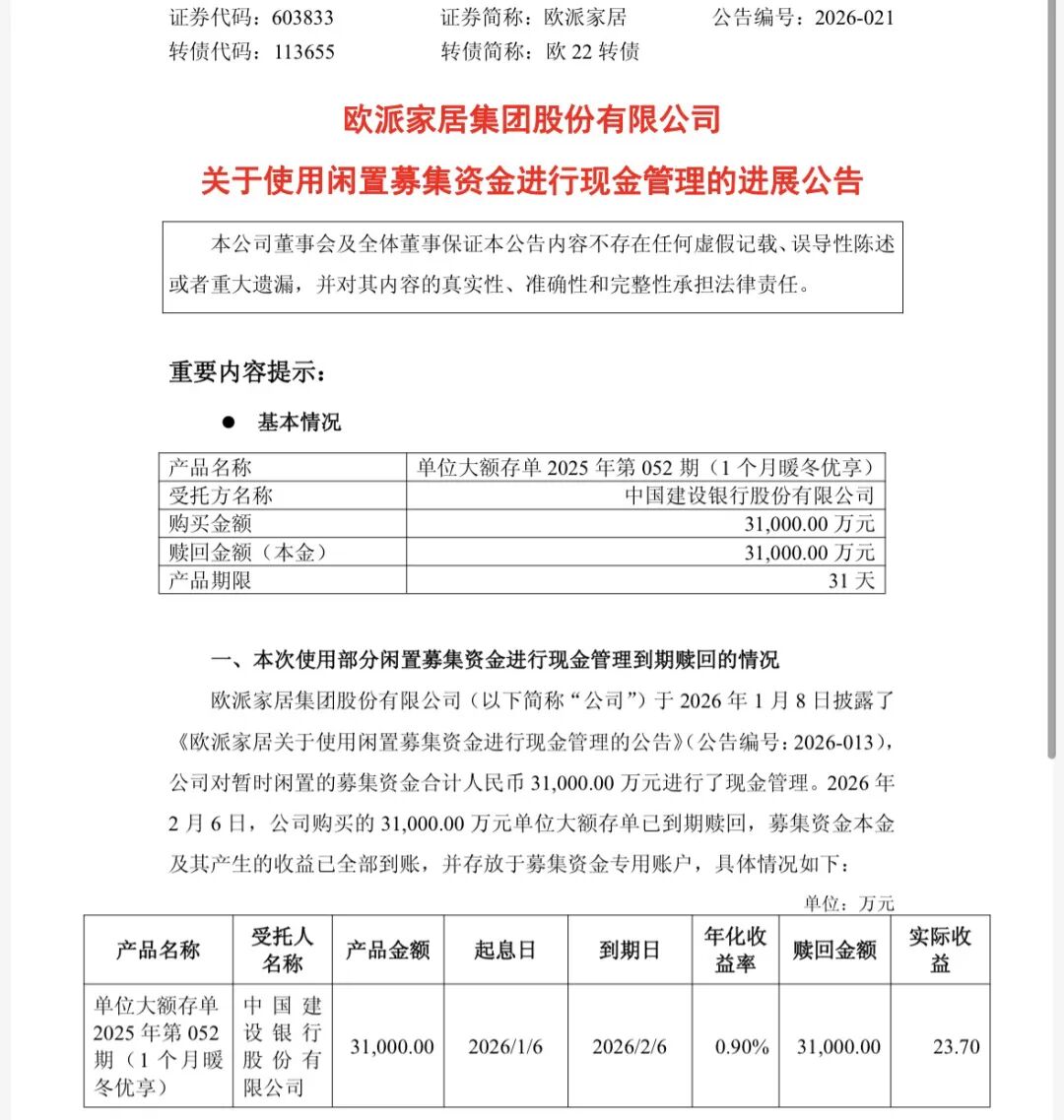
Core Viewpoint - The company, Oppein Home (603833), is reallocating its remaining funds from an unfinished project to other investments due to prolonged delays and challenges in the home furnishing industry [1][9]. Group 1: Fund Management and Project Status - Oppein Home announced that it has engaged in cash management for temporarily idle raised funds of 310 million yuan, yielding a return of 237,000 yuan [1][6]. - The company has invested a total of 1.708 billion yuan in the "Oppein Smart Manufacturing (Wuhan) Project," with an investment progress of 85.62% as of November 2025 [8]. - The remaining balance of raised funds is approximately 320 million yuan, which will be redirected to other projects as the original project has not been completed [8][12]. Group 2: Industry Challenges and Financial Performance - The home furnishing industry is facing significant challenges, including weak demand, structural changes in supply and demand, and intensified competition, leading to operational pressures for companies [9][10]. - For the first three quarters of 2025, Oppein Home reported a revenue of 13.21 billion yuan, a year-on-year decline of 4.8%, with a net profit attributable to shareholders dropping by 9.8% to 1.83 billion yuan [10][11]. - Sales across all product lines have decreased, with cabinets down 4.8%, wardrobes and related furniture down over 5%, and other categories also experiencing declines [11]. Group 3: Future Plans and Investments - The company plans to invest approximately 370 million yuan in three new projects focused on digital and intelligent upgrades, with 320 million yuan sourced from the remaining funds of the Wuhan project [12][13]. - The expected construction period for these new projects ranges from 2 to 3 years, raising questions about the company's trajectory during this period [13].
被曝“收钱后跑路、经销商资金链断裂”,知名品牌紧急声明
Nan Fang Du Shi Bao· 2026-02-07 16:52
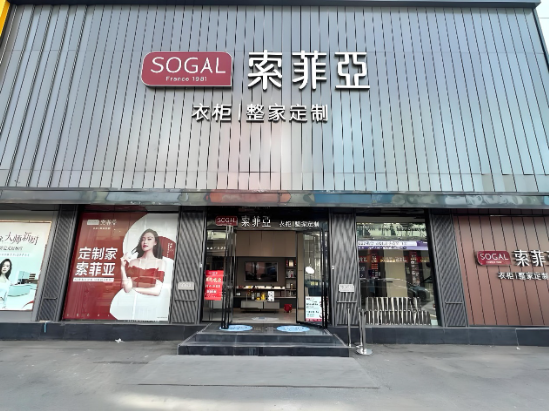
Core Viewpoint - The high-end cabinet brand Simi, under Sophia, is facing a public relations crisis due to a suspected financial collapse of a Shenzhen dealer, leading to significant consumer complaints regarding prepaid orders at risk, estimated to involve amounts reaching tens of millions [1][2]. Group 1: Incident Overview - A dealer named Anjia Tianxia in Shenzhen has reportedly collected consumer payments ranging from tens of thousands to hundreds of thousands, but has failed to deliver products on time, leading to a consumer-identified total of potentially tens of millions at risk [2]. - The root cause of the crisis is attributed to the dealer's unauthorized operations beyond their authorized scope, which has led to a breakdown in their financial chain [4]. Group 2: Company Response - On February 5, Simi issued a "Consumer Protection Action Statement," establishing a special emergency working group to address the situation and initiate a classification disposal plan [1][6]. - For valid orders that can be verified in Simi's system, the brand has begun the delivery process, with reports of installations already completed for over ten affected consumers [6]. Group 3: Legal and Consumer Support - Simi has advised consumers affected by unauthorized transactions to seek legal recourse, while also forming a legal aid team to assist in collecting evidence and reporting to authorities [7]. - The company is facing challenges due to the separation of signing and payment entities, complicating the resolution process for consumers [5]. Group 4: Industry Implications - This incident highlights long-standing management vulnerabilities within the custom home furnishing industry, particularly in the franchise model that combines brand authorization with local dealer operations, which can lead to inconsistent service quality and lack of financial oversight [7]. - Simi has committed to nationwide reforms, including evaluating partner qualifications and implementing an electronic contract system for traceable order processes, although the effectiveness of these measures remains uncertain [8].

定制家居龙头索菲亚“塌房”:旗下经销商突然跑路,业主称被卷走千万
Xin Lang Cai Jing· 2026-02-05 07:27
Core Viewpoint - The recent incident involving the sudden disappearance of a dealer under the leading custom home furnishing company, Sophia, has raised concerns about the company's franchise management system and its operational challenges amid a declining real estate market and increasing competition [2][11][25]. Group 1: Incident Overview - Multiple homeowners reported that a dealer of Sophia's brand, Simi, in Shenzhen abruptly "ran away," affecting hundreds of homeowners with an estimated total amount involved reaching tens of millions [2][17]. - Homeowners learned about the dealer's failure when notified by store employees that the owner had fled with funds, leaving employees unpaid for three months and many homeowners who had paid deposits or full amounts without receiving their orders [2][17]. - The incident has highlighted significant flaws in Sophia's franchise management system, as many homeowners were misled into believing they were dealing with an authorized dealer through official channels [2][4][21]. Group 2: Financial Impact on Homeowners - The incident has left homeowners in a "money and goods empty" situation, with over 300 homeowners affected and payment ratios for custom cabinets ranging from 40% to 80%, with amounts varying from tens of thousands to over 300,000 [17][18]. - Homeowners were able to connect with the dealer primarily through Sophia's official channels, which included customer service recommendations and social media advertisements [4][17]. Group 3: Company Response and Management Issues - Sophia has stated that it is conducting a comprehensive verification of order information related to Simi products but has not provided any updates to affected homeowners [6][20]. - The company has been criticized for its inadequate control over franchisees, as previous incidents of dealer failures were not taken seriously enough, leading to a lack of effective warnings for other dealers [9][23]. Group 4: Financial Performance and Market Challenges - Sophia has faced significant operational challenges, with revenue declining since 2024, reporting a 10% year-on-year decrease to 10.49 billion in 2024, and a further 8.46% decline in the first three quarters of 2025 [11][25]. - The company's net profit for 2024 was reported at 1.371 billion, reflecting a growth slowdown compared to previous years, with a 26.05% year-on-year decrease in the first three quarters of 2025 [11][25]. - The overall cash flow situation has worsened, with negative operating cash flow recorded for three consecutive quarters, totaling -405 million in the first three quarters of 2025 [11][25]. Group 5: Brand Performance and Strategic Issues - The performance of Sophia's core brands has shown increasing divergence, with the main brand experiencing revenue declines while sub-brands like Simi are reporting losses, exacerbating operational pressures [13][27]. - The company has been relying on a "direct + franchise" model for market expansion, with franchise channels contributing approximately 78% of revenue in the first half of 2025, highlighting the importance of effective franchise management [21][25].
兔宝宝(002043):定制化趋势下的全方位变革,新动能助力新成长
GOLDEN SUN SECURITIES· 2026-01-30 07:27
Investment Rating - The report gives a "Buy" rating for the company, marking its first coverage [4]. Core Insights - The company is positioned as a leading player in the engineered wood panel industry, benefiting from the growing demand for customized furniture and the shift towards B-end customers [3][4]. - The engineered wood panel market in China is projected to reach a consumption volume of 330 million cubic meters by 2024, with a market size of approximately 725.3 billion yuan [1]. - The company has a strong reputation for environmental sustainability, achieving a formaldehyde release level that is one-third of the industry's highest recognized standard [2]. Summary by Sections Company Overview - The company, 德华兔宝宝装饰新材股份有限公司 (Rabbit Baby), was established in 1992 and is the first listed company in China's decorative panel industry, focusing on decorative materials and customized home furnishings [14]. Market Dynamics - The engineered wood panel industry is entering a mature phase, with significant growth opportunities in specific segments like particleboard, driven by the rapid development of the custom furniture sector [1][40]. - The market is characterized by a high degree of fragmentation, with over 8,600 companies operating in the sector as of the end of 2024 [1]. Environmental Commitment - The company emphasizes its commitment to environmental standards, which has become a primary criterion for consumers when selecting wood panels [2]. Business Strategy - The company is actively transforming its sales channels towards B-end customers, focusing on partnerships with small and medium-sized custom furniture manufacturers to enhance brand differentiation [3]. - The company is also expanding its product offerings to include high-margin auxiliary materials, which are expected to drive revenue growth [4]. Financial Projections - The company is expected to achieve net profits of 764 million yuan, 900 million yuan, and 1.046 billion yuan for the years 2025, 2026, and 2027, respectively, with a projected annual growth rate exceeding 21% [4]. - The company maintains a strong cash flow and generous dividend policy, with a historical dividend payout ratio exceeding 50% [38].

一老一小工程
Xin Lang Cai Jing· 2026-01-25 20:19
Group 1 - The core objective is to appropriately increase the basic pension for retirees and implement mechanisms to raise the basic pension for urban and rural residents in a timely manner [2] - A total of 16 projects for the renovation and capacity enhancement of elderly care facilities have been initiated, along with the adaptation of at least 1,500 households for elderly individuals [2] - The average monthly increase in the basic pension for urban residents is 25 yuan, while the basic pension for retirees from enterprises and public institutions has been raised by 2% [2] Group 2 - The completion of 2,056 household adaptations for elderly individuals and the construction of 108 rural mutual happiness homes have been reported [2] - The total number of childcare service spots has reached 27,360, with a ratio of 4.57 spots per 1,000 people [2] - The installation of various elderly-friendly facilities has significantly improved the quality of life for seniors, addressing issues such as mobility and daily living challenges [3][4]