
科学智能

Search documents
中国科学院院士姚期智:科学前沿工作者如何把AI与传统科技融合是当前的重大课题
Mei Ri Jing Ji Xin Wen· 2025-11-16 01:55
Core Viewpoint - The rapid rise of "AI for Science" is a significant topic, emphasizing the need for researchers at the forefront of science to integrate AI with traditional technologies, as methods of scientific research will evolve dramatically in the coming years [1] Group 1 - The "2025 AI+" conference highlights the importance of adapting to the integration of AI in scientific research [1] - Yao Qizhi, a Turing Award winner and academician, stresses the urgency for scientists to understand and leverage the development trends of AI [1] - The methods of conducting scientific research are expected to change significantly within the next five to ten years [1]
2025西丽湖论坛成功举办 AI驱动科学发现与产业未来定义新范式
Zheng Quan Shi Bao Wang· 2025-11-15 13:26
Core Insights - The 2025 Xili Lake Forum focuses on accelerating scientific discovery and defining the future of industries, emphasizing the integration of artificial intelligence and scientific research [1] - Key announcements include the establishment of the International Intellectual Property Academy and the launch of the Peking University AI4S Talent Cultivation Program [1] Group 1: Forum Highlights - The forum gathers academic leaders, industry pioneers, and cross-disciplinary forces to discuss topics related to scientific infrastructure in the AI era and seizing opportunities in new industrial transformations [1] - Zhang Jin, a prominent academic figure, highlights "scientific intelligence" as a crucial innovation merging AI with scientific research, marking it as a significant outcome of the new technological revolution [1] Group 2: Strategic Importance - The forum underscores Shenzhen's commitment to enhancing original innovation and investing in talent, which is deemed significant in the context of global industrial restructuring [2] - Lin Ziao, CEO of Aosheng Cheng, emphasizes that accelerating scientific discovery will grant greater influence in future industries [2]
AI for Science驱动科研范式变革,青年科学家能力重构 | 巴伦精选
Tai Mei Ti A P P· 2025-11-11 03:37
Core Insights - The forum "AI for Science" held during the 2025 World Internet Conference focused on how AI is reshaping scientific research paradigms and stimulating new productivity [2][3][4] Group 1: AI Applications in Scientific Research - AI is becoming a crucial tool to overcome long-standing challenges in materials research, such as measurement limitations, as highlighted by Chen Lidong from the Shanghai Institute of Silicate [3] - AI models have shown significant potential in enhancing catalyst performance by 50% through iterative experimentation and modeling, demonstrating the efficiency of AI in material discovery [3] - The concept of "AI for Materials" and "Materials for AI" emphasizes a reciprocal relationship between AI and materials science [4] Group 2: AI in Healthcare - AI brain-machine interfaces are being applied in managing neurodegenerative diseases, with advancements allowing for quicker detection of seizures compared to traditional methods [5] - The accuracy of language decoding in AI has improved significantly, particularly in recognizing Chinese phonetics, achieving over 70% accuracy [5] Group 3: AI's Impact on Innovation - Generative AI is optimizing product design and team collaboration in open innovation, while its direct impact on disruptive innovation remains limited, underscoring the importance of human creativity [7] Group 4: Future Directions in AI and Science - The "scientific intelligence" concept is seen as a pathway to superintelligence, with significant advancements in drug design for diseases lacking clear targets, achieving a 50-fold improvement in molecular design [9][10] - The demand for computational power in AI for science is growing exponentially, necessitating a unique capability to couple high and low precision in scientific calculations [11] - The release of the "Global AI Standards Development Report" calls for collaboration among international organizations, governments, and industries to establish responsible global standards [13] Group 5: AI Infrastructure and Talent Development - The "Panshi V1.5" platform aims to empower scientific research across disciplines, covering the entire research process from hypothesis to discovery [18] - The forum concluded with discussions on the role of AI in empowering young scientists, emphasizing the need for interdisciplinary collaboration and the evolution of AI from a tool to a collaborator [25]

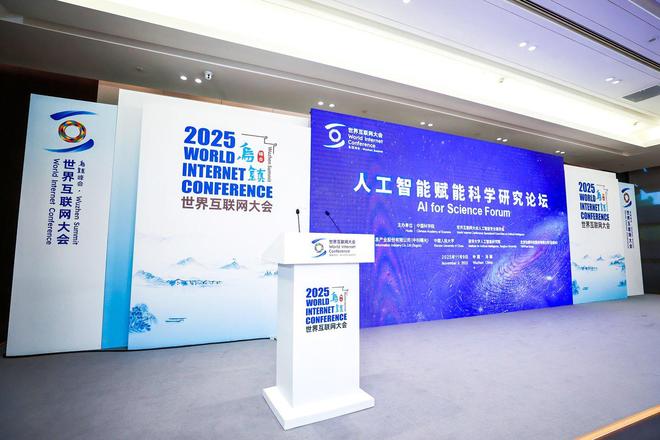
【人民网】一站式智能科研平台“磐石”亮相世界互联网大会乌镇峰会
Ren Min Wang· 2025-11-10 00:54
Core Insights - The "Panshi V1.5: One-stop Research Platform" was officially launched at the 2025 World Internet Conference, marking a significant evolution from the previous version released on July 26 this year [1] - The V1.5 upgrade enhances the foundational capabilities of "Panshi: Scientific Foundation Model" and "Panshi: Literature Compass," while introducing two new scientific intelligent agents: "Panshi: Innovation Assessment" and "Panshi: Intelligent Factory," making the platform more comprehensive [1] Group 1: Applications in Astrophysics - In the field of astrophysics, a star parameter inversion toolchain was developed in collaboration with the National Astronomical Observatory, addressing high computational costs and complex processes [2] - The new system transforms traditional complex numerical calculations into efficient interpolation and weighted matching, significantly improving inversion speed and enhancing result reliability, stability, and interpretability [2] - This advancement reduces computational costs and lowers the usage threshold, enabling cross-disciplinary researchers to easily conduct star parameter analysis and validation [2] Group 2: Innovations in Energy Materials - In the energy materials sector, a fully automated end-to-end material reverse design system, S1-MatAgent, was created in partnership with the Shanghai Institute of Ceramics, Chinese Academy of Sciences [2] - This system autonomously performs literature reading, material calculations, and optimizations, successfully identifying 13 high-performance materials from 20 million candidate formulations, with new materials showing a 38% improvement in activity over traditional commercial catalysts [2] - The design cycle, which previously took months, has been reduced to just 30 minutes, marking a critical shift from "trial-and-error" to "AI-driven" material development [2] Group 3: Advancements in Mechanical Engineering - In mechanical engineering, an intelligent load calculation technology was developed in collaboration with the Institute of Mechanics, Chinese Academy of Sciences, addressing high costs and long cycles in fluid load calculations for complex configurations like high-speed trains and aircraft [3] - This technology reduces key parameter errors by 42% in data-scarce scenarios and shortens the simulation analysis time for high-speed train aerodynamic issues from several hours to seconds [3] - It supports multi-format 3D configuration input and automates the entire process from data parsing to result visualization, providing critical data support for the design and optimization of major equipment configurations [3]

北京市科学技术奖公布
Bei Jing Ri Bao Ke Hu Duan· 2025-11-07 22:33
Core Insights - The 2024 Beijing Science and Technology Awards recognized 38 scientists and 193 achievements, with over half of the awarded projects involving enterprises for six consecutive years [1][3] - Basic research achievements accounted for 29.5% of the total awards, indicating a growing emphasis on foundational scientific work [1][2] Summary by Categories Basic Research Achievements - Basic research is highlighted as the source of innovation, with significant contributions in fields like new information technology, new materials, and health [2] - Notable awardees include Professor Deng Hongkui for developing new strategies in stem cell therapy and researcher Dong Jin for leading the development of the "Chang'an Chain," a domestically controllable blockchain technology [2] Enterprise Innovation - The project "Advanced Oxide Semiconductor Technology for Intelligent Display" won the first prize in scientific and technological progress, showcasing the critical role of enterprises in innovation [3] - Companies like BOE Technology Group have demonstrated a commitment to R&D, with a focus on talent retention and long-term investment in technology development [3] Young Talent - Over 50% of the awardees are under 45 years old, reflecting a vibrant pool of young talent in the scientific community [4] - Young scientists like Liu Ying and Chang Kai are making significant contributions in life sciences and quantum materials, respectively, indicating a strong future for innovation in these fields [4][7] Award Overview - The awards included 57 natural science achievements, 24 technological invention awards, and 112 scientific and technological progress awards, with a total of 15 first prizes in natural sciences and 29 first prizes in technological progress [6]
晶泰科技获纳入MSCI中国指数,全球投资基准认可发展潜力
Zhi Tong Cai Jing· 2025-11-06 07:41
Core Insights - MSCI announced the inclusion of JingTai Technology in the MSCI China Index, effective November 24, 2025, recognizing its innovation in AI and robotics for new drug and material development [1][4]. Group 1: MSCI Inclusion - JingTai Technology is among 26 new stocks added to the MSCI China Index, which includes various resource stocks and technology companies in AI, robotics, semiconductors, and high-end manufacturing [3][4]. - Inclusion in the MSCI China Index signifies entry into the MSCI global standard index series, attracting significant passive investment tracking [4]. Group 2: Company Profile - JingTai Technology is an innovative R&D platform integrating quantum physics, AI, and standardized experimental robotics, focusing on the commercialization of AI in various sectors including pharmaceuticals, energy, agriculture, and new materials [5]. - The company has established partnerships with over 300 international enterprises and research institutions, and aims to achieve profitability in the first half of 2025 [5]. - JingTai Technology is one of the few platforms with high-value collaborations in both AI small molecule and AI biopharmaceutical development, serving 15 of the top 20 global pharmaceutical companies [5].
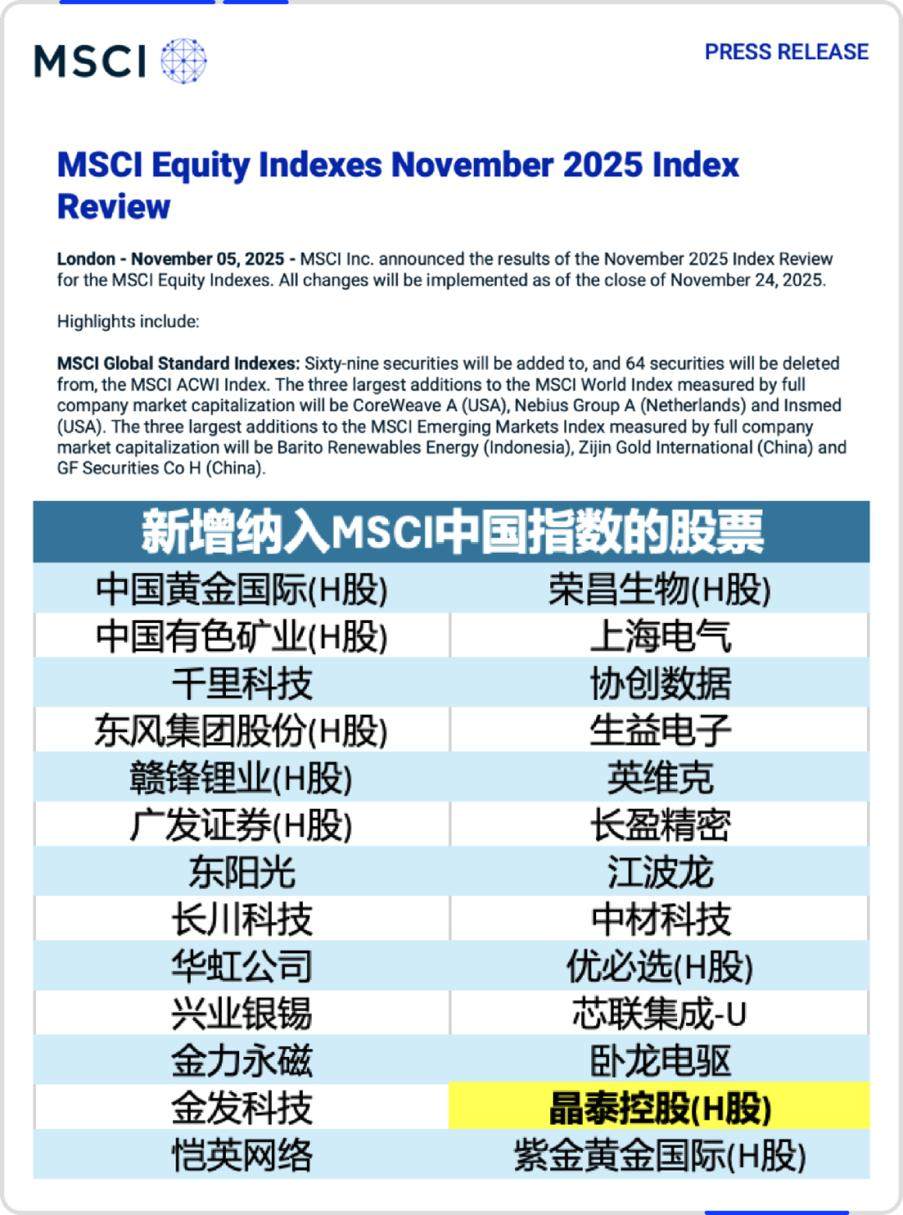
晶泰科技(02228)获纳入MSCI中国指数,全球投资基准认可发展潜力
智通财经网· 2025-11-06 07:40
Core Insights - MSCI announced the inclusion of JingTai Technology (02228) in the MSCI China Index, effective after the market close on November 24, 2025, recognizing its innovation in AI and robotics for new drug and material development [1][4]. Group 1: MSCI Inclusion - The MSCI China Index added 26 stocks, including JingTai Technology, which signifies entry into the MSCI global standard index series, attracting passive investment funds [3][4]. - The selection for the MSCI China Index is based on objective quantitative metrics such as market capitalization, free float, liquidity, and market investability, indicating JingTai Technology meets strict international standards [4]. Group 2: Company Overview - JingTai Technology is an innovative R&D platform integrating quantum physics, AI, and standardized experimental robotics, focusing on the commercialization of AI in various sectors including pharmaceuticals, energy, agriculture, and new materials [5]. - The company has established partnerships with over 300 international enterprises and research institutions, and aims to achieve profitability in the first half of 2025 [5]. - JingTai Technology is one of the few platforms with high-value collaborations in both AI small molecule and AI biopharmaceutical development, serving 15 of the top 20 global pharmaceutical companies [5].
良乡大学城人工智能大讲堂启动
Zheng Quan Ri Bao Wang· 2025-10-21 13:44
Core Insights - The "Liangxiang University Town AI Lecture Hall" was officially launched on October 21, 2025, with its first lecture themed "Frontier Development and Strategic Landscape of AI" [1] - The initiative aims to implement national strategies, support the construction of Beijing's international science and technology innovation center, and empower high-quality regional development [1] - The lecture series is designed to break down barriers between universities and disciplines, creating an open and continuous knowledge-sharing platform to foster innovative talent capable of navigating the intelligent era [2] Group 1 - The first lecture featured Chen Kai, a mentor from the Zhongguancun AI Research Institute, who reviewed the three waves of AI development and discussed the collaborative evolution of algorithms, data, and computing power [1] - Key topics included large models, embodied intelligence, and scientific intelligence, with an emphasis on their technical principles, current development status, and core challenges [1] - The lecture highlighted the strategic value of AI in reshaping business organizations, creating new paradigms for human-computer interaction, and optimizing research processes [1] Group 2 - The lecture hall is part of a series of courses that span ten weeks, covering AI foundational theories, core technologies, and cross-disciplinary applications in various fields such as culture, education, healthcare, transportation, finance, manufacturing, and robotics [2] - The "AI+Finance" innovation laboratory collaborates with experts from Tsinghua University, Beijing Jiaotong University, Huawei, and the Zhongguancun AI Research Institute to enhance the curriculum [2] - The series also incorporates investor education to improve students' financial literacy and risk awareness, addressing issues like investment-related telecom fraud [3] Group 3 - The ongoing series aims to expand students' technological perspectives and strengthen their knowledge of AI, enhancing their future career competitiveness [3] - The initiative serves as a crucial support for regional technological innovation and industrial upgrading, aligning with national strategic goals [2]
聚焦青年科学家激发原始创新,上海市科学智能“百团百项”阶段成果亮相
Xin Lang Cai Jing· 2025-09-25 10:45
Core Insights - Scientific intelligence is reshaping research paradigms and empowering industrial upgrades through AI integration in various scientific fields [1][2] - The "Hundred Teams, Hundred Projects" initiative aims to support at least 100 teams and projects within two years, fostering collaboration among AI talents, scientists, and engineers [1][2] - The average age of project leaders in the initiative is 35, highlighting a focus on young scientific talent [1] Group 1: Project Highlights - Professor Gao Yue from Fudan University developed electrolyte materials for lithium iron phosphate batteries, achieving 96% health status after 12,000 charge-discharge cycles and establishing production lines for large-scale manufacturing [2] - The initiative emphasizes cross-disciplinary collaboration and data sharing, which are crucial for driving original innovation [2] - The Zhu Tong team from Shanghai Chuangzhi Academy developed machine learning methods for quantum chemistry calculations, improving efficiency by three orders of magnitude compared to traditional methods [2][3] Group 2: Innovations in Engineering - The Zhou Ying team from Tongji University proposed an automated and intelligent full-link process for building design, increasing modeling and modification efficiency by over 10 times compared to traditional methods [3] - The Lin Zhouhan team from Shanghai Jiao Tong University built a specialized pre-trained model for wind power prediction, achieving the highest accuracy in national renewable energy forecasts for the first quarter of 2025 [3] Group 3: Characteristics of the Initiative - The "Hundred Teams, Hundred Projects" initiative showcases deep integration between young AI scientists and domain experts, creating an efficient collaborative innovation mechanism [4] - Some projects have already partnered with leading companies like CATL, demonstrating the advantages of the "AI scientist + domain expert + engineer" co-creation model [4] - Original breakthroughs in AI methodologies have been achieved, significantly accelerating the scientific discovery process [4] Group 4: Future Directions - The initiative will focus on transforming cutting-edge original achievements into real productive forces by creating industry solution showcases and building an open scientific intelligence cloud platform [5]
周伯文“六问”AGI for Science 探索科学智能边界
Xin Hua Cai Jing· 2025-09-25 08:02
Core Viewpoint - The article discusses the potential and challenges of Artificial General Intelligence (AGI) in the context of scientific research, emphasizing the need for a balanced perspective on its capabilities and limitations [1][2]. Group 1: AI for Science Developments - AI for Science (AI4S) is recognized for its value in scientific research, with recent achievements presented at the 2025 Pujiang Innovation Forum, including the Amix-Agent for protein design and the DeepPeptide model for peptide synthesis [2][5]. - The integration of AI in various scientific fields such as biomanufacturing, quantum technology, and climate energy is being promoted through the establishment of the "Scientific Intelligence Strategic Technology Alliance" [5]. Group 2: Six Questions on AGI for Science - The first question addresses the boundaries of AI, questioning whether all scientific problems can be solved by AI, highlighting the historical context of this debate [2]. - The second question examines the predictive capabilities of AGI, cautioning against overestimating current models' ability to predict scientific phenomena due to limitations in existing human knowledge [3]. - The third question focuses on the representation of scientific concepts, suggesting that AI should move beyond natural language to include symbolic languages for better expression [3]. - The fourth question explores the potential for AGI to foster interdisciplinary collaboration, emphasizing its role in revealing unseen connections between different scientific fields [3]. - The fifth question proposes a thought experiment to evaluate AGI's ability to make significant scientific discoveries, using the example of deriving general relativity from prior knowledge [4]. - The sixth question discusses the evolving relationship between researchers, research subjects, and tools, indicating AI's potential to identify valuable patterns in unstructured data [4].