退市新规

Search documents
三家公司在退市新规下折戟沉沙
Huan Qiu Wang· 2025-05-08 02:24
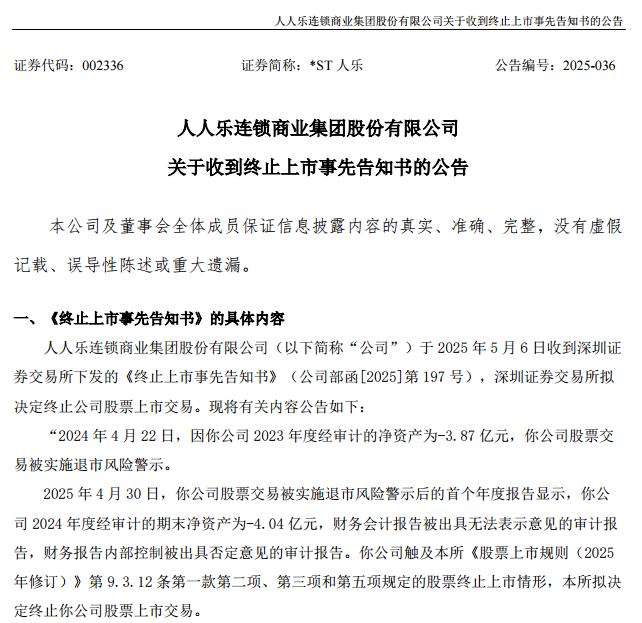
Group 1 - Three companies, *ST Zhongcheng, *ST Renle, and *ST Hengli, received the "Notice of Termination of Listing" from the Shenzhen Stock Exchange, indicating a potential exit from the A-share market [1][4] - The termination of listings reflects the intensified efforts to clear out risk companies under the new delisting regulations, marking the end of the "zombie" era in the A-share market [1][9] Group 2 - *ST Zhongcheng's delisting is closely linked to its long-term financial fraud, with the company having inflated its revenue by 1.403 billion yuan in 2017, accounting for 92.18% of its reported revenue for that period [2] - *ST Hengli faced a dramatic delisting path, with new controlling shareholder Shi Shengping failing to rescue the company, which reported negative net profits for two consecutive years and revenue below 100 million yuan [3][4] - *ST Renle's operational difficulties are highlighted by a nearly 50% year-on-year decline in revenue for 2024 and a negative net asset of -404 million yuan, leading to an audit report that could not express an opinion [5][6] Group 3 - The experiences of these three companies illustrate the impact of the new delisting regulations, which feature stricter financial delisting indicators and create a balance with the comprehensive registration system, promoting the exit of "bad money" and reallocating resources to quality enterprises [9]

锦州港财务造假屡犯不改 造假多年被审计机构大华无视?
Xin Lang Zheng Quan· 2025-05-07 10:00
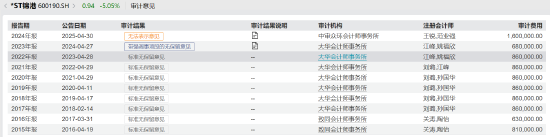
令人震惊的是,锦州港在2024年11月首次被证监会立案调查并处罚后,仍持续造假。值得注意的是,公 司18年至23年年报审计机构均为大华会计事务所,但造假似乎被其无视,多年出具无保留的审计意见类 型。 曾系统性财务造假被立案,虚增利润超1.7亿元 锦州港的财务造假行为最早可追溯至2018年。根据中国证监会2024年6月披露的《行政处罚及市场禁入 事先知书》,公司为"做大收入和利润、满足银行贷款需求",通过无商业实质的虚假贸易业务,系统性 虚增营业收入、营业成本和利润总额。具体来看: 造假规模:2018年至2021年累计虚增营业收入86.24亿元,虚增利润总额1.79亿元。其中,2018年虚增利 润2070.9万元,2019年3899.9万元,2020年4415.7万元,2021年7511.4万元。 造假手段:通过子公司锦国投(大连)发展有限公司控制上下游供应商及客户的资金流转,形成闭环资 金池。例如,采购资金经大连和境等五家供应商流入锦国投资金池,再通过上海盛辙、舟山丰聚益尚等 公司回流至锦州港,制造虚假贸易流水。 责任认定:时任董事长徐健、副董事长兼总经理刘辉被认定为直接负责的主管人员,财务总监李挺等高 管为 ...

退市新规显威 首个年报季精准出清经营风险公司
Huan Qiu Wang· 2025-04-30 01:57
Group 1 - The implementation of new delisting regulations has led to a significant number of companies on the main board facing delisting risk warnings due to net profit losses and revenues below 300 million yuan [1][3] - As of April 29, a total of 48 companies have triggered financial delisting indicators, primarily in the social services, machinery, and textile industries, indicating prolonged losses and ineffective business transformations [3] - The new regulations aim to accurately identify "shell companies" and accelerate the elimination of poor-performing firms, thereby directing capital towards stable and fundamentally sound enterprises [3][4] Group 2 - The revenue threshold for delisting has been raised from 100 million yuan to 300 million yuan, intensifying the elimination of "zombie companies" [4] - *ST Longjin serves as a typical case under the new regulations, having been suspended due to continuous losses and revenues below 300 million yuan, with its revenue hovering around 100 million yuan from 2022 to 2024 [4] - The synergy between the new delisting rules and the comprehensive registration system is becoming evident, ensuring the effective operation of the capital market's survival of the fittest mechanism [4]



退市新规后首个年报季 组合类财务退市指标“亮剑”显威
Shang Hai Zheng Quan Bao· 2025-04-29 20:02
Core Viewpoint - The newly revised financial delisting indicators have effectively identified a number of main board companies with net profit losses and revenue below 300 million yuan, highlighting their weak operational sustainability and leading to delisting risk warnings for some companies [1][4]. Group 1: Financial Delisting Indicators - A total of 48 main board companies have triggered the new financial delisting indicators as of April 29, with industries such as social services, machinery, and textiles being the most affected [1]. - The new rules have raised the revenue threshold for delisting from 100 million yuan to 300 million yuan, directly impacting companies like Aiai Precision Engineering, which has struggled with revenue below the new threshold [2][4]. Group 2: Company Performance and Risks - Aiai Precision Engineering has reported continuous revenue below 300 million yuan since its listing in 2017, with a net profit loss of 8.8461 million yuan in 2024 due to poor operational performance and asset impairment [2]. - Other companies such as Weitai, Xingguang Co., and Sitong Co. have also faced delisting warnings due to similar financial issues, indicating a broader trend among underperforming firms [2][4]. Group 3: Regulatory Impact - The new delisting regulations are expected to accelerate the elimination of "shell" companies, thereby improving the overall quality of listed companies on the main board [1][4]. - Companies like *ST Longjin have been warned of delisting due to continuous losses and revenue below 100 million yuan, reflecting the stringent enforcement of the new rules [4]. Group 4: Broader Market Implications - The tightening of delisting criteria is seen as a mechanism to redirect capital towards more stable and profitable companies, enhancing the overall market quality [5][6]. - The regulatory framework aims to create a balanced and orderly exit for underperforming companies, facilitating a shift of resources towards high-quality enterprises [5][6].

吉药控股触发“1元退市” 行业六年沉疴集中爆发
Xin Lang Zheng Quan· 2025-04-29 10:45
近日,吉药控股因股价连续20个交易日低于1元,成为2025年第四家触发退市机制的A股药企。从"化工 +医药"双主业光环到六年累亏超40亿,吉药控股的坠落轨迹,映射出医药行业在政策、治理与市场三 重压力下的生存危机。 吉药控股:从跨界神话到退市样本 吉药控股的退市之路堪称"教科书式"风险暴露案例。2014年,公司通过收购金宝药业切入医药赛道, 但"化工+医药"的协同效应始终未能兑现。公司营收从2018年峰值9.4亿元骤降至2024年不足3.6亿元,六 年累计亏损超40亿元。 2022年,原董事长孙军因涉嫌职务侵占被捕,涉案金额达3.3亿元。管理层动荡直接导致融资渠道断 裂,2024年负债率飙升至161.77%,短期债务与可用资金缺口高达21亿元对480万元。伴随业绩连年暴 雷,公司市值从2015年巅峰期的80亿元缩水至退市前不足5亿元,投资者用脚投票最终触发"1元退市"红 线。 2025退市新规显威,医药板块成重灾区 吉药控股并非孤例。2025年退市新规实施后,医药行业已现四例退市/拟退市案例,包括大理药业、龙 津药业、普利制药、吉药控股。医药企业退市潮背后,直指三大结构性矛盾。首先是政策冲击未出清, 带量采购 ...

5只A股,遭*ST!
Sou Hu Cai Jing· 2025-04-28 16:07
Core Viewpoint - Five A-share companies will be subject to delisting risk warnings starting April 29, indicating a potential increase in companies facing performance-related risks as financial reports are disclosed [1][2]. Group 1: Delisting Risk Warnings - Five companies, including Lihang Technology and Gengxing Co., announced their stocks will be suspended for one day on April 28 and will receive delisting risk warnings from April 29 [1][2]. - The upcoming busy period for annual and quarterly report disclosures may lead to more companies reporting underperformance or losses, raising the likelihood of delisting risk warnings [2][4]. Group 2: Regulatory Changes - The "new delisting regulations" introduced stricter standards for mandatory delisting, including raising the revenue threshold for loss-making companies on the main board from 100 million to 300 million [2][3]. - The market capitalization delisting threshold has been increased from below 300 million to below 500 million, and the criteria for significant violations leading to delisting have been lowered [2][3]. Group 3: Impact on Market Dynamics - The introduction of dividend risk warnings aims to improve the dividend behavior of listed companies, which is expected to enhance investor returns and promote a positive investment cycle [4]. - The ongoing emphasis by the China Securities Regulatory Commission on solidifying the delisting mechanism is crucial for the healthy development of the capital market [4].


年报披露季退市新规显威,20家公司因财务不达标面临风险警示
Di Yi Cai Jing· 2025-04-28 12:14
Core Viewpoint - The new delisting regulations have significantly impacted the A-share market, with many companies facing delisting risks due to negative net profits and revenues below 300 million yuan, marking a shift towards stricter financial criteria for maintaining listings [1][2][6]. Group 1: Delisting Risks - As of April 28, 2024, six companies were issued delisting risk warnings, primarily due to financial criteria violations [2]. - A total of 20 companies are facing delisting risks, with most falling under the category of "negative net profit and revenue below 300 million yuan" [1][2]. - The new regulations have raised the revenue threshold for delisting from 100 million yuan to 300 million yuan, intensifying the elimination of underperforming companies [2][6]. Group 2: Specific Company Cases - Companies such as *ST Jianyi and *ST Baoying have been warned due to negative net assets projected for the end of 2024, alongside other financial issues [2][3]. - *ST Gengxing reported a loss exceeding 200 million yuan in various profit metrics, with a revenue of only 246 million yuan, leading to a negative net asset situation [3]. - Other companies like *ST Hengli and *ST Lingda have revenues below 100 million yuan and are also facing negative net asset warnings [4][6]. Group 3: Future Delisting Projections - It is anticipated that 30 to 40 companies may be delisted by 2025 due to stricter financial criteria [1][6]. - The number of delistings in 2024 is projected to reach 52, a historical high, with expectations for further increases in 2025 [9]. - The trend of delisting is expected to normalize, with a potential rise in the delisting rate from 1% towards 10%, similar to U.S. markets [9].
退市首日两度临停,普利制药暴跌73%、可转债跌超18%
Ge Long Hui· 2025-04-28 07:47
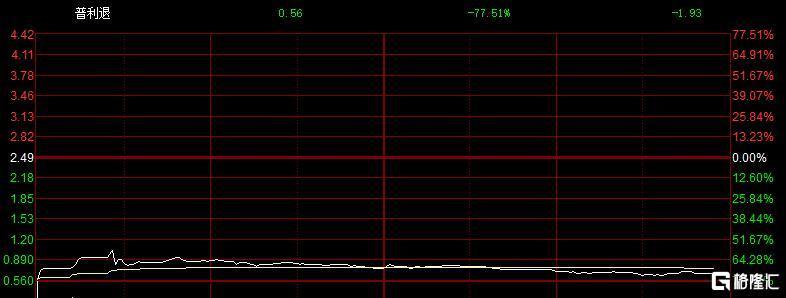
Core Viewpoint - Puli Pharmaceutical has officially entered the delisting preparation period due to serious financial fraud, marking a significant case of forced delisting in the A-share market [2][7]. Group 1: Company Overview - Puli Pharmaceutical, once a star in the pharmaceutical industry with a stock price exceeding 100 yuan, has faced severe penalties for financial misconduct, leading to its delisting [2][9]. - The company reported a dramatic decline in net profit from 4.08 billion yuan in 2020 to a loss of 982.7 million yuan in 2023, indicating a hollowing out of actual performance after excluding fraudulent activities [9]. Group 2: Financial Fraud Details - The China Securities Regulatory Commission (CSRC) found that Puli Pharmaceutical inflated its revenue by 1.029 billion yuan and profits by 669 million yuan over two years, accounting for 73.83% of the disclosed profits during that period [7]. - In 2021, the company falsely reported 514 million yuan in revenue (34.07% of that year's disclosed revenue) and 290 million yuan in profit (62.06% of disclosed profit) [7]. - In 2022, the inflated figures were 515 million yuan in revenue (28.51%) and 379 million yuan in profit (86.36%) [7]. Group 3: Market Reaction - On the first day of the delisting preparation period, the stock price of Puli Pharmaceutical plummeted by 77%, closing at 0.65 yuan per share, with a total market value shrinking to 365 million yuan, a loss of over 20 billion yuan from its peak [3][9]. - The convertible bonds issued by Puli also experienced a significant drop, with an intraday decline of 33.72% [5]. Group 4: Regulatory Actions - The CSRC imposed a fine of 10 million yuan on Puli Pharmaceutical, with the chairman and other executives facing substantial penalties and market bans [8]. - The new delisting regulations have led to increased scrutiny, with over 30 ST stocks facing similar fates, indicating a tightening of financial and regulatory standards in the market [11].
微盘股遭遇“倒春寒”!该如何摒弃“投资偏见”?
券商中国· 2025-04-02 11:47
Core Viewpoint - The recent downturn in micro-cap stocks, which had previously led the market rally, is attributed to multiple factors including regulatory changes, earnings concerns, and market dynamics [1][4][5]. Group 1: Market Performance - The Wind micro-cap stock index saw a year-to-date increase of over 20% until March 20, 2023, but faced significant pullbacks afterward, impacting related funds [3]. - Funds heavily invested in micro-cap stocks experienced an average gain of 12.72% from the beginning of the year to March 20, followed by an average decline of nearly 3% in the subsequent week [3]. Group 2: Factors Influencing Micro-Cap Stocks - The new delisting regulations are causing concerns about the stability of smaller companies, leading to fears of potential delistings or ST (special treatment) designations [4]. - There are worries regarding annual report performance, as the effects of economic stabilization policies may take time to reflect in company earnings, prompting early sell-offs by investors [4]. - The significant prior gains in micro-cap stocks have led to a decline in valuations as investor risk appetite decreases [4]. Group 3: Market Dynamics and Strategies - The recent adjustments in micro-cap stocks are partly attributed to a calendar effect, with April being a peak month for annual report releases and potential delistings [4]. - The volatility in micro-cap stocks is seen as a normal part of market fluctuations, although the current environment and technological advancements have made this period different from early 2024 [5]. - Concerns about high-frequency trading and quantitative strategies exacerbating market declines are noted, but some experts argue that these strategies can also provide liquidity and stabilize the market [6][7]. Group 4: Investment Strategies and Opportunities - Fund managers are innovating strategies to manage volatility, such as maintaining a constant stock-bond ratio and employing barbell strategies to balance portfolios [11]. - There is recognition of the long-term investment value in micro-cap stocks, as many are overlooked and may contain significant growth potential [12][13]. - The current economic transition and technological advancements present opportunities for micro-cap stocks in sectors like AI, semiconductor equipment, and automation [14].