
量化基金

Search documents
多只绩优量化基金开启限购
Shang Hai Zheng Quan Bao· 2025-07-31 18:08
Group 1 - The core viewpoint of the articles highlights that several high-performing quantitative funds are implementing purchase limits to manage investor enthusiasm and ensure strategy effectiveness [1][2][3] - Recent announcements from Guojin Fund indicate that the purchase limit for its quantitative products has been significantly reduced from 10 million yuan to 10,000 yuan, reflecting a rapid response to inflows [2][3] - The average net value increase of quantitative funds has reached 12% this year, with specific funds like Guojin Quantitative Selection and Guojin Quantitative Multi-Factor showing net value increases around 30% [2][3] Group 2 - The scale of Guojin Quantitative Selection and Guojin Quantitative Multi-Factor increased by 1 billion yuan and 1.3 billion yuan respectively, with growth rates of 54% and 45% compared to the previous quarter [3] - Industry experts suggest that controlling the growth rate of quantitative funds is essential to mitigate operational challenges and maintain performance continuity, thereby protecting long-term investor interests [3] - The recent trend of concentrated purchase limits serves as a warning signal, as historical instances have shown that such actions often precede significant fluctuations in fund net values [3]
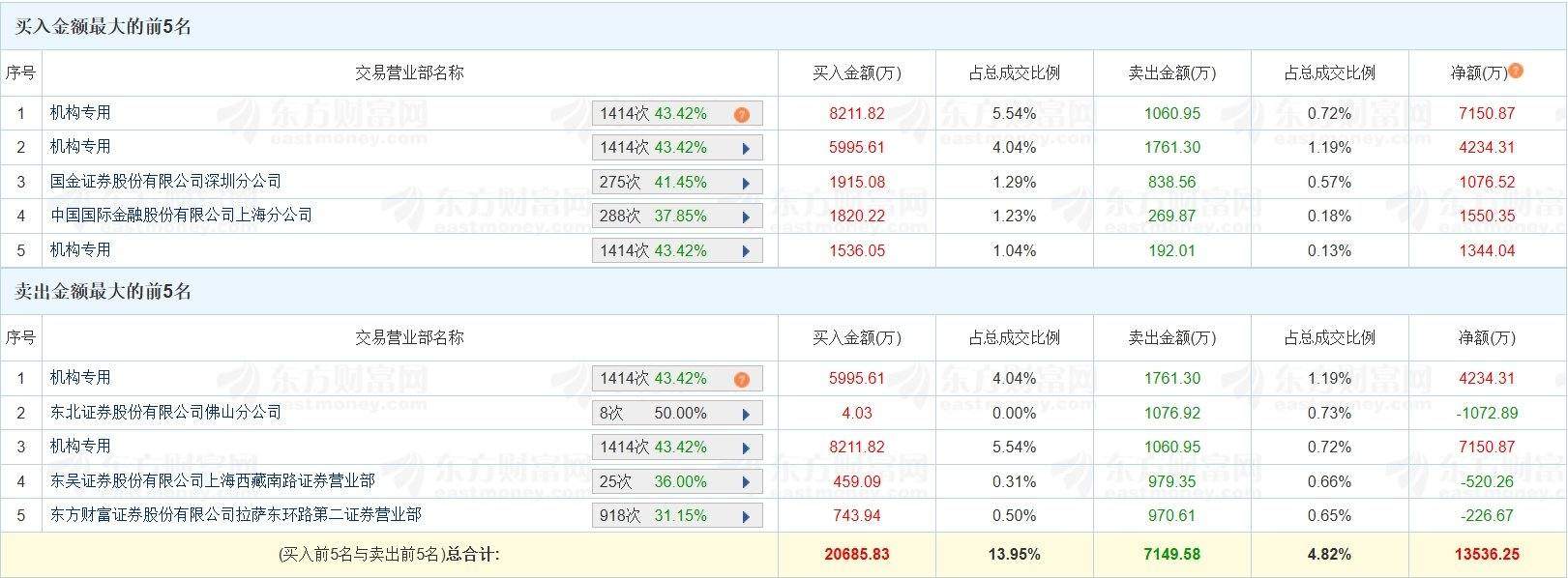
A股龙虎榜丨北方长龙涨17.22%创新高,三家机构买入1.57亿,卖出3014万,净买入1.27亿,量化基金位列买四席位,净买入1550万
Ge Long Hui· 2025-07-31 09:08
格隆汇7月31日|北方长龙(301357.SZ)今日大涨17.22%,股价创历史新高,换手率66.12%,成交额14.82 亿元。龙虎榜数据显示,三家机构买入1.57亿元,卖出3014万元,净买入1.27亿元;"量化基金"位列买 四席位,净买入1550万元。(格隆汇) 【免责声明】本文仅代表作者本人观点,与和讯网无关。和讯网站对文中陈述、观点判断保持中立,不对所包含内容 的准确性、可靠性或完整性提供任何明示或暗示的保证。请读者仅作参考,并请自行承担全部责任。邮箱: news_center@staff.hexun.com (责任编辑:宋政 HN002) | 关入金额最大的前5名 | | | | | | | | | --- | --- | --- | --- | --- | --- | --- | --- | | 序号 | 交易营业部名称 | | 买入金额(万) | 占息成交比例 | 卖出金额(万) | 占总成交比例 | 净额(万)® | | 1 | 机构专用 | 1414次 43.42% 0 | 8211.82 | 5.54% | 1060.95 | 0.72% | 7150.87 | | 2 | 机构专用 | ...

逾300只量化基金净值创历史新高 小微盘“高光”背后有何风险?
Di Yi Cai Jing· 2025-07-30 03:22
Group 1 - The A-share market has recently rebounded, with small-cap stocks outperforming the broader market significantly, leading to a collective rise in the net value of quantitative public funds, with over 97% achieving positive returns this year [1][2][3] - The Wind data shows that as of July 28, 314 out of 652 quantitative public funds have refreshed their historical net value highs, representing over 48% of the total [2][3] - The small-cap stock index reached a historical high of 476,824.12 points on July 29, with a year-to-date return of 50.23%, significantly outperforming larger indices [2][3] Group 2 - Due to the limited capacity of small-cap stocks to absorb funds, several high-performing products have implemented purchase limits, with some reducing the daily purchase limit to as low as 1,000 yuan [3][4] - Approximately 28 quantitative products are currently under restrictions for large purchases, with some tightening their purchase limits further [4] - Fund managers indicate that maintaining a comfortable management scale around 20 billion yuan is crucial for effective strategy execution [4] Group 3 - Despite the strong performance of small-cap stocks, there are emerging risks, including high crowding in small-cap strategies, which could lead to significant downturns if market sentiment shifts [6][7][8] - Analysts have noted that the current rally in small-cap stocks is heavily reliant on sentiment and liquidity rather than solid performance fundamentals, raising concerns about potential valuation bubbles [6][7] - Fund managers have cautioned about the risks associated with high crowding and the need for careful monitoring of market volatility and external uncertainties [7][8]
逾300只量化基金净值创历史新高,小微盘“高光”背后有何风险?
Di Yi Cai Jing· 2025-07-30 03:09
Group 1 - The core viewpoint of the articles highlights the strong performance of small-cap stocks in the A-share market, significantly outperforming larger indices, leading to a surge in public quantitative fund net values, with over 97% of these funds achieving positive returns this year [1][2][3] - The Wind data indicates that as of July 28, 314 out of 652 public quantitative funds have reached historical net value highs, representing over 48% of the total [2][3] - The small-cap stock index reached a historical high of 476,824.12 points on July 29, with a year-to-date return of 50.23%, while the mid-cap indices also showed substantial gains compared to larger indices [2][3] Group 2 - Due to the limited capacity of small-cap stocks to absorb funds, several high-performing products have implemented purchase limits, with some reducing daily purchase limits to as low as 1,000 yuan [3][4] - Approximately 28 quantitative products, including the CITIC Prudential Multi-Strategy Fund, have suspended large purchases, indicating a trend towards tighter purchase limits across the sector [4] - Fund managers suggest that a comfortable management scale for small-cap products is around 20 billion yuan, with a target position maintained between 60% to 80% to manage risks effectively [4] Group 3 - Analysts express concerns about the high "crowding" in small-cap stocks, which could lead to significant risks if market sentiment shifts, although the likelihood of extreme adjustments similar to early 2024 is considered low [6][7][8] - The reliance on sentiment and liquidity in small-cap stocks has raised concerns about their underlying fragility, with many stocks driven by themes rather than solid performance, leading to potential valuation bubbles [6][7] - Fund managers have cautioned about the need to monitor market volatility closely and prepare for potential risks, emphasizing that the current high levels of investment in small-cap stocks may not be sustainable [7][8]
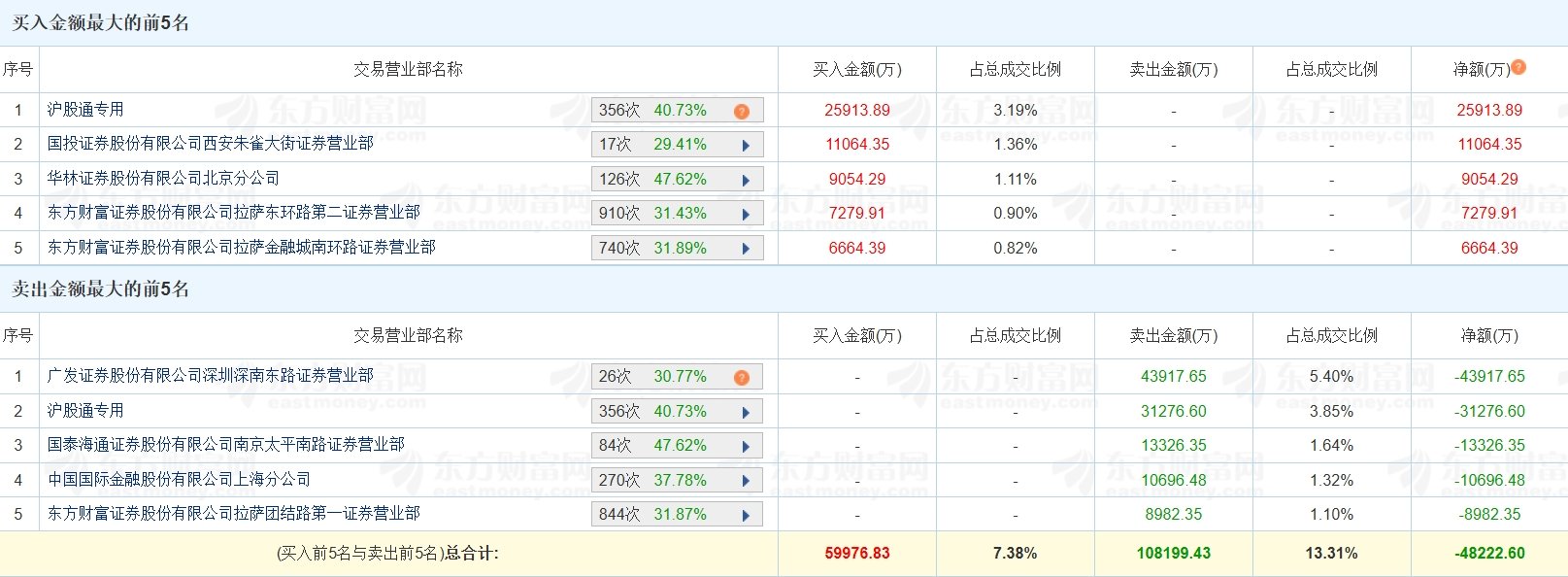
A股龙虎榜丨西藏天路7天6板,沪股通净卖出5363万,广发证券深圳深南东路卖出4.39亿,游资作手新一卖出1.33亿,量化基金卖出1.07亿
Ge Long Hui· 2025-07-29 11:01
Core Viewpoint - Xizang Tianlu (600326.SH) experienced a significant increase, hitting the daily limit and recording six consecutive days of gains, indicating strong market interest and trading activity [1] Trading Activity - The stock recorded a turnover rate of 37.99% and a total transaction value of 8.13 billion yuan [1] - The Shanghai Stock Connect saw a net sell of 53.63 million yuan, with purchases amounting to 259 million yuan and sales reaching 313 million yuan [1] - Notable selling positions included GF Securities (000776) with a sell amount of 439 million yuan and a notable trader "Zuoshu Xin Yi" selling 133 million yuan [1] - Overall, the top trading seats bought 600 million yuan and sold 1.082 billion yuan, resulting in a net sell of 482 million yuan [1]


龙虎榜丨西藏天路7天6板,广发证券深圳深南东路卖出4.39亿元
Ge Long Hui A P P· 2025-07-29 09:20
炒股就看金麒麟分析师研报,权威,专业,及时,全面,助您挖掘潜力主题机会! 西藏天路(600326.SH)今日涨停,录得7天6板,换手率37.99%,成交额81.3亿元。龙虎榜数据显示,沪股通买入2.59亿元,卖出3.13亿元,净卖出5363万元; 广发证券深圳深南东路位列卖一席位,卖出4.39亿元;游资"作手新一"位列卖三席位,卖出1.33亿元;"量化基金"位列卖四席位,卖出1.07亿元。上榜席位 全天买入6亿元,卖出10.82亿元,合计净卖出4.82亿元。(格隆汇) | 序号 | 交易营业部名称 | | 头人金额(万) | 占总成交比例 | | --- | --- | --- | --- | --- | | | 广发证券股份有限公司深圳深南东路证券营业部 | 26次 30.77% (2) | | | | 2 | 沪股通专用 | 356次 40.73% | | | | 3 | 国泰海通证券股份有限公司南京太平南路证券营业部 | 84次 47.62% | | | | 4 | 中国国际金融股份有限公司下海分公司 | 270次 37.78% | | | | 5 | 东方财富证券股份有限公司拉萨团结路第一证券营业部 ...
从资管产品视角看下半年增量资金哪里来?
2025-07-15 01:58
Summary of Conference Call Records Industry Overview - The capital market has shown a "barbell" structure since 2023, with large-cap and small-cap companies performing well, while mid-cap companies have been relatively flat. Large-cap stocks benefit from state-owned enterprises and insurance funds, while small-cap stocks are driven by on-market funds and quantitative private equity strategies [1][2][5]. Key Insights and Arguments - **Market Dynamics**: The A-shares and H-shares have performed more evenly, influenced by the southbound capital flow into Hong Kong stocks [1][5]. - **Investment Shifts**: The decline in deposit rates has led residents to seek higher certainty investment products, such as participating whole life insurance, creating a positive feedback loop through bank channels [1][6]. - **Future Market Outlook**: The market outlook remains optimistic, particularly for the financial sector. The valuation recovery of large-cap stocks led by insurance funds is expected to continue, while small-cap stocks are reaching new highs, although some pullbacks are inevitable [1][7]. - **Incremental Capital**: Recent incremental capital is limited, with insurance wealth management contributing approximately 1 trillion annually. However, after September, there will be a shift towards dividend insurance, prompting insurance companies to increase equity investments, with an estimated 30%-40% of new funds directed towards high-growth assets, bringing in 300-400 billion [1][8]. Additional Important Content - **Asset Allocation Changes**: The new accounting standards require insurance companies to increase standardized asset allocation, which is expected to promote stock market development [4]. - **Bank Wealth Management Trends**: The average yield on bank wealth management products is around 2.5%, with a gradual shift towards multi-asset strategies, including equities, convertible bonds, REITs, and alternative assets, expected to bring in around 100 billion annually [1][8]. - **Public Fund and Securities Company Trends**: Public funds have seen stable active equity scales, while FOF products have significantly increased due to their focus on controlling drawdowns and absolute returns [9]. Securities companies are leveraging off-market derivatives like DCN to meet investor demand for high-yield fixed-income products [10][11]. - **Regulatory Impact on Quantitative Funds**: New regulations have led to a significant increase in the issuance of neutral strategy products by quantitative funds, which are primarily linked to small-cap stocks [12][13]. - **Future of Off-Market Derivatives**: The off-market derivatives business is expected to have a positive impact on the capital market, although it carries risks, particularly in volatile conditions [15][16]. Potential Sources of Incremental Capital - Future incremental capital may come from insurance funds, bank wealth management, FOFs, and overseas funds, especially in a low-risk-free rate environment and with the potential for RMB appreciation [17].
2025上半年量化基金10强揭晓!小盘指增包揽前10!
Sou Hu Cai Jing· 2025-07-03 11:05
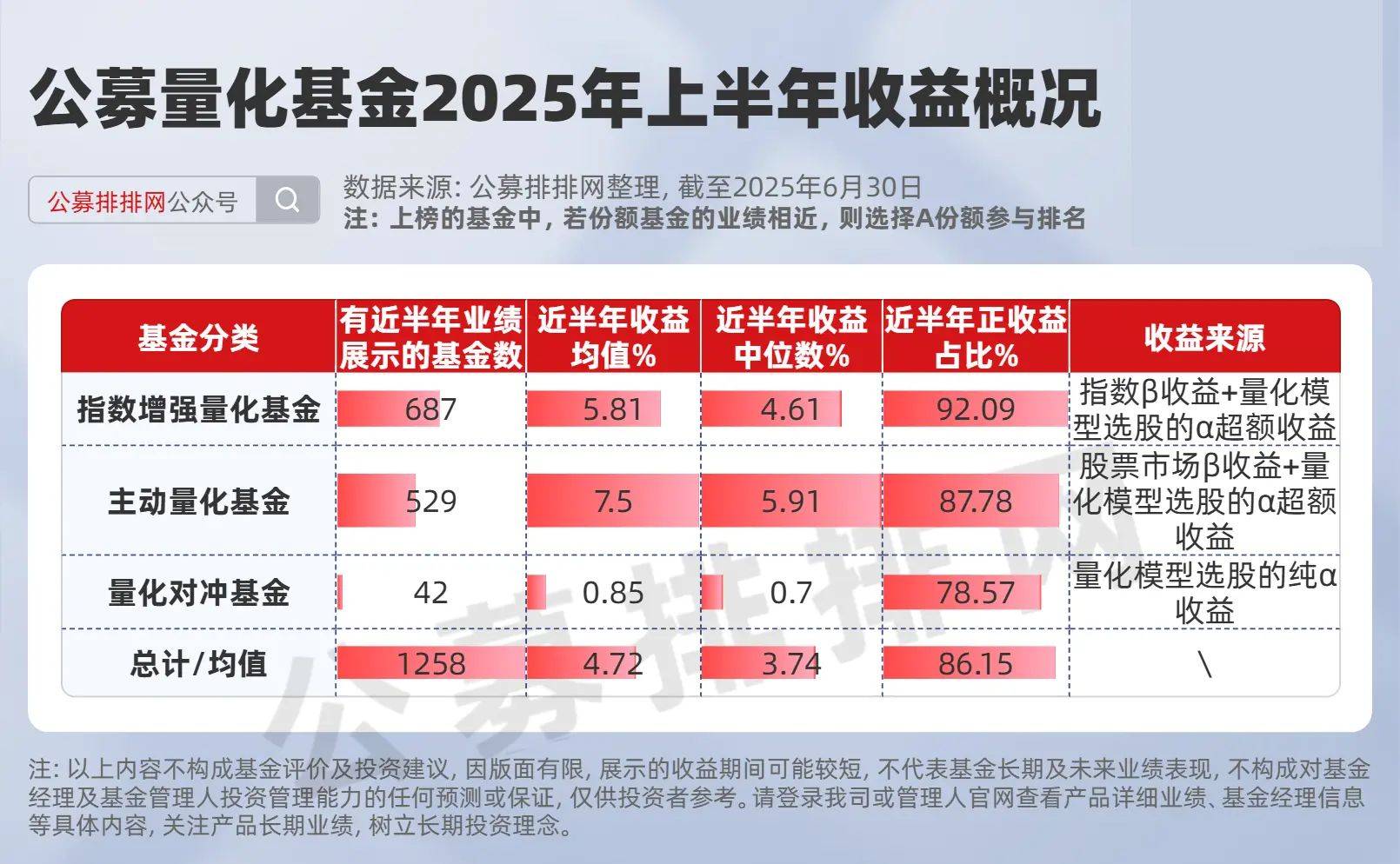
Core Viewpoint - In the first half of 2025, the popularity of quantitative trading continues to rise amid increased activity in small-cap stocks and market volatility, with a significant number of quantitative funds showing positive returns [1][3]. Group 1: Performance of Quantitative Funds - As of June 30, 2025, there are 1,258 quantitative funds with an average return of 4.72% and a median return of 3.74%, with 86.15% of these funds achieving positive returns [1]. - Among the three categories of public quantitative funds, active quantitative funds have the highest returns, with average and median returns of 7.5% and 5.91% respectively [1]. - Index-enhanced funds, while slightly lower in returns, have the highest proportion of positive returns at 92.09% [1]. Group 2: Top Performing Funds - The threshold for the top 10 index-enhanced quantitative funds is set at 18.77%, with all top 10 funds tracking small-cap stock indices [3]. - The top three funds in the index-enhanced category are managed by 创金合信基金, 招商基金, and 长盛基金 [3]. - The top-performing index-enhanced fund, 创金合信北证50成份指数增强A, achieved a return of 37.17% in the first half of 2025 [5]. Group 3: Active Quantitative Funds - The threshold for the top 10 active quantitative funds is the highest at 24.64%, with the top three funds managed by 诺安基金, 中加基金, and 汇安基金 [8]. - The leading active quantitative fund, 诺安多策略A, recorded a return of 40.62% [10]. - The second-ranked fund, 中加专精特新量化选股A, achieved a return of 35.55% [11]. Group 4: Quantitative Hedge Funds - The threshold for the top 10 quantitative hedge funds is 0.82%, with 中邮基金, 富国基金, and 申万菱信基金 managing the top three funds [12]. - 工银瑞信基金 has two funds listed among the top 10 [12].
瑞银证券:量化基金助推A股小盘股行情
news flash· 2025-06-30 08:35
Group 1 - The core viewpoint is that small-cap stocks are currently performing well, influenced by both retail and quantitative fund inflows into the A-share market [1] - Quantitative funds, including enhanced index funds, are selecting a basket of high-valuation small-cap stocks to enhance potential returns [1] - UBS believes that the trend of small-cap stocks outperforming the market will continue in the short term [1]
重返美国?欧洲资产遭获利了结,美股能否开启新行情
Di Yi Cai Jing Zi Xun· 2025-06-25 23:32
Group 1 - The core viewpoint of the articles indicates a significant shift of funds from European assets to the US market, driven by easing recession fears and a lack of short-term catalysts in Europe [1][3][2] - Goldman Sachs reports that short-selling in European stocks has reached its highest level in nearly a year, with hedge funds establishing new short positions [2][3] - European stock performance has been notably strong recently, with the DAX 30 index rising nearly 19% year-to-date, but concerns over growth and valuation have led to net selling of European defense stocks [2][3] Group 2 - Barclays analyst Emmanuel Cau notes that the cautious sentiment among investors is leading to a preference for US stocks, as European performance weakens and geopolitical uncertainties persist [3][2] - Nomura Securities predicts that over $100 billion may flow into the US market next month, marking the largest expected inflow for volatility-control funds since 2004 [3][4] - The recent decline in realized volatility is driving this predicted influx, as volatility-control funds may soon increase their risk exposure [4][5]


