
南向资金

Search documents
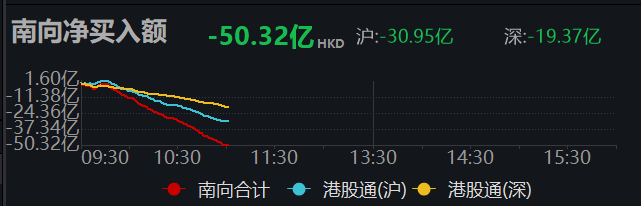
南向资金净卖出超50亿港元
Shang Hai Zheng Quan Bao· 2025-08-04 05:40
数据来 源:Wind 上证报中国证券网讯 8月4日11时01分,南向资金净卖出超50亿港元。 来源:上海证券报·中国证券网 ...

南向资金净卖出额超90亿港元
Zheng Quan Shi Bao Wang· 2025-08-04 04:21
人民财讯8月4日电,截至发稿,南向资金净卖出额超90亿港元。 (原标题:南向资金净卖出额超90亿港元) ...
截至目前,南向资金净卖出近90亿元,结束此前连续七日净买入,迈向5月12日以来最大单日净卖出。
news flash· 2025-08-04 04:00
截至目前,南向资金净卖出近90亿元,结束此前连续七日净买入,迈向5月12日以来最大单日净卖出。 ...
港股早参丨南向资金连续四日扫货超百亿,上周度净买入港股近600亿
Mei Ri Jing Ji Xin Wen· 2025-08-04 01:31
Market Overview - The Hong Kong stock market experienced a collective pullback last week, with the Hang Seng Index declining by 3.47%, the Hang Seng Tech Index down by 4.94%, and the China Enterprises Index falling by 3.78% [1] - Large tech stocks showed mixed performance, while sectors such as big finance, biomedicine, and innovative drugs saw declines; however, logistics stocks performed actively, and some automotive, gold, and semiconductor stocks increased [1] Southbound Capital - On August 1, southbound funds net bought HK stocks worth 12.207 billion HKD, marking the fourth consecutive day of over 10 billion HKD in net purchases. For the week, the total net purchase reached 59.02 billion HKD, and the cumulative net inflow for the year hit 879.049 billion HKD, a record high for annual net inflow [2] - The Hong Kong market is expected to reach new highs in the first half of 2025, with the average daily trading amount on the exchange reaching 240.2 billion HKD, a 118% increase from the same period last year. The total market capitalization rose to 42.7 trillion HKD, up 33% year-on-year [2] Automotive Sector - The Chinese new energy vehicle market continues to show high growth, with BYD maintaining its leading position with sales of 344,300 units. Notably, Leap Motor's sales surged by over 126% year-on-year to 50,100 units in July, while XPeng Motors achieved a record monthly delivery of 36,700 units, a 229% year-on-year increase. Xiaomi's first SUV, the Xiaomi YU7, helped the company surpass 30,000 units in sales for the first time [2] Short Selling Data - On August 1, a total of 621 Hong Kong stocks were short-sold, with a total short-selling amount of 28.889 billion HKD. The top three stocks by short-selling amount were Tencent Holdings at 1.948 billion HKD, Meituan at 1.889 billion HKD, and Xiaomi Group at 1 billion HKD [3] Institutional Insights - According to Jianyin International, the focus will shift to the mid-year reports of Hong Kong stocks, with expectations of moderate profit growth. The likelihood of systemic surprises is low, and more structural opportunities are anticipated, particularly in healthcare and technology sectors, where profit forecasts have been recently upgraded. The market is expected to experience short-term fluctuations, and investors are advised to take profits and consider buying on dips when the index returns to the 23,000 to 24,000 point range [4] Related ETFs - The Hang Seng Tech Index ETF (513180) supports T+0 trading and covers core AI assets in China [5] - The Hong Kong Stock Connect Automotive ETF (159323) also supports T+0 trading and focuses on leading new energy vehicle stocks in Hong Kong [6]
300307,终止重组!南向资金爆买科技巨头
Zheng Quan Shi Bao· 2025-08-03 06:22
Group 1 - Cixing Co., Ltd. (慈星股份) announced the termination of its plan to acquire 75% of Shunyi Technology due to failure to reach consensus on commercial terms with some counterparties, prioritizing the long-term interests of shareholders [2][3] - The company aims to optimize its industrial layout and expand into the defense technology sector through this acquisition, which was intended to create a second growth curve [2] - Cixing Co., Ltd. has previously terminated another major asset restructuring plan earlier this year, indicating challenges in executing strategic acquisitions [3] Group 2 - Southbound funds recorded a net inflow of 590.2 billion HKD this week, marking an 82.43% increase week-on-week, despite a general market downturn [4] - Xiaomi Group-W saw the highest net buy amount from southbound funds at 33.65 billion HKD, reversing a 14-week decline in shareholding [4][5] - The top ten active stocks included several major players, with InnoCare Pharma achieving the highest weekly gain of 31.51% [4][5] Group 3 - Two stocks, Sanhua Intelligent Control and BYD, experienced a doubling in shareholding from southbound funds, indicating significant investor confidence [6] - Sanhua Intelligent Control reported a net profit increase of 25% to 50% year-on-year, driven by growth in its air conditioning components business [6][8] - Shandong Molong's shareholding increased by 11.17% despite a projected net profit decline of 92.36% to 94.12% year-on-year [7][8]

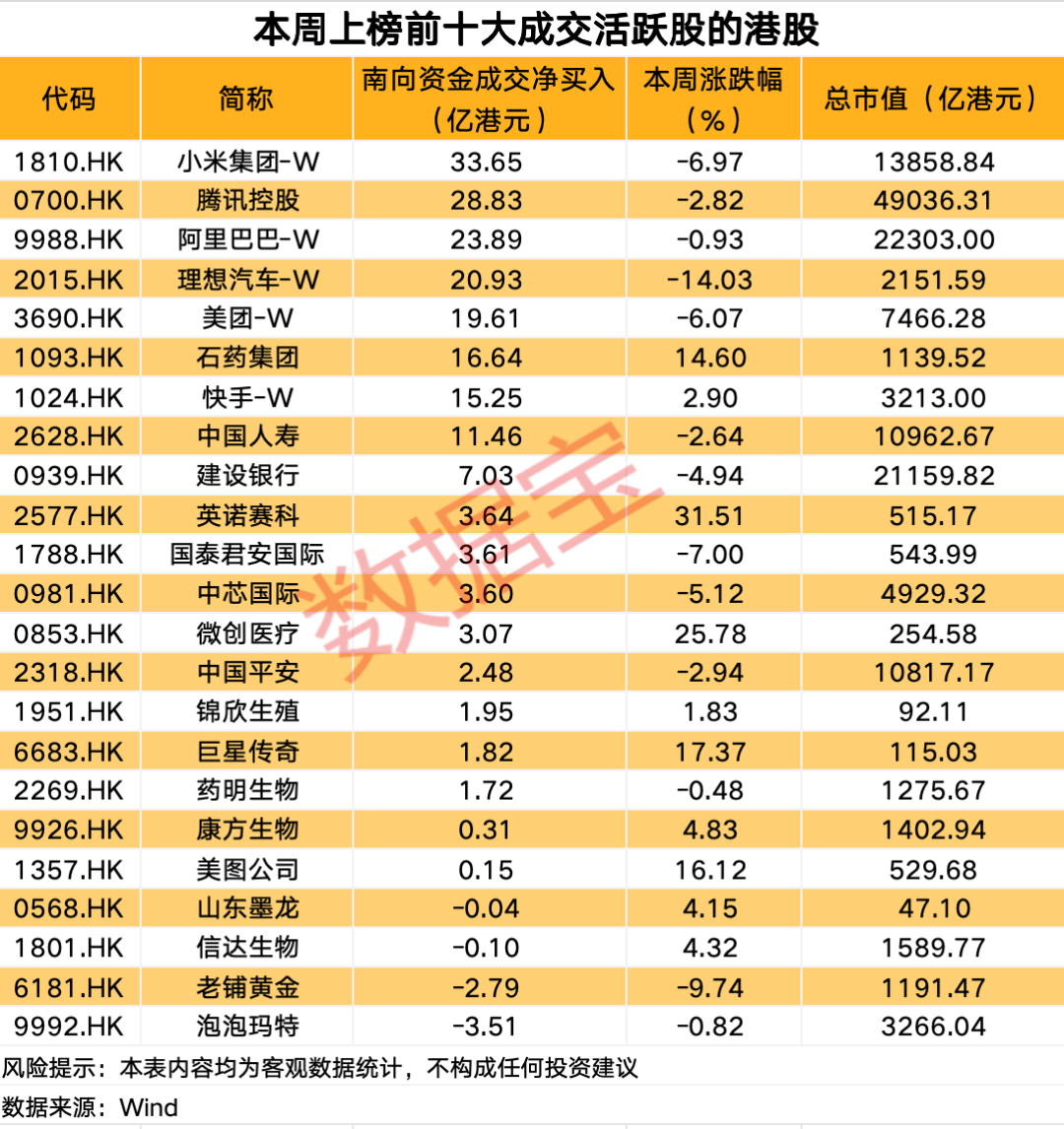
南向资金持续加仓港股,关注恒生ETF易方达(513210)、H股ETF(510900)等产品投资机会
Mei Ri Jing Ji Xin Wen· 2025-08-03 03:22
Market Overview - The Hong Kong stock market experienced a correction this week, with the Hang Seng Index declining by 3.5%, the Hang Seng China Enterprises Index down by 3.8%, and the CSI Hong Kong Stock Connect China 100 Index falling by 3.3% [1][3]. Fund Flows - Southbound funds were actively increasing their positions, with a total net purchase of nearly 60 billion yuan [1]. Index Performance - The rolling price-to-earnings (P/E) ratios for the indices are as follows: Hang Seng Index at 11.3 times, Hang Seng China Enterprises Index at 10.2 times, and CSI Hong Kong Stock Connect China 100 Index at 10.7 times [3]. - The rolling P/E ratio percentiles indicate that the Hang Seng Index is at 50.4%, the Hang Seng China Enterprises Index at 62.3%, and the CSI Hong Kong Stock Connect China 100 Index at 87.6% [3]. Sector Composition - The CSI Hong Kong Stock Connect China 100 Index comprises 100 large-cap and actively traded companies from mainland China, with financials, consumer discretionary, and information technology sectors accounting for over 65% of the index [6]. - The broader index sectors, including consumer discretionary, financials, information technology, and energy, collectively represent over 85% of the index [6]. Historical Performance - Year-to-date performance shows the Hang Seng Index up by 22.2%, the Hang Seng China Enterprises Index up by 20.8%, and the CSI Hong Kong Stock Connect China 100 Index up by 23.7% [7]. - Over the past year, the Hang Seng Index has increased by 44.6%, the Hang Seng China Enterprises Index by 47.4%, and the CSI Hong Kong Stock Connect China 100 Index by 49.9% [7].
8月1日南向资金净买入122.07亿港元
Zheng Quan Shi Bao Wang· 2025-08-01 13:48
Market Overview - On August 1, the Hang Seng Index fell by 1.07%, closing at 24,507.81 points, while southbound funds through the Stock Connect recorded a net purchase of HKD 12.207 billion [1] Trading Activity - The total trading volume for the Stock Connect on August 1 was HKD 133.536 billion, with a net purchase of HKD 12.207 billion [1] - The Shanghai Stock Connect had a trading volume of HKD 82.794 billion and a net purchase of HKD 5.575 billion, while the Shenzhen Stock Connect had a trading volume of HKD 50.742 billion and a net purchase of HKD 6.632 billion [1] Active Stocks - In the Shanghai Stock Connect, the most actively traded stock was InnoCare Pharma with a trading volume of HKD 33.333 billion, followed by Tencent Holdings and Alibaba Group, with trading volumes of HKD 30.233 billion and HKD 27.36 billion, respectively [1] - The stock with the highest net purchase was Hang Seng China Enterprises, with a net purchase of HKD 1.720 billion, despite a closing price drop of 0.95% [1] - Alibaba Group had the highest net sell amount of HKD 0.416 billion, closing up by 1.04% [1] Shenzhen Stock Connect Highlights - In the Shenzhen Stock Connect, Tencent Holdings led with a trading volume of HKD 23.89 billion, followed by the Tracker Fund of Hong Kong and Southern Hang Seng Technology, with trading volumes of HKD 20.76 billion and HKD 18.54 billion, respectively [2] - The stock with the highest net purchase was the Tracker Fund of Hong Kong, with a net purchase of HKD 2.069 billion, despite a closing drop of 1.11% [2] - The stock with the highest net sell amount was Innovent Biologics, with a net sell of HKD 0.402 billion, closing down by 5.10% [2]


港股通8月1日成交活跃股名单
Zheng Quan Shi Bao Wang· 2025-08-01 13:45
Market Overview - On August 1, the Hang Seng Index fell by 1.07%, with southbound trading totaling HKD 1,335.36 billion, comprising HKD 728.72 billion in buying and HKD 606.64 billion in selling, resulting in a net buying amount of HKD 122.07 billion [1] Southbound Trading Details - Southbound trading through the Stock Connect (Shenzhen) recorded a total trading amount of HKD 507.42 billion, with net buying of HKD 66.32 billion, while the Stock Connect (Shanghai) had a total trading amount of HKD 827.94 billion and net buying of HKD 55.75 billion [1] - The most actively traded stock by southbound funds was Tencent Holdings, with a total trading amount of HKD 54.12 billion, followed by InnoCare Pharma and Alibaba Group, with trading amounts of HKD 43.91 billion and HKD 43.90 billion, respectively [1] Net Buying and Selling Analysis - The top net buying stocks included the Tracker Fund of Hong Kong with a net buying amount of HKD 37.44 billion, followed by Hang Seng China Enterprises with HKD 17.20 billion and Xiaomi Group with HKD 10.99 billion [1] - The stock with the highest net selling was Innovent Biologics, with a net selling amount of HKD 4.02 billion, while Alibaba Group and SMIC experienced net selling of HKD 2.02 billion and HKD 1.77 billion, respectively [1] Continuous Net Buying Stocks - Among the stocks that have seen continuous net buying for more than three days, Tencent Holdings, Xiaomi Group, and Meituan had the longest streaks, with 7 days, 6 days, and 3 days of net buying, respectively [2] - The highest net buying amounts during this period were for Xiaomi Group at HKD 41.36 billion, followed by Tencent Holdings at HKD 35.42 billion and Meituan at HKD 26.12 billion [2] Active Stocks on August 1 - The following stocks were highlighted for their trading activity on August 1: - Tracker Fund of Hong Kong: Total trading amount HKD 376.30 million, net buying HKD 374.44 million, price change -1.11% - Hang Seng China Enterprises: Total trading amount HKD 221.46 million, net buying HKD 171.97 million, price change -0.95% - Xiaomi Group: Total trading amount HKD 399.61 million, net buying HKD 109.92 million, price change +0.47% - Tencent Holdings: Total trading amount HKD 541.21 million, net buying HKD 83.62 million, price change -2.73% [2]

