可选消费

Search documents
2026.03.16-2026.03.22:港股市场回购统计周报-20260324
Zhe Shang Guo Ji Jin Rong Kong Gu· 2026-03-24 06:01
Group 1: Weekly Buyback Statistics - Total buyback amount for the week was HKD 512 million, a decrease of HKD 55 million from the previous week[10] - Number of companies conducting buybacks increased to 27, up by 8 from last week[10] - Xiaomi Group (1810.HK) led with a buyback of HKD 200 million, followed by NetEase Cloud Music (9899.HK) at HKD 75 million[10] Group 2: Industry Analysis - The information technology sector accounted for the highest buyback amount at HKD 275 million[13] - The consumer discretionary sector had the most companies participating in buybacks, with 10 firms involved[13] - The healthcare sector ranked third with 3 companies conducting buybacks[13] Group 3: Company-Specific Data - Buyback amounts for top companies included: - Xiaomi Group (1810.HK): HKD 199.9984 million, 582.54 thousand shares, 0.02% of total shares[14] - NetEase Cloud Music (9899.HK): HKD 74.9798 million, 54.16 thousand shares, 0.25% of total shares[14] - Heart Company (2400.HK): HKD 39.4957 million, 55.30 thousand shares, 0.11% of total shares[14] Group 4: Buyback Significance - Company buybacks are defined as repurchasing shares from the secondary market using available cash[20] - Large-scale buyback trends typically occur during bear markets, signaling that companies believe their stock is undervalued[20] - Historical data shows that buyback waves in the Hong Kong market since 2008 have often preceded upward market trends[20]
港股科技类指数为啥波动,估值如何呢?|第435期精品课程
银行螺丝钉· 2026-03-11 13:57
Group 1 - The main representative indices for Hong Kong technology stocks are the Hang Seng Tech Index (HSTECH.HI) and the Hong Kong Technology Index (931573.CSI) [4][47] - The Hang Seng Tech Index was established in 2020 and includes 30 constituent stocks, while the Hong Kong Technology Index was created in 2014 and consists of 50 stocks [6][8] - The selection criteria for the indices differ, with the Hong Kong Technology Index including medical stocks, making it a combination of technology and healthcare sectors [8][10] Group 2 - The industry distribution of both indices is similar, with Information Technology and Consumer Discretionary sectors accounting for 80%-90% of the total [10][11] - The top ten holdings in both indices show a high overlap, with their combined weight close to 70% [13][14] - Historical performance indicates that both indices have outperformed the Hang Seng Index since their inception, although they exhibit greater volatility [15][19] Group 3 - The recent bull market for Hong Kong technology stocks has seen significant fluctuations, characterized by three waves of "upward and downward" movements since February 2024 [24][32] - The first wave saw an increase of 87.51% followed by a 21.45% correction, attributed to previously low valuations [27] - The second wave resulted in a 55.72% rise and a subsequent 29.58% drop due to external factors like tariff crises [29] Group 4 - The third wave from April to October 2025 recorded a 67.65% increase, followed by a 24.27% correction, driven by strong earnings growth in the technology sector [31][36] - The investment behavior in Hong Kong is more rational, with institutional investors closely aligning their actions with earnings reports, leading to a cycle of growth and decline every 3-4 months [33][36] - Concerns over AI spending impacting profit growth have contributed to the recent corrections in the technology indices [37][39] Group 5 - After recent corrections, the Hong Kong technology indices have returned to undervalued levels, suggesting potential for dollar-cost averaging investments [39] - It is recommended to limit exposure to individual sectors to 15%-20% for a more stable investment approach [40][51] - The indices are suitable for pairing with value-oriented investments to enhance overall portfolio stability [44][51]


VIX 快破 30 了,美股艰难的一周又开始了
美股研究社· 2026-03-09 11:12
Core Viewpoint - The current market risks are not merely about stock price declines but rather a shift in narrative, as indicated by the rising CBOE Volatility Index (VIX) approaching 30, suggesting a transition from a bullish to a defensive market stance [2][3]. Group 1: Macroeconomic Factors - The macroeconomic environment that previously supported the stock market is being shaken by new variables, including rising oil prices due to geopolitical conflicts, renewed inflation uncertainties, and weakened expectations for interest rate cuts [3][6]. - Historical data shows that rising oil prices during geopolitical tensions often lead to concerns about inflation rather than supply shortages, as energy prices are a direct catalyst for inflation [6]. - The Federal Reserve's high interest rates, maintained above 5% from 2022 to 2024, were initially expected to ease by 2025-2026, but rising oil prices could fundamentally alter this narrative, delaying potential rate cuts [6][7]. Group 2: Market Structure and Sector Performance - The current market has developed a clear four-layer structure, indicating a divergence in capital flows. The most resilient sectors include energy and certain defense industries, which benefit from rising oil prices [12]. - AI hardware and infrastructure companies are also attracting capital due to their clear orders and technological barriers, viewed as essential in the ongoing AI development trend [12]. - Conversely, sectors like transportation, airlines, and discretionary consumer goods are highly sensitive to energy prices, with rising oil costs likely to lead to downward revisions in earnings expectations [12][13]. - Small-cap stocks and high-leverage cyclical stocks are facing significant challenges due to high financing costs and growth uncertainties, leading to underperformance compared to larger indices like the S&P 500 [13]. Group 3: Upcoming Economic Indicators - The upcoming U.S. CPI data is critical for the Federal Reserve's decision-making. A sustained decline in core inflation could maintain optimistic market expectations for rate cuts, while an unexpected rise would necessitate a reevaluation of the entire rate-cutting cycle [9][10]. - The technology sector is approaching a pivotal moment with earnings reports from companies like Oracle and Adobe, which will serve as key indicators of AI investment returns. The substantial capital expenditures in AI, projected to exceed $200 billion by 2025, raise questions about the timing of revenue and profit realization [10]. Group 4: Investment Strategy and Market Signals - As the VIX approaches 30, the market is entering a phase characterized by conflicting narratives between AI-driven profit growth expectations and macroeconomic pressures from energy and inflation [15]. - Investors are advised to focus on three key signals: the trajectory of oil prices, movements in U.S. Treasury yields, and the performance of technology stocks. Maintaining balance among these factors could allow for structural market opportunities [15].

国泰海通香江策论之专题报告港股IPO、再融资及解禁对港股行情的影响:顺势而为,基本面为王
Haitong Securities International· 2026-03-08 23:30
Group 1: IPO and Fundraising Trends - Hong Kong IPOs and follow-on fundraising are closely aligned with market cycles, with peaks typically coinciding with market highs, such as in 2010 and 2015[1] - In 2025, the Hong Kong IPO market saw a significant rebound, with total IPO proceeds reaching HKD 285.7 billion, a 224% increase year-on-year, while combined IPO and follow-on fundraising totaled HKD 645.9 billion compared to HKD 192.2 billion in 2024[1][7] - The IPO fundraising in 2025 marked the highest level since 2022, indicating a recovery trend supported by favorable policies and returning international capital[2][10] Group 2: Future Projections and Market Structure - In 2026, IPO proceeds are expected to exceed HKD 300 billion, continuing the recovery trend from 2024, driven by strong demand from emerging industries and policy support[2][10] - As of late February 2026, IPO proceeds had already reached over 25% of the previous year's total, with 488 companies in the pipeline, primarily from technology and healthcare sectors[2][10] - The supply structure of IPOs is improving, which may enhance the representation of growth industries in the Hong Kong market[2][10] Group 3: Regulatory Environment and Market Impact - The Hong Kong SFC introduced five new regulatory requirements to prioritize quality over quantity in IPOs, including tighter sponsor workload limits and stricter vetting standards[3][14] - IPO waves typically create structural rather than systemic impacts on the market, with temporary supply pressures absorbed by market liquidity[3][27] - Historical data shows that the Hang Seng Index does not experience systemic declines during unlock events, but rather exhibits increased volatility before unlocks and stabilization afterward[4][28] Group 4: Unlock Supply and Market Dynamics - In 2026, the unlock supply is expected to exceed HKD 450 billion in the first half, peaking at approximately HKD 581.6 billion in September, primarily driven by Zijin Gold International[4][15] - The unlock supply is concentrated in the IT, consumer discretionary, and healthcare sectors, which may lead to sector-level volatility during the unlock period[4][28] - Macro fundamentals and global liquidity conditions remain key determinants of market trends, with unlocks reflecting structural disturbances rather than systemic risks[4][16]
策略周报:内外变化下,如何把握市场方向?-20260307
Guoxin Securities· 2026-03-07 12:30
Group 1 - The report highlights that recent geopolitical conflicts and changes in AI narratives may temporarily affect risk appetite, but the market tends to revert to its inherent trends in the medium term [1][11] - The National People's Congress (NPC) has set a positive and stable policy tone, with ongoing capital market reforms expected to support the market, indicating that post-NPC market trends are often policy-related [1][3] - Despite short-term fluctuations, the overall bullish market pattern for the year remains intact, with a focus on AI applications, strategic resources under security considerations, and traditional assets related to domestic demand [1][3][26] Group 2 - The "HALO" trading paradigm has emerged as a significant investment logic among foreign capital, reflecting a shift towards heavy asset sectors that are less likely to be disrupted by AI, while light asset sectors are facing outflows [2][16] - Historical data suggests that foreign trading trends tend to have continuity, with upcoming earnings reports serving as a critical observation window for the sustainability of the "HALO" trading narrative [2][16] - The report indicates that if internet companies or leading overseas software firms report strong fundamentals, along with a potential easing of geopolitical tensions, the narrative around foreign "HALO" trading may reverse [2][16] Group 3 - The NPC's policy framework for 2026 emphasizes a balance between domestic demand and technological advancement, aiming for qualitative improvements and reasonable growth [3][19] - The report notes that the government aims for a growth target of 4.5-5% for 2026, reflecting a shift from quantity-focused to quality-focused growth strategies [19][20] - The capital market is expected to see enhanced stability and improved institutional frameworks, with a focus on deepening reforms and protecting investors [3][20] Group 4 - The report identifies three key investment themes from the NPC's policies: technology, security, and domestic demand, aligning with previous insights on investment opportunities in AI, resource sectors, and traditional assets [27][30] - The "smart economy," driven by AI, is highlighted as a primary investment focus, with an emphasis on the development of new infrastructure and energy systems [30][31] - The report suggests that traditional assets related to domestic demand, such as real estate and consumer goods, may see a reversal in expectations due to supportive policies and improving fundamentals [31][32]
港股通数据统计周报-20260303
Zhe Shang Guo Ji Jin Rong Kong Gu· 2026-03-03 08:36
Group 1: Top Net Buy/Sell Companies - Tencent Holdings (0700.HK) had a net buy amount of ¥146.77 billion, with a holding change of 28,334,468 shares[8] - Alibaba Group (9988.HK) saw a net buy of ¥52.66 billion, with a holding change of 36,851,141 shares[8] - Zijin Mining (2899.HK) was the top net sell company with a net sell amount of -¥16.98 billion, with a holding change of -37,743,221 shares[9] Group 2: Industry Distribution of Net Buy/Sell - The technology sector had significant net buying, leading with ¥146.77 billion from Tencent and ¥42.69 billion from Xiaomi[8] - The materials sector experienced notable net selling, with Zijin Mining and Jiangxi Copper reporting net sells of -¥16.98 billion and -¥10.90 billion respectively[9] - The financial sector also saw net selling, with China Ping An reporting a net sell of -¥10.46 billion[9] Group 3: Active Stocks - The top active stock in the Shanghai-Hong Kong Stock Connect was the Yingfu Fund (2800.HK) with a total trading volume of ¥68.61 billion and a net buy of ¥67.77 billion[18] - Tencent Holdings (0700.HK) was also active with a trading volume of ¥27.64 billion and a net buy of ¥2.36 billion[18] - Alibaba Group (9988.HK) had a trading volume of ¥27.41 billion but a net sell of -¥1.93 billion, indicating selling pressure despite high activity[18]
恒生科技跌24%!现在要不要卖?
雪球· 2026-03-01 04:10
Core Viewpoint - The article discusses the recent decline of the Hang Seng Tech Index, which has dropped nearly 24% since October of last year, and emphasizes the importance of maintaining a long-term investment perspective despite short-term losses [1]. Group 1: Reasons for the Decline - The decline in the Hang Seng Tech Index is attributed to three main factors: 1. **Corporate Competition**: Significant expenditures on delivery subsidies and AI initiatives have raised concerns about profit margins for related companies [2]. 2. **AI Disruption**: The emergence of AI unicorns like Zhipu and MiniMax has made traditional internet giants appear less attractive [3]. 3. **Liquidity Issues**: Expectations of a downgrade in the Federal Reserve's interest rate cuts, combined with the capital absorption by sectors like resources and AI, have led to liquidity shortages in the Hong Kong stock market [4]. Group 2: Long-term Value of Hong Kong Stocks - The long-term investment value of the Hang Seng Tech Index remains intact, driven by the uniqueness and irreplaceability of its constituent stocks, which are primarily leading companies in various sectors listed only in Hong Kong [11]. - The index's sector distribution includes software services, semiconductors, automotive, and consumer discretionary, linking it to both AI and technological innovation as well as the fundamentals of consumer spending [11]. - The current price-to-earnings (PE) ratio of around 21 times, while higher than the 17 times seen in the first half of 2024, is still within a historically undervalued range, suggesting that the current prices are more attractive for investment [12]. Group 3: Asset Allocation Strategies - The article outlines three foundational principles of asset allocation to alleviate anxiety over market fluctuations: 1. **Normalcy of Fluctuations**: A healthy investment portfolio will naturally include underperforming assets, which is a designed outcome of diversification [14]. 2. **Risk Management through Position Sizing**: Maintaining a smaller position in volatile assets, such as the Hang Seng Tech Index, can limit overall portfolio impact, allowing for a more comfortable investment experience [17]. 3. **Focus on Overall Strategy**: Emphasizing the importance of a balanced portfolio that includes both low-cost assets and those generating returns, rather than fixating on individual asset performance [19].

港股科技类指数为啥波动,估值如何呢?|第435期直播回放
银行螺丝钉· 2026-02-27 14:00
Group 1 - The core viewpoint of the article discusses the characteristics, performance, and investment strategies related to Hong Kong technology stocks and their representative indices [1][39]. - The main representative indices for Hong Kong technology stocks include the Hang Seng Tech Index and the Hong Kong Technology Index, which are significant in terms of influence and the number of tracking funds [3][4]. - The Hang Seng Tech Index consists of 30 stocks, while the Hong Kong Technology Index includes 50 stocks, with different selection criteria focusing on market capitalization and R&D investment [4][6]. Group 2 - The industry distribution of both indices shows a high concentration in Information Technology and Consumer Discretionary, accounting for approximately 80%-90% of the total [8]. - The top ten holdings in both indices have a high overlap, with their combined weight nearing 70% [10]. - Historical performance indicates that both indices have consistently outperformed the Hang Seng Index since the end of 2014 [12]. Group 3 - The recent bull market has seen both indices experience significant gains, with the Hang Seng Tech Index rising by 87.51% before a subsequent correction of 21.45% [20]. - The volatility of the Hong Kong technology indices is notable, often characterized by cycles of "up and down" movements, aligning closely with earnings report cycles [27][29]. - Recent concerns regarding AI spending have led to a market correction, impacting the profitability growth expectations for the fourth quarter [13][29]. Group 4 - Following the recent correction, the Hong Kong technology indices have returned to undervalued levels, suggesting potential for dollar-cost averaging investments for long-term idle funds [31]. - It is advised to limit exposure to individual sectors or themes to 15%-20% for a more stable investment approach [33][36]. - The Hong Kong Technology Index is recommended to be paired with value-style investments, such as low-volatility dividend stocks, to enhance overall portfolio stability [36][37].
港股节后走弱,关注恒生科技ETF易方达(513010)、港股通互联网ETF易方达(513040)等产品投资机会
Jin Rong Jie· 2026-02-27 11:47
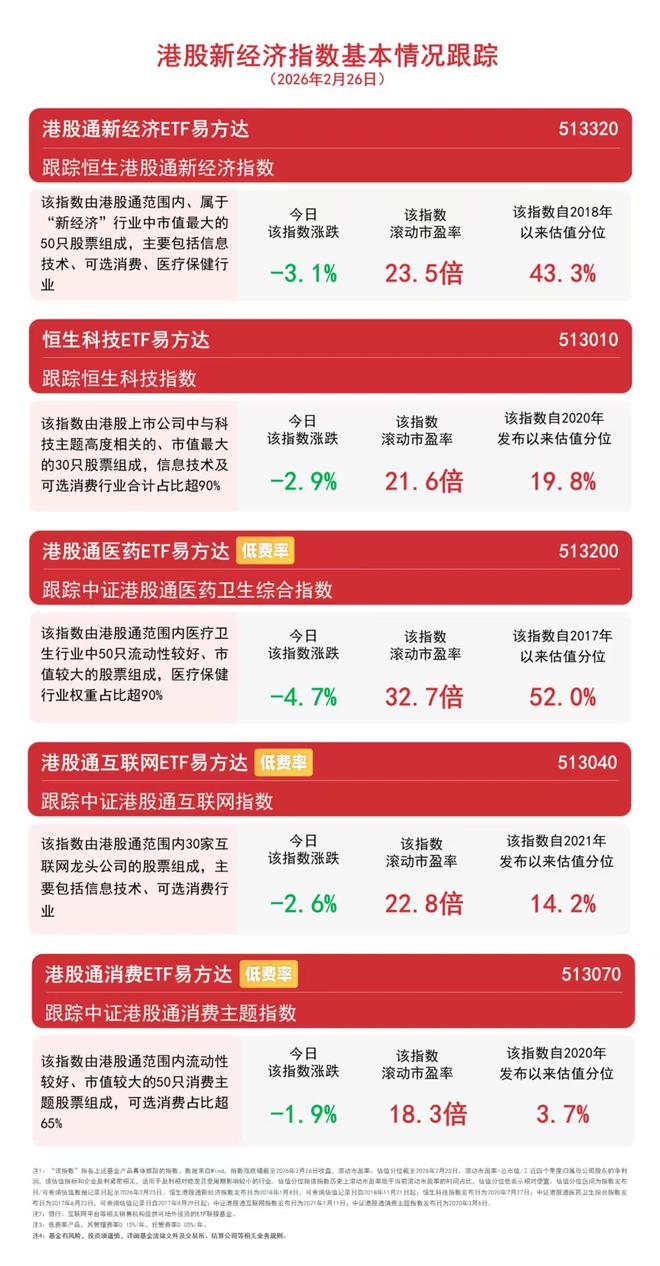
Core Viewpoint - The Hong Kong stock market has shown significant divergence in performance among various indices, with a notable decline in technology and healthcare sectors, while consumer data remains strong but has not significantly boosted sector performance [1][5]. Index Performance Summary - The CSI Hong Kong Stock Connect Consumer Theme Index decreased by 0.9% - The Hang Seng Technology Index fell by 1.4% - The CSI Hong Kong Stock Connect New Economy Index dropped by 2.0% - The CSI Hong Kong Stock Connect Internet Index declined by 2.8% - The CSI Hong Kong Stock Connect Healthcare Comprehensive Index saw a decrease of 4.5% [1]. Fund Inflows - Despite the declines, there was a net inflow of 4.2 billion yuan into the Hang Seng Technology ETF (513010) and 1.3 billion yuan into the Hong Kong Stock Connect Internet ETF (513040) over the past month [1]. Market Outlook - According to Huatai Securities, the market is expected to experience increased volatility, particularly around index adjustments, and investors are advised to be cautious of individual stock fluctuations [1]. - The medium-term investment focus remains on technology and cyclical materials as clear main lines [1]. Historical Index Performance - Over the past month, the Hang Seng New Economy Index has decreased by 10.7%, while the Hang Seng Technology Index has dropped by 12.9% - Year-to-date, the CSI Hong Kong Stock Connect Healthcare Comprehensive Index has increased by 6.7%, and the Consumer Theme Index has risen by 9.4% [5]. - Over the past three years, the Hang Seng New Economy Index has increased by 29.3%, while the Consumer Theme Index has risen by 37.1% [5]. Index Composition - The Hang Seng Technology Index consists of the 30 largest stocks related to technology, with over 90% of its composition from information technology and consumer discretionary sectors [4]. - The CSI Hong Kong Stock Connect Healthcare Comprehensive Index includes 50 liquid and large-cap stocks in the healthcare sector, with over 90% weight in healthcare [4]. - The CSI Hong Kong Stock Connect Internet Index comprises 30 leading internet companies, primarily from information technology and consumer discretionary sectors [4]. - The CSI Hong Kong Stock Connect Consumer Theme Index includes 50 consumer stocks, with over 55% from consumer discretionary [4].

港股全线回调,关注恒生科技ETF易方达(513010)、港股通互联网ETF易方达(513040)等产品投资机会
Jin Rong Jie· 2026-02-26 11:06
Group 1 - The core viewpoint of the articles indicates a decline in various Hong Kong stock indices, with the Consumer Theme Index down by 1.9%, the Internet Index down by 2.6%, and the Technology Index down by 2.9% [1] - The report from Huatai Securities highlights a divergence in the Hong Kong stock market during the Spring Festival, with AI new forces and internet giants showing contrasting trends, while consumption data remains strong but does not significantly boost sector performance [1] - The short-term outlook suggests investors should be cautious of fluctuations in individual stocks around index adjustments, while the medium-term focus remains on technology and cyclical materials as clear main lines for investment [1] Group 2 - The Hong Kong Stock Connect Consumer ETF (513070) tracks the Consumer Theme Index, which consists of 50 major consumer stocks with good liquidity, and has a significant allocation to discretionary consumption [3] - The rolling price-to-earnings ratio for the Consumer Theme Index is reported at 18.3 times, with a decline of 1.9% noted [3] - The index has been published since 2020 and has shown a valuation percentile that reflects its performance in the market [3]