
可控核聚变

Search documents
全市场超百股涨停
财联社· 2026-01-08 07:11
今日沪指窄幅震荡,创业板指盘中跌超1%。沪深两市成交额2.8万亿,较上一个交易日缩量538亿,成交额连续4个交易日超2.5万亿。 市场概况 2445 1187 752 310 267 111 155 112 144 75 14 9 6 小于 大于 涨停 -6% -8% +8% +6% +4% +2% 0% -2% -4% 跌停 +8% -8% 持平 上涨 3731家 144家 下跌 1595家 跌停 涨停 111家 停牌 11家 6家 盘面上,市场热点快速轮动, 全市场超3700只个股上涨,其中111只个股涨停。 从板块来看, 商业航天概念集体爆发 ,二十余只成分股涨停,鲁信 创投10天8板,金风科技3连板。脑机接口概念延续强势,创新医疗、普利特、南京熊猫4连板。可控核聚变概念表现活跃,中国一重、国机重装、中 国核建2连板。AI应用概念走高,久其软件、宝信软件涨停。 | 市场热度:62 0 | | | 两市成交额:2.8万亿 较上一日: - 538亿 | | --- | --- | --- | --- | | -- | | | | | 0 | 50 | 100 | 今日预测量能: | | | | | 2.8万 ...


收评:创业板指震荡调整跌0.82% 全市场超百股涨停
Mei Ri Jing Ji Xin Wen· 2026-01-08 07:10
每经AI快讯,1月8日,沪指窄幅震荡,创业板指盘中跌超1%。沪深两市成交额2.8万亿,较上一个交易 日缩量538亿,成交额连续4个交易日超2.5万亿。盘面上,市场热点快速轮动,全市场超3700只个股上 涨,其中111只个股涨停。从板块来看,商业航天概念集体爆发,二十余只成分股涨停,鲁信创投 (600783)10天8板,金风科技(002202)3连板。脑机接口概念延续强势,创新医疗(002173)、普利 特(002324)、南京熊猫(600775)4连板。可控核聚变概念表现活跃,中国一重(601106)、国机重 装(601399)、中国核建(601611)2连板。AI应用概念走高,久其软件(002279)、宝信软件 (600845)涨停。下跌方面,大金融、稀土永磁、有色金属等板块跌幅居前。其中证券方向集体下挫, 华林证券(002945)跌停。截至收盘,沪指跌0.07%,深成指跌0.51%,创业板指跌0.82%。 ...





A股收评:沪指微跌录得15连阳!全市场成交额2.82万亿元,军工、商业航天板块爆发
Ge Long Hui· 2026-01-08 07:08
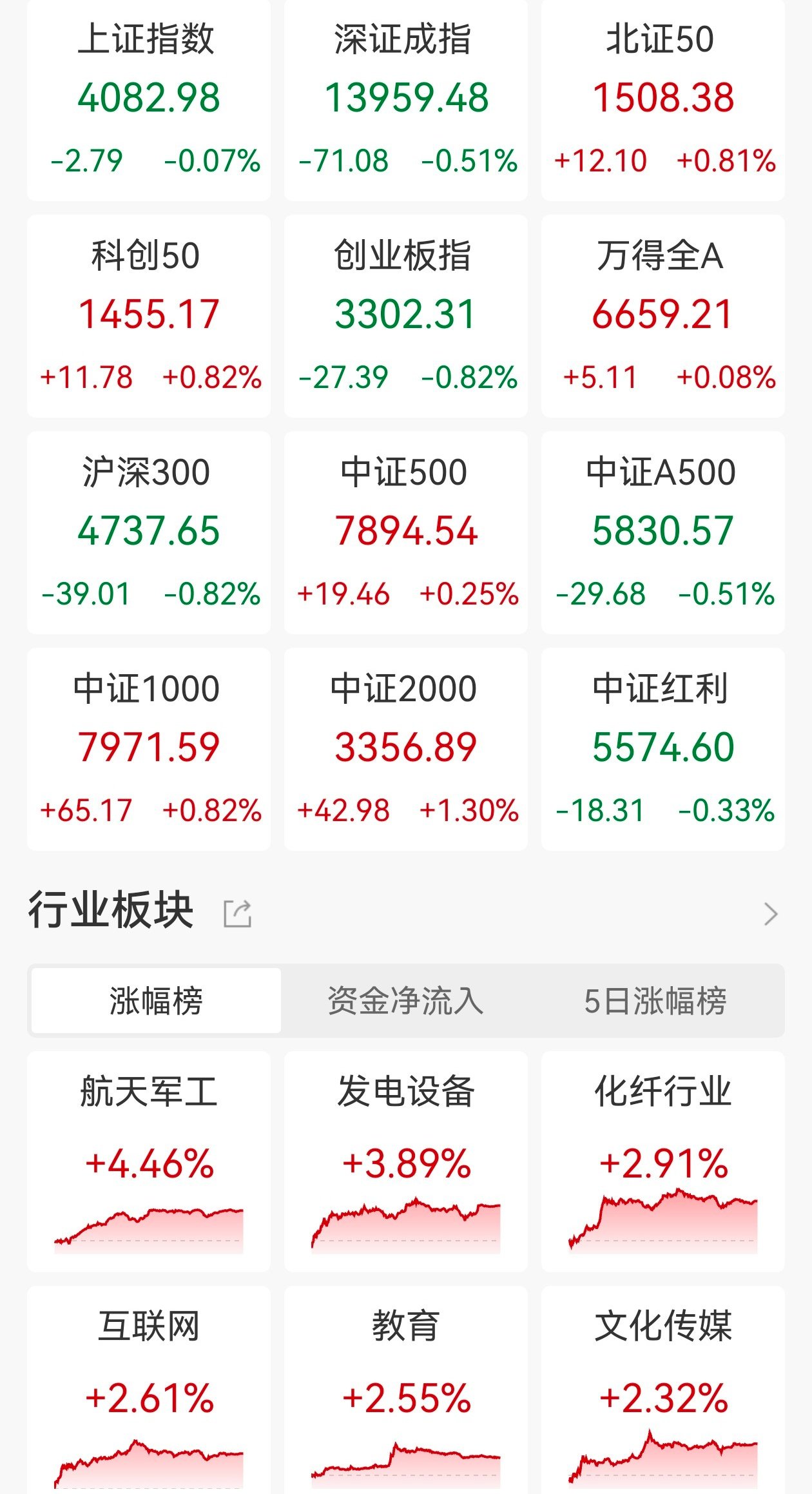
Market Overview - The three major A-share indices experienced fluctuations and closed lower, with the Shanghai Composite Index slightly down by 0.07% at 4082.98 points, marking a 15-day consecutive rise [1] - The Shenzhen Component Index fell by 0.51%, while the ChiNext Index decreased by 0.82% [1] - Total market turnover was 2.82 trillion yuan, a decrease of 568 billion yuan compared to the previous trading day, with over 3700 stocks rising and more than 100 stocks hitting the daily limit [1] Sector Performance - The U.S. significantly increased its military budget to 15 trillion yuan, leading to a surge in military, large aircraft, and aircraft carrier sectors, with multiple stocks such as Hailanxin and China First Heavy Industries hitting the daily limit [1] - The commercial aerospace and satellite internet sectors were actively traded, with stocks like Aerospace Electronics and Tongyu Communication also reaching the daily limit [1] - The brain-computer interface sector saw gains, with stocks like Sairui Medical hitting the daily limit [1] - Sectors related to 6G, controllable nuclear fusion, and AI pharmaceuticals showed strong performance [1] Declining Sectors - The large financial sector collectively retreated, with insurance and brokerage stocks leading the decline, including Hualin Securities hitting the daily limit down [1] - The lithium mining sector experienced a downturn, with Zhongmin Resources dropping over 7% [1] - The CPO concept weakened, with Dekeli falling nearly 7% [1] - Other sectors such as titanium dioxide, small metals, and fluorochemical industries also faced significant declines [1] Top Gainers - The top gainers included sectors such as chemical fibers, aerospace and military, and power generation equipment, with respective increases of 4.46%, 3.89%, and 2.91% [2] - Other notable sectors with gains included education, internet, and cultural transmission, with increases of 2.61%, 2.55%, and 2.32% respectively [2]
A股收评:沪指微跌0.07%、创业板跌0.82%,全市场超百股涨停,两市成交额连续四日超2.5万亿
Jin Rong Jie· 2026-01-08 07:06
Core Viewpoint - The A-share market experienced a narrow fluctuation with all three major indices closing down, while the commercial aerospace and AI application sectors showed significant strength [1][2][4] Market Performance - The Shanghai Composite Index fell by 0.07% to 4082.98 points, the Shenzhen Component Index decreased by 0.51% to 13959.48 points, and the ChiNext Index dropped by 0.82% to 3302.31 points [1] - The total trading volume in the Shanghai and Shenzhen markets reached 2.8 trillion yuan, marking the fourth consecutive trading day with volumes exceeding 2.5 trillion yuan [1] - Over 3700 stocks rose, with 111 stocks hitting the daily limit up [1] Sector Highlights Commercial Aerospace - The commercial aerospace sector saw a collective surge, with over 20 stocks hitting the daily limit up, including Galaxy Electronics and Shaoyang Hydraulic [2] - The upcoming launch of the "Vesta-1 Sea Launch" commercial rocket by Xinghe Power Aerospace is expected to catalyze further growth in this sector [2] Controlled Nuclear Fusion - The controlled nuclear fusion sector continued its strong performance, with multiple stocks, including China Nuclear Engineering and Xue Ren Group, achieving consecutive limit ups [3] - The sector is benefiting from breakthroughs in high-temperature superconductors and AI technology, with significant investment opportunities emerging in the upstream segment [3] AI Computing Chips - The AI computing chip sector showed robust growth, with stocks like Haiguang Information rising over 10% [4] - The Ministry of Industry and Information Technology and other departments issued guidelines to enhance AI computing power supply, supporting the development of key technologies in this area [4] Institutional Insights Citic Securities - Citic Securities suggests a higher probability of upward market movement in 2026, emphasizing the balance between external and internal demand [5] - The firm recommends focusing on sectors with lower heat and higher long-term return on equity potential, such as chemicals, engineering machinery, and new energy [5] Zhongtai Securities - Zhongtai Securities maintains a cautiously optimistic view on the technology sector, advising investment in well-logic-driven sub-sectors [6] - The firm notes potential market volatility due to seasonal tightening of funds, suggesting a window for low-price acquisitions [6] Everbright Securities - Everbright Securities highlights increasing divergence among market participants, indicating a need to be cautious of market volatility risks [7][8] - The firm points to the upcoming AI hardware exhibition in Shenzhen as a potential catalyst for related concepts [8]
万马股份:公司产品暂未应用于可控核聚变核心领域
Ge Long Hui· 2026-01-08 07:05
格隆汇1月8日丨万马股份(002276.SZ)在投资者互动平台表示,公司产品暂未应用于可控核聚变核心领 域。 ...

万马股份(002276.SZ):公司产品暂未应用于可控核聚变核心领域
Ge Long Hui· 2026-01-08 07:05
Group 1 - The core viewpoint of the article is that Wanma Co., Ltd. (002276.SZ) has stated that its products are not yet applied in the core field of controllable nuclear fusion [1]
收评:沪指微幅震荡录得15个阳线,商业航天,军工板块掀起涨停潮
Xin Lang Cai Jing· 2026-01-08 07:03
Market Overview - The A-share market experienced a collective adjustment, with the Shanghai Composite Index down by 0.07%, the Shenzhen Component Index down by 0.51%, and the ChiNext Index down by 0.82% [1] - The North Stock 50 Index increased by 0.81%, with a total trading volume of 28.262 billion yuan, a decrease of 55.3 billion yuan compared to the previous day [1] Sector Performance - Leading sectors included military equipment, commercial aerospace, brain-computer interfaces, photovoltaic equipment, controllable nuclear fusion, AI agents, real estate, quantum technology, and CRO concept stocks [1] - Underperforming sectors included insurance, securities, non-ferrous metals, rare earth permanent magnets, and battery sectors [1] Notable Stocks - The satellite navigation and commercial aerospace sectors saw significant gains, with over 30 stocks including Shaoyang Hydraulic, Aerospace Hongtu, and others hitting the daily limit [1] - The military equipment sector also showed strong performance, with stocks like Hailanxin and Inner Mongolia First Machinery Group reaching the daily limit [1] - The photovoltaic equipment sector experienced fluctuations, with Jun Da Co. hitting the daily limit and leading gains alongside Haiyou New Materials and Maiwei Co. [1] Market Adjustments - The insurance and securities sectors mostly adjusted, with Huayin Securities hitting the daily limit down, and major companies like China Ping An and Huatai Securities following suit [1] - The non-ferrous metals sector saw a decline in the afternoon, with stocks like Greeenmei and Shengda Resources experiencing varying degrees of losses [1]
可控核聚变概念强势来袭,市场规模有望跃升至万亿美元量级
Sou Hu Cai Jing· 2026-01-08 06:36
Core Viewpoint - The A-share market is experiencing a surge in the controlled nuclear fusion concept, driven by significant technological breakthroughs and strong policy support, attracting substantial market interest and investment. Group 1: Technological Breakthroughs - The Chinese Academy of Sciences announced a major breakthrough with the EAST device, confirming the existence of a density-free zone in tokamaks, which provides crucial physical evidence for high-density operation in magnetic confinement fusion [2] - The AIForScience team developed the PaMMA-Net deep neural network model, enhancing predictive capabilities for plasma behavior, significantly accelerating the engineering process of fusion research [3] - The global first high-temperature superconducting tokamak device, Honghuang 70, achieved a 120-second steady-state long-pulse plasma operation, marking a milestone in commercial fusion technology [2] Group 2: Policy Support - The implementation of the "Atomic Energy Law" on January 15, 2026, will encourage and support controlled thermonuclear fusion research, providing a regulatory framework for innovation in fusion energy [4] - Controlled nuclear fusion has been included in the national "14th Five-Year Plan" as a key future industry, with various provinces like Anhui and Sichuan introducing policies to promote development in this field [4][5] Group 3: Market Dynamics - The controlled nuclear fusion industry is witnessing unprecedented growth opportunities, with core companies like China National Machinery Industry Corporation (Sinomach) leading the market due to their technological advantages and order fulfillment capabilities [5] - Sinomach has secured 44% of the Chinese market share for the ITER project and 70% for the CFETR project, with related orders exceeding 5.3 billion yuan [5] - China National Nuclear Corporation (CNNC) is also a key player, participating in major projects like ITER and CFETR, and has shown strong stock performance in the current market [5] Group 4: Industry Growth Projections - The global nuclear fusion market is projected to exceed $496.5 billion by 2030 and reach a trillion-dollar scale by 2050, driven by technological advancements and capital influx [7] - Investment in the global nuclear fusion industry is expected to rise from $1.9 billion in 2021 to $9.7 billion by 2025, reflecting a 405% increase [7] - By 2025, China's total investment in nuclear fusion projects is anticipated to surpass 150 billion yuan, with significant contributions from local governments [7] Group 5: Future Developments - The BEST project aims to achieve a budget of 2.043 billion yuan by 2027, focusing on engineering verification and commercial application pathways [8] - The domestic nuclear fusion industry is entering a phase of engineering experimental pile construction, with core suppliers expected to benefit from increased scale and investment [9] - The market for controlled nuclear fusion is expected to grow from $19.15 billion in 2025 to $47.82 billion by 2030, indicating an acceleration in commercialization [10]
涨停巨浪袭来!“人造太阳”再迎新突破,核聚变行情全面点燃
Ge Long Hui· 2026-01-08 06:11
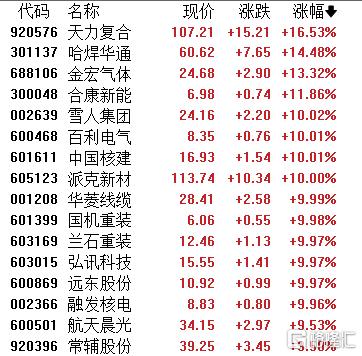
Core Viewpoint - The recent technological breakthroughs in controlled nuclear fusion are driving a surge in the market, with significant gains in related stocks and a positive outlook for the sector's long-term development [1][5]. Market Performance - The controlled nuclear fusion sector in the A-share market has shown strong performance, with a cumulative increase of over 9% in January alone, and several stocks, including Tianli Composite and Haheng Huaton, experiencing gains of over 16% and 14% respectively [1][2]. Key Developments - Significant advancements have been made in the controlled nuclear fusion field, including the confirmation of the existence of a density-free zone in Tokamak devices by the Hefei Institute of Physical Science, and the successful operation of a high-temperature superconducting Tokamak device by Energy Singularity [3]. - These breakthroughs enhance the feasibility of controlled nuclear fusion as a clean and virtually limitless energy source compared to current nuclear fission technologies [3]. Policy and Strategic Support - The global surge in AI is increasing electricity demand, highlighting the necessity for disruptive energy solutions, with controlled nuclear fusion being elevated to a national strategic priority in the U.S. and China [4]. - China's "14th Five-Year Plan" has identified nuclear fusion as a key industry direction, supported by the recent implementation of the Atomic Energy Law, which encourages research in controlled thermonuclear fusion [4]. Market Expansion and Investment - The controlled nuclear fusion market is expected to approach $500 billion by 2030, with optimistic long-term projections suggesting it could exceed $40 trillion by 2050 [6]. - Companies are actively investing in the sector, with Changqing Co. planning to invest 20 million yuan in a private equity fund focused on new materials and controlled nuclear fusion [6]. Future Outlook - Analysts believe that controlled nuclear fusion is a crucial strategic development direction for China, with ongoing construction of various fusion devices and significant events expected to boost market attention [7]. - Key projects such as the BEST device and the Helion device are anticipated to enhance the sector's visibility and drive further investment in core components [7].


A股午评 | 指数走势分化 科创50半日涨1.77%!券商持续回调
智通财经网· 2026-01-08 06:06
Market Overview - The A-share market showed mixed performance on January 8, with the Sci-Tech 50 Index rising by 1.77% and a half-day trading volume of 1.77 trillion, down by 701 billion from the previous trading day [1] - The Shanghai Composite Index increased by 0.09%, while the Shenzhen Component Index and the ChiNext Index fell by 0.2% and 0.52%, respectively [1] - Huachuang Securities believes the market is not extremely overheated, with trading volume and turnover rates indicating room for growth [1] Key Sectors Controlled Nuclear Fusion - The controlled nuclear fusion sector continued to show strength, with companies like China Nuclear Engineering and others achieving consecutive gains [3] - CITIC Securities noted that breakthroughs in high-temperature superconductors and AI technology are driving investment in large scientific facilities, creating significant opportunities in the upstream segment of the industry [3] Commercial Aerospace - The commercial aerospace sector experienced repeated strength, with companies such as Galaxy Electronics and others hitting their daily price limits [4] - Zhongtai Securities indicated that the commercial aerospace industry is entering a new phase of rapid development, with upcoming catalysts expected to enhance investment opportunities [4] Computing Power Chips - The computing power chip sector saw gains, with companies like Haiguang Information rising over 10% [5] - The Ministry of Industry and Information Technology, along with other departments, issued guidelines to strengthen AI computing power supply, promoting the development of intelligent chips and related technologies [5] Institutional Insights - CITIC Securities predicts a higher probability of upward market fluctuations in 2026, emphasizing the need for a balance between external and internal demand [7] - Zhongtai Securities maintains a cautiously optimistic view on the technology sector, suggesting that investors focus on specific sub-sectors with strong fundamentals [8] - Everbright Securities warns of increased market volatility due to profit-taking pressures, advising caution in investment strategies [9]