区块链技术

Search documents
OCR发票识别:让财务工作告别繁琐手工录入
Sou Hu Cai Jing· 2025-08-13 13:13
Core Viewpoint - The article emphasizes the significance of OCR (Optical Character Recognition) technology in streamlining financial processes by automating the extraction of key information from invoices, thereby enhancing efficiency and accuracy in financial operations [1][10]. Group 1: What is OCR Technology? - OCR technology converts printed documents into editable electronic text using optical scanning devices and complex algorithms to analyze text shapes and arrangements [2]. Group 2: Working Principle of OCR Invoice Recognition - The OCR invoice recognition process involves several steps: image acquisition, image preprocessing, character segmentation, character recognition, and information extraction and validation [3][4][5][6]. Group 3: Applications of OCR Invoice Recognition - **Expense Reimbursement**: Automates the entry of invoice information into reimbursement systems, significantly reducing manual input workload [7]. - **Tax Reporting**: Automatically extracts key invoice information for tax reporting, improving efficiency and reducing risks associated with manual entry errors [7]. - **Financial Auditing**: Enhances the auditing process by quickly extracting and verifying invoice information against financial data [8]. Group 4: Benefits of OCR Invoice Recognition - **Increased Efficiency**: Reduces the time required for invoice entry from days to hours, especially for companies processing thousands of invoices monthly [8]. - **Error Reduction**: Minimizes errors associated with manual data entry, ensuring higher accuracy in financial data [9]. - **Lower Labor Costs**: Frees up financial personnel from tedious tasks, allowing them to focus on higher-value activities, with some companies reporting a 30% reduction in workload [9]. - **Enhanced Compliance**: Ensures the accuracy and completeness of invoice data for tax and audit purposes, reducing the risk of penalties [10]. Group 5: Future Trends in OCR Technology - **Integration with AI and Machine Learning**: Enhances recognition accuracy and efficiency through adaptive learning algorithms [11]. - **Big Data Analysis**: Combines with big data to improve data management and risk detection [12]. - **Blockchain Technology**: Ensures secure storage and sharing of invoice information, enhancing data integrity and traceability [13].
黄金,3355继续空!
Sou Hu Cai Jing· 2025-08-13 05:55
Core Insights - The cryptocurrency market experiences cyclical bull markets approximately every four years, with Bitcoin (BTC) reaching a peak of $60,000 in 2021 before dropping to over $10,000, and is projected to return to $120,000 in the next cycle [1] - The proliferation of blockchain technology has led to various applications on public chains, with the previous bull market focusing on decentralized storage, NFTs, and the metaverse [1] - The current market is witnessing the introduction of stablecoin legislation, tokenization of real-world assets (RWA), decentralized finance (DeFi), and new concepts in decentralized exchanges (DEX) like Uniswap, indicating a shift towards more innovative financial solutions [1] - Over the past decade, the cryptocurrency market has transitioned from chaotic growth to more structured promotion, becoming increasingly integrated into everyday life [1] - The long-awaited approval of Bitcoin ETFs has reignited interest in the market, with prices starting from over $1,000 in April [1]
5190枚以太币浮盈3700万,上市公司炒币潮卷向港交所
智通财经网· 2025-08-13 03:48
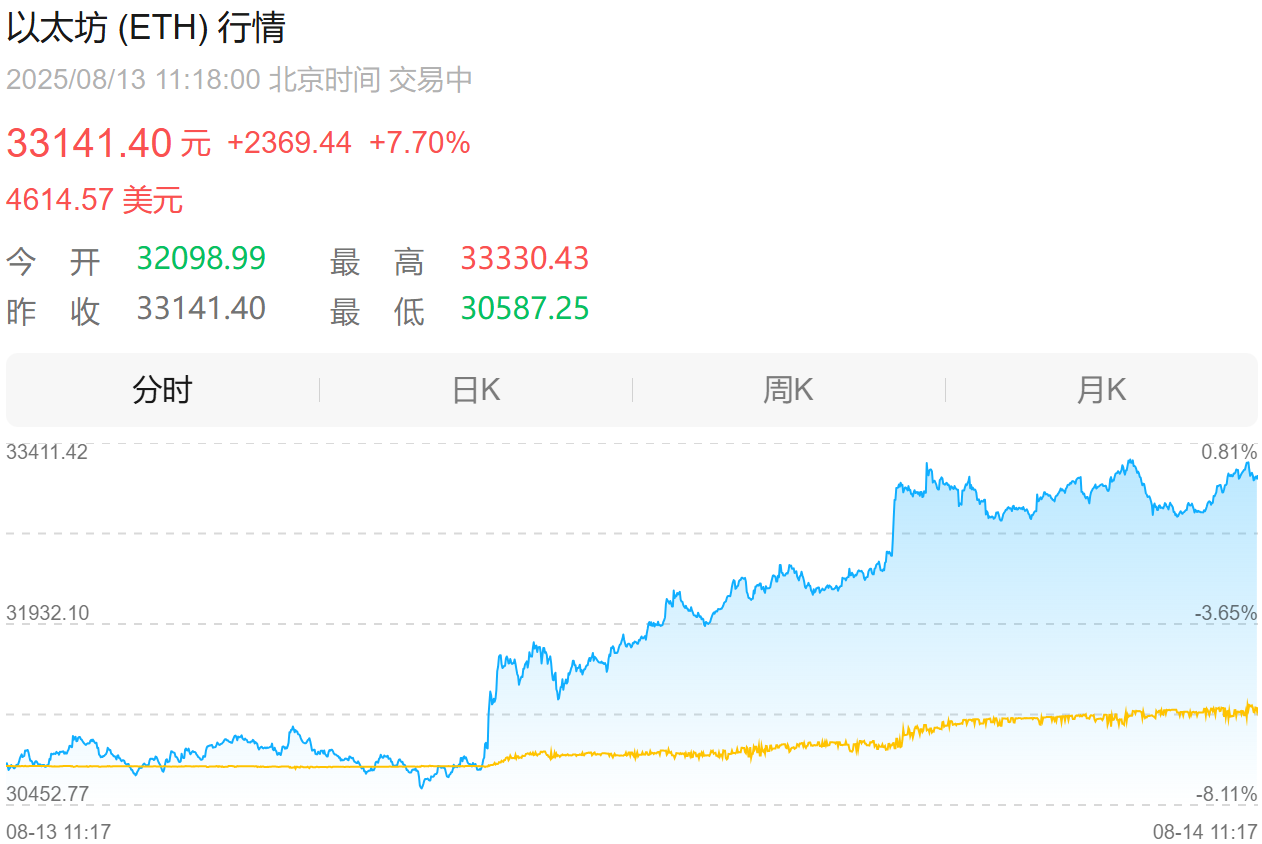
Core Insights - Ethereum (ETH) has become a popular asset among Hong Kong-listed companies, with significant gains reported by several firms following a price surge above $4600 [1][4][11] Group 1: Company Holdings and Gains - Hong Kong-listed company Huajian Medical (01931) reported a floating profit of $482.52 million (approximately HKD 37.87 million) from its strategic reserve of 5190 ETH, purchased at an average price of $3661 [1][5] - Other companies also reported gains: Jinyong Investment holds 527.2 ETH with a floating profit of $46.1 million, Boya Interactive holds 298 ETH with a floating profit of $87.3 million, and Blueport Interactive holds 818 ETH with an estimated floating profit of $171 million [5][6] - The total floating profit from ETH holdings across these four companies reached nearly $787 million (approximately HKD 61.77 million) within a week [6] Group 2: Strategic Approaches to Digital Assets - Companies are adopting differentiated strategies in their cryptocurrency investments: Boya Interactive and Blueport Interactive focus on diversified holdings, while Jinyong Investment is exploring a "light asset model" for Web3 development [7] - Huajian Medical aims to become the largest Ethereum reserve holder, with plans to continuously increase its holdings and a budget of HKD 880 million for future purchases [7][8] Group 3: Market Trends and Institutional Interest - Ethereum's price has increased over 100% this year, driven by technological upgrades and institutional interest [11] - Major institutions, such as BlackRock, have significantly increased their ETH purchases, with a record $12 billion bought in a single week [12] - As of August 5, 59 global companies have added 1.97 million ETH to their balance sheets, indicating a growing trend of corporate adoption of digital assets [12][13]

研究| 稳定币暗战: 银行家们不愿公开的稳定币真相
未可知人工智能研究院· 2025-08-13 03:02
Group 1 - The article discusses the historical evolution of the US dollar's global dominance, from the Bretton Woods system to the current challenges posed by digital currencies and emerging economies [2][4][5] - The dollar's status as a reserve currency remains strong, with a projected 58% share of global allocated foreign exchange reserves in 2024, despite challenges from the rise of the yuan and other currencies [7][9] - The article highlights the "petrodollar" system, where the US dollar is used for global oil trade, reinforcing its dominance through capital inflows from oil-exporting countries [6][10] Group 2 - Inflation has eroded the purchasing power of the dollar, with a reported 39% decline over the past 20 years, exacerbated by the Federal Reserve's monetary policies [13][17] - The article outlines the relationship between the Federal Reserve's policies and inflation, noting that quantitative easing and low interest rates have contributed to rising inflation [14][15] - Emerging market countries have faced significant economic challenges due to dollar depreciation, leading to crises in countries like Venezuela and Argentina [16] Group 3 - The weaponization of financial sanctions by the US has created a trust crisis in the dollar, prompting countries to seek alternatives to dollar-denominated transactions [21][23] - Countries like Russia and China are exploring alternative payment systems to reduce reliance on the dollar, indicating a trend towards "de-dollarization" [22][24] - The article notes that the legitimacy of dollar hegemony is increasingly questioned, with calls for a more equitable global financial system [25][26] Group 4 - The article discusses the inefficiencies of the SWIFT system in cross-border payments, highlighting its reliance on multiple intermediaries and the associated high costs [35][39] - It emphasizes the slow processing times of SWIFT transactions, which can take 3 to 5 days, compared to the real-time capabilities of stablecoins [41][42] - The emergence of alternative payment solutions, such as CBDCs and blockchain-based systems, is presented as a response to the limitations of the SWIFT system [57][58] Group 5 - The case of Venezuela illustrates the consequences of hyperinflation and the collapse of trust in local currency, leading to a shift towards dollarization in everyday transactions [62][70] - The article highlights the social implications of dollarization, where wealth disparities are exacerbated as only certain segments of the population can access stable currencies [77][78] - It concludes that while dollarization may provide short-term relief from inflation, it ultimately leads to a loss of monetary sovereignty and increased dependency on external dollar supply [83]

创业黑马: 民生证券股份有限公司关于深圳证券交易所《关于创业黑马科技集团股份有限公司发行股份及支付现金购买资产并募集配套资金申请的审核问询函》回复之核查意见
Zheng Quan Zhi Xing· 2025-08-12 16:26
Core Viewpoint - The company is undergoing a restructuring process involving the acquisition of 100% equity in Beijing Banshinet Technology Co., Ltd. and is addressing inquiries from the Shenzhen Stock Exchange regarding the sustainability of the target asset's operations and the legality of its electronic copyright certification services [1][2][3]. Group 1: Target Asset's Business Model - The target asset focuses on providing electronic copyright certification services to mobile application developers, with revenue from this service accounting for 88.36% and 95.37% of total revenue in the respective reporting periods, and maintaining gross margins of 96.56% and 98.17% [2][3]. - The electronic copyright certification service is designed to meet the copyright protection needs of software developers, providing a certificate that serves as proof of copyright for applications on distribution platforms [2][3][10]. - The company has established a blockchain-based system for electronic copyright certification, which enhances the efficiency of the certification process and meets the market demand for rapid verification [10][11]. Group 2: Regulatory Compliance and Market Position - The company has obtained necessary licenses and regulatory approvals from relevant authorities, including the Ministry of Industry and Information Technology and the National Internet Information Office, ensuring compliance with legal requirements for its operations [16][22][27]. - The electronic copyright certification service aligns with national policies aimed at promoting high-quality development in the copyright industry and leveraging blockchain technology for copyright protection [14][15][22]. - The service has been recognized and accepted by major mobile application distribution platforms, establishing a solid market position and demonstrating its compliance with industry standards [15][33]. Group 3: Financial Implications and Future Outlook - The acquisition will result in a significant increase in goodwill, representing 41.04% of the net assets attributable to the parent company as of the end of 2024 [2][3]. - The company is expected to enhance its operational sustainability through this acquisition, addressing potential risks associated with market competition and regulatory changes [4][11].
新晨科技:公司在国际结算领域均具备多年的实践经验和技术积累
Zheng Quan Ri Bao Wang· 2025-08-12 11:52
Core Viewpoint - The company, Xinchen Technology, has extensive experience and technical accumulation in the field of international settlement and trade financing, which positions it well to meet market demands [1] Group 1: Company Capabilities - The international settlement and trade financing system developed by the company is based on mature international settlement and trade financing products, integrating deep understanding and years of implementation experience in the financial industry [1] - The system comprehensively covers bank international settlement and trade financing business, domestic specialty business, and interbank agency business [1] - By automating international settlement and trade financing processes, the company helps banks reduce risks and lower costs [1] Group 2: Technological Innovation - The successful application of blockchain technology in areas such as letter of credit settlement demonstrates the effective utilization of the company's R&D achievements in blockchain [1] - This application not only meets the business needs of the company's clients but also showcases the practical implementation of innovative technology in financial services [1]

孙宇晨为何成华人商业宇航员第一人,实现马斯克没实现的梦想?
Sou Hu Cai Jing· 2025-08-12 10:38
Core Insights - Elon Musk's SpaceX is a benchmark in the commercial space industry, yet he has never personally experienced space travel, a gap filled by Chinese cryptocurrency entrepreneur Sun Yuchen [2] - Sun Yuchen became the youngest Chinese commercial astronaut by completing a suborbital flight on Blue Origin's New Shepard on August 3, 2025, at a ticket price of $28 million, showcasing a new level of personal marketing [2] - The article discusses Sun's rise from a Beijing University student to a billionaire in the cryptocurrency space, highlighting his strategic moves and the controversies surrounding his wealth accumulation [3][5] Group 1: Background and Rise - Sun Yuchen's wealth story began with his education, where he excelled academically and later engaged with blockchain technology at Ripple Labs, recognizing its potential to disrupt the global financial system [3] - In 2017, he founded the TRON Foundation, raising over $70 million through an ICO during the cryptocurrency market's peak, making him a billionaire at just 28 [3] Group 2: Controversies and Wealth Accumulation - Sun faced backlash in 2018 for selling TRON tokens worth approximately $300 million, leading to accusations of fraud, yet his net worth continued to grow amid market volatility [5] - His diversified strategy included acquiring BitTorrent and launching various tokens, which contributed to his sustained wealth growth [5][6] Group 3: Marketing and Strategic Moves - Sun's $28 million purchase of a Blue Origin flight seat was initially seen as a publicity stunt, but it later proved to be a savvy investment that elevated his personal brand [8] - His marketing strategy involved high-profile expenditures that generated significant media attention, enhancing the visibility of the TRON ecosystem [9] Group 4: Space Flight and Symbolism - The space flight served as a symbolic act, representing TRON's aspirations and community engagement, as Sun carried 1,000 wishes from the TRON community into space [11] - The extensive media coverage from this event provided invaluable brand exposure, transforming Sun's image from a controversial figure to a leader in technological exploration [11] Group 5: Comparison with Elon Musk - The article contrasts Sun Yuchen's approach with Elon Musk's, noting that Musk's focus is on product development and company operations, while Sun leverages personal experiences to enhance community trust in TRON [12][13] - Sun's willingness to take risks, such as his space flight, is interpreted as a demonstration of confidence in his project, which resonates well within the cryptocurrency community [13]

港股异动 复星国际(00656)午后飙升逾20% 报道称复星已确定在港申请稳定币牌照
Jin Rong Jie· 2025-08-12 07:14
Core Viewpoint - Fosun International (00656) has seen a significant stock price increase of over 20% following the news of its application for a stablecoin license in Hong Kong, indicating strong market interest and potential growth in the virtual asset sector [1]. Group 1: Company Developments - Fosun International's stock surged by 20.6%, reaching HKD 6.44, with a trading volume of HKD 287 million [1]. - The company has established a dedicated team for the stablecoin license application in Hong Kong, led by its chairman Guo Guangchang [1]. - On August 6, key executives from Fosun's stablecoin team met with Hong Kong's Chief Executive John Lee and Financial Secretary Paul Chan, highlighting the importance of regulatory engagement [1]. Group 2: Regulatory and Market Position - On July 21, Fosun Wealth International Holdings submitted trademark applications for "Xing Coin" and "Fosun Wealth RWA," indicating a strategic move into virtual assets and tokenization [1]. - Fosun International has obtained an upgraded Type 1 license from the Hong Kong Securities and Futures Commission, allowing it to provide comprehensive account services through a virtual asset trading platform (VATP) [1]. - The company’s subsidiary, Xinglu Technology, held a product launch summit for RWA on July 23, aiming to introduce version 1.0 of its virtual asset trading system [1].

以数字化转型助力“稳外贸” 中信银行发布国际业务智慧网银4.0
Xin Hua Wang· 2025-08-12 06:27
Core Viewpoint - CITIC Bank has launched its International Business Smart Online Banking 4.0, enhancing digital financial services for enterprises, particularly in cross-border financial services, to support small and medium-sized enterprises during the pandemic [1][2]. Group 1: Product Features - The new online banking platform offers a comprehensive range of services including global account management, cross-border settlement, investment financing, supply chain management, and foreign exchange trading, covering over 100 products in both domestic and foreign currency [1][2]. - The "Cross-Border Cash Management Comprehensive Service Plan" enables Chinese enterprises to manage global account information visually, facilitating quick cross-border fund transfers and small payments [2]. - "Cross-Border Capital Treasure" provides digital services for capital project foreign exchange income and payments, streamlining processes and creating a "green channel" for clients [2]. - The platform offers personalized foreign exchange management solutions and self-service online trading for foreign exchange derivatives, enhancing the timeliness and accuracy of foreign exchange management [2]. Group 2: Customer Experience - The Smart Online Banking features tailored services for different customer segments, providing various versions such as standard and international business versions to enhance personalized service [3]. - It includes flexible foreign exchange services, with intelligent generation of remittance applications and real-time tracking of remittance progress, ensuring quick fund transfers [3]. - The platform supports multiple mainstream browsers and offers a secure login method, enhancing user experience and accessibility [3]. Group 3: Strategic Direction - CITIC Bank's foreign exchange business is characterized by professionalism, speed, and flexibility, focusing on supporting small and medium-sized export enterprises and leading in cross-border e-commerce [4]. - The bank is committed to digital transformation and has established a blockchain forfaiting trading platform recognized by the central bank as an industry platform [4]. - Future plans include continuous exploration of innovations in financial technology, such as artificial intelligence and big data, to provide advanced cross-border financial services [4].

各路“兵马”布局数字藏品 银行入场名单正扩容
Xin Hua Wang· 2025-08-12 06:26
Group 1 - The core viewpoint of the articles highlights the increasing involvement of companies and financial institutions in the digital collectibles sector, with a focus on the launch of the "Fifth Dimension" app by Zhongwen Online, which aims to create a content-rich IP digital collectibles platform [1] - Numerous listed companies are entering the digital collectibles space, recognizing the potential of blockchain technology for copyright protection and asset digitization, although current revenue contributions from this business remain limited [1][2] - Financial institutions, including banks and payment companies, are also actively participating in the digital collectibles market, with early movers like Baixin Bank and various other banks launching their own digital collectibles [2] Group 2 - The rapid acceleration of activities in the digital collectibles sector by listed companies and financial institutions is driven by the ongoing popularity of digital collectibles and the desire to capture market demand and attract younger consumers [3] - Companies are establishing their own digital collectibles platforms, while financial institutions are experimenting with themed or seasonal digital collectibles as part of a diversified business strategy [2][3] - There is a cautionary note regarding the potential for speculative behavior among users, emphasizing the importance of focusing on the intrinsic artistic value of digital collectibles and establishing clear trading rules to prevent misuse [3]