
宏观政策

Search documents
5000亿新型政策性金融工具稳投资:全部用于补充项目资本金
2 1 Shi Ji Jing Ji Bao Dao· 2025-09-29 10:09
Economic Performance - In August, China's industrial added value above designated size grew by 5.2% year-on-year, while the service production index increased by 5.6%, and retail sales of consumer goods rose by 3.4%, indicating a marginal weakening in economic indicators compared to the previous month [1] - The profit growth of industrial enterprises improved significantly, with profits for the first eight months turning from a decline of 1.7% to a growth of 0.9%, and a monthly increase of 20.4% in August compared to a decline of 1.5% in July [2] Supply-Side Analysis - The manufacturing and service sectors showed stable growth, with the added value of equipment manufacturing and high-tech manufacturing increasing by 8.1% and 9.3% respectively in August, outpacing the overall industrial growth rate [1] - Key sectors such as integrated circuits, aerospace equipment, industrial robots, civilian drones, and new energy vehicles maintained rapid growth [1] Demand-Side Insights - The consumption sector demonstrated resilience, with retail sales of new energy vehicles growing over 20% year-on-year in the first eight months, and service retail sales increasing by 5.1% [2] - Manufacturing investment rose by 5.1% in the first eight months, with significant growth in information services, aerospace, and computer equipment manufacturing investments [2] Policy and Financial Tools - The National Development and Reform Commission (NDRC) is implementing new policy financial tools aimed at supporting emerging industries and infrastructure, with a total scale of 500 billion yuan designated for project capital [4][5] - These new financial tools are intended to stimulate effective investment and are positioned as "quasi-fiscal" instruments to enhance capital availability for key projects [4]
国家发改委宣布,新型政策性金融工具规模共5000亿元
Zhong Guo Zheng Quan Bao· 2025-09-29 09:45
Core Viewpoint - The National Development and Reform Commission (NDRC) is actively promoting new policy financial tools to support economic stability and growth, with a total scale of 500 billion yuan allocated for project capital supplementation [1][4]. Group 1: Economic Monitoring and Policy Implementation - The NDRC emphasizes the importance of continuous economic monitoring and timely policy adjustments in response to changing circumstances [3]. - Despite external pressures, China's economy is generally stable, with solid progress in high-quality development driven by macro policies [3]. - The NDRC plans to enhance macro policy implementation and strengthen economic monitoring to ensure sustained economic health [3]. Group 2: New Policy Financial Tools - The new policy financial tools amount to 500 billion yuan, specifically aimed at supplementing project capital [4]. - The NDRC is working to expedite the allocation of these funds to specific projects, aiming to accelerate construction and increase effective investment [4]. Group 3: Artificial Intelligence Integration - The NDRC is focusing on the integration of artificial intelligence in key sectors such as education, healthcare, and transportation, supporting enterprises in pilot demonstrations [5][6]. - A target for the application rate of new intelligent terminals and systems has been set for 2027, with a structured approach to policy development and standardization [5][6]. - The NDRC aims to foster collaboration between AI companies and industry leaders to drive innovation and application in various sectors [5][6]. Group 4: Support for Enterprises - The NDRC recognizes the critical role of private enterprises, especially SMEs, in the development of AI technologies and has proposed measures to support their participation [8]. - Policies will be implemented to enhance the development of domestic computing power, models, and data resources, facilitating greater involvement of private enterprises in AI initiatives [8].

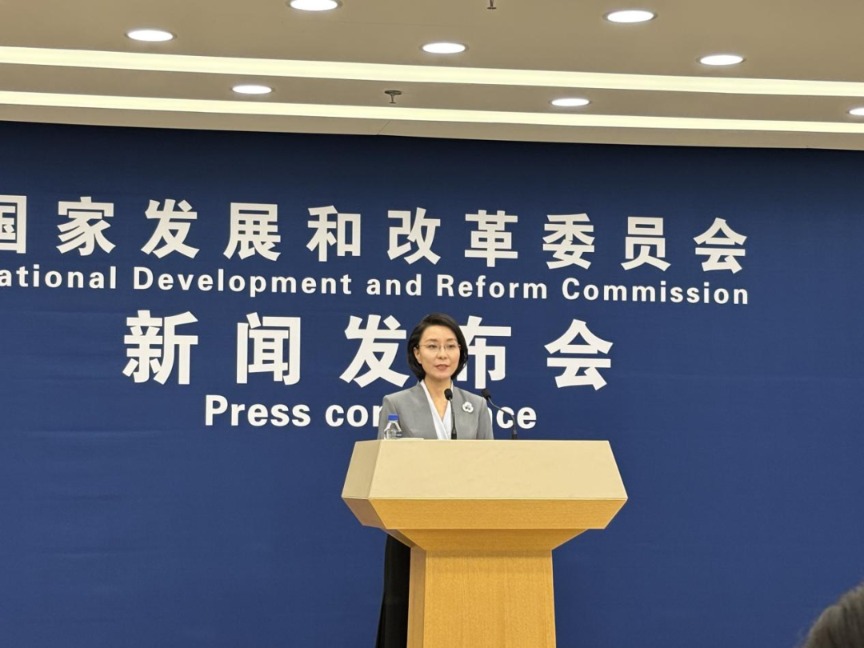
国家发改委重磅发声!将适时加力实施宏观政策
财联社· 2025-09-29 09:37
Core Viewpoint - The National Development and Reform Commission (NDRC) emphasizes that the current economic operation faces numerous risks and challenges, and the foundation for economic recovery needs further consolidation. The NDRC plans to strengthen macro policies and enhance economic monitoring and forecasting [1]. Group 1: Economic Performance - In August, the overall economic operation remained stable, driven by continuous macro policy efforts. Key sectors such as manufacturing and services showed positive growth [1]. - The value added of high-tech manufacturing and equipment manufacturing increased by 9.3% and 8.1% year-on-year, respectively, outpacing the overall industrial growth rate by 4.1 and 2.9 percentage points [3]. Group 2: Smart Technology Development - The NDRC aims to promote the application and popularization of new-generation smart terminals and intelligent systems by creating a supportive policy environment, advancing technological innovation, and expanding market capacity [2][4]. - The NDRC will support private enterprises in participating in the "Artificial Intelligence +" initiative, highlighting their role as pioneers in applying AI in production processes [5]. Group 3: Financial Tools and Support - A new type of policy financial tool has been established with a total scale of 500 billion yuan, aimed at supplementing project capital. The NDRC is working to allocate these funds to specific projects promptly [6][7].

5000亿元!国家发改委:全部用于补充项目资本金
Zheng Quan Shi Bao· 2025-09-29 09:04
Core Viewpoint - The National Development and Reform Commission (NDRC) emphasizes the need for macroeconomic policy adjustments to address ongoing challenges in economic operations, while highlighting the resilience and growth in key sectors like manufacturing and services [2]. Group 1: Economic Performance - In August, China's economic operation remained generally stable, supported by continuous macro policy efforts [2] - Manufacturing and service sectors showed positive growth trends, with retail sales related to trade-in programs maintaining rapid growth [2] - Despite these positive indicators, the economy still faces significant risks and challenges, particularly from a complex external environment [2] Group 2: Policy Implementation - The NDRC plans to strengthen economic monitoring, forecasting, and early warning systems, and will prepare policies for timely implementation based on changing circumstances [2] - The NDRC will work with relevant departments to create a conducive policy environment for the application and popularization of new-generation smart terminals and intelligent systems [3] Group 3: Support for Private Enterprises - Private enterprises are identified as key players in the "Artificial Intelligence +" initiative, with 254,000 new AI software development firms established in Q1 of this year [4] - The NDRC aims to support various enterprises, including private ones, in deepening their participation in the AI sector through policy and financial measures [4] Group 4: Financial Tools - The NDRC is advancing new policy financial tools totaling 500 billion yuan, all designated for supplementing project capital [5] - Efforts are being made to ensure that these financial tools are quickly allocated to specific projects to promote stable and healthy economic development [5]
5000亿元!国家发改委:全部用于补充项目资本金
证券时报· 2025-09-29 08:55
今日(9月29日),国家发改委召开9月份新闻发布会。 要点如下: 李超表示,民营企业是参与人工智能+行动的主力军,以今年一季度为例,我国新设立人工智能软件研发类民营企业25.4万户。从成效看,民营企业是推动人 工智能落地应用的先锋队,不少民营企业已经率先把人工智能运用到其生产工艺和业务流程当中。下一步,国家发展改革委将会同相关部门多措并举,支持 包括民营企业在内的各类企业深度参与人工智能+行动。在政策上,将在"两重"建设当中支持国产算力模型语料库的发展,加大"两新"政策对民营企业的支持 力度,在资金上持续在算力等领域发放人工智能券,为企业使用算力服务提供补贴。 国家发改委:新型政策性金融工具共5000亿元 全部用于补充项目资本金 李超表示,为促进金融更好地服务实体经济,推动扩大有效投资。国家发展改革委会同有关方面积极推进新型政策性金融工具相关工作,新型政策性金融工 具规模共5000亿元,全部用于补充项目资本金。国家发展改革委正在会同有关方面,抓紧把新型政策性金融工具资金投入到具体项目上,后续将督促各个地 方推动项目加快开工建设,促进经济平稳健康发展。 责编:李丹 校对:陶谦 版权声明 国家发改委:经济运行仍存 ...

国家发改委,最新发声!
Sou Hu Cai Jing· 2025-09-29 08:54
国家发改委:经济运行仍存挑战,将适时加力实施宏观政策 9月29日,国家发展改革委政策研究室副主任、新闻发言人李超表示,8月份,在宏观政策持续发力等因 素的带动之下,我国经济运行总体平稳。从供给侧看,生产平稳增长,制造业、服务业的重点领域增势 良好;从需求侧看,政策效能持续显现,展现出较强的韧性和抗压能力。在消费方面,以旧换新相关零 售额继续保持较快的增长。不过,当前经济运行当中依然面临着不少的风险和挑战,外部环境仍然严峻 复杂,经济回升向好的基础仍需进一步巩固。下一步,国家发展改革委将持续发力,适时加力实施宏观 政策。同时国家发展改革委也将持续加强经济的监测、预测、预警,做好政策预研储备,根据形势变化 及时推出。 国家发改委:从供需两端发力,推动智能终端和智能体市场扩容 9月29日,国家发展改革委政策研究室副主任、新闻发言人李超表示,国家发展改革委将会同有关部门 从三个方面推动新一代智能终端和智能体的加快应用普及。一是加强构建导向明确、尊重规律、规范发 展的政策环境,制定政策指引;二是协同推进技术攻关和开源共享,加快创新步伐,支持人工智能企业 和各行业龙头企业开展协同创新;三是在供需两端同步发力,推动市场扩容 ...
国家发展改革委:将持续发力,适时加力实施宏观政策
2 1 Shi Ji Jing Ji Bao Dao· 2025-09-29 08:47
9月29日,在国家发展改革委9月份新闻发布会上,国家发展改革委政策研究室副主任、新闻发言人李超 表示,当前经济运行依然面临不少风险挑战,外部环境仍然复杂严峻,经济回升向好的基础仍需进一步 巩固。 下一步,国家发展改革委将深入贯彻落实党中央、国务院决策部署,持续发力、适时加力实施宏观政 策。同时,我们将持续加强经济监测预测预警,做好政策预研储备,根据形势变化及时推出。随着各项 政策效应充分释放,我们有信心继续保持经济平稳健康发展,有信心实现全年目标任务。 0:00 ...
国家发改委,最新发声!
券商中国· 2025-09-29 08:39
国家发改委:经济运行仍存挑战,将适时加力实施宏观政策 国家发改委:新型政策性金融工具共5000亿元,全部用于补充项目资本金 9月29日,国家发展改革委政策研究室副主任、新闻发言人李超表示,为促进金融更好地服务实体经济,推动 扩大有效投资。国家发展改革委会同有关方面积极推进新型政策性金融工具相关工作,新型政策性金融工具规 模共5000亿元,全部用于补充项目资本金。国家发展改革委正在会同有关方面,抓紧把新型政策性金融工具资 金投入到具体项目上,后续将督促各个地方推动项目加快开工建设,促进经济平稳健康发展。 责编:罗晓霞 校 对:高源 百万用户都在看 9月29日,国家发展改革委政策研究室副主任、新闻发言人李超表示,8月份,在宏观政策持续发力等因素的带 动之下,我国经济运行总体平稳。从供给侧看,生产平稳增长,制造业、服务业的重点领域增势良好;从需求 侧看,政策效能持续显现,展现出较强的韧性和抗压能力。在消费方面,以旧换新相关零售额继续保持较快的 增长。不过,当前经济运行当中依然面临着不少的风险和挑战,外部环境仍然严峻复杂,经济回升向好的基础 仍需进一步巩固。下一步,国家发展改革委将持续发力,适时加力实施宏观政策。同时 ...
国家发改委:持续发力、适时加力实施宏观政策 有信心实现全年目标任务
智通财经网· 2025-09-29 08:15
Economic Overview - In August, China's economy showed overall stability, supported by continuous macro policies and strong resilience in demand [1][5] - Manufacturing and service sectors experienced steady growth, with key areas performing well [5][6] - The added value of major industries such as equipment manufacturing and high-tech manufacturing grew by 8.1% and 9.3% year-on-year, respectively [5][6] Policy Initiatives - The National Development and Reform Commission (NDRC) is implementing macro policies to maintain economic stability and achieve annual targets [1][7] - A notification was issued to promote the regular application of Real Estate Investment Trusts (REITs) in infrastructure, aiming to support private investment [3][4] Artificial Intelligence Development - The "Artificial Intelligence+" initiative aims for over 70% application penetration of new intelligent terminals and agents by 2027 [8][9] - The initiative emphasizes the importance of AI in enhancing productivity across various sectors, including manufacturing and services [8][9] Investment Trends - In the first eight months, manufacturing investment increased by 5.1%, with significant growth in information services and aerospace sectors [6][7] - The total import and export volume in August rose by 3.5% year-on-year, indicating a diversified trade performance [7] Environmental Initiatives - The "Three Norths" project, a long-term ecological restoration initiative, has been revised to set more ambitious goals for forest coverage and land management by 2050 [10][12] - The establishment of the China-Shanghai Cooperation Organization Green Industry Cooperation Platform aims to enhance international collaboration in green technology and finance [21][22]
适时加力实施宏观政策,发改委最新发声
Di Yi Cai Jing Zi Xun· 2025-09-29 07:56
9月29日,国家发展改革委政策研究室副主任、新闻发言人李超表示,当前经济运行依然面临不少风险 挑战,外部环境仍然复杂严峻,经济回升向好的基础仍需进一步巩固。下一步,国家发展改革委将持续 发力、适时加力实施宏观政策。同时,将持续加强经济监测预测预警,做好政策预研储备,根据形势变 化及时推出。随着各项政策效应充分释放,有信心继续保持经济平稳健康发展,有信心实现全年目标任 务。 ...