
医疗大模型

Search documents
港仔机器人尾盘涨近12% 公司与美年健康达成合作 推动具身智能人形机器人+医疗大模型规模化落地
Zhi Tong Cai Jing· 2025-09-17 08:20
Core Viewpoint - The partnership between 港仔机器人 and 美年健康 marks a significant advancement in the integration of AI technology into health management, aiming to create a large-scale health service network utilizing intelligent robots [1] Company Summary - 港仔机器人 experienced a stock price increase of nearly 12% at the close, finishing up 5.43% at 1.36 HKD, with a trading volume of 25.586 million HKD [1] - The company has successfully delivered 1,000 quadruped robots to 香港通宏护卫, demonstrating its recognized commercial viability in the market [1] Industry Summary - The strategic cooperation agreement signed between 港仔机器人 and 美年健康 is valued at over 800 million RMB, representing a historic breakthrough in the health management sector with the introduction of "AI proactive health protection" [1] - Over the next three years, the partnership plans to deploy 20,000 "smart health robot examination centers," aiming to establish the largest "human-machine collaborative health service network" globally [1]

港股异动 | 港仔机器人(00370)尾盘涨近12% 公司与美年健康达成合作 推动具身智能人形机器人+医疗大模型规模化落地
智通财经网· 2025-09-17 08:19
Group 1 - The core viewpoint of the article highlights the strategic partnership between 港仔机器人 (00370) and 美年健康 (002044.SZ), which is expected to leverage their respective strengths in the health management sector [1] - 港仔机器人 experienced a significant stock price increase, closing up 5.43% at 1.36 HKD, with a trading volume of 25.586 million HKD [1] - The partnership involves a commercial contract valued at over 800 million HKD, marking a historic breakthrough in integrating "embodied intelligent humanoid robots" with medical AI models into the health management field [1] Group 2 - 美年健康 operates over 500 offline branches and has a customer base in the millions, providing a nationwide channel network for the collaboration [1] - 港仔机器人 has successfully delivered 1,000 quadruped robots to Hong Kong Tonghong Security, demonstrating its recognized commercial deployment capabilities [1] - Over the next three years, the two companies plan to deploy 20,000 "smart health robot examination centers," creating the largest "human-machine collaborative health service network" globally [1]
8亿+战略合作落地!港仔机器人(00370)×美年健康(002044.SZ):重塑人类健康管理,开启AI医疗新纪元
Zhi Tong Cai Jing· 2025-09-17 07:48
Core Insights - The collaboration between Hong Kong-based Portai Robotics and China's Meinian Health marks a significant shift in the global health industry, introducing AI-driven health management solutions through a strategic partnership valued at over 800 million yuan [1][5]. Group 1: Innovative Health Management - The partnership aims to address traditional health management challenges by deploying 20,000 "smart health robot examination centers" over the next three years, making health services more accessible and proactive for individuals [2][4]. - This initiative will create a "15-minute accessible health examination circle," allowing employees and community members to receive health assessments conveniently [2][4]. Group 2: Technological Integration - The collaboration combines Portai Robotics' advanced humanoid robots with Meinian Health's medical expertise, enabling comprehensive health management from detection to rehabilitation [3][4]. - Portai's humanoid robots feature over 30 instant detection functions and are supported by the "Huirui OS" cloud-based medical brain, which can analyze health data in real-time and provide personalized health recommendations [3][5]. Group 3: Strategic Synergy - The partnership leverages Meinian Health's extensive network of over 500 clinics and a large customer base, enhancing the reach of smart health services [4]. - Portai Robotics' technological capabilities complement Meinian Health's market presence, creating a differentiated service system that benefits both companies and their customers [4][5]. Group 4: Global Impact - This collaboration signifies a milestone in China's export of intelligent medical paradigms, establishing a new standard for global medical AI [5]. - The deployment of 20,000 smart examination centers is expected to reach 300,000 corporate users and millions of individual users, contributing to a significant accumulation of health data and setting a benchmark for future health management solutions [5].
【私募调研记录】中欧瑞博调研迈瑞医疗、新产业等3只个股(附名单)
Zheng Quan Zhi Xing· 2025-09-01 00:09
Company Highlights - Mindray Medical has launched the world's first clinically implemented large model for critical care, named Qiyuan Critical Care Model [1] - The company has established a subsidiary focused on animal healthcare [1] - In the field of medical imaging, Mindray's "Ruiying Cloud++" has partnered with DeepSeek to officially release the "Ruiying·AI+" solution [1] Industry Insights - New Industries has faced revenue pressure due to the downward trend in domestic reagent prices influenced by the Anhui procurement policy and VAT adjustments, although total testing volume continues to grow [1] - The company expects a dual recovery in "volume" and "price" by Q3 2025, which will help domestic business recover from the low point in Q2 [1] - Overseas business remains stable, with reagent sales growing over 35% year-on-year, supported by previous large equipment deployments [1] - Instrument growth has slowed due to logistics issues and a strategic focus on breaking into the mid-to-large instrument market [1] - The market share for immunodiagnostics in emerging markets remains low, indicating significant growth potential overseas through brand enhancement and product synergy [1] Financial Performance - Aibo Medical reported a main revenue of 787 million yuan for the first half of 2025, a year-on-year increase of 14.72% [2] - The net profit attributable to shareholders was 213 million yuan, up 2.53% year-on-year, while the net profit excluding non-recurring items was 204 million yuan, increasing by 2.63% [2] - In Q2 2025, the company achieved a single-quarter main revenue of 430 million yuan, a 14.44% year-on-year increase, and a net profit of 121 million yuan, up 14.85% [2] - The debt ratio stands at 23.63%, with investment income of 3.01 million yuan and financial expenses of 8.33 million yuan, while the gross profit margin is 65.25% [2]




【私募调研记录】同犇投资调研迈瑞医疗、泽璟制药等3只个股(附名单)
Zheng Quan Zhi Xing· 2025-09-01 00:08
Group 1: Company Highlights - Mindray Medical has launched the world's first clinically implemented critical care large model, named Qiyuan Critical Care Model, and established a subsidiary for animal healthcare [1] - In the field of medical imaging, Mindray's "Ruiying Cloud++" has partnered with DeepSeek to officially release the "Ruiying·AI+" solution [1] - Zai Lab achieved a revenue of 376 million yuan in the first half of 2025, representing a year-on-year growth of 56%, driven by increased drug sales [1] - Zai Lab's recombinant human thrombin has been included in medical insurance, boosting sales, and the company is advancing multiple clinical trials for various tumors [1] - Zai Lab's NDA for Jikaxitini tablets for severe alopecia has been accepted, and several Phase III trials in the autoimmune field are under observation [1] - Dia Group reported a revenue of 786 million yuan in the first half of 2025, a year-on-year increase of 0.97%, with a net profit of 76 million yuan, up 131.61% [2] - The average sales of upgraded stores in the red gold theme have increased by approximately 36% year-on-year [2] - Dia Group plans to implement an equity incentive plan annually over four years and is expanding its presence in overseas markets, particularly in Paris and the U.S. [2] Group 2: Institutional Overview - Tongxin Investment, established in January 2014, is a distinctive sunshine private equity firm with a registered capital of 10 million yuan [3] - The firm is recognized for being one of the few sunshine private equity firms founded by top analysts from New Fortune and has a strong focus on consumer investment [3]


【私募调研记录】健顺投资调研迈瑞医疗、迪阿股份
Zheng Quan Zhi Xing· 2025-09-01 00:08
Group 1: Company Highlights - Mindray Medical has launched the world's first clinically implemented critical care large model, named Qiyuan Critical Care Model [1] - Mindray has established a subsidiary focused on animal healthcare [1] - In the field of medical imaging, Mindray's "Ruiying Cloud++" has partnered with DeepSeek to officially release the "Ruiying·AI+" solution [1] Group 2: Diya Co. Performance - In the first half of 2025, Diya Co. achieved a revenue of 786 million yuan, a year-on-year increase of 0.97%, and a net profit of 76 million yuan, up 131.61% [1] - The number of upgraded Hongjin theme stores has reached 76, with average sales growth of approximately 36% post-renovation [1] - Sales growth in first and second-tier cities exceeded 40%, while same-store sales growth in third to fifth-tier cities approached 20% [1] - Diya Co. has launched its first equity incentive plan, set to be implemented annually over four years [1] - Internationally, the Paris store will also serve R&D and design functions, while the U.S. market focuses on New York, Los Angeles, and San Francisco, with plans to open 1-2 new stores in the second half of the year [1]
【私募调研记录】彤源投资调研迈瑞医疗、迪阿股份
Zheng Quan Zhi Xing· 2025-09-01 00:08
Group 1 - Tongyuan Investment recently conducted research on two listed companies, Mindray Medical and Dia Shares [1] - Mindray Medical launched the world's first clinically implemented critical care large model, "Qiyuan Critical Care Model," and established an animal medical subsidiary [1] - In the field of medical imaging, Mindray's "Ruiying Cloud++" has partnered with DeepSeek to officially release the "Ruiying·AI+" solution [1] Group 2 - Dia Shares reported a revenue of 786 million yuan for the first half of 2025, a year-on-year increase of 0.97%, and a net profit of 76 million yuan, a year-on-year increase of 131.61% [1] - The number of upgraded Hongjin theme stores increased to 76, with average sales growth of approximately 36% post-renovation [1] - Sales in first and second-tier cities grew over 40% year-on-year, while same-store sales in third to fifth-tier cities increased nearly 20% [1] - Dia Shares launched its first equity incentive plan, set to be implemented annually over four years [1] - The company plans to open 1-2 new stores in the US market, focusing on New York, Los Angeles, and San Francisco [1]
讯飞医疗发布2025年中期业绩:实现营收2.99亿元 同比增长30%
Zheng Quan Ri Bao· 2025-08-21 07:43
Core Insights - Company achieved a revenue of 299 million yuan, representing a year-on-year growth of 30% [2] - Gross profit reached 154 million yuan, with a year-on-year increase of 27%, resulting in a gross margin of 51.5% [2] - R&D investment amounted to 134 million yuan, accounting for 45% of revenue, highlighting the company's commitment to innovation [2] Product Development - The core achievement of the R&D investment is the Spark Medical Model, which is the only large model trained on domestic computing power, ranking first in the Medbench evaluation [2] - The upgraded Spark Medical Model X1, launched in July, demonstrates advanced capabilities in general medical tasks, maintaining a significant industry lead [2] Strategic Positioning - Company is leveraging its leading position in medical AI technology and the broad coverage of its mature products to capitalize on the accelerating growth of the AI healthcare industry [3] - Future strategies include focusing on technological breakthroughs and deepening application scenarios to enhance healthcare services and provide efficient diagnostic tools for doctors [3]
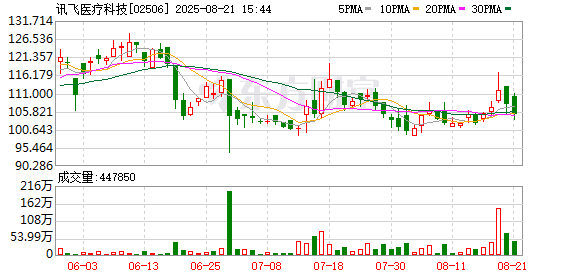
讯飞医疗科技上半年营收同比增长30.26%
Zheng Quan Ri Bao Wang· 2025-08-21 01:40
Core Viewpoint - The company reported a significant increase in revenue and gross profit for the first half of 2025, driven by advancements in AI healthcare technology and supportive national policies [1]. Financial Performance - The company achieved an operating income of 299 million yuan, representing a year-on-year growth of 30.26% [1]. - The gross profit reached 154 million yuan, with a year-on-year increase of 26.96% [1]. Industry Context - The company is positioned to benefit from the "Digital China" and "Healthy China" strategies, with national policies promoting the integration of AI in healthcare [1]. - The company leverages its leading position in core medical model technology and extensive product coverage across the country to capitalize on the accelerating growth of the AI healthcare industry [1]. Future Strategy - The company plans to continue focusing on its development strategy, utilizing policy advantages to drive technological breakthroughs and deepen application scenarios in medical models [1]. - The company aims to provide higher quality medical services to residents and more efficient diagnostic tools for doctors [1]. Technological Advancements - Since the launch of the Xunfei Spark Medical Model in 2023, the company has expanded its technological advantages and achieved breakthroughs in multiple fields [1]. - In July 2025, the Xunfei Spark Medical Model underwent further upgrades, enhancing its capabilities and maintaining industry leadership in key medical task scenarios [1].
讯飞医疗科技上半年实现营收2.99亿元 同比增长30%
Zheng Quan Shi Bao Wang· 2025-08-20 12:55
Core Insights - Company reported a revenue of 299 million yuan for the first half of 2025, representing a year-on-year growth of 30% [1] - Gross profit reached 154 million yuan, with a growth of 27% year-on-year, resulting in a gross margin of 51.5% [1] - The net profit attributable to shareholders was -74 million yuan, significantly narrowing from -130 million yuan in the same period of 2024 [1] Government Solutions - Revenue from grassroots solutions grew by 52% year-on-year, while regional solutions surged by 178% [1] - The core product "Smart Medical Assistant" has been implemented in 697 districts and counties, covering over 75,000 grassroots institutions, with more than 1.01 billion AI-assisted diagnoses completed [1] - AI infectious disease prevention solutions have been scaled in several provinces including Anhui, Jiangxi, Zhejiang, Shaanxi, and Hunan [1] Hospital Solutions - AI solutions have been deployed in over 500 top-tier hospitals, including institutions like the First Affiliated Hospital of the University of Science and Technology of China and Peking Union Medical College Hospital [2] - The company has assisted nearly 20 hospitals in achieving electronic medical record level five and smart service level three evaluations [2] - Continuous iteration of the Spark Medical Model enhances efficiency and quality in precise diagnosis, scientific treatment, and systematic management for hospitals and doctors [2] Patient Management - Revenue from patient management increased by 10.1% year-on-year, with the AI health assistant "iFlytek Xiaoyi" completing 140 million AI consultations [2] - The company has extended its business into home care scenarios through a "hardware + service" model, creating a health management entry point for millions of users [2] R&D Investment - The company invested 134 million yuan in R&D, accounting for 45% of its revenue [2] - In March, the company launched the Spark Medical Model X1, which features "deep reasoning capabilities," and upgraded it in July to maintain its lead in general medical tasks [2] - The Spark Medical Model has been implemented in over 20 leading hospitals nationwide [2]