增强现实

Search documents
谷歌首款搭载Gemini的AI眼镜将于2026年推出
Zheng Quan Shi Bao Wang· 2025-12-09 00:50
Core Viewpoint - Google is developing two types of AI glasses, one with a display and another focused on audio functionality, with the first model expected to launch in 2026 [1] Group 1: Product Development - The first AI glasses will be co-developed with partners including Samsung Electronics, Warby Parker, and Gentle Monster, although final design proposals have not yet been revealed [1] - Google is collaborating with Chinese AR company Xreal on an independent glasses project called "Project Aura," which will operate on the same Android XR system and will not require a smartphone, but will need an external battery [1] Group 2: Software Upgrades - Google announced several software upgrades for the Samsung Galaxy XR headset, including a "travel mode" that allows the mixed reality device to function properly in mobile environments such as cars or airplanes [1]

AI眼镜大战升温!谷歌(GOOGL.US)首款产品搭载Gemini明年硬撼Meta(META.US)、苹果(AAPL.US)
智通财经网· 2025-12-08 23:51
Core Insights - Google is developing two types of AI glasses to compete with Meta's existing models, one with a screen and another focused on audio features, with a launch planned for 2026 [1] - The new products and the Android XR operating system represent a more refined strategy compared to the previous Google Glass [2] - The glasses will connect wirelessly to smartphones, allowing them to handle most processing tasks, making the glasses lightweight and resembling regular eyewear [2] Group 1 - Google aims to balance weight, style, and immersion in its AI glasses, ensuring software experiences perform well across both formats [3] - The glasses will support augmented reality overlays for applications like Google Maps and Google Meet, with the dual-lens design offering a larger virtual display [2][3] - The Aura project glasses, developed in collaboration with Xreal, will run on the Android XR system and require an external battery pack, featuring a 70-degree field of view [3] Group 2 - Google and Samsung are responding to early feedback on the $1,800 Galaxy XR headset by introducing a "travel mode" for easier use while in motion [4] - A new PC Connect application will allow Windows PCs to connect to the Galaxy XR, enabling users to mirror their laptop screens in a virtual environment, expanding the headset's appeal [4] - Google is also launching a new realistic virtual avatar style for Galaxy XR users, allowing them to scan their faces for accurate representation in video calls [5]

AI眼镜取代不了手机,它想“干掉”传统眼镜
3 6 Ke· 2025-12-08 00:50
Core Insights - The current trend in AI glasses is not to replace smartphones but to replace traditional glasses with smart features. The focus is on creating high-quality eyewear that integrates AI technology [7][4]. Market Overview - In the past two months, 20 AI glasses have been launched in the Chinese market, including products from major companies like Baidu, Lenovo, and Alibaba, as well as startups like Rokid and Yingmu Technology [1]. - There are approximately 5 billion smartphone users globally, while the number of people who wear glasses is around 2 billion, indicating a significant market opportunity for AI glasses [2]. - The decision-making process for purchasing AI glasses is simplified for nearsighted individuals, as many are already spending hundreds to thousands of yuan on traditional glasses [3]. Competitive Landscape - The AI glasses market is becoming increasingly competitive, with five main categories of participants: smartphone manufacturers, internet giants, established AR glasses companies, new automotive players, and traditional eyewear brands collaborating with tech companies [4]. - IDC predicts that global shipments of smart glasses will reach 12.8 million units by 2025, with a 26% year-on-year growth, and the Chinese market alone is expected to exceed 2.75 million units, growing by 107% [4]. Product Development - The current AI glasses lack a "killer application" that makes them indispensable, which is a challenge for widespread adoption [6]. - A good pair of glasses must meet basic requirements of comfort and style, and partnerships between tech companies and traditional eyewear brands are a direct approach to achieving this [8][9]. - The weight of AI glasses is a critical factor; for instance, Ray-Ban Meta weighs 49 grams, significantly lighter than previous AR devices, while traditional prescription glasses weigh between 20-30 grams [13]. User Experience - AI glasses currently offer limited functionality, primarily focused on navigation and translation, and there is a gap between user expectations and the current capabilities of these devices [17]. - The most clear and irreplaceable function of AI glasses is hands-free recording, which is particularly useful in scenarios where users need to capture video without using their hands [19][21]. - Battery life remains a concern, with mainstream products offering 7-18 hours of usage, but improvements are being made, such as charging cases and replaceable components [17]. Future Outlook - The future of AI glasses is seen as a combination of AI and AR, aiming for a seamless integration of virtual and real-world experiences [28]. - The potential for AI glasses to become a primary interface for AI interaction is significant, with the possibility of them replacing smartphones in the long term [30]. - The market for specialized AI glasses, such as those designed for visually impaired users, represents an untapped opportunity that could address specific needs without requiring major technological breakthroughs [29].




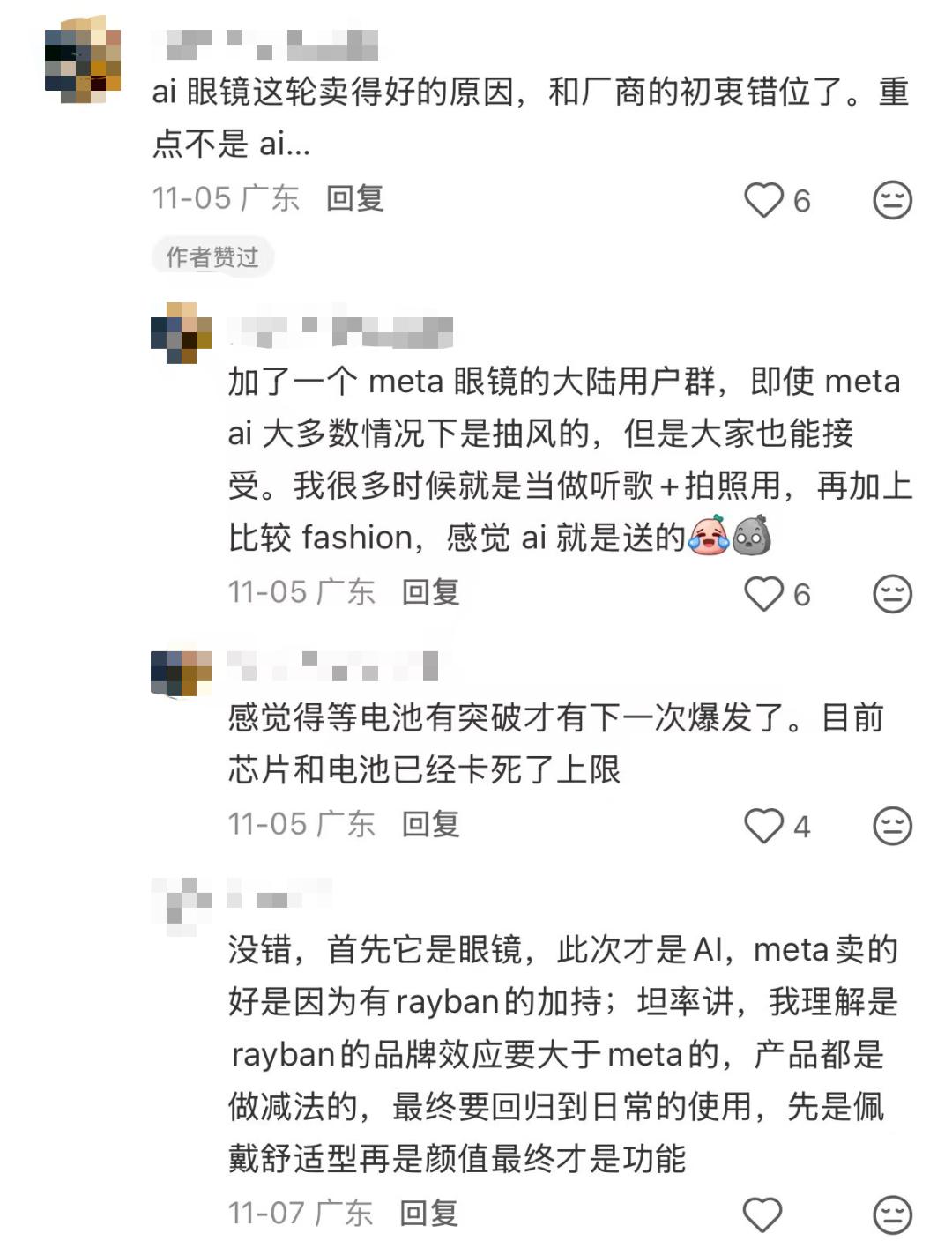
高盛上调中国AI眼镜市场预期:明后年出货量翻倍增长,5年后市场规模达30亿美元
智通财经网· 2025-12-02 13:20
Core Insights - Goldman Sachs has raised its forecast for the Chinese AI/AR glasses market, predicting a shipment growth of 87% in 2026 and 121% in 2027, with a market size expected to reach $946 million in 2026, and a compound annual growth rate of 24% from 2027 to 2030, ultimately reaching $3 billion by 2030 [1][2]. Part 1: Product Features and Core Value - The core AI functionalities of current AI/AR glasses include real-time subtitles, instant translation, visual Q&A, AR navigation, and AI smart assistants, making them suitable for daily life and seen as potential successors to smartphones [4]. - The first-person perspective experience allows glasses to display content directly in the user's line of sight and deliver sound, enhancing social sharing capabilities [4]. - The hands-free convenience integrates seamlessly into activities like walking and cycling, catering to various personal, entertainment, and office efficiency needs [4]. Part 2: Key Hardware Optimization Directions - Enhancements in perception capabilities involve increasing the number of cameras to improve motion capture and environmental detection accuracy [5]. - AI performance upgrades focus on enhancing the responsiveness and accuracy of smart assistance features [6]. - Display improvements include adopting full-color, high-resolution screens optimized for visibility in bright and dim environments [6]. - Portability enhancements aim to reduce the weight of devices (currently between 35-80 grams) to extend wear time [7]. Part 3: Cost Structure and Supply Chain - The cost structure for AI glasses includes system-on-chip (SoC) at 35%-40%, structural components at 10%-15%, sensors/memory at 5%-10%, acoustic components at 5%-10%, batteries at 3%, packaging at 2%-3%, and other costs at 0%-10% [10]. - For AR glasses, the display accounts for 30%-35%, SoC modules for 20%-25%, optical components for 15%-20%, sensors for 5%-10%, and batteries for 1%-2% [11]. - Key supply chain companies include Sunny Optical for cameras, AUO and BOE for displays, Lianyi Intelligent Manufacturing and Changying Precision for structural components, GoerTek and AAC Technologies for acoustics/batteries, and Qualcomm and Realtek for chips [12]. Part 4: Usage Scenarios and Target Users - Core usage scenarios encompass life and entertainment (first-person perspective recording, AR navigation, immersive gaming, instant messaging), and office efficiency (meeting notes, real-time translation, presentation script display, virtual workstations) [13]. - The target user group includes the 660 million myopic individuals in China (as of 2020) who have a natural habit of wearing glasses [14]. - Early adopters of new technologies, such as drones, robots, and VR devices, are also a significant target market, as Chinese consumers show a high acceptance of innovative tech products [14].
福蓉科技:公司生产的高强度铝制结构件材料已用于MR、AR眼镜
Zheng Quan Ri Bao· 2025-12-02 12:08
Core Insights - Furong Technology has confirmed that its high-strength aluminum structural components are being utilized in MR and AR glasses, with major brands including Samsung and Vivo [2] Company Summary - Furong Technology produces high-strength aluminum structural components [2] - The company's products are currently used in MR and AR glasses [2] - Key clients include prominent brands such as Samsung and Vivo [2]


长盈精密跌2.00%,成交额9.33亿元,主力资金净流出2226.37万元
Xin Lang Cai Jing· 2025-12-02 01:58
Core Viewpoint - Longying Precision has experienced significant stock price growth this year, with a year-to-date increase of 155.25% and a recent surge in trading activity, indicating strong market interest and potential investment opportunities [1][2]. Company Overview - Longying Precision Technology Co., Ltd. is located in Bao'an District, Shenzhen, Guangdong Province, and was established on July 17, 2001, with its IPO on September 2, 2010 [2]. - The company specializes in the development, production, and sales of electronic connectors, precision small parts for smart electronics, connectors and modules for new energy vehicles, and precision structural components for consumer electronics [2]. - The revenue composition includes: 41.16% from consumer electronics precision structural components, 34.04% from new energy product components and connectors, 20.28% from electronic connectors and smart electronic small parts, and 4.07% from other sources [2]. Financial Performance - For the period from January to September 2025, Longying Precision achieved a revenue of 13.51 billion yuan, representing a year-on-year growth of 11.68%, while the net profit attributable to shareholders decreased by 21.25% to 468 million yuan [2]. - The company has distributed a total of 1.023 billion yuan in dividends since its A-share listing, with 176 million yuan distributed over the past three years [3]. Shareholder Structure - As of September 30, 2025, the number of shareholders increased to 172,400, with an average of 7,871 circulating shares per person, a decrease of 9.29% from the previous period [2]. - Major shareholders include Hong Kong Central Clearing Limited, which holds 27.21 million shares, and E Fund's ChiNext ETF, which holds 20.10 million shares [3].

佰维存储:公司ePOP系列产品目前已被Meta等企业应用于其AI/AR眼镜等智能穿戴设备上
Zheng Quan Ri Bao Wang· 2025-12-01 13:44
Core Viewpoint - The company Bawei Storage has successfully integrated its ePOP series products into various smart wearable devices for renowned global companies, indicating strong market demand and partnerships in the AI/AR sector [1] Group 1 - Bawei Storage's ePOP series products are currently utilized by major companies such as Meta, Google, Xiaomi, Xiaotiancai, Rokid, and Thunderbird Innovation [1] - The applications of these products include AI/AR glasses and smartwatches, showcasing the versatility and relevance of Bawei Storage's technology in the wearable device market [1] - The company advises stakeholders to refer to publicly disclosed information for details regarding its business collaboration with Google [1]
水晶光电涨2.15%,成交额2.93亿元,主力资金净流入1100.23万元
Xin Lang Cai Jing· 2025-12-01 02:32
Core Viewpoint - Crystal Optoelectronics has shown a positive stock performance with a year-to-date increase of 12.76% and a recent rise of 9.67% over the last five trading days, indicating strong market interest and potential growth opportunities [1]. Company Overview - Zhejiang Crystal Optoelectronics Technology Co., Ltd. was established on August 2, 2002, and listed on September 19, 2008. The company specializes in the research, production, and sales of optical imaging, film optical panels, automotive electronics (AR+), reflective materials, and related products [2]. - The main revenue composition includes consumer electronics (84.20%), automotive electronics (AR+) (8.00%), reflective materials (6.21%), and other (1.60%) [2]. - As of September 30, 2025, the company reported a revenue of 5.123 billion yuan, representing a year-on-year growth of 8.78%, and a net profit attributable to shareholders of 983 million yuan, reflecting a 14.13% increase compared to the previous year [2]. Stock Performance and Market Activity - As of December 1, the stock price of Crystal Optoelectronics was 24.72 yuan per share, with a trading volume of 293 million yuan and a turnover rate of 0.88%, leading to a total market capitalization of 34.376 billion yuan [1]. - The stock has appeared on the "Dragon and Tiger List" twice this year, with the most recent occurrence on April 3, where it recorded a net buy of -21.11 million yuan [1]. Shareholder Information - As of September 30, 2025, the number of shareholders was 124,700, a decrease of 4.10% from the previous period, while the average circulating shares per person increased by 4.54% to 10,926 shares [2][3]. - The second-largest circulating shareholder is Hong Kong Central Clearing Limited, holding 119 million shares, an increase of 6.128 million shares from the previous period [3].

凌云光跌2.04%,成交额1.79亿元,主力资金净流出703.85万元
Xin Lang Cai Jing· 2025-12-01 02:19
Core Viewpoint - Lingyun Optical has experienced significant stock price fluctuations and growth in revenue and profit, indicating a strong performance in the machine vision and optical communication sectors [2][3]. Group 1: Stock Performance - As of December 1, Lingyun Optical's stock price decreased by 2.04%, trading at 39.82 CNY per share with a total market capitalization of 18.356 billion CNY [1]. - The stock has increased by 81.87% year-to-date, with a 7.27% rise over the last five trading days [2]. - The company has appeared on the "Dragon and Tiger List" once this year, with a net purchase of 233 million CNY on February 20 [2]. Group 2: Financial Performance - For the period from January to September 2025, Lingyun Optical reported a revenue of 2.127 billion CNY, representing a year-on-year growth of 34.30% [3]. - The net profit attributable to shareholders for the same period was 133 million CNY, reflecting an 18.46% increase compared to the previous year [3]. Group 3: Business Overview - Lingyun Optical, established on August 13, 2002, focuses on machine vision and optical communication, with a strategic emphasis on machine vision [2]. - The revenue composition includes intelligent visual equipment (34.69%), configurable visual systems (30.97%), optical communication products (27.44%), visual devices (5.31%), and service income (1.59%) [2]. - The company is categorized under the machinery equipment sector, specifically in specialized equipment [2]. Group 4: Shareholder Information - As of November 10, the number of shareholders for Lingyun Optical was 27,300, a decrease of 2.63% from the previous period [3]. - The average number of circulating shares per shareholder increased by 2.70% to 16,903 shares [3]. - As of September 30, 2025, the top ten circulating shareholders included a new entrant, E Fund National Robot Industry ETF, holding 4.2567 million shares [4].

超1亿港元!雷军增持小米股票;特斯拉在印度两个多月仅卖出100多辆丨Going Global
创业邦· 2025-11-30 10:48
Key Points - TikTok Shop has announced a new policy requiring all orders shipped via USPS to use official TikTok Shipping labels starting January 2026, enhancing logistics management and compliance [5] - Beyond Meat has closed its Tmall flagship store, indicating a retreat from the Chinese market after struggling with declining revenues and significant losses, with the latest stock price at $1.02 [7][10] - Xiaomi's CEO Lei Jun has increased his stake in the company by purchasing over 2.6 million shares for more than HKD 100 million, raising his ownership to 23.26% [11][12] - Shenzhen is set to establish the world's largest 3D printing factory, with plans to deploy 15,000 3D printers by Q1 2026, reflecting the growing demand in the 3D printing market [13][15] - ByteDance is in discussions to sell its gaming subsidiary, Moonton Technology, to Saudi Arabia's Savvy Games Group, following challenges in expanding its gaming portfolio [16][17][18] - Tencent has launched the international version of its Mix Yuan 3D creative engine, allowing global users to create high-quality 3D works easily [19][21] - Tesla's performance in India has been disappointing, with only over 100 cars sold since its entry in July 2023, attributed to high pricing compared to local competitors [23][24][25] - SoftBank has completed the acquisition of Ampere, a U.S. chip design company, for $6.5 billion, as part of its strategy to strengthen AI infrastructure [26] - AMD's CEO Lisa Su expressed confidence in the AI market's growth, predicting a $1 trillion market by 2030, and emphasized the importance of investment in AI infrastructure [27][28] - Google is reviving its AI glasses project, with plans for a potential release in Q4 2026, showcasing its ongoing commitment to innovation in wearable technology [29][30][32]