
多资产配置

Search documents
FOF基金:2025年度策略回顾与2026年度策略展望
Shenwan Hongyuan Securities· 2026-01-10 13:07
1. Report's Investment Rating for the Industry The provided content does not mention the industry investment rating. 2. Core Views of the Report - In 2025, the scale of FOF funds rebounded against the trend, with the cumulative scale exceeding that at the end of 2021. The performance of all FOF achieved positive returns, and high - performing FOF continued the passive investment trend and some emphasized multi - asset allocation. FOF showed a preference for equity and other risk assets and continued to strengthen passive investment in Q3 2025. The scale of personal pension funds maintained a high growth rate. Customized FOF, such as the Changying Plan and Longying FOF, focused on multi - asset allocation. In 2026, FOF products with multi - asset and multi - strategy allocation capabilities have broad development prospects [1]. 3. Summary According to the Directory 3.1 Scale Dimension: Which Type of FOF Funds Does the Market Pay More Attention to? - **Overall Scale Recovery**: In 2025, the number of new FOF funds increased to 93 from 38 in the previous year, and 43 FOF funds were liquidated. The total scale of FOF reached 238.376 billion yuan, an increase of 105.226 billion yuan compared to the end of 2024. The new - issue scale was 84.5 billion yuan, and the continuous - operation scale increased by about 20.696 billion yuan, ending three consecutive years of decline [9]. - **Outstanding New - issue Institutions**: Products托管 by China Merchants Bank were prominent in terms of scale and quantity, with a new - issue scale exceeding 40 billion yuan. Fund companies such as Fullgoal Fund, Orient Securities Asset Management, and Ping An Fund had new - issue scales exceeding 5 billion yuan [11]. - **Popularity of Changying Plan - Related FOF**: FOF products with large net subscriptions in 2025 were mostly bond - type FOF and fixed - income + FOF. The top 5 funds in net subscriptions were all from the Changying Plan. The top 10 funds in new - issue scale were mostly fixed - income + FOF or bond - type FOF, and 8 of them were托管 by China Merchants Bank [13]. - **Changes in Fund Company Scale**: In 2025, the scale of most leading fund managers increased, and the scale ranking changed significantly. Fullgoal Fund and E Fund's scale increased by over 10 billion yuan. Leading fund managers showed two layout characteristics: balanced layout in multiple types of FOF or specialization in a single track [16]. 3.2 Performance Dimension: High - performing FOF Continued the Passive Investment Trend, and Some Emphasized Multi - asset Allocation - **Positive Returns in 2025**: In 2025, all FOF achieved positive returns. The performance was positively correlated with the position, and equity - type FOF performed best with a median return of 25.25%, while bond - type FOF was relatively weak with a median return of 2.70%. Two FOF products exceeded 10 billion yuan in scale [20][21]. - **Investment Characteristics of High - performing FOF**: High - performing bond - type FOF generally allocated multi - assets such as commodities; high - performing fixed - income + FOF obtained returns from both fixed - income + and stock funds while having multi - asset allocation features; high - performing balanced - type FOF mainly adopted passive investment and focused on ETFs with themes of gold, TMT, and new energy; high - performing equity - type FOF further strengthened the theme concentration [25]. - **Outstanding Performance of Cathay Fund's FOF Team**: In 2025, Cathay Fund's FOF team performed outstandingly in various types of FOF, including bond - type, fixed - income +, balanced - type, and equity - type FOF [30]. 3.3 Investment Characteristics: The Allocation Ratio of A - share Equities Such as Active Equities Increased, and the Increase in Holdings in Q3 25 Showed a Preference for Technology and Advanced Manufacturing - **Multi - asset Allocation of Leading Managers**: Leading managers generally attached importance to multi - asset allocation, with different investment directions. Some focused on QDII stocks, some on mutual - recognition funds, and some on commodities [38]. - **Overall Market Characteristics**: In Q3 2025, FOF decreased the holding ratio of pure - bond funds and increased the attention to active and passive equity funds, showing a preference for risk assets and strengthening passive investment. The heavy - position funds showed a preference for A - share technology and advanced manufacturing assets [40]. 3.4 Personal Pension Funds: The Total Y - share Amounted to 1.2817 Billion Yuan As of Q3 2025, the scale of personal pension funds reached 1.2817 billion yuan, an increase of 1.983 billion yuan compared to Q2 25 and 3.99 billion yuan compared to the end of 2024. Pension target date funds were more popular, with a current scale of 7.803 billion yuan [49]. 3.5 Customized FOF: Changying Plan & Longying FOF - **Changying Plan**: Established in early 2025, the included products are all positioned as multi - asset allocation FOF, with different levels corresponding to different return and risk targets. The products in the plan met the return and risk requirements in 2025, with relatively low maximum drawdown rates and prominent risk - return ratios. Other new - issue FOF products托管 by China Merchants Bank also had similar multi - asset allocation characteristics [59][68]. - **Longying FOF**: Established in early 2026, initially only including multi - asset allocation FOF, and will expand to ETF - FOF and global investment FOF in the future. The included products mostly met the return/withdrawal limits in 2025 and had multi - asset allocation characteristics, with a greater focus on overseas investment [77][82]. - **Other Multi - asset Allocation FOF**: Some products, such as Orient Securities Pension and Zhongtai Tianze, have adhered to multi - asset allocation for a long time and achieved excellent performance in 2025. More than half of the new - issue FOF in 2025 emphasized multi - asset allocation in their performance comparison benchmarks [88][93]. - **Investment Strategy for 2026 FOF Funds**: FOF can achieve diversified investment through multi - asset allocation, improve the risk - return ratio of the investment portfolio, and create differentiated investment targets. Low - volatility FOF products represented by bond - type and fixed - income + have been favored by funds in recent years, and the development of multi - asset allocation FOF remains an important direction in the future [95].
固收-系列电话会
2026-01-08 16:02
Summary of Conference Call Records Industry Overview - The fixed income strategy is facing challenges due to increased interest rate volatility, leading to the ineffectiveness of single-duration strategies and limited space for credit spreads. The fixed income plus strategy is gaining attention, but the traditional fixed income plus sector is limited in capacity and facing a contraction issue [1][3]. Key Insights and Arguments - **Mixed Investment Strategy**: A mixed investment strategy combining stocks and bonds can optimize risk and return. International experiences, such as the Morningstar Core Plus Bond fund, suggest that increasing equity assets can enhance returns. The long-term return of China's equity market is promising, but it is characterized by high volatility. The National Social Security Fund has achieved an average annual return of 7.39% through mixed investments [1][5]. - **Policy Guidance for Long-term Funds**: Policies guiding long-term funds into the market are encouraging institutions to increase equity allocations. Large insurance companies are expected to invest 30% of new premiums into A-shares annually. By the end of 2025, the proportion of stock and fund investments by life insurance companies is projected to reach about 15%, resulting in an estimated annual inflow of over 100 billion yuan into the A-share market [1][6]. - **Impact of Incremental Funds**: Incremental funds are expected to have a rapid corrective effect on undervalued assets. For instance, the banking sector is favored by insurance funds due to its low valuation and high dividends, with the price-to-book ratio expected to recover from 0.52 to 0.74, indicating a cumulative increase of nearly 64% from 2024 to 2025 [1][7]. - **Valuation Comparison**: As of November 2025, the PE TTM of the CSI 300 index is 13.92, significantly lower than the S&P 500 index at 28. This indicates that Chinese equity assets offer high cost-performance compared to global markets [1][8]. - **Concentration in Growth Sectors**: The ChiNext board focuses on high-end manufacturing, with the top seven constituent stocks being leading blue-chip companies. The dynamic PE for 2026 is expected to be around 25 times, reflecting an increase in concentration and a slow bull market similar to the Nasdaq 100 index [1][4][10]. Additional Important Insights - **Challenges for Traditional Fixed Income Strategies**: The traditional fixed income strategies are challenged by increased interest rate volatility and limited credit spread expansion, making it difficult for investors to find yield [2][3]. - **Emerging Tools in Fixed Income Plus Market**: New tools in the fixed income plus market include convertible bond ETFs and a focus on fixed proportion stock-bond ETFs, which are expected to attract long-term capital due to their low fees and high transparency [1][13][14]. - **Rebalancing Strategy Benefits**: Implementing a rebalancing strategy can significantly reduce the volatility of an asset portfolio, enhancing overall stability by adjusting asset proportions based on market movements [1][18]. - **Future of Multi-Asset Allocation**: The trend towards multi-asset allocation is characterized by high transparency and liquidity, which will lower the entry barriers for individual investors and promote innovation among institutions [1][25]. - **Performance of Dividend Low Volatility Index**: The dividend low volatility index has shown stable historical performance, with a 5-year annualized return of 4% and a volatility of only 1%, indicating its robustness compared to other indices [1][24]. This summary encapsulates the key points from the conference call records, highlighting the challenges and opportunities within the fixed income and equity markets, as well as the implications of policy changes and investment strategies.
2025年私募备案产品超1.2万只 股票策略占比六成以上
Zheng Quan Shi Bao Wang· 2026-01-08 05:49
Group 1 - In 2025, the private securities product registration surged, with a total of 12,645 products registered, marking a 99.54% increase from 6,337 in 2024 [1] - Stock strategies emerged as the preferred choice for private institutions, with 8,328 stock strategy products registered, accounting for 65.86% of all registered products [1] - Multi-asset strategies and futures & derivatives strategies ranked second and third in registration numbers, with 1,806 and 1,274 products respectively, representing 14.28% and 10.08% of the total [1] Group 2 - Quantitative products showed remarkable performance in 2025, with 5,617 products registered, a 114.31% increase from 2,621 in 2024, and accounting for 44.42% of the total [2] - Among quantitative products, stock strategy quantitative products dominated with 4,077 registered, making up 72.58% of the total quantitative products [2] - Futures and derivatives quantitative strategies accounted for 13.76% of the total, with 773 products registered, and the core segment being quantitative CTA strategies with 726 products [2] Group 3 - The registration of private products in 2025 exhibited a clear concentration among leading firms, with 26 out of 29 firms having registered at least 50 products being billion-yuan private institutions [3] - Mingyuan Investment led the registration with 157 products, followed by Century Frontier, Black Wing Asset, and Kuande Private with 147, 138, and 127 products respectively [3] - The steady growth of the private securities industry is attributed to the deepening of capital market reforms and continuous improvements in strategy innovation and risk management by institutions [3]
券商资管2026年展望:权益掘金牛市后半程,多元配置凸显价值
Zhong Guo Ji Jin Bao· 2026-01-04 14:16
Core Viewpoint - The brokerage asset management sector is optimistic about the investment landscape for 2026, focusing on equities, bonds, and FOF strategies, with a clear direction for the year ahead [1] Equities Market: Anchoring in the Bull Market's Second Half - Multiple brokerage asset management firms maintain a positive outlook for the A-share market in 2026, believing it is still in the "second half of the bull market," driven by ample liquidity, a recovering profit cycle, ongoing policy support, and a shift in household asset allocation [2] - Guojin Asset Management notes that the current liquidity and regulatory environment is improving, with long-term capital inflows expected, and structural opportunities arising from technological advancements and economic highlights [2] - Caitong Asset Management anticipates a "spring rally" potentially occurring at the end of the year, focusing on TMT and small-cap styles, while identifying sectors like power equipment, non-bank financials, and media as having favorable price-to-book (PB) and return on equity (ROE) metrics [2] - Guotai Haitong Asset Management believes the current A-share market began its rally on September 24, 2024, with a slow bull trend expected to solidify in 2025 and 2026, amidst a favorable environment of RMB appreciation and low domestic interest rates [2] Key Investment Sectors for 2026 - Guotai Haitong Asset Management recommends focusing on the "5+X" sectors in the first half of 2026, including photovoltaic, brokerage, semiconductors, consumer electronics, and basic chemicals, with an additional focus on Hang Seng Technology [3] - Huatai Securities Asset Management emphasizes four main investment lines: technology growth with expanding fundamentals, upstream sectors benefiting from "anti-involution" policies, advanced manufacturing in the midstream, and deeply undervalued consumer and non-bank financial sectors [3] Bonds Market: Wide Fluctuations as the Main Theme - Several brokerage asset management firms predict that bond yields will maintain a wide fluctuation trend, with limited space for both upward and downward movements, focusing on wave trading and structural opportunities [4] - Guojin Asset Management suggests that active fiscal policies may continue to exert pressure on bond yields, while Caitong Asset Management indicates that weak fundamental recovery will support the bond market, with an emphasis on capturing wave trading opportunities [4][5] FOF Market: Multi-Asset Strategies Present Configuration Opportunities - The brokerage asset management sector is optimistic about multi-asset FOF strategies for 2026, believing that quantitative strategies and active funds will contribute to excess returns [6] - Guojin Asset Management highlights that the current complementary credit cycles between China and the U.S. support total demand, leading to a cautious optimism regarding multi-asset FOF returns in 2026 [6] - Caitong Asset Management stresses the advantages of diversified asset allocation in 2026, with expectations for active funds to continue generating excess returns [7]

券商资管2026年展望:权益掘金牛市后半程,多元配置凸显价值
中国基金报· 2026-01-04 14:09
Core Viewpoint - The article emphasizes that in 2026, brokerage asset management will focus on equities, bonds, and FOF (Fund of Funds) strategies, indicating a clear investment direction for the year. The equity market is seen as being in the "second half of a bull market," with abundant structural opportunities, while the bond market is expected to maintain a wide range of fluctuations. Multi-asset and multi-strategy allocations remain the mainstream choice in a volatile environment [2]. Equity Market: Anchoring the Bull Market's Second Half - Multiple brokerage asset management firms hold a positive outlook for the A-share market in 2026, believing it remains in the "second half of a bull market." Key drivers include ample liquidity, a recovering profit cycle, ongoing policy support, and a shift in residents' asset allocation [4]. - Guojin Asset Management notes that the current liquidity and regulatory environment is improving, with long-term capital inflows expected. Structural opportunities are anticipated in certain industries due to technological breakthroughs and economic highlights [4]. - Caitong Asset Management suggests that a "spring rally" may occur at the end of the year, primarily driven by TMT (Technology, Media, and Telecommunications) and small-cap stocks. They highlight sectors like power equipment, non-bank financials, and media as having favorable price-to-book (PB) and return on equity (ROE) metrics [4]. - Guotai Haitong Asset Management believes the current A-share market began its rally on September 24, 2024, with a steady "slow bull" trend expected in 2026, supported by a favorable environment of RMB appreciation and low domestic interest rates [4]. - Guotai Haitong recommends focusing on "5+X" industries in the first half of 2026, including solar energy, brokerage firms, semiconductors, consumer electronics, and basic chemicals, with an additional focus on Hang Seng Technology [5]. - Huatai Securities Asset Management identifies four main investment lines: technology growth, upstream sectors benefiting from "anti-involution" policies, advanced manufacturing, and deeply undervalued consumer and non-bank financial sectors [5]. Bond Market: Wide Fluctuations as the Main Theme - Several brokerage asset management firms predict that bond yields will maintain a wide fluctuation trend in 2026, with limited space for both upward and downward movements. Focus should be on wave trading and structural opportunities, with credit bonds and convertible bonds each having their own value [6]. - Guojin Asset Management states that active fiscal policies may continue to exert pressure on bond yields, while basic economic pressures remain. The central bank's liquidity is expected to remain loose to support fiscal policy implementation [7]. - Caitong Asset Management emphasizes that weak economic recovery will support the bond market, with an overall expectation of fluctuating bond yields in 2026. They highlight the value of credit bonds amid a prolonged "asset shortage" [8]. FOF Market: Multi-Asset Strategies Present Allocation Opportunities - The market is expected to mature in 2025, with a significant reduction in the phenomenon of betting on single assets or strategies, highlighting the advantages of multi-asset allocation. In 2026, brokerage asset management firms are optimistic about multi-asset FOF strategies, anticipating that quantitative strategies and active funds will contribute to excess returns [9]. - Guojin Asset Management notes that the complementary nature of the credit cycles in China and the U.S. supports total demand, leading to a cautious optimism regarding multi-asset FOF returns in 2026 [10]. - Caitong Asset Management emphasizes that multi-asset allocation will have significant advantages in 2026, with expectations for a "slow bull" in equities and opportunities in commodities and global assets [10]. - Guotai Haitong Asset Management maintains a positive outlook on quantitative stock selection strategies, expecting a favorable environment for stock quantitative strategies due to ample liquidity in the equity market [11].


主动管理、固收+、ETF三大赛道--一文读懂今年公募基金大赢家
Hua Er Jie Jian Wen· 2026-01-01 06:41
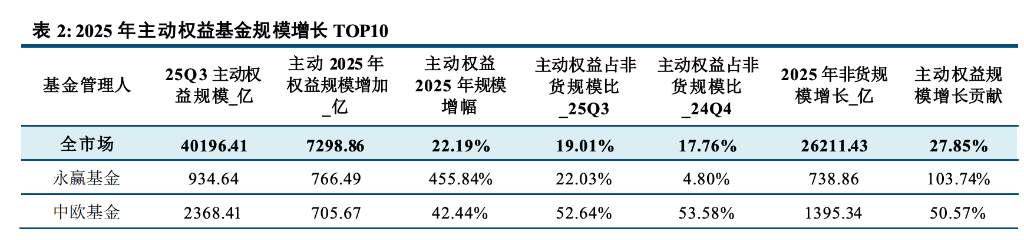
Core Insights - The public fund market is expected to accelerate growth in 2025, driven by a continued ETF investment boom and a shift towards multi-asset allocation strategies [1] - The report from CITIC Securities highlights a recovery in active equity fund sizes, primarily driven by net asset value increases, while passive index funds dominate growth [1][3] - Fixed income products are experiencing significant differentiation, with a notable expansion in "fixed income plus" products amid a low-interest-rate environment [1][13] Group 1: Fund Market Trends - By Q3 2025, the size of passive index funds increased by over 1.1 trillion yuan, with ETF sizes surpassing 5 trillion yuan [1] - Active equity funds have shown a recovery in excess returns, but their size growth is mainly due to net asset value increases, reflecting investors' tendency to take profits in a recovering market [1] - The fixed income market is weakening, with long-term pure bond fund sizes decreasing by over 600 billion yuan, while short-term pure bond funds decreased by nearly 250 billion yuan [1] Group 2: FOF Market Recovery - The FOF (Fund of Funds) market has significantly rebounded, with over 80 new FOF funds launched in 2025, totaling a new issuance scale of 80 billion yuan [2] - New FOFs increasingly reflect multi-asset allocation characteristics, including equity, fixed income, commodity funds, QDII funds, and public REITs [2] Group 3: Active Equity Fund Performance - Notable growth in active equity funds was observed among several fund managers, with Yongying Fund, China Europe Fund, and E Fund each increasing their active equity fund sizes by over 35 billion yuan [3][8] - Yongying Fund's "Smart Selection Series" achieved a remarkable growth of over 760 billion yuan in active equity fund size, with a 576 billion yuan increase attributed to this series alone [7][8] - China Europe Fund's active equity fund size grew by over 705 billion yuan, with a 42.44% increase, driven by strong performance in TMT sector funds [8] Group 4: Fixed Income Plus Fund Growth - The report indicates a significant growth in "fixed income plus" funds, with the size of these funds increasing by over 1.1 trillion yuan, particularly favored by institutional investors [13][14] - The leading growth in fixed income plus funds is attributed to secondary bond funds, with many achieving top rankings in performance over the past two years [14] Group 5: ETF Market Dynamics - The ETF market is showing a clear trend of concentration among leading players, with Huaxia Fund, E Fund, and Huatai-PB Fund each holding over 10% market share [16] - By Q3 2025, Huaxia Fund's ETF size reached 941.69 billion yuan, accounting for 16.52% of the market, while E Fund's ETF size was 872.96 billion yuan, representing 15.32% [16] - Major contributors to ETF size growth include gold ETFs and mainstream broad-based ETFs, with significant increases noted in the sizes of Huatai-PB CSI 300 ETF and Huaxia CSI 300 ETF [16][18]
20251226多资产配置周报:权益、商品延续强势,风险资产占优-20251230
Orient Securities· 2025-12-30 14:31
Asset Performance - The report indicates a strong performance in equities and commodities, with A-shares and precious metals leading the gains[11] - The Shanghai Composite Index saw a weekly increase of 1.88% and a year-to-date increase of 21.49%[12] - The CSI 500 Index experienced a weekly rise of 4.03% and a year-to-date increase of 34.49%[12] Market Expectations - The U.S. GDP for Q3 2025 grew at an annualized rate of 4.3%, significantly above the expected 3.3%[19] - The offshore RMB exchange rate broke the 7.00 mark, enhancing the attractiveness of RMB-denominated assets[23] - The report anticipates continued strength in risk assets due to expectations of U.S. economic downturn and policy easing[22] Strategy Recommendations - The report recommends a bullish stance on A-shares, commodities, and gold, with a focus on mid-cap blue-chip stocks and sectors such as non-ferrous metals, basic chemicals, and telecommunications[28] - It suggests monitoring A-share equity-related index enhancement strategies and commodity-related CTA strategies[54] Risk Considerations - The report highlights potential extreme risk events, such as U.S.-China relations and unexpected global geopolitical events, which could disrupt historical patterns[4] - It also notes the risk of quantitative indicators becoming ineffective, as historical data may not reliably predict future outcomes[4]

ETF规模突破6万亿元,年内增长超63%
Jin Rong Shi Bao· 2025-12-30 10:53
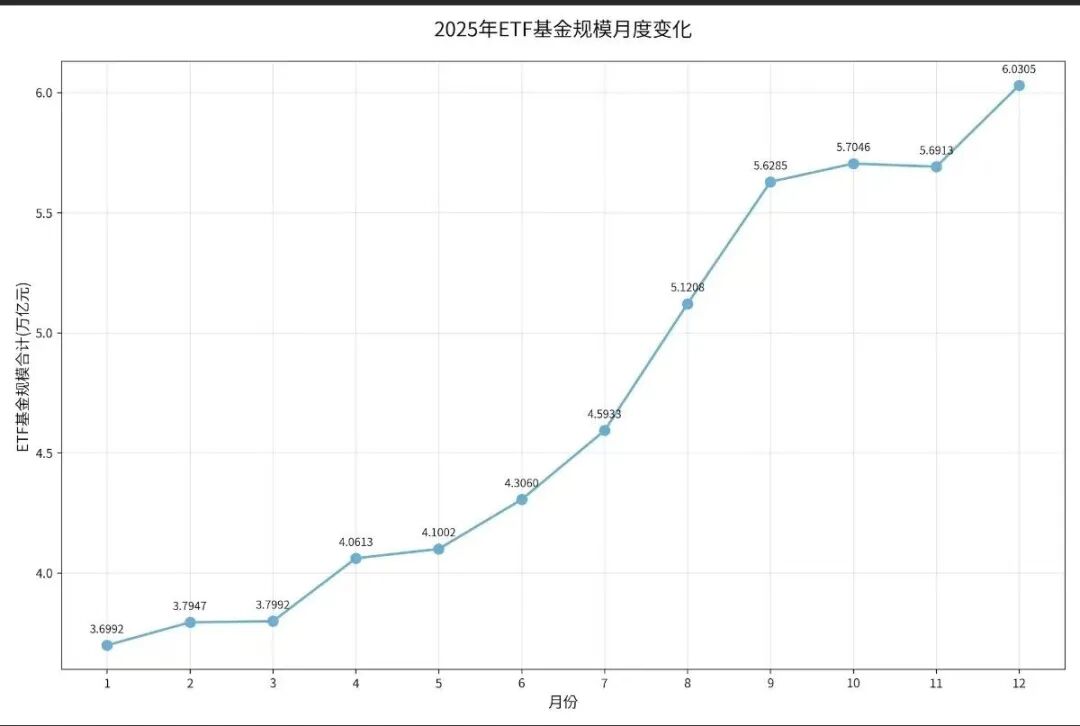
Group 1 - The total scale of ETFs in China has surpassed 6 trillion yuan, reaching 6.03 trillion yuan, representing a growth of over 63% compared to the beginning of the year [1] - As of December 29, the domestic ETF market reached a total scale of 60,281.10 billion yuan, with stock ETFs being the largest category at 38,500 billion yuan, accounting for 63.8% of the total [3] - The growth in stock ETFs this year exceeded 800 billion yuan, with the CSI A500 ETF being the largest contributor, attracting a net inflow of 960.65 billion yuan in December alone [3] Group 2 - The largest ETF product is the Huatai-PB CSI 300 ETF, with a scale of 4270.67 billion yuan, followed by the E Fund CSI 300 ETF, which exceeds 2100 billion yuan [4] - Long-term funds, represented by insurance and social security funds, have been increasing their positions in A-shares, primarily through ETF tools, focusing on core broad-based and high-dividend assets [4] - The trend of long-term investment is deepening, with insurance funds directly investing in A-shares reaching 3.6 trillion yuan, accounting for 9.7% of the total investment balance [4] Group 3 - The investment community is entering a new era of ETFs, with index investment becoming a mainstream tool in capital markets [5] - Index investment is not merely passive; it can incorporate stock selection logic and asset allocation strategies, especially in a market with structural differentiation [5] - The application of AI technology and the maturation of index investment participants are enhancing the value of factor-based indices, allowing for more refined investment strategies [5] Group 4 - For investors seeking stable returns, a multi-asset and multi-strategy allocation approach is essential for achieving long-term goals [6] - The recommended asset allocation hierarchy follows the logic of "equities > commodities > bonds," with adjustments based on market assessments [6] - The current market offers a variety of low-correlation assets, providing a solid foundation for multi-asset allocation strategies [7]
从“基金买手”到“资产管家”,FOF产品该如何穿越波动?
聪明投资者· 2025-12-30 03:57
Core Viewpoint - The article emphasizes that in a low-interest, high-volatility market environment, diversified asset allocation remains the only "free lunch" for investors, with FOF (Fund of Funds) evolving from a "fund buyer" to an "asset manager" to help investors navigate market fluctuations and reduce allocation difficulties [2][5]. Group 1: FOF Development and Strategy - FOF scale has seen positive growth for three consecutive quarters, reaching a three-year high by September 30, 2025 [2][4]. - The article discusses the unique value of FOF in the context of low interest rates and market uncertainty, highlighting the need for FOF managers to create products that cater to the majority of investors [5]. - The FOF manager's role is likened to that of a chef, where understanding client preferences (risk-return goals) is crucial for selecting and combining suitable funds (ingredients) to achieve investment objectives [6][8]. Group 2: Multi-Asset Allocation Approach - The article notes that 64% of low-volatility FOF products with performance benchmarks between 10%-13% have adopted multi-asset allocation strategies, indicating market acceptance and practicality [9]. - The FOF team employs a "three-tier allocation logic," starting with macro analysis to determine asset allocation benchmarks, followed by industry and style selection, and finally identifying fund managers with unique alpha capabilities [9][10]. - The upcoming WanJia QiTai Stable FOF product exemplifies this multi-asset allocation philosophy, combining low-correlation assets like dividend low-volatility stocks, S&P indices, bonds, and gold to achieve dynamic balance amid market fluctuations [10]. Group 3: Research and Team Collaboration - The FOF management system emphasizes systematic collaboration and specialization within the team, enhancing decision-making efficiency and precision [11][12]. - The team conducts regular research meetings to discuss key dimensions such as style stability and risk-return characteristics, maintaining a long-term perspective to avoid being misled by short-term market fluctuations [11]. - The research framework integrates macro, meso, and micro-level analyses, ensuring comprehensive coverage from economic cycles to fund manager capabilities [12]. Group 4: Performance and Future Outlook - The article highlights the performance of two FOF products managed by the team, with returns exceeding benchmarks, showcasing the effectiveness of their collaborative approach [13]. - The upcoming WanJia QiTai Stable FOF will continue to leverage team strengths, with a focus on multi-asset strategies and risk control [13]. - The article concludes that the true competitive advantage lies in a systematic, evolving approach to multi-asset allocation, ensuring steady returns for investors [13][14].

汇丰晋信基金总经理李选进,最新发声!
Zhong Guo Ji Jin Bao· 2025-12-30 02:13
Core Viewpoint - HSBC Jintrust Fund emphasizes the importance of long-termism in investment, aiming to simplify the investment experience for clients while focusing on sustainable investment strategies [1][2]. Group 1: Company Philosophy and Development - The company was founded with the principle of "making investment simpler," which reflects its commitment to enhancing investor experience and focusing on long-term needs [1][2]. - Over its 20-year history, the company has maintained a consistent operational philosophy, emphasizing the importance of long-term commitment in a rapidly evolving industry [2][4]. - HSBC Jintrust Fund has achieved significant recognition in the public fund industry, with its equity asset scale reaching 27 billion yuan, placing it in the top third of the industry as of September 30, 2025 [2]. Group 2: Investment Performance and Recognition - The company has consistently delivered positive returns on most of its actively managed equity products since inception, with many funds ranking highly in Morningstar ratings over various time frames [2][4]. - HSBC Jintrust Fund has received recognition from institutional investors, including insurance asset management firms, validating its long-term investment capabilities [4][5]. Group 3: Research and Investment Framework - The company has developed a systematic investment research framework that is transparent, replicable, and predictable, enhancing the investment experience for clients [6][7]. - The investment process includes macro and strategy input, industry research, stock selection, and portfolio construction, all of which are traceable and can be reviewed [7][8]. Group 4: Future Directions and Market Trends - The public fund industry is transitioning from providing basic tools to offering comprehensive investment solutions, with a focus on multi-asset allocation to meet diverse investor needs [10][11]. - HSBC Jintrust Fund aims to enhance its global asset allocation capabilities and develop products that align with global best practices, particularly in response to increasing demand for overseas investments [12][13]. Group 5: Talent Development and Organizational Growth - The company identifies talent development as a critical area for future growth, emphasizing the need for professionals who can adapt to a systematic investment framework and possess a global perspective [17][18]. - HSBC Jintrust Fund plans to launch a series of multi-asset products, focusing on long-term performance to build investor trust and contribute to the broader financial ecosystem [18].