
投资者适当性管理

Search documents
招商证券携手暨南大学:以适当性管理教育开启金融学子合规从业第一步
Quan Jing Wang· 2025-11-20 02:39
Group 1 - The core objective of the event was to instill scientific investment concepts and compliance awareness among students at Jinan University, as part of the "Investor Education into Hundreds of Schools" initiative by China Merchants Securities [1][2] - The course on "Investor Suitability Management" emphasized the protective role of suitability management in investment, using real-life cases to illustrate the risks of blind leverage [1] - The interactive teaching method combined Q&A and case analysis to enhance students' interest and understanding of professional content [1] Group 2 - The "Wealth Management Career Development Planning" session provided systematic employment guidance, detailing job types, core competency requirements, and typical career advancement paths in the wealth management sector [2] - The session also addressed the opportunities and challenges in wealth management amid digital transformation, encouraging students to plan their career paths early [2] - China Merchants Securities aims to deepen cooperation with universities and offer more practical courses and simulations to enhance students' risk awareness and wealth management skills [2]

“打折”又“调级”!银行代销基金动作频频
Bei Jing Shang Bao· 2025-11-19 13:04
Core Insights - Recent actions by banks in the public fund distribution sector reflect a competitive strategy to attract clients through fee reductions while simultaneously increasing risk ratings for certain funds, indicating a focus on investor protection and appropriate risk management [1][6][8] Fee Discounts - Minsheng Bank announced a 50% discount on the subscription fee for the "Minsheng Jiayin Multi-Asset Stable Allocation Fund" from November 24 to December 31, 2025, applicable through various banking channels [3] - Industrial Bank also introduced a 50% discount on subscription and regular investment fees for four Morgan fund products starting November 25, 2025, with specific fee reductions detailed [4] - WeBank has taken a more aggressive approach, offering some funds with a 0% subscription fee, significantly lower than traditional banks' discounts [4][5] Risk Rating Adjustments - Minsheng Bank has raised the risk ratings of several public fund products from "low risk" to "medium risk," emphasizing the importance of investor suitability and risk awareness [6][7] - Other banks, including China Construction Bank and Postal Savings Bank, have also adjusted risk ratings upward for various funds, indicating a trend of increasing risk assessments across the industry [7][8] - The adjustments are seen as a proactive measure to enhance compliance and protect investor interests amid market volatility [8] Industry Trends - The competitive landscape in wealth management is shifting from a focus on sales to a more client-centric approach, with banks aiming to improve customer experience and long-term value through diversified services [6][10] - Analysts suggest that banks need to overcome traditional sales-focused mindsets and enhance their advisory capabilities to build sustainable competitive advantages [9][10] - The emphasis on risk rating adjustments and fee discounts reflects a broader industry trend towards more precise risk disclosures and improved investor protection [8][9]




基金适当性管理新规来了,风险测评不能再“走过场”
第一财经· 2025-11-16 12:51
Core Viewpoint - The article discusses the new regulations issued by the China Securities Investment Fund Association aimed at enhancing investor suitability management in the mutual fund industry, emphasizing the need for appropriate product sales to suitable investors, particularly focusing on risk assessment and the protection of vulnerable groups like the elderly [3][4][5]. Group 1: Risk Assessment Management - The new regulations impose strict norms on risk assessment management, requiring fund managers and sales institutions to ensure that risk assessments are not merely formalities and must be updated regularly [5][6]. - Investors can only undergo risk assessments a limited number of times within a day and a year, with results needing to be confirmed if there are discrepancies [5][6]. - The validity of risk assessment results is set to a maximum of 12 months, necessitating re-evaluation if there are significant changes in the investor's circumstances [5][6]. Group 2: Fund Risk Rating Standards - The regulations require the establishment of a comprehensive risk rating system for funds, combining quantitative and qualitative indicators to determine risk levels accurately [6][7]. - Funds with higher stock positions, greater net asset volatility, and larger maximum drawdowns must have a risk rating that reflects these factors, ensuring consistency across the industry [6][7]. - The regulations aim to address past issues where sales institutions prioritized performance over risk warnings, leading to mismatches between investor risk tolerance and product suitability [6][7]. Group 3: Special Attention to Vulnerable Groups - The new rules mandate special care when selling high-risk funds to investors aged 65 and above, requiring sales personnel to exercise greater caution and provide thorough explanations [8][9]. - This measure is designed to protect elderly investors from impulsive decisions that may not align with their risk profiles [8][9]. Group 4: Regulation of Live Sales Channels - The regulations also cover the emerging sales channels like live streaming, requiring that risk assessments be completed before any sales are made through these platforms [10]. - Sales through live streaming must include comprehensive risk disclosures and ensure that products match the investors' risk preferences, eliminating the possibility of impulsive purchases [10]. Group 5: Ongoing Industry Adjustments - Several fund companies have begun adjusting the risk ratings of their products in response to the new regulations, reflecting a trend towards more rigorous risk management practices [12][13]. - The industry is shifting from a scale-oriented approach to one focused on investor returns, emphasizing the importance of investor education and understanding of product risks [13][14].

基金风险等级如何评定?中基协最新披露:投资者需“风险适配”
券商中国· 2025-11-16 09:48
Core Viewpoint - The article discusses the newly proposed "Guidelines for the Suitability Management of Investors in Publicly Offered Securities Investment Funds," which aims to enhance investor protection and ensure appropriate matching of investment products to investors' risk profiles [1][3]. Group 1: Investor Suitability Management - The guidelines emphasize the obligation of fund managers and sales institutions to assess investors' risk tolerance and match them with suitable fund products based on their investment goals and risk preferences [3][4]. - Fund managers must provide complete information regarding the risk classification of funds to sales institutions, and if such information is incomplete, sales institutions are required to refuse sales [4]. - The guidelines stipulate that the frequency of risk assessments for ordinary investors should be controlled, with a maximum of two assessments per day and eight assessments within twelve months [4][6]. Group 2: Risk Assessment and Fund Classification - The guidelines require that the risk classification of funds incorporates factors such as stock position, historical volatility of fund net value, and maximum drawdown, using both quantitative and qualitative analyses [2][8]. - Fund managers and sales institutions must establish a mechanism for regular review and dynamic adjustment of fund risk classifications, with at least one review conducted annually [9]. - The guidelines specify that the risk classification results used by sales institutions must not be lower than those determined by fund managers [6][8]. Group 3: Special Considerations for Older Investors - When selling high-risk funds (R4 level and above) to investors aged 65 and above, fund managers and sales institutions must adhere to special obligations, including more cautious sales processes and enhanced risk disclosures [6][7]. Group 4: Communication and Transparency - Fund managers and sales institutions are required to improve communication with investors, ensuring they have a comprehensive understanding of fund characteristics and risks [3][7]. - In cases of changes in risk tolerance or fund risk classification, timely notifications must be sent to investors through various communication channels [6][9].
中基协就公募投资者适当性征求意见!涉及向老年人销售、直播推介基金
Bei Jing Shang Bao· 2025-11-13 13:53
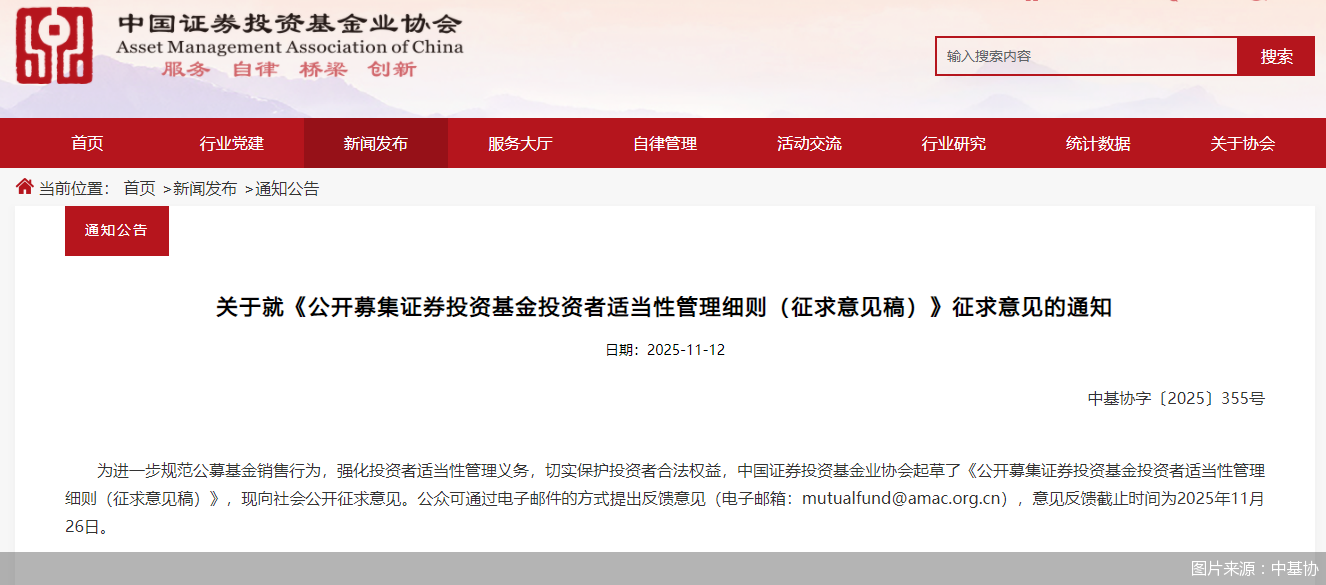
Core Viewpoint - The China Securities Investment Fund Industry Association (CSRC) has drafted the "Investor Suitability Management Guidelines for Publicly Offered Securities Investment Funds" to enhance the regulation of fund sales and protect investors' rights, with feedback due by November 26 [1][2]. Group 1: Investor Suitability Management - The guidelines require fund managers and sales institutions to assess investors' risk tolerance and match them with suitable funds based on their investment goals and risk preferences [1][2]. - Fund managers and sales institutions must conduct risk assessments for ordinary investors no more than twice a day and a maximum of eight times within 12 months, with assessment results valid for up to 12 months [2]. Group 2: Special Provisions for Elderly Investors - Specific requirements are set for selling high-risk funds to investors aged 65 and above, mandating enhanced sales processes, risk warnings, and increased follow-up communications [2]. - The guidelines aim to protect elderly investors from significant losses due to inadequate risk awareness or misleading information, thereby holding institutions accountable for their sales practices [2]. Group 3: Live Streaming Regulations - The guidelines address the promotion of funds through live streaming, requiring fund managers and sales institutions to establish internal review processes and ensure compliance with suitability management obligations during live broadcasts [3]. - Fund managers and sales institutions must provide comprehensive risk disclosures and ensure that investors complete risk assessments before engaging in fund purchases via live streaming [3].
事关七亿基民!最新规范来了
中国基金报· 2025-11-13 06:59
Core Viewpoint - The article discusses the recent draft of the "Investor Suitability Management Guidelines for Publicly Offered Securities Investment Funds" by the Asset Management Association of China, aimed at enhancing investor protection and regulating fund sales practices, particularly in the context of live streaming and sales to elderly investors [2][4]. Group 1: Investor Suitability Management - The guidelines require fund managers and sales institutions to conduct risk assessments based on investors' goals, risk preferences, and loss tolerance, ensuring appropriate fund sales [4][5]. - The frequency of risk assessments for ordinary investors is limited to a maximum of two times per day and eight times within twelve months [5][6]. - The validity of risk assessment results is generally capped at twelve months, necessitating re-evaluation if this period is exceeded or if the investor reports changes affecting their risk capacity [5][6]. Group 2: Fund Risk Classification - The guidelines establish clear quantitative requirements for fund risk classification, mandating the development of a comprehensive risk classification system by fund managers and sales institutions [7][8]. - Factors such as stock allocation, historical net value volatility, and maximum drawdown must be considered in determining fund risk levels, with specific rules on how these factors influence risk ratings [7][8]. Group 3: Live Streaming and Elderly Investor Protections - The guidelines introduce specific measures for fund promotion through live streaming, requiring internal review processes and risk disclosures during live sessions [10][11]. - Special attention is given to the sale of high-risk funds to investors aged 65 and above, necessitating more cautious sales processes, enhanced risk warnings, and increased follow-up interactions [11][12].

皮海洲:科创成长层来了,有关配套制度还应尽快跟上 | 立方大家谈
Sou Hu Cai Jing· 2025-11-04 23:12
Core Points - The establishment of the "Science and Technology Innovation Growth Tier" is a significant move to support the development of technology-oriented enterprises, allowing even unprofitable companies to go public [2][4] - The implementation of the "Growth Tier Guidelines" on July 13 marks the official launch of this new tier, which includes 32 existing unprofitable companies [1][2] - The growth tier aims to enhance the inclusiveness of the Chinese stock market and support new productive forces [2] Investment Thresholds - The current investment threshold for the growth tier remains the same as the Sci-Tech Innovation Board, requiring investors to have assets of 500,000 yuan and two years of experience [3] - It is suggested that the investment threshold for new investors should be increased to 800,000 or 1,000,000 yuan after a transition period of six months for existing investors [3] Shareholder Regulations - There is a need to improve the shareholder reduction system for companies listed in the growth tier, prohibiting the reduction of original shares held by shareholders until the company exits the growth tier [4] - This measure aims to protect public investors from the risks associated with unprofitable companies transferring their risks through share reductions [4] Delisting System - A delisting system should be established for the growth tier, limiting the time unprofitable companies can remain listed to a maximum of five years [4] - Companies that fail to achieve profitability within this timeframe should be delisted to maintain the growth tier's integrity and purpose [4]
贵金属投资市场生变?两家大行出手调整 积存金兑换实物等暂时受限
Bei Jing Shang Bao· 2025-11-03 11:36
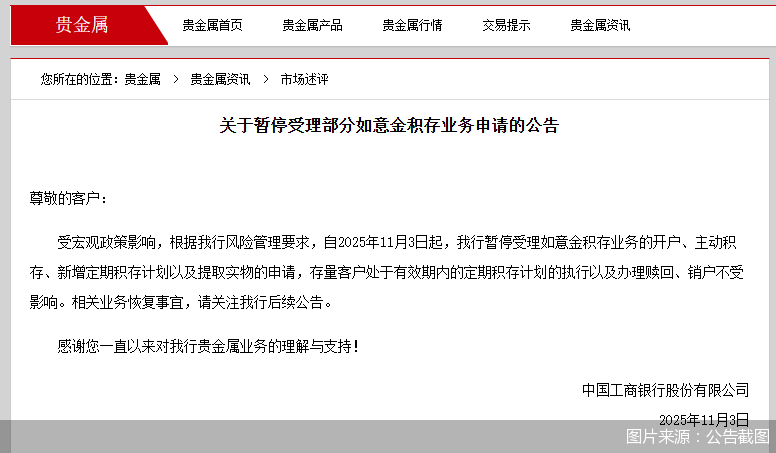
Core Viewpoint - The recent volatility in gold prices has prompted several major banks in China to adjust their gold accumulation business, with both Industrial and Commercial Bank of China (ICBC) and China Construction Bank (CCB) suspending certain services due to macroeconomic policies and risk management requirements [1][2][5]. Group 1: Bank Adjustments - ICBC announced the suspension of its "Ruyi Gold" accumulation business effective November 3, 2025, affecting new account openings, active accumulation, and new periodic accumulation plans, while existing plans remain unaffected [2]. - CCB also suspended its "Easy Gold" accumulation services, including real-time purchases and physical gold exchanges, starting November 3, 2025, with existing plans continuing to operate [2]. - Other banks, such as Industrial Bank and Ping An Bank, have raised the minimum purchase amounts for their gold accumulation services in response to market fluctuations [3]. Group 2: Market Context - The international gold price has experienced significant fluctuations this year, reaching a peak of $4,381 per ounce before recently declining, with a year-to-date increase of over 53% as of November 3, 2025 [5]. - Factors contributing to the high volatility include global economic uncertainties, central bank monetary policy expectations, geopolitical tensions, and fluctuations in the U.S. dollar [5]. Group 3: Risk Management and Investor Education - Banks are tightening their gold accumulation business rules and enhancing investor risk education in light of the volatile market conditions [5][7]. - The adjustments reflect a proactive approach to risk management and compliance with regulatory requirements, aiming to balance operational compliance, risk control, and market stability [4][7]. - Financial institutions are emphasizing the importance of investor awareness regarding market risks and encouraging diversified investment strategies to mitigate potential losses [8].


投资者适配为先多机构调整基金风险等级
Zhong Guo Zheng Quan Bao· 2025-10-21 20:18
Core Insights - The recent adjustment of risk levels for various fund products indicates a significant shift in the fund industry, with many funds experiencing an increase in their risk ratings, particularly those with strong performance this year [1][2]. Fund Risk Level Adjustments - Starting from October 15, Citic Bank adjusted the risk levels of 17 asset management products, raising the risk rating of 15 funds while only lowering 2 [2]. - Notably, high-performing funds, such as the Huatai-PineBridge North Exchange Innovation Selected Fund, saw their risk rating increase from "Medium-High Risk" (PR4) to "High Risk" (PR5) due to a return rate exceeding 76% this year [2]. - Other fund companies, including Fortune Fund and Tianhong Fund, have also announced similar risk level adjustments, with a majority of their products experiencing an increase in risk ratings [3]. Underlying Factors for Adjustments - The primary reasons for the increase in risk ratings include rising volatility, increased maximum drawdown multiples, and changes in asset allocation, particularly in bond funds [3][4]. - The bond market's increased volatility and the rising equity allocation in some bond funds have contributed to the adjustments in risk ratings [4][5]. Impact on Fund Sales and Investor Behavior - The adjustments in risk ratings will have a tangible impact on fund sales, as banks will automatically intercept investment plans that do not match the new risk levels [1][5]. - Investors, particularly those purchasing funds through banks, tend to be cautious about high-risk products, especially after recent market fluctuations, leading to a potential decrease in the willingness to invest in products with higher risk ratings [6]. - The adjustments also signal to investors the need to regularly review their fund holdings and risk profiles, as the risk-return characteristics of products are subject to change [6].

年内多家银行上调部分代销公募基金风险评级
Zheng Quan Ri Bao Zhi Sheng· 2025-10-17 15:38
Core Viewpoint - Multiple banks in China, including CITIC Bank, are adjusting the risk ratings of their asset management products, primarily to comply with regulatory requirements and enhance investor protection [1][4]. Group 1: Risk Rating Adjustments - CITIC Bank announced an adjustment of risk ratings for 17 asset management products, with 15 products seeing an increase in their risk ratings and 2 experiencing a decrease [2]. - The adjustment covers a wide range of product types, including passive index bond funds, mixed equity funds, and flexible allocation funds, indicating a comprehensive approach to risk assessment [2]. - This marks the fourth adjustment by CITIC Bank in 2023, reflecting ongoing regulatory compliance and the need for consistent risk rating practices [2]. Group 2: Regulatory and Market Influences - The adjustments are driven by the dual factors of deepening regulatory requirements and changes in market conditions, necessitating a more accurate reflection of risk levels [4]. - The regulatory framework established by the National Financial Supervision Administration in March 2023 mandates banks to independently assess the risk of asset management products and align them with appropriate customer profiles [4]. - As market volatility increases, the underlying risk-return characteristics of certain funds have changed, prompting banks to adjust ratings accordingly [4]. Group 3: Implications for the Banking and Asset Management Industry - In the short term, banks may experience fluctuations in sales revenue from high-risk products due to these adjustments, but long-term benefits include reduced legal disputes and enhanced reputation through improved compliance [5]. - The dynamic rating system is expected to encourage asset management companies to optimize product design and risk control, shifting the industry focus from "scale expansion" to "high-quality development" [5]. - Banks are advised to enhance their due diligence capabilities to better manage risks associated with asset management product sales [5].