改革开放

Search documents
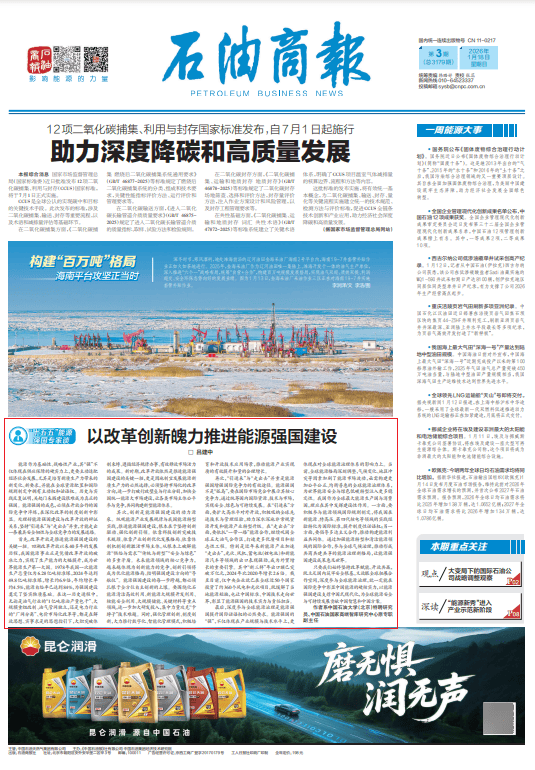
“十五五”能源强国专家谈 | 吕建中:以改革创新魄力推进能源强国建设
Sou Hu Cai Jing· 2026-01-19 09:47
Core Viewpoint - The construction of an energy power must adapt to the new changes and requirements brought by the cultivation of new productive forces, emphasizing the importance of open cooperation and international competition in achieving energy security and global competitiveness [1] Group 1: Reform and Opening Up - Reform and opening up are crucial for advancing the construction of an energy power, with significant production capacity increases since 1978, where primary energy production rose from 628 million tons of standard coal to 4.98 billion tons in 2024, a growth of approximately 6.9 times, with an average annual growth rate of about 4.5% [2] - The energy self-sufficiency rate has reached 84%, laying a solid material foundation for the construction of a strong nation [2] - Key reforms in the oil and gas industry, such as the "1 million tons of crude oil production quota" and the separation of power generation and grid management in the electricity sector, have effectively released market vitality [2] Group 2: Innovation as a Driving Force - Innovation is identified as the driving force for building an energy power, emphasizing the need for technological, industrial, and institutional innovations to resolve multiple contradictions in energy supply and demand [3] - Future competitiveness in the energy sector will increasingly depend on innovation capabilities, with a focus on clean and efficient use of fossil energy, large-scale development of renewable energy, and safety in nuclear energy [3] - Increased R&D investment is necessary to tackle critical technological challenges and promote digital and intelligent management models [3] Group 3: International Engagement - Balancing "bringing in" and "going out" is an effective way to enhance international competitiveness, with a focus on expanding high-level openness and absorbing global advanced technologies [4] - The export of new energy products, including photovoltaic, wind turbines, and lithium batteries, has become a significant driver of foreign trade growth, with exports of these "new three items" exceeding 1 trillion yuan in 2024, a 2.6 times increase compared to 2020 [4] - Central enterprises have invested in approximately 360 wind and photovoltaic projects across nearly 50 countries, showcasing China's technological strength and responsibility [4] Group 4: Global Energy Governance - Deep participation in global energy governance is essential for enhancing international discourse power, with a need for a fair and balanced global energy governance system [5] - As the largest energy producer and consumer, China should actively participate in the formulation of international energy rules and advocate for multilateral cooperation [5] - Strengthening international cooperation in energy transition and clean energy can contribute to global climate governance and promote a new energy governance framework that benefits all [5]

人民财评:5.0%的增长,“十五五”开局的坚实起点
Ren Min Wang· 2026-01-19 08:55
Economic Performance - In 2025, China's GDP reached 140,187.9 billion yuan, growing by 5.0% year-on-year, marking a solid foundation for high-quality development and showcasing the resilience of a large economy [1] - The manufacturing sector maintained its position as the world's largest, with industrial added value increasing by 5.8%, and manufacturing specifically growing by 6.1%, providing core support for economic stability [1] Macroeconomic Stability - The 5.0% growth rate reflects the effectiveness of China's macroeconomic policies, with measures such as "two重" construction and consumer goods replacement helping to counteract downward pressure [2] - The urban unemployment rate averaged 5.2% for the year, indicating a stable employment situation that supports economic stability [2] - The core Consumer Price Index (CPI) showed a mild recovery, and the manufacturing Purchasing Managers' Index returned to expansion, indicating improving business expectations [2] Industrial Structure Optimization - High-tech manufacturing added value grew by 9.4%, outpacing overall industrial growth by 3.5 percentage points, with its share rising to 17.1% [2] - The production of new products such as 3D printing equipment and industrial robots saw rapid growth, contributing to the rise of new productive forces [2] - The output of new energy vehicles surpassed 16 million units, reflecting the robust development of green industries and the transition from factor-driven to innovation-driven economic growth [2] Improvement in Living Standards - In 2025, the per capita disposable income of residents increased by 5.0%, aligning with economic growth, and rural income growth outpaced urban income at 6.0% [3] - The total retail sales of consumer goods reached 501,202 billion yuan, with a 5.5% increase in service retail, indicating enhanced consumer capacity and the potential of the domestic market [3] Reform and Opening Up - The construction of a unified national market and the implementation of the Private Economy Promotion Law have improved the business environment, injecting vitality into economic activities [3] - The total import and export volume grew by 3.8%, with high-tech product exports increasing by 13.2%, highlighting China's improving position in the global value chain [3] Future Outlook - The solid GDP total and growth rate of 5.0% in 2025 provide a strong starting point for the "15th Five-Year Plan," with a focus on maintaining stability and promoting high-quality development [4]
推出更多实质性改革开放举措
Xin Lang Cai Jing· 2026-01-17 07:27
Core Viewpoint - The meeting of the Shanghai Free Trade Zone Promotion Work Leading Group emphasized the need to implement the spirit of the 20th National Congress of the Communist Party of China and related important directives from Xi Jinping, focusing on accelerating the development of the Pudong Pilot Zone, Free Trade Zone, and Lingang New Area to enhance their role as experimental fields for reform and opening up [1] Group 1: Progress and Achievements - The construction of the Pudong Pilot Zone, Free Trade Zone, and Lingang New Area made positive progress last year, with continuous implementation of central support policies and innovative institutional achievements [1] - The high-quality development momentum has been continuously enhanced, marking the beginning of the 14th Five-Year Plan [1] Group 2: Focus Areas for Reform and Opening Up - The focus will be on pioneering trials to achieve new breakthroughs in reform and opening up, emphasizing systematic, holistic, and coordinated approaches [2] - Key areas with application scenarios and conditions for breakthroughs will be targeted, with more substantial reform measures introduced to optimize policy supply and expand platform functions [2] Group 3: Industrial and Innovation Development - The emphasis is on deep integration to promote the collaborative innovation of industrial and innovation chains, with a focus on the real economy and technological innovation [3] - There will be efforts to replicate and promote institutional innovation results on a larger scale, transforming "bonsai" into "nurseries" and then into "forests" [3]
推出更多实质性改革开放举措 上海自贸区推进工作领导小组会议召开
Jie Fang Ri Bao· 2026-01-17 03:09
Group 1 - The meeting of the Shanghai Free Trade Zone Promotion Work Leading Group emphasized the need to fully implement the spirit of the 20th National Congress of the Communist Party of China and related central economic work meetings, focusing on advancing the construction of the Pudong Pilot Zone, Free Trade Zone, and Lingang New Area [1] - Significant progress was reported in the construction of the Pudong Pilot Zone, Free Trade Zone, and Lingang New Area last year, with continuous implementation of central support policies and innovative institutional achievements [1] - The year is identified as the starting point of the 14th Five-Year Plan, with a call for focused efforts to achieve rapid progress and a strong start [1] Group 2 - The focus is on fostering a global resource allocation hub by aligning with international high-standard economic and trade rules, enhancing the openness of the service industry, and improving the overseas comprehensive service system [2] - Emphasis is placed on deep integration to promote collaboration between the industrial chain and innovation chain, with a focus on the real economy and technological innovation [2] - There is a commitment to replicate and promote institutional innovation achievements on a larger scale, enhancing the legislative quality and quantity in Pudong [2]
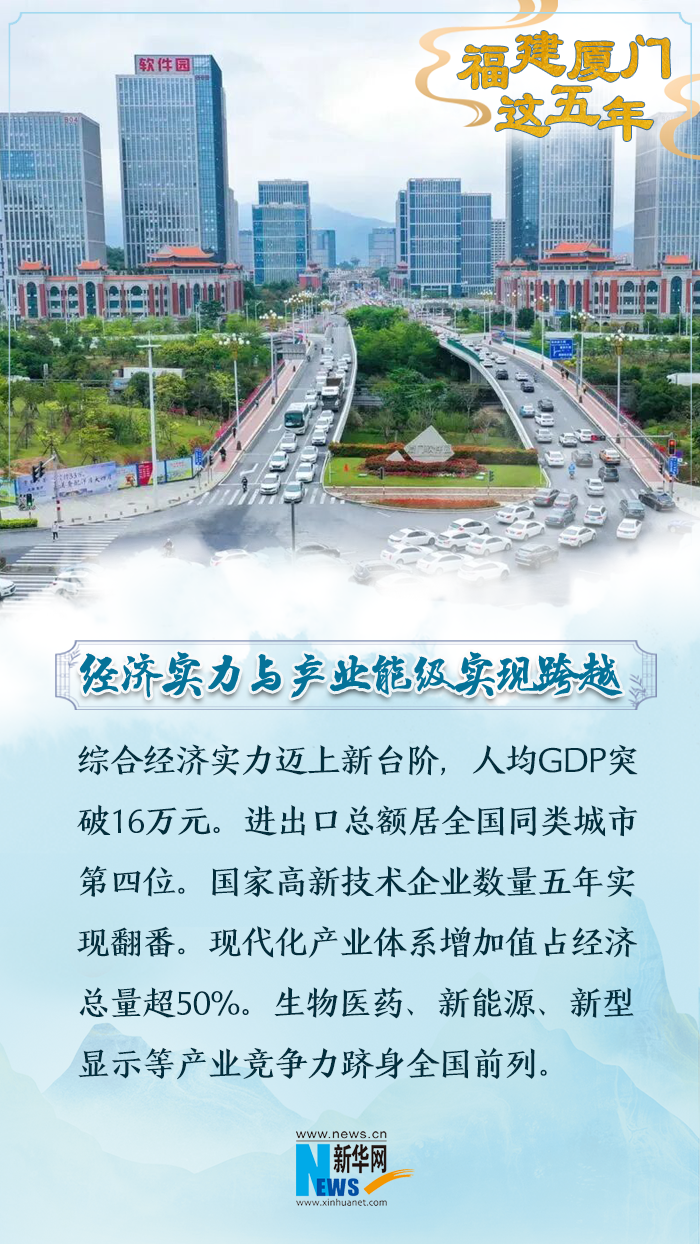
福建厦门这五年:颜值与实力实现“双跃升”
Xin Hua Wang· 2026-01-15 10:09
Group 1 - The core achievement of Xiamen during the 14th Five-Year Plan period includes a per capita GDP exceeding 160,000 yuan and a permanent resident urbanization rate reaching 91% [1][7] - Xiamen has established itself as a leader in various industries, including biomedicine, new energy, and new display technologies, with competitive strengths ranking among the top in the nation [4] - The city has implemented 29 reform experiences that have been promoted nationwide, showcasing its commitment to comprehensive reform and opening up [4] Group 2 - Xiamen's transportation infrastructure is highlighted by its international airport, which is expected to handle 45 million passengers annually, ranking fourth in the country for international transit passenger volume [5] - The city has achieved significant milestones in regional collaboration and cross-strait integration, with the "Little Three Links" accounting for 90% of the passenger volume between the two sides [7] - Xiamen has been recognized as a national model for ecological civilization, with top rankings in waste classification and air quality, and it attracts over 100 million domestic and international tourists annually [9] Group 3 - Over 70% of Xiamen's fiscal expenditure is allocated to social welfare, contributing to a high life expectancy of 83.62 years, comparable to developed countries [12] - The city has achieved national recognition for its educational satisfaction and governance quality, maintaining a leading position in basic education and urban management [12]
广东省委书记黄坤明到暨南大学讲授思政课并调研
Zhong Guo Fa Zhan Wang· 2026-01-14 03:48
Group 1 - The core message emphasizes the importance of advancing Chinese-style modernization as a pathway to national rejuvenation, highlighting the role of the Communist Party of China in this process [2][3][4] - The historical context of China's modernization efforts is outlined, indicating that the journey has been marked by significant achievements and strategic planning, which have led to the nation's progress from standing up to becoming prosperous and strong [4][5] - The necessity of reform and opening up is reiterated as a critical factor for the success of Chinese-style modernization, providing both material and institutional support for development [3][4] Group 2 - The role of youth, particularly students, is emphasized as vital in the pursuit of Chinese-style modernization, encouraging them to take action and embody the spirit of hard work and dedication [6][7] - The upcoming 120th anniversary of Jinan University is highlighted, with a call for the institution to focus on cultivating socialist builders and successors, enhancing its educational quality and international reputation [8] - The importance of integrating historical wisdom and contemporary challenges is stressed, urging a commitment to high-quality development amidst a complex global landscape [5][6]
“中国是我的‘第二故乡’”(缘启中国)——访埃塞俄比亚前总统穆拉图
Ren Min Ri Bao· 2026-01-14 03:37
Core Viewpoint - The article highlights the importance of international friendships and exchanges, particularly focusing on the experiences of foreign individuals who have studied or worked in China, exemplified by former Ethiopian President Mulatu Teshome's reflections on his time in China and its impact on his life and career [1][2]. Group 1: Personal Experience and Education - Mulatu Teshome recalls his journey to China as a public scholarship student, emphasizing the difficulty of being selected among thousands of applicants [1]. - His initial year of studying Chinese at Beijing Language University laid the foundation for his later academic pursuits, including a bachelor's degree in philosophy and a doctorate in international politics from Peking University [2]. - Teshome describes his time in China as a critical period for personal growth, fostering deep friendships and enhancing his worldview [2]. Group 2: Professional Development and Diplomatic Relations - After completing his studies, Teshome returned to Ethiopia and entered the diplomatic service, eventually becoming the ambassador to several countries, including China [2]. - His presidency began with a visit to China, reflecting his strong emotional ties and desire to strengthen Ethiopia-China relations [3]. - Teshome acknowledges China's significant economic development under the Communist Party's leadership, noting its transformation into the world's second-largest economy and the positive impact of foreign investment [3]. Group 3: Lessons for Development - Teshome emphasizes that China's unique modernization path offers valuable lessons for developing countries, including those in Africa, in their pursuit of peace, stability, and economic prosperity [4]. - He highlights Ethiopia's focus on agriculture, technology, and industrial modernization, inspired by China's development experience [4]. - The article mentions China's commitment to enhancing trade relations with African nations, including tax exemptions for exports from the least developed countries, showcasing a collaborative approach to international development [4].
“中国是我的‘第二故乡’”(缘启中国)
Ren Min Ri Bao· 2026-01-13 23:17
Core Viewpoint - The article highlights the importance of international friendships and exchanges, particularly focusing on the experiences of foreign individuals who have studied or worked in China, exemplified by former Ethiopian President Mulatu Teshome's reflections on his time in China and its impact on his life and career [1][2]. Group 1: Personal Experience and Education - Mulatu Teshome recalls his journey to China as a public scholarship student, where he faced intense competition, with only 5 out of thousands of Ethiopian applicants selected [1]. - His initial year of studying Chinese led to a transition to Peking University, where he earned a bachelor's degree in philosophy in 1982, followed by a master's and a doctorate in international politics [2]. - Teshome emphasizes that his time in China was crucial for his personal growth, fostering deep friendships and enhancing his worldview, which laid a solid foundation for his future endeavors [2]. Group 2: Professional Impact and Diplomatic Relations - After completing his studies, Teshome returned to Ethiopia and entered the diplomatic service, eventually serving as ambassador to several countries, including Japan, Australia, and China [2]. - His presidency began in 2013, with China being his first state visit, reflecting his strong emotional ties and desire to strengthen Ethiopia-China relations [3]. - Teshome expresses admiration for China's rapid development under the Communist Party's leadership, noting its transformation into the world's second-largest economy and the positive impact of its open market policies on foreign investment and domestic living standards [3]. Group 3: Development Insights and Cooperation - Teshome points out that China's unique modernization path offers valuable lessons for developing countries, including those in Africa, emphasizing the shared goals of peace, stability, and economic prosperity [4]. - He highlights Ethiopia's focus on agriculture, technology, and industrial modernization, drawing from China's development experiences to combat poverty [4]. - The article mentions China's commitment to enhancing trade relations with African nations, including a zero-tariff policy for 53 African countries, which aims to foster mutual progress and contribute to a shared future for humanity [4].
读懂中国式现代化的底蕴与要义
Bei Jing Ri Bao Ke Hu Duan· 2026-01-11 21:17
Core Viewpoint - Understanding Chinese-style modernization is essential for comprehending the new era and journey of China, guided by Xi Jinping's thoughts on socialism with Chinese characteristics for a new era [2] Group 1: Definition and Characteristics of Chinese-style Modernization - Chinese-style modernization is a significant achievement of the Communist Party of China, integrating Marxist principles with China's specific realities and excellent traditional culture [3] - It is characterized by common features of modernization found globally, while also possessing unique Chinese characteristics based on national conditions [4][5] - The essence of Chinese-style modernization is rooted in socialism, emphasizing the leadership of the Communist Party as crucial for its success [5][6] Group 2: Goals and Pathways - The ultimate goal is to build a prosperous, democratic, civilized, harmonious, and beautiful socialist modernized nation, with a two-step approach: achieving basic modernization by 2035 and becoming a fully modernized nation by the mid-21st century [8][9] - The focus is on high-quality development as the main line of modernization, addressing various aspects such as population, common prosperity, and ecological balance [12][14] Group 3: People's Role and Values - The principle of putting people first is central to Chinese-style modernization, distinguishing it from Western capitalist models [10][11] - The modernization process aims to enhance the well-being of all citizens, ensuring that development benefits are shared equitably [11] Group 4: Reform and Opening-up - Reform and opening-up are identified as decisive factors in promoting Chinese-style modernization, enabling significant historical achievements and transformations [18][19] - Continuous reform is necessary to adapt to new challenges and ensure the success of modernization efforts [19]
新年贺词中的家、国、天下
Xin Lang Cai Jing· 2026-01-11 20:19
Group 1 - The core message of the New Year speeches by President Xi Jinping emphasizes the interconnectedness of family, nation, and the world, promoting a vision that aligns personal dreams with national aspirations and global destiny [1] - The speeches highlight the importance of "home" as a tangible concept, focusing on everyday life aspects such as employment, education, healthcare, and social welfare, which contribute to the overall happiness and security of families [3][4] - The narrative illustrates how individual family efforts contribute to national development, showcasing the dual relationship between personal responsibilities and national progress [4][6] Group 2 - The speeches document China's historical mission of national rejuvenation and modernization, emphasizing the importance of reform and opening up as essential for progress [6][7] - They reflect on China's advancements in technology and innovation, showcasing significant achievements in various fields, which underline the country's manufacturing and creative capabilities [7] - The speeches advocate for ecological civilization, highlighting the importance of harmonious coexistence between humanity and nature, and positioning ecological values as central to high-quality development [8] Group 3 - The speeches express a commitment to peace and development, framing these as fundamental to achieving a harmonious global community, and emphasizing China's role as a responsible major power [10][11] - They promote the idea of mutual respect for cultural diversity and the importance of civilizational exchanges, aiming to overcome barriers and conflicts through dialogue and cooperation [12] - The overarching theme of the speeches is the pursuit of a shared future for humanity, advocating for global cooperation and the construction of a community with a shared destiny [10][12]