贸易逆差

Search documents
深度 | 对等关税,影响了谁?——特朗普经济学系列之十三【财通宏观•陈兴团队】
陈兴宏观研究· 2025-03-09 12:33
Core Viewpoint - The article discusses Trump's proposal for a "fair reciprocal trade plan" aimed at imposing equal tariffs on trade partners to address perceived trade imbalances and enhance U.S. economic security and job creation [1][4][20] Group 1: Reasons for Proposing "Reciprocal Tariffs" - Trump believes that many countries impose unequal tariffs on U.S. goods, putting American companies at a competitive disadvantage [4] - The proposal aims to correct trade imbalances and create more jobs in the U.S. [4] - Key considerations for imposing reciprocal tariffs include high tariffs imposed by other countries, unfair taxes like digital service taxes, non-tariff barriers, and currency manipulation [5][20] Group 2: Assessment of Tariff Inequality - The concept of "excess tariffs" is defined as the extent to which tariffs imposed by other economies on U.S. imports exceed those imposed by the U.S. on their exports [7] - Contrary to expectations, most economies do not impose significantly higher tariffs on U.S. goods, with China facing the highest tariffs from the U.S. [7][9] - As of February, the U.S. tariffs on China were 12% higher than those China imposes on U.S. goods, indicating that China is disproportionately affected [7][9] Group 3: Impact on Specific Industries - If reciprocal tariffs are specifically targeted at China, industries such as textiles, light manufacturing, and electronics may be significantly impacted [11][12] - The textile and apparel industry is particularly vulnerable, with China's tariffs on U.S. imports exceeding those imposed by the U.S. [11][13] - Key products like computers and accessories, toys, and fans are likely to face higher tariffs, with an example being a 25% tariff on U.S. laptops imported into China [13] Group 4: Advantages for Chinese Industries - If reciprocal tariffs are applied uniformly across all trade partners, many Chinese export industries could benefit due to lower tariffs compared to those imposed by other countries [14][15] - The electronics and machinery sectors are highlighted as having significant potential advantages, as they represent a large share of China's exports to the U.S. [15][19] - Industries such as power equipment, knitting, and chemical fibers also show strong potential advantages in the context of reciprocal tariffs [18][19]


石破茂反驳特朗普
券商中国· 2025-03-08 23:28
Group 1 - The core viewpoint of the article highlights the tension in the US-Japan security alliance, with Japan asserting its obligations to provide bases for the US, countering Trump's claims of a one-sided relationship [1][2] - Japanese Prime Minister Shigeru Ishiba emphasized that Japan is not solely reliant on the US for protection, indicating a mutual defense responsibility [1] - Japanese Foreign Minister Taro Kono mentioned the security laws allowing collective self-defense, suggesting seamless cooperation between the US and Japan in all situations [1] Group 2 - Trump expressed dissatisfaction with the US-Japan alliance, stating that while the US must defend Japan, Japan does not have the obligation to defend the US [2]

负增长?美国经济,突传危险信号!
证券时报· 2025-03-04 14:34
Core Viewpoint - The article highlights a concerning GDP forecast from the Atlanta Federal Reserve, predicting a contraction of 2.825% for the first quarter of 2025, marking the first negative growth for the U.S. economy since the COVID-19 pandemic [1][5]. Economic Forecast - The Atlanta Fed's GDPNow model has significantly downgraded its forecast for Q1 2025, from a previous estimate of a 2.33% growth to a contraction of 2.825% [6]. - This prediction is the worst since the second quarter of 2020, when GDP shrank by 7.5% [6]. - The model's downgrade is attributed to an increase in the U.S. trade deficit, which reached a record -$153 billion in January, exceeding market expectations of -$116 billion [7]. Market Reaction - U.S. stock indices opened lower, with the Dow Jones down 0.96%, Nasdaq down 1.19%, and S&P 500 down 1.01% [2]. - European markets also experienced declines, with Germany's DAX index falling nearly 3%, France's CAC40 down nearly 2%, and the UK's FTSE 100 down nearly 1% [3]. Data Analysis - The GDPNow model's latest forecast reflects a significant shift in economic outlook, with personal consumption expenditure (PCE) and private fixed investment growth predictions dropping to 0.0% and 0.1%, respectively [7]. - The ISM manufacturing index also showed a decline from 50.9 to 50.3, contributing to the negative GDP forecast [7]. Government Response - U.S. government officials are reportedly anxious about the economic implications of a potential contraction, particularly concerning the reputation of the current administration [9]. - The Secretary of Commerce suggested a reevaluation of the indicators used to determine economic recession, indicating a potential change in how government spending is accounted for in GDP reports [10].

特朗普为何又对钢铝“开刀”?哪国受影响最大?专家解读→
Zhong Guo Jing Ji Wang· 2025-02-12 01:05
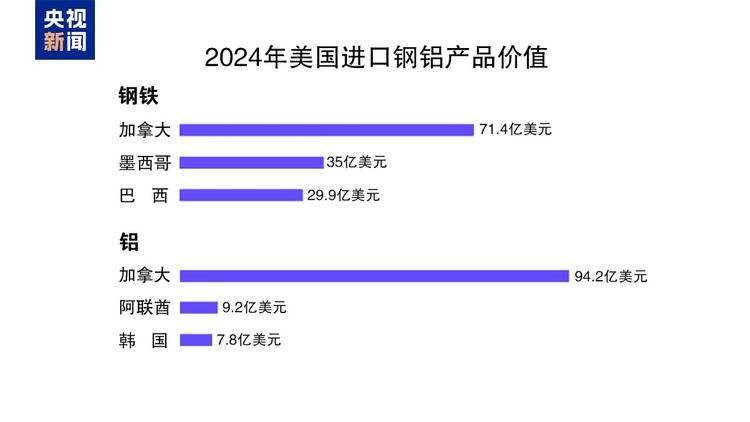
Group 1 - The core point of the news is that President Trump signed an executive order imposing a 25% tariff on all U.S. imports of steel and aluminum, effective March 12, which cancels exemptions for certain trade partners [1] - The countries most affected by the tariffs include Canada, Mexico, and Brazil for steel, and Canada, the UAE, and South Korea for aluminum, with nearly 25% of U.S. steel imports and almost 80% of aluminum imports coming from Canada [1] Group 2 - The rationale behind Trump's repeated imposition of tariffs on steel and aluminum during both terms includes addressing trade deficits and gaining support from voters in key manufacturing states like Indiana and Pennsylvania [2] - The first round of tariffs did not lead to a manufacturing boom in the U.S. but instead resulted in job losses, with a nearly 10% decline in domestic steel production compared to a decade ago [3] Group 3 - The new tariffs are expected to negatively impact U.S. manufacturing by increasing costs for companies purchasing steel and aluminum, particularly affecting the automotive sector [4] - Long-term uncertainty regarding the permanence of these tariffs may deter manufacturers from making significant investments, leading to broader negative implications for the U.S. economy and global supply chains [4]