熊市

Search documents
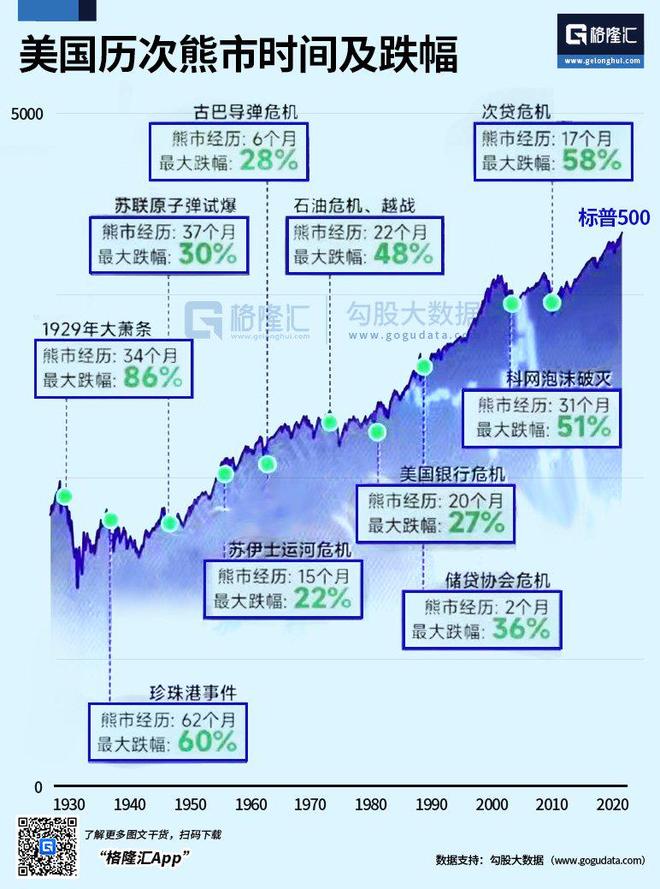
图解丨美国历次熊市时间及跌幅
Ge Long Hui A P P· 2025-10-11 08:05
Core Viewpoint - The U.S. stock market experienced a significant decline due to threats of tariffs from Trump, raising concerns about a potential market peak and entry into a bear market [1] Group 1 - The U.S. stock market fell sharply on Friday, influenced by tariff threats from Trump [1] - There is growing anxiety among investors regarding the possibility of the U.S. stock market reaching its peak and transitioning into a bear market [1] - Historical data on previous bear markets in the U.S. has been reviewed, highlighting the duration and magnitude of declines [1]

X @杀破狼 WolfyXBT
杀破狼 WolfyXBT· 2025-10-10 21:32
Market Trend Analysis - Bitcoin's 4-year cycle suggests a potential bull-bear market watershed around October 6, 2025 [1] - The analysis is specific to Bitcoin, with altcoins potentially experiencing continued rallies [1]
X @杀破狼 WolfyXBT
杀破狼 WolfyXBT· 2025-10-10 21:03
今天是熊市的第 5 天。巨大的下跌,巨大的清算,半年后你会发现杀破狼是唯一会在人声沸腾时为你指点迷津的良心博主。杀破狼 WolfyXBT (@Wolfy_XBT):🚨目前距离牛市结束还剩最后 1 天!虽然事实非常地残酷,但是狼仔还是要残忍地告诉大家,比特币已经来到了 4 年周期理论的牛熊分水岭节点,也就是 2025/10/06,可能日期不会绝对精准,但是大致的位置就在这里。这个理论也仅限于比特币,不排除山寨币有继续狂欢的可能性。 ...
X @杀破狼 WolfyXBT
杀破狼 WolfyXBT· 2025-10-10 15:40
Market Trend Analysis - The analysis suggests that the Bitcoin bull market has ended, with a potential four-year wait for the next one [1] - The analysis indicates that altcoins might still experience rallies, despite the overall Bitcoin trend [1] Time-Sensitive Prediction - The analysis predicts the end of the current bull market around October 6, 2025, based on a four-year cycle theory [1] - The analysis emphasizes that this four-year cycle theory applies specifically to Bitcoin and may not hold true for altcoins [1]
Technical Tuesday: SPX Weakness, CRWV "Dicey" & RDDT Bear Flag Test
Youtube· 2025-10-07 22:00
Market Overview - The S&P 500 has snapped its seven-day winning streak, with intraday highs reaching 6754 but currently trading around 6700, which coincides with previous peaks from late September [1][2][3] - Traders are closely monitoring whether the index can hold above 6700; if it fails, the next support level is around 6650, followed by 6500 at the 50-day moving average [3][4] Trading Strategies - Weakness in the market may prompt traders to tighten their positions, with a close below 6700 potentially leading to a pullback [4] - Traders are advised to prepare "if-then" statements to manage their positions effectively in case of market breakdowns [4] Bull Market Context - The market is currently three years into a bull market, with discussions around whether it will continue into a fourth year [6] - Despite some volatility, many traders remain optimistic and are not inclined to sell off entirely, although concerns about overvaluation persist [7] Stock Performance - CoreWeave has seen a significant recovery, with its stock up 50% from a double bottom in mid-August and early September, indicating an improving trend [7][8] - The stock's recent intraday low tested the 20-day moving average, which is currently at 12625, suggesting a potential support level [8][9] Reddit Stock Analysis - Reddit's stock has experienced a 30% pullback from its peak in September, settling around $200, which may serve as a support level [10][11] - A bearish flag pattern suggests that a break below $200 could lead to further declines, potentially down to the 200-day moving average around 155 [12][13]


X @杀破狼 WolfyXBT
杀破狼 WolfyXBT· 2025-10-05 11:25
Market Trend Prediction - The analysis suggests that the Bitcoin bull market is nearing its end, with an estimated 69 days remaining [1] - The predicted end date for the bull market is October 6, 2025, based on a 4-year cycle theory [1] - A bear market is anticipated to follow, with a projected bottom date of October 5, 2026 [1] Cryptocurrency Specifics - The 4-year cycle theory is specifically applied to Bitcoin, and altcoins may experience different market behavior [1]
每日钉一下(为啥牛市是散户亏钱的主要原因?)
银行螺丝钉· 2025-09-30 13:25
Group 1 - Fund regular investment is a suitable investment method for lazy investors, and it is essential to prepare before starting and to create a solid investment plan [2][3] - There are four methods of regular investment, and it is important to determine which one is most suitable for individual needs and how to take profits [2] Group 2 - The statement that bull markets are a primary reason for retail investors losing money may seem counterintuitive, but it reflects reality [6] - The first common reason for losses is chasing prices, where investors tend to buy at market peaks during bull markets, leading to higher costs [7] - Another reason for losses is frequent trading, which can cause investors to miss out on gains and experience losses despite overall market increases [10] Group 3 - Investing in stocks should shift away from a trading mindset; instead, it should be viewed as owning a basket of companies through funds, which allows for easier management without direct involvement [12]

跟随“聪明钱”!牛市高效选基策略:这些基金经理正被机构疯抢
市值风云· 2025-09-29 10:07
Group 1 - The article highlights the exceptional performance of certain fund managers in the bull market, who have also gained significant institutional recognition, leading to increased holding ratios [4][5]. - Following successful fund managers is considered a smart investment strategy, as institutional investors possess extensive research capabilities and their increased holdings serve as a vote of confidence for these funds and managers [5][6]. - Fund managers favored by institutions tend to outperform their peers during bull markets, providing investors with better profit opportunities [6]. Group 2 - Institutional large-scale subscriptions can provide continuous incremental capital to heavily held stocks, creating a self-reinforcing cycle that drives fund net asset values upward during bull markets [6]. - The article notes that while new and successful fund managers may excel in bull markets, their performance in bear markets may not be as strong, suggesting that investors should consider exiting at market peaks to secure profits [6]. - There is a caution regarding the timeliness of the data, as the current holdings data reflects mid-2025, indicating the possibility that institutions may have already reduced their positions [6].

Peter Schiff:我一直认为刺破比特币泡沫的会是黄金,没想到是白银,“数字币财库公司”面临残酷熊市
华尔街见闻· 2025-09-26 08:51
Core Viewpoint - The strategy of holding large amounts of cryptocurrency as corporate reserves is facing significant challenges as Bitcoin prices continue to decline, with recent market turmoil leading to substantial liquidations and a drop in Bitcoin below the $110,000 support level [1][4]. Group 1: Market Conditions - The cryptocurrency market has experienced a large-scale liquidation, with Bitcoin falling below $110,000 and Ethereum dropping below $3,900 [1]. - In contrast, the price of physical silver has surged, surpassing $45, marking a 14-year high [1]. Group 2: Company-Specific Concerns - Peter Schiff, a prominent critic of Bitcoin, has warned that companies holding Bitcoin as an asset are entering a "brutal bear market," raising doubts about the sustainability of their business models [4][5]. - MicroStrategy (MSTR), known for its significant Bitcoin holdings, has seen its stock price drop sharply, falling below $300 for the first time since April, effectively erasing its gains for the year [9][11]. - MSTR's stock price is highly correlated with Bitcoin prices, and the recent weakness in Bitcoin has directly impacted MSTR's stock performance [11]. Group 3: Financial Risks and Strategies - Schiff has previously indicated that many companies are emulating MSTR's founder Michael Saylor's unconventional business strategy, but few have acknowledged the significant decline in MSTR's stock price [12]. - MSTR's recent Bitcoin purchases have been partially funded by selling its own stock, which raises concerns about financial risk during a downturn in asset prices [14]. - Technical analysis suggests that MSTR's stock price outlook is bleak, with warnings that failure to maintain current support levels could lead to further declines, potentially down to $240 [15].


终于知道为什么牛市要拿住不动!
集思录· 2025-09-17 14:31
Core Viewpoint - The article discusses the challenges and strategies of stock market rotation, emphasizing the difficulty of successfully timing investments and the psychological pressures involved in trading during a bull market. Group 1: Market Behavior and Strategies - The stock market often breaks established habits, leading to unexpected trends such as major upward or downward movements [3][8] - Many investors struggle with rotation strategies, often resulting in losses when trying to switch from strong to weak stocks [8][9] - A simpler approach suggested is to focus on strong sectors and hold positions rather than frequently rotating [4][10] Group 2: Investment Psychology - The psychological pressure of trading can lead to poor decision-making, especially in a bull market where investors may feel compelled to act [4][9] - The belief that weak stocks will eventually rise is often misguided, as their lack of interest from investors is what keeps them down [2][8] - The article highlights that successful investing often requires a mindset shift away from trying to time the market perfectly [3][11] Group 3: Rotation Strategies - A specific rotation strategy for convertible bonds is described, focusing on selecting bonds with certain criteria and adjusting positions based on performance [5][6] - The importance of objective decision-making in rotation strategies is emphasized, as subjective choices can lead to losses [9][14] - The article suggests that many rotation strategies are often seen as unreliable or even deceptive, particularly when they promise consistent profits [11][12]