节能减排

Search documents
正丹股份:募投项目反应尾气综合利用制氮项目试生产
智通财经网· 2025-12-23 10:08
"反应尾气综合利用制氮项目"是公司通过对现有偏苯三酸酐生产装置排放的中压富氮尾气进行综合回收 利用。本项目是公司践行节能减排、实现资源循环利用的重要举措,有助于公司降低综合能耗、巩固偏 苯三酸酐产品的竞争优势,并有望产生良好的经济效益,符合国家环保双降、绿色低碳的可持续发展战 略。 智通财经APP讯,正丹股份(300641.SZ)发布公告,公司向不特定对象发行可转换公司债券募集资金投资 项目中的"反应尾气综合利用制氮项目"已完成工程主体建设及设备安装、调试工作,试生产方案及试生 产条件论证报告经专家评审通过,该项目进入试生产阶段。 ...

正丹股份(300641.SZ):募投项目反应尾气综合利用制氮项目试生产
智通财经网· 2025-12-23 09:57
Core Viewpoint - The company Zhengdan Co., Ltd. has completed the main construction and equipment installation of its "Reaction Tail Gas Comprehensive Utilization Nitrogen Project," which has now entered the trial production phase [1] Group 1: Project Development - The "Reaction Tail Gas Comprehensive Utilization Nitrogen Project" utilizes medium-pressure nitrogen-rich tail gas emitted from the existing production facility of phthalic anhydride for comprehensive recovery and utilization [1] - The trial production plan and conditions have been approved by expert review, indicating readiness for the next phase of operations [1] Group 2: Environmental and Economic Impact - This project is a significant initiative for the company to practice energy conservation and emission reduction, contributing to resource recycling [1] - It is expected to lower overall energy consumption and strengthen the competitive advantage of phthalic anhydride products, while also promising good economic benefits [1] - The project aligns with national strategies for environmental protection and sustainable development, focusing on reducing emissions and promoting a green, low-carbon economy [1]
国家“十四五”电力发展规划重点工程津南500千伏输变电工程投产送电
Zhong Guo Jing Ji Wang· 2025-12-23 06:31
Core Insights - The Tianjin 500 kV Xianping Substation has officially commenced operation, marking the 12th 500 kV substation in Tianjin and a significant milestone in the national "14th Five-Year" power development plan [1] Group 1: Project Overview - The first phase of the project has a total investment of approximately 707 million yuan, with construction starting in July 2024 and lasting for 17 months [1] - The new substation and associated transmission lines will enhance the power capacity by 2.4 million kVA, addressing regional load growth and supporting high-quality economic development in southern Tianjin [1] Group 2: Environmental and Technological Innovations - The project integrates green construction and technological innovation, utilizing transformers that meet national standards of energy efficiency, reducing energy loss by about 5% annually compared to standard transformers [1] - The construction employs prefabricated steel structures, improving efficiency by 30% to 40% compared to traditional reinforced concrete methods [1] Group 3: Operational Impact - The commissioning of the substation will optimize the power supply structure and alleviate high load conditions at existing 500 kV substations, enhancing the overall power supply capacity of the grid [2] - This project is the first 500 kV transmission and transformation project fully initiated and debugged by State Grid Tianjin Electric Power, showcasing meticulous planning and management throughout all construction phases [2]
广西白龙核电1号机组核岛第一罐混凝土浇筑
Guang Xi Ri Bao· 2025-12-23 03:10
12月22日上午,广西白龙核电1号机组启动核岛第一罐混凝土浇筑,标志着国家电投在桂首个核电 项目全面进入主体工程建设阶段。 据了解,白龙核电项目积极贯彻落实中央关于民营企业参与国家重大工程的战略部署,一期工程引 入民营资本参股,为实现国有资本与民营资本优势互补、协同发展,推动重大基础设施项目投资体制改 革提供了示范样板。 一期工程建成投运后,预计年发电量约200亿千瓦时,相当于每年减少标煤消耗约600万吨,减排二 氧化碳约1600万吨,减排效应相当于种植阔叶林4.4万公顷,将对优化广西能源结构、促进节能减排发 挥积极作用,为广西加快建设国家综合能源安全保障区、服务民族地区高质量发展提供稳定可靠的清洁 能源支撑。(陆权香 单祉宁 崔洪瀚) 此次1号机组核岛第一罐混凝土浇筑量约6615立方米,浇筑时长持续近60小时。为保障浇筑安全高 质量实施,广西核电联合各参建单位成立专项指挥机构,实施全过程高标准、高质量管控。 白龙核电项目位于防城港市江山半岛南端,规划建设6台百万千瓦级核电机组,一次规划,分期建 设。其中,一期工程1、2号机组于2024年8月19日获得国家核准,采用自主设计、国产化的第三代先进 核电技术,单台 ...
重庆国际复材突破技术瓶颈精准治污 玻纤废水变直饮水
Xin Hua Wang· 2025-12-22 05:04
Core Viewpoint - Chongqing International Composite Materials Co., Ltd. has successfully transformed complex fiberglass wastewater into drinkable water through advanced treatment processes, achieving a significant milestone in environmental sustainability and resource recycling [2][5]. Group 1: Challenges and Solutions - The company faced two major technical challenges: the complex composition of fiberglass wastewater and the difficulty in managing treatment by-products, which typically resulted in high energy consumption and hazardous waste [2][3]. - After extensive research, the company decided to invest several million yuan to develop a comprehensive wastewater treatment project, viewing it as a critical step towards green transformation [3][4]. Group 2: Innovative Treatment Process - The wastewater treatment project employs a seven-step process: chemical coagulation, hydrolysis acidification, biological treatment, membrane bioreactor (MBR), ultrafiltration, reverse osmosis (RO), and advanced oxidation with ozone, designed to treat 1,800 cubic meters of wastewater daily [5]. - The treatment system has achieved a wastewater reuse rate of over 70%, allowing high-quality soft water to be recycled back into the fiberglass production process [5]. Group 3: Environmental and Economic Benefits - The project is expected to reduce wastewater discharge by approximately 250,000 cubic meters annually and save around 310,000 cubic meters of tap water, significantly lowering the company's water consumption per product by over 32% [5]. - This initiative not only fulfills the company's social responsibility but also reduces operational costs, creating a win-win situation for environmental and economic benefits [5]. Group 4: Broader Green Initiatives - The wastewater treatment project is part of a larger green strategy, which includes achieving ultra-low emissions from kiln exhaust, enhancing waste recycling technologies, and utilizing solar energy to generate over 5.5 million kilowatt-hours of clean electricity annually [8]. - The company has also focused on product greening, obtaining carbon footprint certifications for various fiberglass products, and developing innovative logistics systems that significantly reduce carbon emissions [8].
研判2025!中国稳压器行业政策环境、产业链、发展现状、竞争格局及未来趋势分析:电力需求稳定增长,稳压器行业规模持续扩容[图]
Chan Ye Xin Xi Wang· 2025-12-21 01:18
Core Insights - The voltage stabilizer market in China is projected to grow from 17 billion yuan in 2020 to 22.2 billion yuan by 2024, with a compound annual growth rate (CAGR) of 6.9% [1][9] - The growth is driven by advancements in technology, government support for power infrastructure, and emerging application areas [1][9] Industry Overview - Voltage stabilizers are essential devices that automatically adjust output voltage to provide stable and reliable power for various electronic devices [3][9] - They are classified into linear and switching voltage stabilizers, with switching stabilizers being more efficient and suitable for high-power demands [3][10] Market Size and Growth - The market size for voltage stabilizers in China is expected to reach 23.4 billion yuan by 2025 [1][9] - The linear voltage stabilizer market is projected to grow to 10.893 billion yuan, while the switching stabilizer market is expected to reach 12.507 billion yuan by 2025 [11] Industry Policies - The Chinese government has implemented policies to support the growth of the voltage stabilizer industry, including the "Power Equipment Industry Growth Work Plan (2023-2024)" aiming for an average annual revenue growth of over 9% [4][5] Competitive Landscape - Major companies like Zhejiang Chint Electric, ST Yishite, and Tianzheng Electric dominate the market, leveraging scale and service networks [12][14] - Smaller companies focus on niche markets to establish unique advantages [12] Industry Trends - There is a growing demand for energy-efficient and low-loss voltage stabilizers due to increasing energy efficiency standards [16] - The integration of smart and digital features is transforming voltage stabilizers from passive devices to active power management nodes [17] - Customization and modular design are becoming essential to meet diverse market needs across different industries [18]


格力在迪拜Big 5 Global展示最新产品
Shang Wu Bu Wang Zhan· 2025-12-18 16:01
Core Viewpoint - Gree showcased its latest energy-efficient, smart, and durable products at the Big 5 Global exhibition in Dubai, emphasizing its commitment to sustainable cooling solutions and health-oriented living [1] Group 1: Product Highlights - Gree introduced a zero-carbon source system (solar-powered air conditioning) that directly utilizes solar energy to operate appliances and contribute to emissions reduction [1] - The new products include home air conditioners, commercial HVAC systems, and other household appliances [1] Group 2: Partnerships and Initiatives - Gree is collaborating with its UAE partner NIA to promote sustainable cooling and health living solutions [1]

信能低碳(00145)附属拟与伙伴公司就几内亚光伏项目及相关贸易事宜进行合作
智通财经网· 2025-12-18 13:41
Core Viewpoint - The company has entered into a framework agreement for a photovoltaic solar power project in Guinea, which aligns with its strategy to enhance energy efficiency and reduce carbon emissions [1][2]. Group 1: Project Details - The company’s wholly-owned subsidiary, Xinneng Engineering (China) Co., Ltd., has signed a framework agreement with a partner company registered in China to collaborate on the Guinea photovoltaic project [1]. - The total estimated investment for the Guinea photovoltaic project is approximately RMB 4 billion, with capital investment around RMB 1.3 billion [1]. - The project company will be responsible for overall planning, design, contractor selection, procurement of equipment, and financing for the project [1]. Group 2: Operational Responsibilities - Upon completion of the Guinea photovoltaic project, the company or its designated entity will manage the operation, maintenance, and supply of solar power, charging an annual service fee of 1.5% of the total investment [1]. - The company will also engage in international trade cooperation regarding bauxite mining with the partner company, assisting in handling international letters of credit and logistics services [2]. Group 3: Business Strategy and Market Trends - The company aims to leverage its experience in energy-saving solutions through this collaboration, which aligns with its business strategy and benefits its shareholders [2]. - The anticipated rapid growth in electric vehicle numbers is expected to increase demand for electric vehicle charging stations in Hong Kong, which will support the company's development in this area [2]. - Recently, high-speed electric vehicle charging stations have begun testing operations, capable of servicing multiple electric taxis and private cars simultaneously [2].
2025年航空运输行业回顾及展望:国际市场快速修复 行业运行稳中提质
Chan Ye Xin Xi Wang· 2025-12-18 02:27
Group 1 - The aviation transportation industry in China has benefited from a stable economic environment, with steady growth in resident income and resilient foreign trade since 2025 [1] - Domestic passenger and cargo transport markets have shown steady growth, while international passenger transport has exceeded levels from the same period in 2019, and international cargo transport has also experienced rapid growth despite a complex trade environment [1] - The price of aviation kerosene has fluctuated downwards, and the depreciation of the US dollar against the RMB has continued to release profit margins for aviation transport companies, although the mandatory procurement of sustainable aviation fuel (SAF) may negatively impact cost control [1] Group 2 - In the first three quarters of 2025, sample aviation transport companies have shown continuous improvement in operating performance, achieving profitability and maintaining positive cash flow from operating activities [2] - Major airlines have demonstrated good performance in fulfilling social responsibilities, with ongoing effects in energy conservation and emissions reduction [2] - The overall debt burden of sample aviation transport companies remains heavy, primarily consisting of long-term debt, with an increase in bond financing scale since 2025, indicating smooth overall financing channels [2]
年复合增长2.6%|全球变频器市场争夺战,五大厂商拿下45%份额
Sou Hu Cai Jing· 2025-12-17 13:42
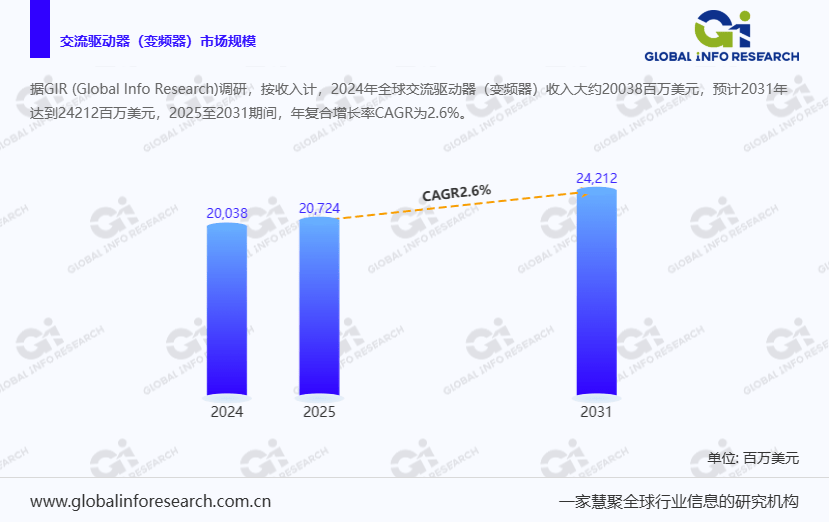
Core Insights - The global market for AC drives (inverters) is projected to grow from approximately $20.038 billion in 2024 to $24.212 billion by 2031, with a compound annual growth rate (CAGR) of 2.6% from 2025 to 2031 [3][5]. Market Overview - The major manufacturers of AC drives include ABB, Siemens, Inovance, Schneider Electric, Yaskawa Electric, Rockwell Automation, Danfoss, Fuji Electric, Mitsubishi Electric, and Delta Electronics [5]. - The top five manufacturers are expected to hold about 45.0% of the market share in 2024 [5]. Product Type Segmentation - Low and medium voltage inverters currently dominate the market, accounting for approximately 62.3% of the total market share [8]. Application Segmentation - The petrochemical industry is the primary source of demand for AC drives, representing about 17.5% of the market [11]. Market Dynamics - Key drivers for the AC drives market include the increasing global demand for energy efficiency and the promotion of energy-saving policies. The rise in energy costs and the implementation of carbon neutrality goals are leading industries to adopt inverters for precise control of motor speed and torque, significantly reducing energy consumption [15]. - The acceleration of industrial automation and smart manufacturing is also driving the widespread application of inverters in production lines, conveyor systems, and process control [15]. Challenges - The market faces challenges such as high initial investment costs, particularly for small and medium-sized enterprises, which can deter widespread adoption [16]. - There is a strong reliance on specialized knowledge and skilled personnel for the selection, configuration, integration, and maintenance of inverters, which can limit market expansion [17]. Opportunities - The AC drives industry is poised for unprecedented growth opportunities driven by global energy transitions and industrial digitization. The demand for energy-saving retrofits under carbon reduction strategies presents a significant market opportunity [18]. - The advancement of Industry 4.0 and smart manufacturing is opening new avenues for value enhancement, as modern inverters evolve into intelligent nodes capable of predictive maintenance and energy management [18]. - Emerging industries such as electric vehicles, photovoltaic manufacturing, and data center cooling systems are creating substantial demand for high-precision and reliable inverters, providing lucrative profit growth points [18]. Industry Chain - The AC drives industry chain is well-defined, with upstream components including power modules, microprocessors, and other essential materials. The midstream involves core manufacturing and R&D, while the downstream penetrates various industrial and some civilian sectors, emphasizing the importance of energy savings and process control [19].