
资金占用

Search documents
2025强制退市企业再增:连续5年造假、96%净资产被掏空,A股\"医美第一股\"崩塌
Xin Lang Cai Jing· 2025-12-02 12:05
Core Viewpoint - The healthcare industry is undergoing a severe "cleansing operation" in 2025, exemplified by the forced delisting of *ST Suwu (Jiangsu Wuzhong) due to significant financial fraud amounting to 1.772 billion [1][19]. Group 1: Major Violations - *ST Suwu was found guilty of three major violations: concealing the change of actual controller, significant financial fraud, and non-operational fund occupation by related parties [2][21]. - The company concealed the change of its actual controller from "Qian Qunying" to "Qian Qunshan" from 2018 to 2023, misrepresenting the controller in annual reports [2][21]. - The financial fraud involved inflating revenue by 1.772 billion from 2020 to 2023 through non-commercial trade activities, with inflated profits of 76 million and inflated operating costs of 1.695 billion during the same period [2][22]. Group 2: Financial Condition - The financial condition of *ST Suwu has deteriorated significantly, with net assets dropping from 1.072 billion in 2020 to 68.35 million in 2023, while liabilities surged from 1.191 billion to 2.202 billion [11][31]. - Cash flow has been consistently negative, reaching -1.63 billion in 2023, indicating severe liquidity issues [11][31]. - By the end of Q3 2025, the company reported a loss of 87.47 million, with cash flow at -894 million and receivables amounting to 2.1 billion [33]. Group 3: Market Impact - The stock price of *ST Suwu has plummeted over 70% from around 6 yuan in 2020 to approximately 1.5 yuan by the end of 2023, reflecting a market valuation drop from 6 billion to 1.7 billion [15][35]. - In 2025, the stock experienced an 89% decline, with multiple warnings issued due to the price falling below 1 yuan [16][36]. - The delisting of *ST Suwu is part of a broader trend, with several healthcare companies facing delisting in 2025 due to financial misconduct, impacting thousands of investors [1][20].


遭立案天风证券股价低开近9%,年内先后有前高管被曝失联
Nan Fang Du Shi Bao· 2025-12-01 10:14
Core Viewpoint - Tianfeng Securities' stock price dropped significantly following the announcement of an investigation by the China Securities Regulatory Commission (CSRC) for alleged information disclosure violations and illegal financing practices [2][3]. Group 1: Company Background - Tianfeng Securities was established in 2000 and went public on the Shanghai Stock Exchange in October 2018. It is headquartered in Wuhan, Hubei Province, and is the only provincial securities company in Hubei [3]. - The current controlling shareholder is Hubei Hongtai Group, a provincial state-owned financial services enterprise, which took over after the previous major shareholder, Contemporary Group, exited due to a debt crisis [4]. Group 2: Investigation and Financial Issues - The investigation is linked to historical issues with the former major shareholder, Contemporary Group, particularly regarding the occupation of funds. This investigation may signify a complete separation between Tianfeng Securities and Contemporary Group [3][4]. - In 2022, Contemporary Group repaid a total of 1.903 billion yuan in principal and 106 million yuan in interest related to the occupied funds, which were fully returned by the end of the year [4]. Group 3: Management Changes and Capital Increase - Following the exit of Contemporary Group, Tianfeng Securities prioritized capital replenishment. In April 2023, the company announced a plan to raise up to 4 billion yuan through a private placement to Hubei Hongtai Group [5]. - The private placement was officially accepted by the Shanghai Stock Exchange in March 2025 and was fully subscribed by Hubei Hongtai Group, increasing its shareholding to 28.14% [5]. Group 4: Shareholder Activity and Performance - UBS entered as a new shareholder but quickly exited Tianfeng Securities' top ten shareholders within a short period [5]. - For the first three quarters of 2025, Tianfeng Securities reported a revenue of 2.112 billion yuan, representing a year-on-year increase of 57.53%, and a net profit attributable to shareholders of 153 million yuan [5].

遭立案后天风证券周一早盘大跌,有外资在三季度退出前十大股东
Di Yi Cai Jing· 2025-12-01 03:44
Core Viewpoint - Tianfeng Securities is facing significant challenges following a regulatory investigation, leading to a sharp decline in its stock price and changes in shareholder composition [2][3]. Group 1: Regulatory Investigation - Tianfeng Securities has been placed under investigation by the China Securities Regulatory Commission (CSRC) for alleged violations related to information disclosure and illegal financing [2]. - The investigation is reportedly linked to issues concerning the former major shareholder, Wuhan Dandai Technology Industry Group, and its fund occupation matters disclosed in the 2022 annual report [2]. Group 2: Stock Performance - Following the announcement of the investigation, Tianfeng Securities' stock opened down nearly 9% and closed at 4.51 CNY per share, reflecting a decline of 6.63% on that day [2]. - For the first three quarters of the year, Tianfeng Securities reported revenue of 2.112 billion CNY, a year-on-year increase of 57.53%, and a net profit of 153 million CNY, marking a return to profitability [2]. Group 3: Shareholder Composition - As of the end of the third quarter, Hubei Hongtai Group is the controlling shareholder of Tianfeng Securities, holding 2.854 billion shares, which is 28.14% of the total [3]. - UBS had entered as a new shareholder with a 0.87% stake but exited the top ten shareholders by the end of September [3].
永泰系盈利承压三公司两家业绩双降 王广西被立案涉占资8.84亿
Chang Jiang Shang Bao· 2025-12-01 02:32
Core Viewpoint - Wang Guangxi, a prominent figure in the A-share market, is under investigation by the China Securities Regulatory Commission (CSRC) for alleged violations related to information disclosure, impacting his companies, including Haide Co., Ltd. and Yongtai Energy [2][5]. Group 1: Investigation Details - On November 28, Haide Co., Ltd. announced that both the company and its actual controller, Wang Guangxi, are under investigation by the CSRC for information disclosure violations [2][5]. - Yongtai Energy and Hailun Zhe also confirmed that Wang Guangxi is being investigated, clarifying that the matter is unrelated to their operations [2][5]. - Haide Co., Ltd. disclosed a historical non-operating fund occupation amounting to 884 million yuan, which has been fully returned as of April 24, 2025 [2][7]. Group 2: Financial Performance - Yongtai Energy and Haide Co., Ltd. reported declining performance for the first three quarters of 2025, with Yongtai Energy's revenue and net profit decreasing by 20.77% and 86.48%, respectively [12]. - Haide Co., Ltd. experienced a significant drop in revenue and net profit, with declines of 46.54% and 66.96%, respectively [12]. - Despite Hailun Zhe showing growth in revenue and net profit by 28.75% and 32.57%, its profitability remains weak, and its influence on Haide Co., Ltd. is limited due to a 12.34% shareholding [13]. Group 3: Background of Wang Guangxi and Yongtai Group - Wang Guangxi, born in 1969, transitioned from a business manager to a real estate entrepreneur, founding Yongtai Investment Holding Co., Ltd. in 2003 [9][10]. - The Yongtai Group has expanded into various sectors, including pharmaceuticals and energy, with significant acquisitions over the years [11][12]. - The aggressive expansion strategy has led to financial pressures, culminating in a debt crisis for Yongtai Energy between 2018 and 2020, requiring judicial restructuring [3][12].


永泰能源实控人遭立案与公司无关 因涉及海德股份前期资金占用
2 1 Shi Ji Jing Ji Bao Dao· 2025-11-30 10:14
Core Viewpoint - Yongtai Energy (600157) disclosed on November 28 that the China Securities Regulatory Commission (CSRC) decided to initiate an investigation against Haide Co., Ltd. (000567) and its actual controller for suspected violations of information disclosure regulations [1] Group 1: Investigation Details - The investigation is related to Haide Co., Ltd.'s previous disclosure in its annual report regarding the rectification of historical non-operating fund occupation issues, which was claimed to be completed in the first half of this year [1] - On April 28, 2025, Haide Co., Ltd. disclosed that it received a warning letter from the CSRC's Hainan Regulatory Bureau regarding this matter, and all occupied funds and interest were fully returned by April 24, 2025 [1] - The initiation of the investigation marks a conclusion to the fund occupation issue for Haide Co., Ltd., and it is considered a procedural action [1] Group 2: Impact on Yongtai Energy - Analysts believe that Yongtai Energy's announcement is a routine disclosure in accordance with the information disclosure requirements for listed companies and is unrelated to the company's operations [1] - The investigation is not expected to have any impact on Yongtai Energy's production and operations [1]
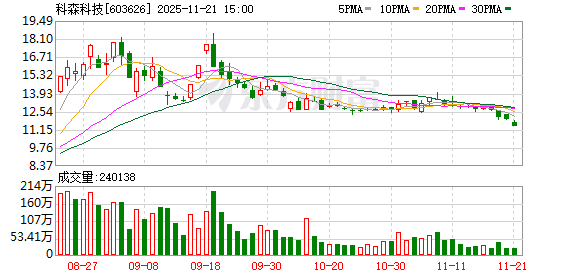
科森科技遭监管处罚 涉信披违规、资金占用等
Zhong Guo Jing Ying Bao· 2025-11-22 01:27
Core Viewpoint - Koson Technology has been found to have multiple regulatory violations, leading to warnings and criticisms from regulatory bodies, which may impact its reputation and operations [1][4]. Group 1: Regulatory Violations - Koson Technology engaged in daily sales transactions with three related parties from 2018 to 2024 without following proper review procedures and disclosure obligations, only supplementing disclosures in April 2025 with errors in the reported amounts [1]. - In 2022, Koson Technology made non-operating fund occupations by transferring funds to a related party under the guise of sales transactions, with individual occupation periods ranging from 1 to 4 days, which were not disclosed as required [1]. - A former director, Li Jin, was placed under judicial supervision in January 2024 for suspected bribery but failed to disclose this investigation, only resigning after receiving a criminal judgment in July 2025 [1]. Group 2: Accountability and Consequences - The Jiangsu Securities Regulatory Bureau identified key responsibilities for the violations, holding former Chairman Xu Jingen and former CFO Xiang Xuemei primarily accountable for the related transactions and fund occupations [1]. - Former director Qu Liping is also held responsible for the violations related to the transactions, while Li Jin faces separate accountability for concealing the investigation [1]. - Koson Technology is required to submit a rectification report within 10 working days, and the Shanghai Stock Exchange has issued public criticisms against the company and its former executives, which will be recorded in the securities market integrity database [1][4]. Group 3: Company Response - Koson Technology has acknowledged the regulatory issues and plans to enhance its understanding of securities laws and regulations, as well as improve its information disclosure management and internal controls [2]. - The company emphasizes that the regulatory measures will not affect its normal production and operations, urging investors to make rational decisions [2].

国联水产:公司、控股股东及相关责任人收到广东证监局警示函
Zheng Quan Shi Bao Wang· 2025-11-21 07:59
人民财讯11月21日电,国联水产(300094)11月21日公告,公司、控股股东及相关责任人近日收到广东 证监局出具的警示函。经查,2024年9月至11月,公司向第一大股东新余国通提供借款,累计发生额780 万元。上述行为构成控股股东及其关联方对公司的非经营性资金占用,截至2024年11月底资金占用余额 已全部清偿。公司对前述事项未及时依法履行审议及信息披露义务,迟至2025年4月28日才在2024年年 度报告中予以披露。李忠作为公司董事长、总经理,樊春花作为公司财务总监,梁永振作为公司董事会 秘书,未能勤勉尽责,对公司上述违规行为负有主要责任。广东证监局决定对国联水产、新余国通、李 忠、樊春花、梁永振采取出具警示函的行政监管措施,并记入证券期货市场诚信档案。 ...

国联水产收到广东证监局警示函
Zhi Tong Cai Jing· 2025-11-21 07:55
国联水产(300094)(300094.SZ)公告,公司于近日收到中国证券监督管理委员会广东监管局("广东证监 局")出具的《关于对湛江国联水产开发股份有限公司、新余国通投资管理有限公司、李忠、樊春花、梁 永振采取出具警示函措施的决定》。 2024年9月至11月,公司向第一大股东新余国通投资管理有限公司(简称新余国通)提供借款,累计发生 额780万元。上述行为构成控股股东及其关联方对国联水产的非经营性资金占用,截至2024年11月底资 金占用余额已全部清偿。公司对前述事项未及时依法履行审议及信息披露义务,迟至2025年4月28日才 在2024年年度报告中予以披露。 ...
江西沐邦高科股份有限公司 关于股票交易的风险提示公告
Zhong Guo Zheng Quan Bao - Zhong Zheng Wang· 2025-11-20 02:14
Core Viewpoint - The company, Jiangxi Mubang High-tech Co., Ltd., has experienced a significant stock price increase of 35.57% since October 30, 2025, with seven trading days hitting the daily limit, which raises concerns about the sustainability of this rise given the underlying fundamentals [1][2]. Group 1: Stock Performance and Risks - The company's stock price has surged significantly, with a cumulative increase of 35.57% since October 30, 2025, including seven trading days of hitting the daily limit [1]. - The company has warned investors about the risks associated with the rapid stock price increase, indicating a potential disconnect from its fundamental performance [1][2]. Group 2: Restructuring Uncertainty - There is a major uncertainty regarding the company's ability to enter the restructuring process by December 31, 2025, as it is currently addressing issues related to fund occupation by its controlling shareholders [2][3]. - The company is actively working to resolve the fund occupation issues but has not confirmed whether it will successfully enter pre-restructuring or restructuring procedures [2][3]. Group 3: Listing Risks - The company faces the risk of delisting due to a negative net profit for the fiscal year 2024 and insufficient operating revenue, which is projected to be below 300 million yuan [2]. - The company reported a revenue of 226.82 million yuan and a net loss of 355.72 million yuan for the first nine months of 2025, which could lead to delisting if certain financial thresholds are not met [2]. Group 4: Investigation Status - The company and its actual controller are currently under investigation by the China Securities Regulatory Commission (CSRC) for suspected violations related to financial data misrepresentation [3]. - The actual controller, Mr. Liao Zhiyuan, is also under investigation for failing to disclose non-operational fund transactions as required [3]. Group 5: Fund Occupation Issues - The company has outstanding fund occupation issues, with significant amounts provided to controlling shareholders and related parties, which have not been repaid [4][5]. - As of the end of June 2025, the controlling shareholder had a non-operational fund occupation balance of 46.06 million yuan, and other related parties had a balance of 35.26 million yuan [5].

山东新华锦国际股份有限公司 关于资金占用责令改正进展暨可能被实施退市风险警示的风险提示公告
Zhong Guo Zheng Quan Bao - Zhong Zheng Wang· 2025-11-15 23:12
登录新浪财经APP 搜索【信披】查看更多考评等级 本公司董事会及全体董事保证本公告内容不存在任何虚假记载、误导性陈述或者重大遗漏,并对其内容 的真实性、准确性和完整性承担法律责任。 二、可能被实施退市风险警示的原因、公司股票停牌情况及退市风险警示实施安排 根据《上海证券交易所股票上市规则》(2025年4月修订)第9.4.1等相关规定,若公司未能按照责令改 正要求在六个月内清收被占用资金,公司股票将被实施停牌,停牌后两个月内仍未完成整改的,公司股 票将被实施退市风险警示,此后两个月内仍未完成整改的,公司股票将被终止上市交易。 三、历次风险提示公告的披露情况 公司于2025年8月27日披露了《山东新华锦国际股份有限公司关于收到青岛证监局〈行政监管措施决定 书〉暨可能被实施其他风险警示及退市风险警示的风险提示公告》(公告编号:2025-045);分别于 2025年9月10日、9月24日披露了《山东新华锦国际股份有限公司关于资金占用责令改正进展暨可能被实 施其他风险警示及退市风险警示的风险提示公告》(公告编号:2025-048、2025-050);分别于2025年 10月18日、11月1日披露了《山东新华锦国际股份有 ...
