
八纵八横高铁网

Search documents
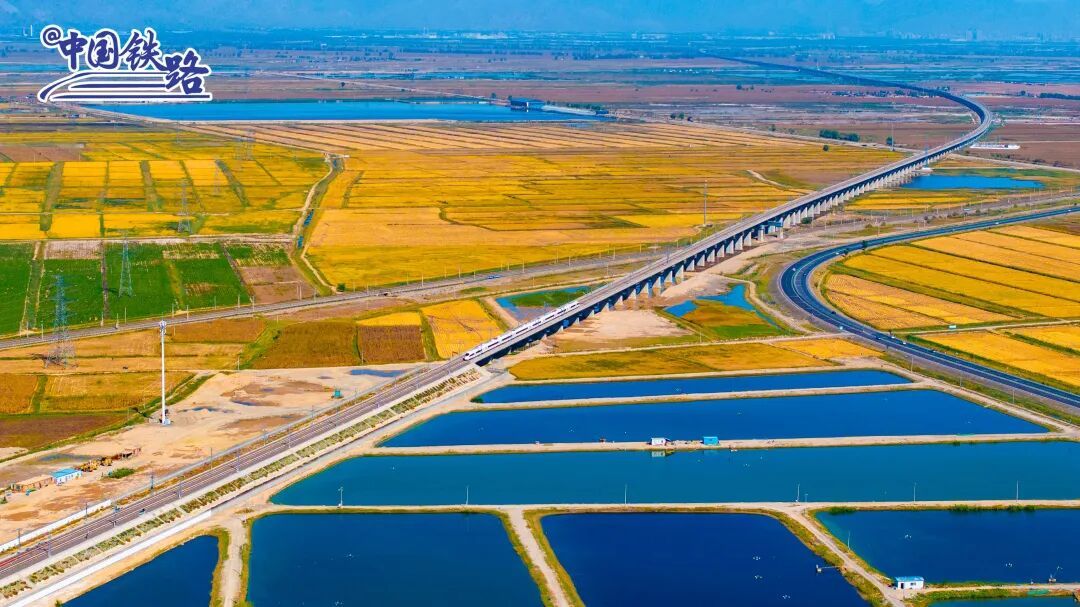
包银高铁将于12月23日全线开通
Xin Lang Cai Jing· 2025-12-20 06:42
Core Viewpoint - The Baoyin High-speed Railway from Baotou to Yinchuan will be completed and opened for operation on December 23, marking the full line operation of the Baoyin High-speed Railway and injecting new momentum into the western development of China [1] Group 1: Project Overview - The Baoyin High-speed Railway starts from Baotou Station and passes through several cities, with a total length of 519 kilometers and a design speed of 250 km/h [3] - The newly opened section from Baotou to Huinong is 422 kilometers long and includes 10 stations, with four existing stations and six new stations [3] Group 2: Construction and Technology - The construction faced significant challenges due to complex geological and hydrological conditions, but the project has integrated green development principles and utilized new technologies throughout the planning and construction phases [5] - Key engineering projects such as the Dengkou Yellow River Bridge and Gander Mountain Tunnel have been successfully completed, ensuring timely project completion [5] Group 3: Operational Details - Upon opening, the Baoyin High-speed Railway will operate at a maximum speed of 250 km/h, with up to 12 train services daily, including 7 cross-line services [7] - Travel times from Baotou to Huinong and Yinchuan will be significantly reduced, with the fastest journeys taking 2 hours and 7 minutes and 2 hours and 38 minutes, respectively [7] Group 4: Strategic Importance - The Baoyin High-speed Railway is part of China's "eight vertical and eight horizontal" high-speed rail network, enhancing connectivity in the northwest region and facilitating high-quality development along the Yellow River [9] - The full operation of the railway will greatly benefit local communities and support the implementation of the new era's western development strategy [9]

包银高铁12月23日全线贯通西北路网再升级
Zhong Guo Jing Ji Wang· 2025-12-20 06:08
Core Viewpoint - The Baotou-Yinchuan High-Speed Railway (Baoyin High-Speed Railway) will be fully operational on December 23, enhancing the high-speed rail network in Northwest China and supporting the new era of Western development [1][2] Group 1: Project Overview - The Baoyin High-Speed Railway spans 519 kilometers with a design speed of 250 km/h, constructed in two phases [1] - The section from Baotou to Huinong, which is 422 kilometers long, includes 10 stations and traverses complex geological and hydrological environments [1] - Key engineering projects include the Tengkou Yellow River Bridge and the Gander Mountain Tunnel, emphasizing ecological priority and technological leadership during construction [1] Group 2: Operational Details - Prior to opening, the railway department completed joint debugging, safety assessments, and ensured stable equipment status [1] - Initial operations will feature multiple high-speed train services, with travel times from Baotou to Yinchuan taking as little as 2 hours and 38 minutes, and from Hohhot to Lanzhou in 7 hours and 27 minutes [1] Group 3: Strategic Importance - The Baoyin High-Speed Railway is a crucial part of the national "Eight Vertical and Eight Horizontal" high-speed rail network, connecting with the Jing-Bao High-Speed Railway to the north and the Yinlan and Yinxi High-Speed Railways to the south [2] - The full operation of the railway will significantly improve travel convenience for residents in the cities of Bayannur and Wuhai, promoting ecological protection and high-quality development in the Yellow River basin [2]
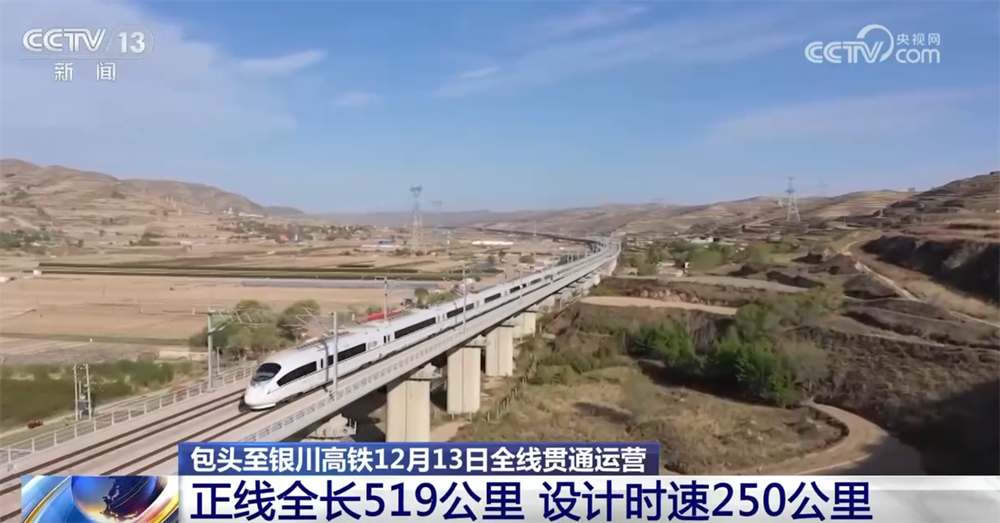
包头至银川高铁即将全线贯通运营 巴彦淖尔市、乌海市将进入“高铁时代”
Yang Shi Wang· 2025-12-20 03:57
Core Viewpoint - The Baotou-Yinchuan High-Speed Railway (HSR) will be fully operational with the opening of the Baotou to Huinong section on December 23, enhancing connectivity in Northwest China [1][5]. Group 1: Project Details - The Baotou-Yinchuan HSR spans a total length of 519 kilometers, with a design speed of 250 km/h, and is constructed in segments [1]. - The newly opened Baotou to Huinong section is 422 kilometers long and includes 10 stations [1]. Group 2: Operational Efficiency - Initially, the Baotou-Huinong section will operate at a maximum speed of 250 km/h, with up to 12 daily train services, including 7 cross-line services [3]. - Travel times from Baotou to Huinong and Yinchuan will be reduced to 2 hours and 7 minutes and 2 hours and 38 minutes, respectively, significantly cutting current travel times by 2 hours and 29 minutes and 3 hours and 20 minutes [3]. Group 3: Strategic Importance - The Baotou-Yinchuan HSR, along with the Beijing-Baotou and Yinchuan-Lanzhou HSRs, forms part of China's "Eight Vertical and Eight Horizontal" high-speed rail network, specifically the Beijing to Lanzhou corridor [5]. - The full operation of this railway will enhance the high-speed rail network layout in Northwest China, marking the entry of cities like Bayannur and Wuhai into the "high-speed rail era" [5].
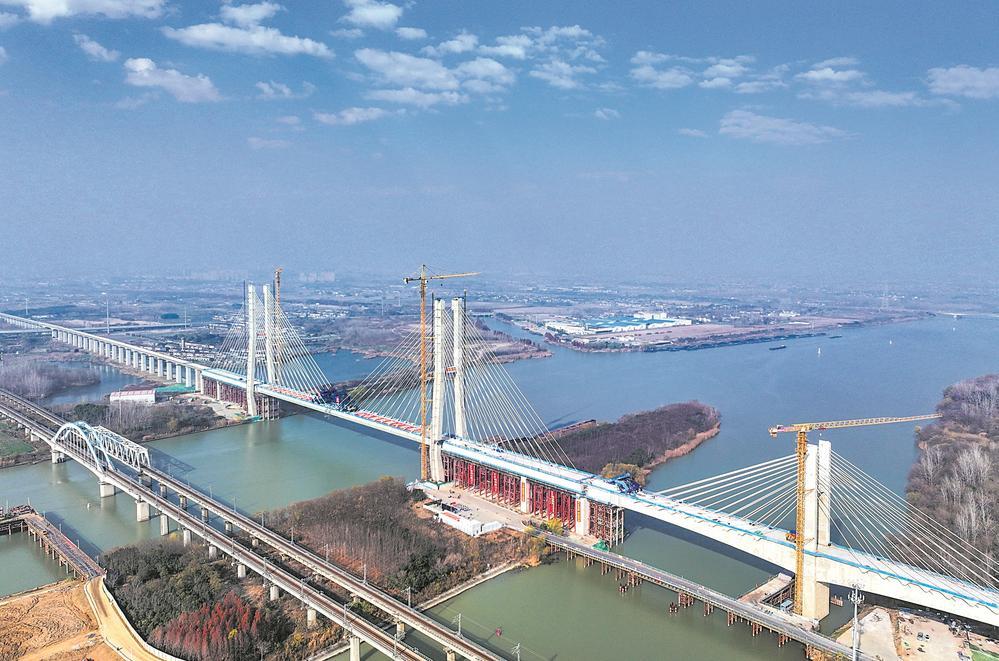
跨京杭运河斜拉桥顺利合龙
Xin Lang Cai Jing· 2025-12-19 18:23
Group 1 - The Tongtaiyang Grand Bridge, part of the Shanghai-Chongqing-Chengdu high-speed railway, has successfully completed the key construction milestone of the cross-Jinghang Canal cable-stayed bridge, laying a crucial foundation for the railway's timely operation [3] - The Tongtaiyang Grand Bridge spans approximately 172.9 kilometers, making it the longest high-speed railway bridge under construction in the world, connecting the cities of Nantong, Taizhou, and Yangzhou in Jiangsu province [3] - The Shanghai-Chongqing-Chengdu high-speed railway is a significant component of the national "Eight Vertical and Eight Horizontal" high-speed rail network, with a total length of about 2100 kilometers and a design speed of 350 kilometers per hour, linking six provinces and municipalities [3] Group 2 - The completion of the bridge will enhance the integration of rail and water transport along the Yangtze River, optimizing the comprehensive transportation system in the region and contributing to the development of the "Railway on the Yangtze River Delta" [3] - The project involves overcoming significant construction challenges, having crossed existing railways, highways, and waterways 116 times [3] - The bridge is noted for having the largest span, the tallest main tower, and the most complex technology among the key control nodes of the entire railway line [3]
雄忻高铁阜平隧道贯通
Zhong Guo Jing Ji Wang· 2025-12-16 08:49
Group 1 - The Fuping Tunnel, the longest tunnel of the Xiongxin High-speed Railway in Hebei, has successfully been completed, laying a solid foundation for the entire line's operation [1] - The tunnel, constructed by Xiong'an High-speed Railway Co., Ltd. and built by China Railway Tunnel Group, spans 11.29 kilometers with a maximum depth of approximately 590 meters, facing complex geological conditions and high construction risks [1] - The project team implemented innovative technologies and a "modular + information-based" management system to enhance safety and construction quality, ensuring real-time data upload and analysis [1] Group 2 - The Xiongxin High-speed Railway, with a total length of 342 kilometers and a design speed of 350 kilometers per hour, is a crucial part of the national "eight vertical and eight horizontal" high-speed rail network [2] - Once operational, the railway will optimize the transportation network in the Beijing-Tianjin-Hebei region, end the historical lack of railway passenger service in Fuping County, and significantly improve local residents' travel conditions [2] - The railway is expected to contribute to rural revitalization, enhance connectivity among urban clusters, and promote coordinated regional development [2]
海南:力争“十五五”期间建成湛海高铁并投入运营
Guan Cha Zhe Wang· 2025-12-12 08:38
Core Viewpoint - The Hainan Provincial Party Committee has released suggestions for the 15th Five-Year Plan, emphasizing the construction of the Zhanhai High-Speed Railway and its expected completion and operation during this period [1][2]. Group 1: Project Overview - The Zhanhai High-Speed Railway is part of the national "eight vertical and eight horizontal" high-speed railway network, serving as a crucial link between Hainan Free Trade Port and the mainland [2][3]. - The railway will connect Zhanjiang in Guangdong Province to Haikou in Hainan Province, filling the gap in direct high-speed rail access between Hainan and the mainland [2][4]. Group 2: Project Significance - The project aims to enhance regional transportation connectivity, facilitating the movement of goods and people, and supporting the economic development of Hainan [3][4]. - It is expected to create a modern transportation framework that allows seamless integration of Hainan's circular economy with the national high-speed rail network, thus promoting Hainan as a significant transportation hub [3][10]. Group 3: Implementation Strategy - A project task force has been established to ensure efficient execution, addressing key challenges and coordinating efforts across various stakeholders [3][9]. - The construction is planned to take four years, with specific engineering components including bridges and port facilities [10].

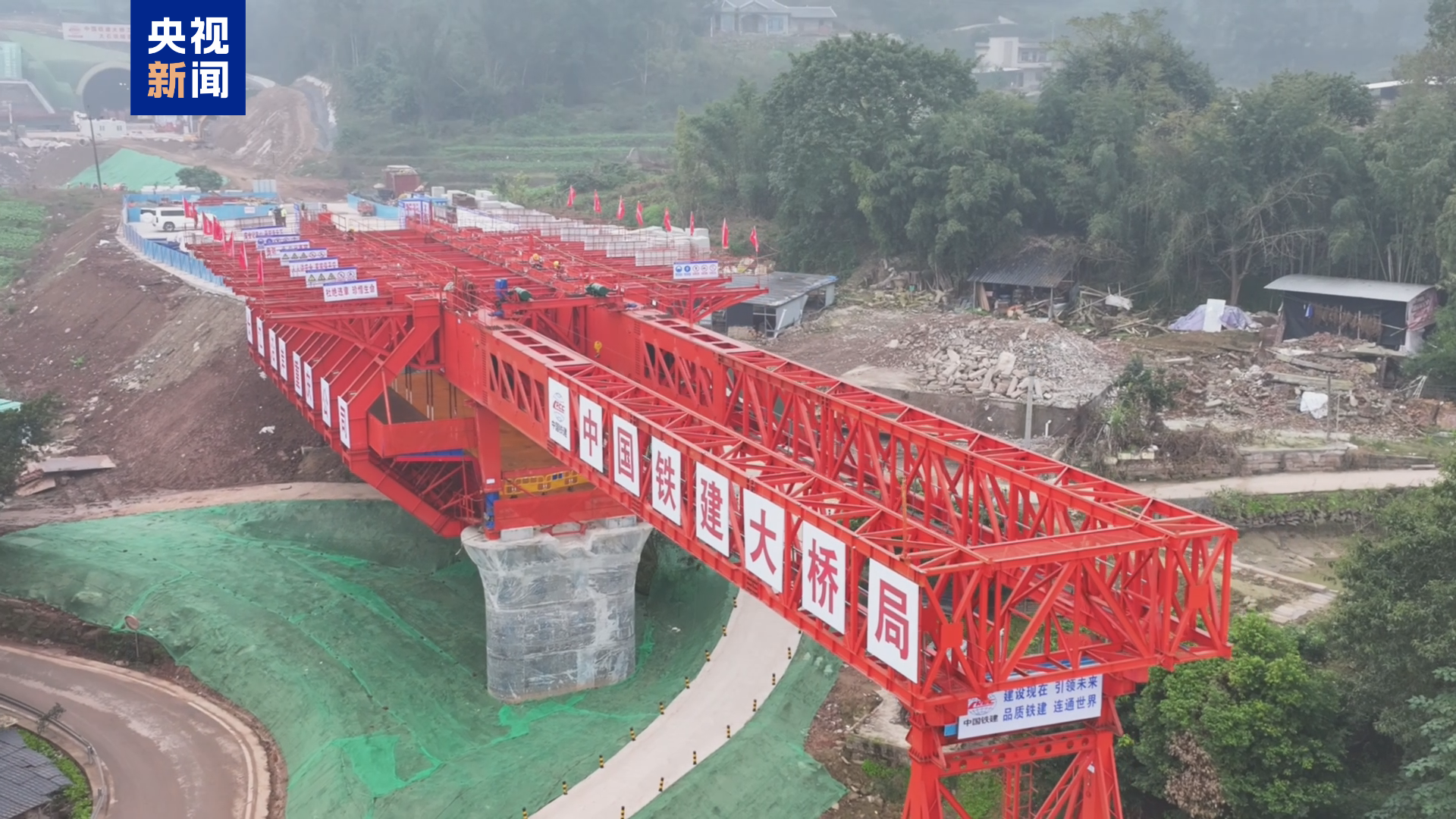
宜涪高铁首个桥梁上部结构开始施工
Yang Shi Xin Wen Ke Hu Duan· 2025-12-08 10:48
Core Viewpoint - The construction of the Yichang to Fuling high-speed railway in the Chongqing section has made significant progress, with the Li Si Village Bridge entering the casting beam moving formwork construction phase, marking the start of superstructure construction for the project [1] Group 1: Project Details - The Li Si Village Bridge is approximately 404 meters long, featuring 2 bridge abutments, 11 piers, and 80 pile foundations, with a span of 32 meters for each bridge section, utilizing a double-block ballastless track [3] - The moving formwork used in the construction weighs over 500 tons and consists of several systems including main beam, suspension, formwork, support and travel, electrical and hydraulic systems, and auxiliary facilities [3] Group 2: Strategic Importance - The Yichang to Fuling high-speed railway is a crucial part of China's "Eight Vertical and Eight Horizontal" high-speed rail network, starting from the under-construction Yichang North Station and extending approximately 471 kilometers with a design speed of 350 kilometers per hour [5] - Upon completion, the Huzhou-Chongqing-Rong high-speed railway project will create a new high-speed rail corridor connecting the Sichuan-Chongqing region with Central China, significantly enhancing travel convenience for local residents [7]
西渝高铁建设稳步推进
Ren Min Wang· 2025-12-07 13:32
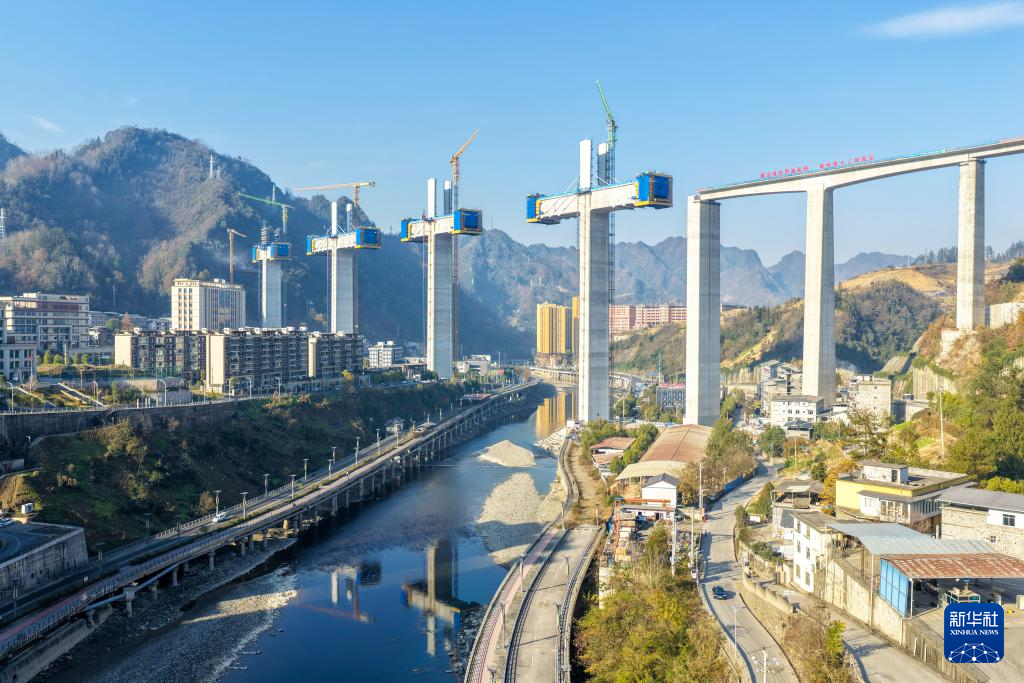
Core Viewpoint - The construction of the Renhe Grand Bridge on the Xiyu High-speed Railway has reached significant milestones, with the completion of the tower column tasks and nearly 70% of the overall bridge construction progress, laying a solid foundation for the timely completion of the entire railway line [2][4][6]. Group 1: Project Details - The Renhe Grand Bridge is located in Chengkou County, Chongqing, and is a critical project in the Kangyu section of the Xiyu High-speed Railway, with a total length of 1,180.52 meters [2][4][6]. - The Xiyu High-speed Railway is an essential part of China's "Eight Vertical and Eight Horizontal" high-speed rail network, connecting Beijing to Kunming and serving as a key link in the Baotou, Yinchuan to Haikou corridor [2][4][6]. - The total length of the Xiyu High-speed Railway is 739 kilometers, designed for a maximum speed of 350 kilometers per hour [2][4][6].
京港高铁雄商段山东境内正线铺轨贯通
Zhong Guo Xin Wen Wang· 2025-11-28 09:21
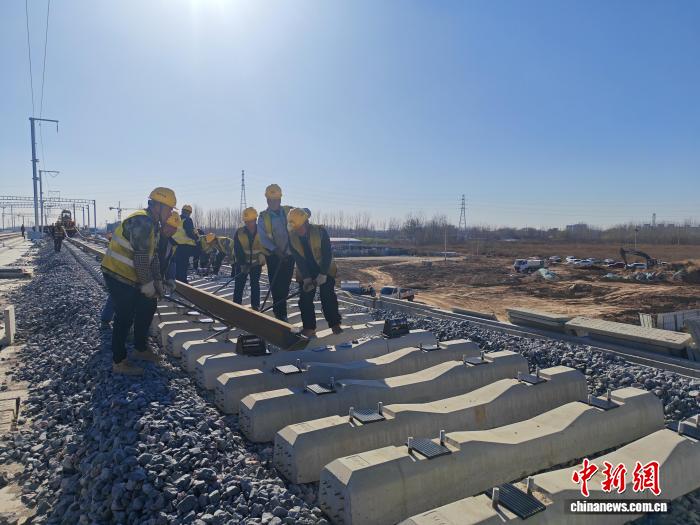
Core Viewpoint - The successful completion of the rail laying for the Xiong'an to Shangqiu section of the Beijing-Hong Kong High-Speed Railway in Shandong marks a significant milestone, transitioning the construction focus from Shandong to Henan, and setting the stage for the entire line's completion by the end of the year [1][3]. Group 1: Project Progress - The rail laying operation has passed through eight stations including Liaocheng, Heze East, and Yuncheng, with a total of 532 kilometers of track laid, accounting for 93% of the total rail laying work [3][4]. - The Yuncheng rail laying base has been operational for 88 consecutive days, employing a "direct laying + side laying" simultaneous advancement model [3]. Group 2: Project Management and Safety - The construction team has implemented a scientific scheduling approach, integrating self-built labor teams and innovating a mechanism of "own workers + cooperative teams + temporary workers" to optimize the construction process [3]. - A special task force has been established to address technical challenges, ensuring precision and quality in rail laying while maintaining a zero-accident safety record throughout the project [3][4]. Group 3: Technological Advancements - The project utilizes intelligent equipment, including smart cranes capable of automatic rail handling, and a real-time monitoring system to enhance operational efficiency and standardization [4]. Group 4: Economic and Social Impact - Upon completion, the Xiong-Shang section will enhance the rail transport network in the Beijing-Tianjin-Hebei, Central Plains, and South China regions, facilitating regional economic development and resource sharing [4].
“千里海河高铁第一隧”顺利贯通
Xin Hua She· 2025-11-27 08:21
Group 1 - The successful completion of the "Tianjin City No. 1" shield tunneling machine marks the breakthrough of the Tianjin-Weifang High-speed Railway's key control project, the Tianjin-Du Haihe Tunnel [1] - The Tianjin-Weifang High-speed Railway has a total length of 348.9 kilometers and a design speed of 350 kilometers per hour, connecting Tianjin Binhai Station to Weifang North Station on the Jiqing High-speed Railway [1] - The Tianjin-Du Haihe Tunnel, at approximately 6.5 kilometers long, is the only tunnel along the Tianjin-Weifang High-speed Railway and the first high-speed railway tunnel over the Haihe River [1] Group 2 - The project is part of China's "Eight Vertical and Eight Horizontal" high-speed rail network, specifically the Beijing-Shanghai corridor and the coastal corridor, enhancing the transportation network in the Bohai Rim region [2] - The completion of the Tianjin-Weifang High-speed Railway will facilitate travel for local residents and support the coordinated development of the Beijing-Tianjin-Hebei region and the Shandong Peninsula urban agglomeration [2]