新能源汽车发展

Search documents
汽车稳增长方案:2025年力争销量3230万辆左右 以旧换新、限购、账期被提及
Zhong Guo Jing Ying Bao· 2025-09-16 15:12
日前,工业和信息化部(以下简称"工信部")等八部门关于印发《汽车行业稳增长工作方案(2025—2026年)》的通知(以下简称《工作方案》)。《工作 方案》提出,2025年,力争实现全年汽车销量3230万辆左右,同比增长约3%。 工信部有关负责人就《工作方案》答记者问时指出:"《工作方案》从扩大国内消费、提升供给质量、优化发展环境、深化开放合作等4个维度,提出了15个 方面工作举措和3个方面保障措施,其中包含的细化措施有60余项。" 《中国经营报》记者关注到,工作举措中特别提到,"切实规范产业竞争秩序。加强成本调查和价格监测,强化产品生产一致性监督检查, 督促重点车企落 实好支付账期承诺。" 2025年,"以旧换新"政策实施以来成效显著。近日,商务部市场运行和消费促进司一级巡视员耿洪洲在"2025中国汽车产业发展(泰达)国际论坛"上表 示:"截至9月10日,今年汽车'以旧换新'申请量已经达到830万份。" 耿洪洲还表示:"商务部将大力提振消费,扩大国内需求。一是抓好汽车以旧换新政策落实,持续优化平台功能,让补贴资金及时、便捷直达消费者。二是 推进汽车流通消费改革试点走深走实,破除束缚汽车消费的限制性措施,推动从 ...

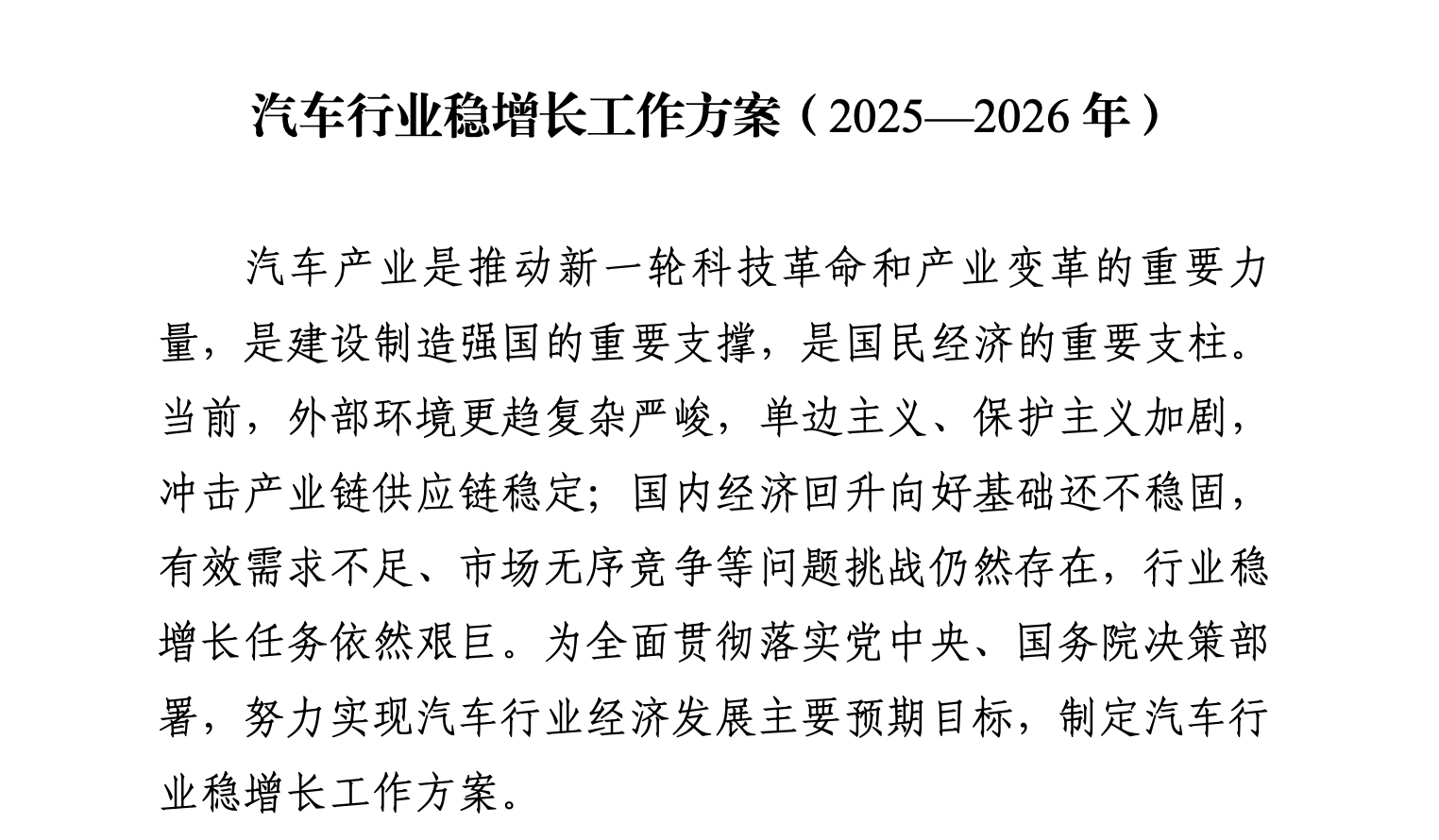
汽车行业迎政策“大礼包”,事关每一位车主!
Zheng Quan Ri Bao Wang· 2025-09-13 04:13
本报讯(记者郭冀川)据公众号"工信微报"9月13日消息,工业和信息化部等八部门近日联合印发《汽车 行业稳增长工作方案(2025—2026年)》(以下简称《工作方案》)。《工作方案》提出,2025年,力争实 现全年汽车销量3230万辆左右,同比增长约3%,其中新能源汽车销量1550万辆左右,同比增长约 20%;汽车出口保持稳定增长;汽车制造业增加值同比增长6%左右。2026年,行业运行保持稳中向好 发展态势,产业规模和质量效益进一步提升。 工业和信息化部装备工业一司介绍,汽车产业是国民经济的支柱产业,产业链长、涉及面广、带动性 强,发挥着工业经济稳增长的"压舱石"作用。在党中央坚强领导下,我国汽车产业连续三年实现稳定增 长,新能源汽车快速增长,转型升级发展取得显著成效。2024年,我国汽车销售完成3143.6万辆、同比 增长4.5%,其中新能源汽车销售完成1286.6万辆、同比增长35.5%,为宏观经济增长贡献了重要力量。 但也要看到,我国汽车产业发展面临的内外部环境日趋严峻复杂,海外竞争加剧,有效需求不足、无序 竞争等问题仍然存在,行业稳增长任务依然艰巨。出台《工作方案》即是为了在良好工作基础上,坚持 问题导 ...
1至8月中国汽车产销首次双超2000万辆
Ren Min Ri Bao· 2025-09-11 20:18
Group 1 - The core viewpoint of the article highlights that from January to August 2023, China's automobile production and sales both exceeded 21 million units for the first time in history, with production at 21.05 million units and sales at 21.128 million units, reflecting year-on-year growth of 12.7% and 12.6% respectively [1] - New energy vehicles (NEVs) accounted for a significant portion of the market, with production and sales reaching 9.625 million units and 9.62 million units respectively, showing year-on-year growth of 37.3% and 36.7%, and NEV sales making up 45.5% of total new car sales [1] - In terms of exports, from January to August, automobile exports reached 4.292 million units, marking a year-on-year increase of 13.7%, while NEV exports surged to 1.532 million units, representing a remarkable growth of 87.3% [1] Group 2 - The deputy secretary-general of the China Automobile Industry Association, Chen Shihua, noted that the overall macroeconomic environment in China remained expansive in August, with automobile production and sales maintaining over 10% year-on-year growth [1] - The "Two New" policies, including personal consumption loans and fiscal interest subsidies, have been effectively implemented, contributing to a high enthusiasm among companies for launching new models, while the industry's comprehensive rectification efforts have shown positive results, leading to a stable overall operation of the automobile market [1]
前8月汽车产销首次双超2000万辆
Zhong Guo Zheng Quan Bao· 2025-09-11 20:17
Group 1 - In the first eight months of this year, China's automobile production and sales reached 21.05 million and 21.128 million units, respectively, marking a year-on-year growth of 12.7% and 12.6%, and the first time both figures exceeded 20 million in history [1] - In August, automobile production and sales maintained over 10% year-on-year growth, with traditional fuel vehicle market stabilizing [1] - From January to August, domestic automobile sales totaled 16.836 million units, a year-on-year increase of 12.3%, while traditional fuel vehicle sales slightly decreased by 0.3% to 8.747 million units [1] Group 2 - In August, new energy vehicle (NEV) production and sales reached 1.391 million and 1.395 million units, respectively, with year-on-year growth of 27.4% and 26.8%, accounting for 48.8% of total new car sales [2] - For the first eight months, NEV production and sales were 9.625 million and 9.62 million units, with year-on-year growth of 37.3% and 36.7%, and NEVs accounted for 45.5% of total new car sales [2] - The proportion of NEVs in domestic automobile sales exceeded 50% in August, with expectations to reach 50% for the entire year [2] Group 3 - Major automotive groups showed strong sales performance, with the top fifteen groups selling a total of 19.49 million units, a year-on-year increase of 12.5%, representing 92.3% of total sales [2] - The top fifteen NEV groups sold 9.146 million units, a year-on-year increase of 39%, accounting for 95.1% of total NEV sales [2] - Many automotive companies are optimistic about market growth in the second half of the year, supported by favorable policies [2] Group 4 - Li Auto aims to enter the pure electric SUV market in 2025, targeting monthly sales of 6,000 units for the Li i8 and 9,000 to 10,000 units for the Li i6, with overall pure electric vehicle sales expected to stabilize between 18,000 and 20,000 units per month [3] - Leap Motor has raised its annual sales target to between 580,000 and 650,000 units, with a third-quarter forecast of 170,000 to 180,000 units [3] - XPeng Motors anticipates monthly deliveries to exceed 40,000 units starting in September [3]


中汽协:汽车产销分别完成281.5万辆和285.7万辆,同比增长13%和16.4%
Ju Chao Zi Xun· 2025-09-11 07:47
Group 1 - In August, the automotive industry in China produced and sold 2.815 million and 2.857 million vehicles respectively, with month-on-month increases of 8.7% and 10.1%, and year-on-year increases of 13% and 16.4% [2] - From January to August, the total production and sales reached 21.051 million and 21.128 million vehicles, reflecting year-on-year growth of 12.7% and 12.6% [2] - In August, new energy vehicle (NEV) production and sales were 1.391 million and 1.395 million units, with year-on-year growth of 27.4% and 26.8%, accounting for 48.8% of total new vehicle sales [2] Group 2 - In the passenger vehicle sector, production and sales in August reached 2.5 million and 2.54 million units, with month-on-month increases of 9% and 11.1%, and year-on-year increases of 12.5% and 16.5% [2] - From January to August, passenger vehicle production and sales totaled 18.338 million and 18.384 million units, with year-on-year growth of 13.6% and 13.8% [2] - In the commercial vehicle sector, production and sales in August were 315,000 and 316,000 units, with month-on-month increases of 5.9% and 3.4%, and year-on-year increases of 16.4% and 16.3% [3] Group 3 - The overall macroeconomic environment in China continues to show expansion, with automotive production and sales maintaining over 10% year-on-year growth in August [3] - The NEV market and vehicle exports are performing well, while the traditional fuel vehicle market is stabilizing [3] - Policies such as personal consumption loans and fiscal subsidies are being implemented, and there is a high enthusiasm for new model launches among companies [3]
今年1至8月我国汽车产销量首次双超2000万辆
第一财经· 2025-09-11 06:34
Core Viewpoint - In the first eight months of this year, China's automobile production and sales both exceeded 20 million units for the first time, indicating a strong recovery and growth in the automotive industry [1][2][3]. Production and Sales Data - From January to August, China's automobile production reached 21.05 million units, while sales totaled 21.12 million units, representing year-on-year increases of 12.7% and 12.6% respectively [3]. - New energy vehicles (NEVs) accounted for significant growth, with production and sales reaching 9.625 million and 9.62 million units, showing year-on-year growth of 37.3% and 36.7% respectively [3]. - NEVs made up 45.5% of total new car sales during this period [3]. Export Performance - In terms of exports, 4.292 million vehicles were exported from January to August, marking a year-on-year increase of 13.7% [3]. - Among these, 1.532 million were new energy vehicles, which saw a remarkable year-on-year growth of 87.3% [3]. Industry Insights - The China Automobile Industry Association noted that the "two new" policies are continuously driving growth, with timely financial support for personal consumption loans and high enthusiasm for new model launches from companies [3]. - The overall operation of the automotive industry remains stable, aided by ongoing efforts to address internal competition and improve industry standards [3].
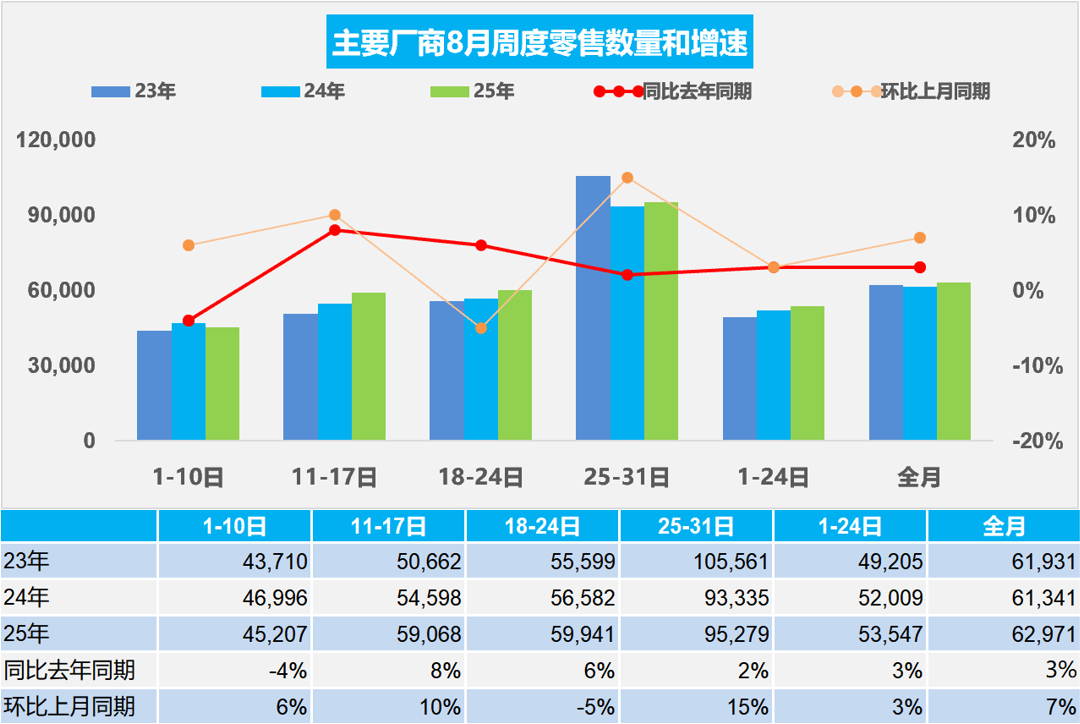
乘联会:8月乘用车零售195.2万辆 新能源渗透率55.3%
Zhong Guo Zhi Liang Xin Wen Wang· 2025-09-05 03:25
Group 1 - In August 2025, the wholesale volume of passenger cars in China reached 2.409 million units, representing a 12% increase year-on-year and an 8% increase month-on-month. Cumulatively, 17.934 million units have been wholesaled this year, also up by 12% compared to the same period last year [1] - Retail sales in August amounted to 1.952 million units, showing a 3% year-on-year increase and a 7% month-on-month increase. Year-to-date retail sales reached 14.698 million units, up 9% year-on-year [1] Group 2 - In August, the wholesale volume of new energy vehicles (NEVs) was 1.292 million units, a 23% increase year-on-year and a 9% increase month-on-month. The cumulative wholesale volume for NEVs this year stands at 8.926 million units, reflecting a 33% year-on-year growth [3] - Retail sales of NEVs in August reached 1.079 million units, marking a 5% year-on-year increase and a 9% month-on-month increase. Year-to-date retail sales for NEVs totaled 7.535 million units, up 25% year-on-year [3] - The retail penetration rate for NEVs in August was 55.3%, while the wholesale penetration rate was 53.6% [3] Group 3 - The pressure for stable economic growth in various regions has significantly decreased in the first half of the year, with promotional policies in the automotive market being steadily implemented. The issuance of subsidies has become more rhythmic and controlled, leading to a relatively stable retail market trend [5] - The global automotive market is further differentiating, with Chinese domestic brands significantly increasing their market share. Companies like BYD, Geely, Chery, and Changan are performing strongly, with BYD ranking 6th globally, Geely 9th, and Chery 11th [5]



8月多家车企销量创新高 新能源汽车和海外市场表现成亮点
Zhong Guo Zhi Liang Xin Wen Wang· 2025-09-04 05:00
Group 1: Overall Market Performance - The automotive market in August showed strong performance, with many traditional and new energy vehicle companies achieving record sales [1][2] - The growth in sales was significantly supported by the performance of new energy vehicles and overseas markets [1] Group 2: Major Traditional Automakers - BYD's August sales reached 373,600 units, nearly flat compared to the same month last year, with cumulative sales of 2.864 million units from January to August, a 23% year-on-year increase [1] - SAIC Motor's total vehicle sales in August were 363,400 units, up 41.04% year-on-year, with new energy vehicle sales of 129,800 units, a 49.89% increase [1] - Geely's August sales were 250,200 units, a 38% increase, with new energy vehicle sales reaching 147,300 units, up 95% and accounting for 59% of total sales [1] Group 3: Emerging Automakers - Chery Group's August sales were 242,700 units, a 14.6% increase, with new energy vehicle sales of 71,200 units, up 53.1% [2] - Changan Automobile's August sales reached 233,000 units, with new energy vehicle sales of 88,000 units, an 80% increase [2] - Great Wall Motors achieved its best August sales with 115,600 units, a 22.33% increase, and new energy vehicle sales of 37,500 units, up 50.92% [2] Group 4: New Energy Vehicle Segment - New energy vehicle sales are a key driver for many automakers, with significant growth observed across various companies [1][2] - New entrants like Leap Motor achieved record deliveries of 57,100 units in August, an 88% year-on-year increase, while XPeng Motors delivered 37,700 units, a 169% increase [3] - NIO delivered 31,300 units in August, a 55.2% increase, marking a historical high for the company [3]



港股异动 | 蔚来-SW(09866)绩后涨超4% 三季度交付及营收指引均创新高
智通财经网· 2025-09-03 01:46
Core Viewpoint - NIO Inc. reported strong second-quarter earnings, leading to a stock price increase of over 4% following the announcement [1] Financial Performance - Revenue for the second quarter reached 19.01 billion RMB, representing a year-on-year growth of 9% and a quarter-on-quarter growth of 57.9% [1] - The net loss narrowed to 4.9948 billion RMB [1] Delivery Performance - The company delivered 72,056 vehicles in the second quarter, marking a year-on-year increase of 25.6% and a quarter-on-quarter increase of 71.2% [1] - For the third quarter, NIO provided delivery guidance of 87,000 to 91,000 vehicles, which translates to a year-on-year growth of 40.7% to 47.1% [1] Future Projections - The revenue guidance for the third quarter is set between 21.81 billion RMB and 22.88 billion RMB, both figures representing historical highs [1] Recent Achievements - In August, NIO delivered 31,300 new vehicles, a year-on-year increase of 55.2%, achieving a historical high [1] - The breakdown of August deliveries includes 10,500 vehicles from the NIO brand, 16,400 from the Ladao brand, and 4,346 from the Firefly brand [1] - The Ladao L90 model achieved a record delivery of 10,600 units in its first month, making it the fastest model in NIO's history to surpass 10,000 deliveries [1]

比亚迪、吉利年中销量首超本田、日产
Di Yi Cai Jing· 2025-08-27 21:12
Core Insights - The competitive landscape of global automotive companies is shifting as Chinese electric vehicle manufacturers, BYD and Geely, have surpassed Honda and Nissan in sales during the first half of 2025 [2][7]. Group 1: Sales Performance - In the first half of 2025, BYD and Geely achieved sales of 2.14 million and 1.93 million vehicles respectively, marking a year-on-year growth of 33% and 29% [7]. - BYD's ranking improved from 8th to 7th globally, while Geely moved from 10th to 9th, both surpassing Honda and Nissan [7]. - The overall automotive market in China saw production and sales exceeding 15 million units, with new energy vehicle sales growing over 40% year-on-year [7]. Group 2: Market Dynamics - The decline of Japanese automakers is evident, with Honda's sales dropping by 5% to 1.78 million units, resulting in a fall from 3rd to 9th place globally [7]. - The impact of a 15% tariff on Japanese cars in the U.S. has negatively affected the sales and performance of major Japanese manufacturers [7]. - Chinese electric vehicle brands are increasingly penetrating markets in Southeast Asia, where Japanese brands previously held over 70% market share [7].