
载人航天

Search documents
中国新一代载人飞船“梦舟”将于2026年首飞
Zhong Guo Xin Wen Wang· 2025-11-01 04:23
Core Points - China is set to launch its new generation crewed spacecraft "Dream Boat" in 2026, with the first flight taking place at the Wenchang Space Launch Site using the Long March 10A rocket [1] - The 2026 mission will include four flight tasks: Tianzhou-10, Shenzhou-22, Shenzhou-23, and Dream Boat-1, focusing on various space operations [1] - The Dream Boat spacecraft is an upgraded version of the Shenzhou spacecraft, featuring a modular design consisting of a return capsule and a service module for transportation to and from the space station [1] Mission Details - The Tianzhou-10 cargo spacecraft will be responsible for transporting supplies for astronauts, including extravehicular suits, maintenance parts, propellants, and various payloads for application tasks, while also managing the disposal of waste in orbit [2] - The Shenzhou-22 and Shenzhou-23 missions will involve extravehicular activities by astronauts, cargo airlock operations, and continued space science experiments and technology tests [1] - Notably, one astronaut from the Shenzhou-22 crew will participate in a long-term stay experiment lasting over one year [1]
神舟二十一号载人飞船发射成功 这些“四川智造”立功了
Si Chuan Ri Bao· 2025-11-01 01:24
Core Points - The Shenzhou-21 manned spacecraft was successfully launched by the Long March 2F Yao-21 rocket from the Jiuquan Satellite Launch Center on October 31, 2023, with the crew in good condition after separation from the rocket [2] - The mission will involve autonomous docking with the space station and various scientific experiments in fields such as life sciences, microgravity physics, and new space technologies [2] - The mission marks the completion of China's manned space launch tasks for 2025 [2] Group 1 - The Sichuan-based China Electronics Technology Group Corporation's 10th Research Institute developed a ground-space measurement and control communication system, ensuring tight communication between the spacecraft and ground [3] - A pulse phase response device, also developed by the Sichuan team, was installed on the rocket to monitor its flight and ensure normal operation until the separation of the spacecraft [4] - Sichuan Aerospace Chuan Nan Fire Technology Co., Ltd. was responsible for the development of over 30 types of pyrotechnic products for the rocket and spacecraft, while Sichuan Aerospace Liaoyuan Technology Co., Ltd. produced cable networks for the rocket's engines [4]

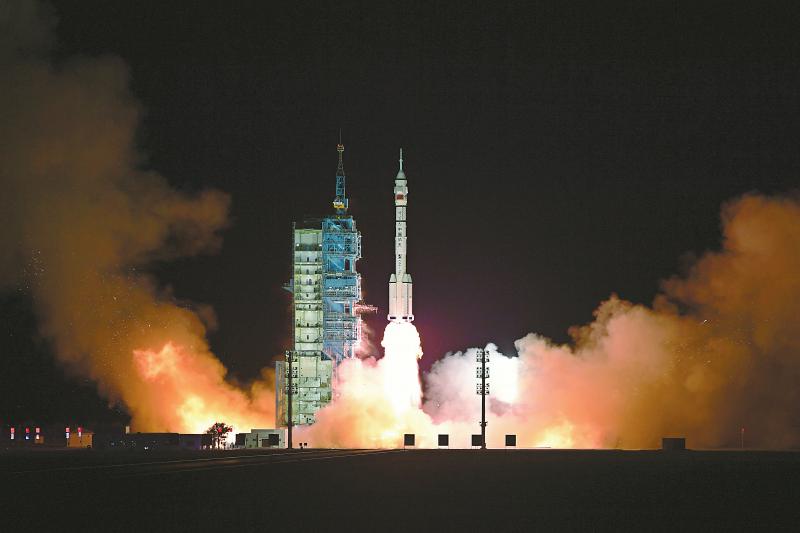
中原力量护航神舟二十一号“太空接力”
He Nan Ri Bao· 2025-10-31 23:59
Group 1 - The Shenzhou 21 manned spacecraft was successfully launched by the Long March 2F rocket, marking the sixth manned flight mission in the space station application and development phase, with three astronauts participating in a six-month stay in orbit and conducting 27 scientific and application projects [1] - The mission involved significant contributions from various aerospace companies in Henan, providing high-tech equipment and products to ensure mission success [1] Group 2 - China Aerospace Science and Industry Corporation (CASC) provided critical components for the thermal control system of the Shenzhou 21 spacecraft, including self-locking valves and temperature control valves, ensuring a comfortable living environment for astronauts [2] - The testing team emphasized a "zero defect" quality assurance approach, ensuring that every data point is traceable and every verification is thorough [2] Group 3 - Zhengzhou Aerospace Electronics Technology Co., Ltd. supplied over 40 types of connectors, switches, and cable networks for the Shenzhou 21 mission, covering the entire process from launch calibration to in-orbit operations [3] - The company developed vertical adjustment equipment to monitor rocket posture in real-time, ensuring optimal launch conditions, and provided external docking connectors that facilitate communication and power supply for astronauts during extravehicular activities [3] Group 4 - The docking process, known as "space needle threading," is one of the most complex and risky phases of manned space missions, with laser radar developed by China Electronics Technology Group Corporation (CETC) serving as the "space eye" to ensure precise docking between the Shenzhou 21 and the space station [4] - CETC's continuous wave high-precision measurement system plays a crucial role in monitoring rocket flight status and providing decision support to ground control [4] - The search and recovery technology team at CETC has established a multi-domain collaborative search and rescue positioning system, enhancing the overall reliability of manned space missions [4]
太空会师!
券商中国· 2025-10-31 23:31
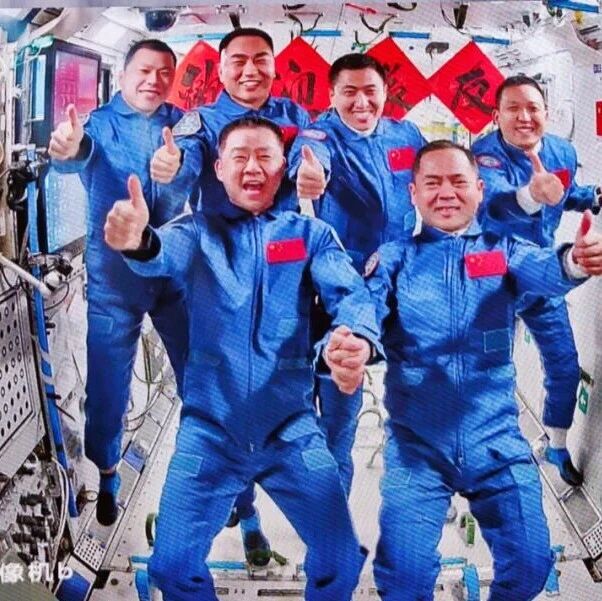
Group 1 - The article highlights the successful docking of the Shenzhou 21 crew with the Chinese space station, marking the 7th "space reunion" in China's space history [1] - The Shenzhou 21 crew joined the Shenzhou 20 crew in the space station, where they will work together for approximately 5 days [1] - The two crews took a group photo to reassure the public of their safety and well-being [1]
神舟二十一号载人飞船发射取得圆满成功,我国2025年载人航天发射任务圆满收官
Yang Shi Xin Wen· 2025-10-31 20:28
Core Points - The Shenzhou 21 manned spacecraft was successfully launched on October 31, 2025, at 23:44 Beijing time, marking a significant achievement in China's manned space program [1] - This mission is the sixth manned flight in the space station application and development phase and the 37th launch since the project's inception [1] - The Shenzhou 21 crew will conduct various experiments in fields such as space life and human research, microgravity physics, and new space technologies during their stay at the space station [1] Summary by Sections Launch Details - The Long March 2F Yao 21 rocket successfully launched the Shenzhou 21 spacecraft from the Jiuquan Satellite Launch Center, with the spacecraft entering its designated orbit approximately 10 minutes post-launch [1] - The mission is part of the Long March series, marking the 604th flight of the series and the 21st flight of the Shenzhou manned spacecraft [1] Mission Objectives - The Shenzhou 21 crew will perform multiple extravehicular activities, install space debris protection devices, and conduct equipment installation, debugging, and maintenance tasks [1] - The spacecraft will autonomously dock with the space station complex, facilitating crew rotation with the Shenzhou 20 crew [1] Current Status - The space station complex is in a good working condition and is ready for docking with the Shenzhou 21 spacecraft [2]
神舟二十一号|神舟二十一号载人飞船与空间站组合体完成自主快速交会对接
Xin Hua She· 2025-10-31 19:33
Core Viewpoint - The Shenzhou 21 manned spacecraft successfully completed a rapid autonomous docking with the space station, setting a new record for the fastest docking time in the history of Shenzhou missions [1] Group 1: Mission Details - The Shenzhou 21 spacecraft was launched on October 31 at 23:44, using the Long March 2F Yao 21 rocket from the Jiuquan Satellite Launch Center [1] - The spacecraft entered orbit and successfully docked with the Tianhe core module of the space station at 3:22 on November 1, completing the docking process in approximately 3.5 hours [1] - This docking time is significantly faster than previous missions, which took about 6.5 hours for the Shenzhou 12 to Shenzhou 20 missions [1] Group 2: Crew Operations - Following the docking, three astronauts aboard Shenzhou 21 will enter the Tianhe core module of the space station [1] - The crew from Shenzhou 20 is prepared to welcome the Shenzhou 21 crew into the space station [1]
神舟二十一号载人飞船发射取得圆满成功 我国2025年载人航天发射任务圆满收官
Yang Shi Xin Wen· 2025-10-31 16:10
Core Points - The Shenzhou-21 manned spacecraft successfully launched on October 31, 2025, at 23:44 Beijing time, marking a significant achievement in China's manned space program [1] - This mission is the sixth manned flight in the space station application and development phase and the 37th launch since the project's inception [1] - The Shenzhou-21 crew will conduct various experiments in fields such as space life and human research, microgravity physics, and new space technologies during their stay at the space station [1] Summary by Categories Launch Details - The Long March 2F Yao-21 rocket successfully launched the Shenzhou-21 spacecraft from the Jiuquan Satellite Launch Center [1] - Approximately 10 minutes post-launch, the spacecraft separated from the rocket and entered its designated orbit [1] Mission Objectives - The Shenzhou-21 crew will perform autonomous rapid rendezvous and docking with the space station and will rotate with the Shenzhou-20 crew [1] - Planned activities include multiple extravehicular activities, installation of space debris protection devices, and maintenance of onboard equipment [1] Program Achievements - As of this mission, China has sent 28 astronauts and 44 crewed missions into space [1] - The Shenzhou-21 mission represents the 604th flight of the Long March series of rockets and the 21st flight of the Shenzhou manned spacecraft [1] - The space station assembly is in a good working condition, ready for docking with the Shenzhou-21 spacecraft [1]
中国人2030年前实现登陆月球的目标不动摇 | 新闻早班车来了
Sou Hu Cai Jing· 2025-10-31 02:52
Economic Developments - China's cultural enterprises above designated size reported a revenue growth of 7.9% year-on-year in the first three quarters [1] - The country's green ship orders account for nearly 70% of the global total [1] - China's foreign trade with APEC economies saw a year-on-year increase of 2% in the first three quarters [1] Real Estate Market - In Beijing, there is a noticeable divergence in the residential market, with new homes seeing 2,746 transactions in October, while second-hand homes reached 8,505 transactions, over three times that of new homes [2] - The real estate market in Chongqing is experiencing a strong recovery, driven by high-quality projects in core areas, indicating sustained demand for premium locations and quality developments [2] Consumer Trends - The silver-haired demographic (aged 60 and above) is increasingly prioritizing quality in travel, with their average accommodation spending being over 30% higher than younger groups, and they are key consumers of high-end travel products [2]
神舟二十一号航天员乘组10月31日出征太空
Ren Min Ri Bao· 2025-10-30 22:37
Core Points - The Shenzhou 21 manned mission is scheduled for launch on October 31, 2023, at 23:44 Beijing time, with a crew consisting of Zhang Lu, Wu Fei, and Zhang Hongzhang [6] - This mission marks the sixth manned flight during the application and development phase of the space station and the 37th flight of the manned space program [7] - The crew will conduct 27 scientific and application projects, including experiments on space life sciences and microgravity fluid physics [8][9] Group 1: Mission Overview - The primary objective of the Shenzhou 21 mission is to complete an in-orbit crew rotation with the Shenzhou 20 crew and to stay in the space station for approximately six months [7] - The mission will involve various tasks such as extravehicular activities, cargo handling, and installation of space debris protection devices [7] - The Shenzhou 21 spacecraft will autonomously dock with the Tianhe core module approximately 3.5 hours after entering orbit [7] Group 2: Scientific Research - The mission will include the first domestic space experiment with rodents, studying the effects of microgravity on behavior and physiological responses [8] - Additional projects will explore the origins of genetic codes and chirality in space environments [8] - The mission aims to provide a foundation for future scientific research and applications in space [9] Group 3: International Cooperation - China plans to arrange for a Pakistani astronaut to participate in a short-term flight mission as part of ongoing international cooperation in manned spaceflight [10] - The selection process for the Pakistani astronaut is underway, with training scheduled to take place in China [10] Group 4: Astronaut Profiles - Zhang Lu, the commander of the Shenzhou 21 mission, emphasizes the importance of thorough training and preparation for the mission [15] - Wu Fei, the youngest astronaut in the mission, has transitioned from an engineering role to a flight engineer, focusing on a broader range of knowledge [20][22] - Zhang Hongzhang, a payload specialist, brings his research background to the mission, highlighting the significance of conducting experiments in space [24][26] Group 5: Future Goals - China remains committed to achieving manned lunar landings by 2030, with ongoing development of key technologies and systems [12] - The country is increasingly involving commercial entities in space projects, enhancing the pace of development [13][14]

在轨期间将新开展27项科学与应用项目 神舟二十一号航天员乘组10月31日出征太空
Ren Min Ri Bao· 2025-10-30 22:36
Core Points - The Shenzhou 21 manned mission is scheduled for launch on October 31, 2023, at 23:44 Beijing time, with a crew consisting of Zhang Lu, Wu Fei, and Zhang Hongzhang, representing three types of active astronauts in China [1] - The mission aims to conduct in-orbit rotation with the Shenzhou 20 crew, stay in the space station for approximately six months, and perform various scientific and application experiments [2][3] - The crew will carry out 27 new scientific and application projects, including experiments on space life sciences and microgravity fluid physics [3] - A Pakistani astronaut is planned to be selected for a short-term flight mission to the Chinese space station, promoting international cooperation in space exploration [4] - Two astronauts from Hong Kong and Macau have integrated into the astronaut team and are undergoing training for future missions [5] - The mission will utilize improved extravehicular spacesuits that have been tested for durability and comfort [6] - China is committed to achieving manned lunar landing by 2030, with ongoing development of various spacecraft and technologies [7] - The commercial space sector is increasingly involved in the development of space station and lunar exploration projects, enhancing efficiency and innovation [8] Mission Details - The Shenzhou 21 mission will involve autonomous rapid rendezvous and docking with the Tianhe core module, forming a combination of three spacecraft and three modules [2] - The crew will engage in space science education and public welfare activities during their stay [2] - The mission will include the installation of space debris protection devices and other external equipment [2] Scientific Research - The mission will focus on key scientific issues in various fields, including space medicine and new technologies [3] - Notable experiments include the first in-orbit study of rodents to understand the effects of microgravity on behavior [3] - Research will also explore the origins of genetic codes and the relationship between chirality and amino acids in space [3] International Collaboration - The selection process for a Pakistani astronaut is underway, with training and preparation being conducted in both Pakistan and China [4] - The initiative aims to foster international cooperation in space exploration and technology development [4] Astronaut Profiles - Zhang Lu, the commander, emphasizes the importance of thorough training and preparation for the mission [9][12] - Wu Fei, the youngest astronaut, focuses on broadening his knowledge across multiple disciplines to ensure effective problem-solving in space [14][15] - Zhang Hongzhang, a payload specialist, expresses the responsibility and honor of conducting experiments in space, highlighting the collaborative effort of ground researchers [18][21]