反垄断

Search documents
谷歌提出新建议 以避免欧盟反垄断罚款
news flash· 2025-07-02 13:27
Core Points - Google has proposed new adjustments to its search results to mitigate increasing criticism from competitors and avoid potential antitrust fines from the EU [1] - An important EU meeting is scheduled for July 7-8, where Google will discuss its proposal with competitors and the European Commission [1] - The antitrust allegations against Google stem from claims that it unfairly favors its own services, such as Google Shopping, Google Hotels, and Google Flights, over those of competitors [1]
苹果限制开发者、推高消费者价格?美法官拒绝撤销反垄断案
Feng Huang Wang· 2025-06-30 23:26
2024年3月,美国司法部联合多个州以及华盛顿特区对苹果提起反垄断诉讼,重点关注苹果对应用开发 者施加的限制与收费,以及对第三方设备和服务(如智能手表、数字钱包和消息服务)设置的技术障碍。 这些产品本可与苹果自家的产品展开竞争。美国司法部指出,这些做法破坏了市场竞争,苹果应被禁止 继续实施相关行为。 美国司法部当时表示,苹果一部iPhone的售价高达1599美元,利润在整个行业中遥遥领先。司法部官员 指出,苹果还暗中向各类商业伙伴收取费用,从软件开发者到信用卡公司,甚至包括像谷歌这样的竞争 对手。这些做法最终推高了消费者的价格,并进一步提升了苹果的利润。 凤凰网科技讯 北京时间7月1日,据路透社报道,美国联邦法官周一驳回了苹果公司的请求,裁定苹果 必须面对美国司法部提起的反垄断诉讼。该诉讼指控苹果非法主导美国智能手机市场。 美国新泽西州纽瓦克地区法官朱利安·尼尔斯(Julien Neals)驳回了苹果提出的撤诉动议。该诉讼指控苹果 通过对第三方应用程序和设备开发者设置限制,阻止用户转向竞争对手,从而非法主导市场。 这一裁决意味着案件将继续推进,苹果可能将面临一场旷日持久的法律战,力阻监管机构试图降低其他 公司 ...

法院裁决显示,苹果(AAPL.O)必须面对美国指控其垄断智能手机市场的反垄断诉讼。
news flash· 2025-06-30 18:45
法院裁决显示,苹果(AAPL.O)必须面对美国指控其垄断智能手机市场的反垄断诉讼。 ...
苹果修改欧盟应用商店政策,试图规避反垄断罚款升级
Huan Qiu Wang· 2025-06-28 02:41
Core Points - Apple announced changes to its App Store policies in the EU to avoid stricter penalties under the Digital Markets Act (DMA) [1][3] - The EU previously fined Apple €500 million for obstructing developers from directing users to alternative payment channels and set a deadline for compliance [3] - Apple plans to implement a unified fee structure by January 1, 2026, transitioning to a "digital goods transaction commission" model for all in-app digital transactions [3] - Following the iOS 18.6 update, EU users will be able to download third-party app stores or independent apps directly from developers' websites [3] - The DMA, effective March 2024, aims to curb monopolistic practices by large tech platforms and ensure consumer choice [3] - Apple claims the policy changes are not voluntary but a response to EU regulatory pressure and plans to appeal the fine, citing concerns over user privacy and security [4] - The EU is reviewing Apple's new terms to determine compliance and will seek input from market operators and relevant third parties before deciding on further actions [4]


据华尔街日报:苹果(AAPL.O)为遵守反垄断命令,改变了在欧洲联盟的应用商店规则。
news flash· 2025-06-26 19:04
Core Insights - Apple has modified its App Store rules in the European Union to comply with antitrust orders [1] Group 1 - The changes in the App Store rules are a direct response to regulatory pressures from the European Union [1]
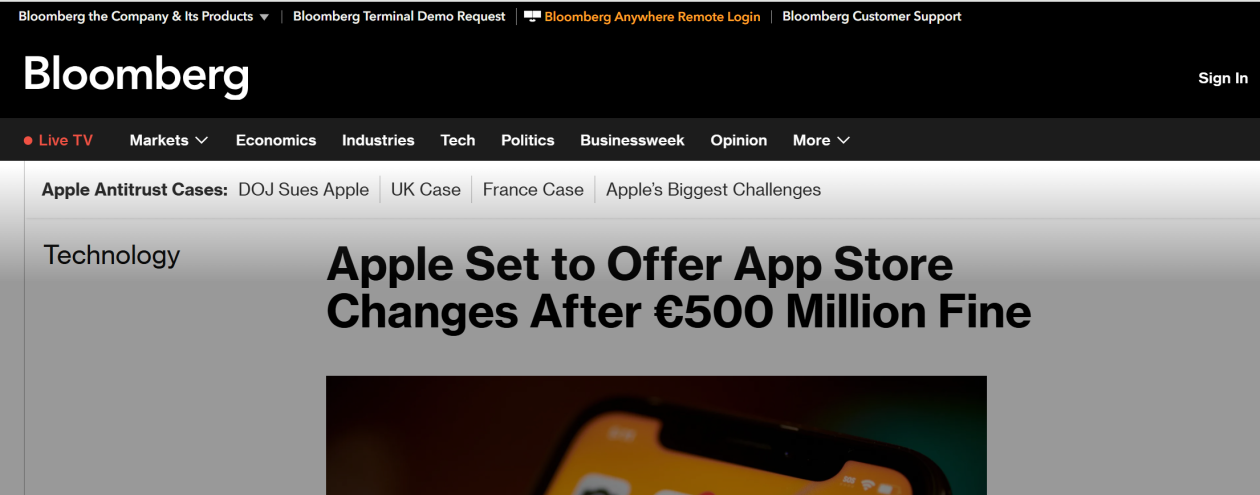
苹果拟调整App Store规则向欧盟示好 避免因反垄断再遭处罚
Huan Qiu Wang· 2025-06-26 06:38
Core Viewpoint - Apple is planning to adjust its App Store rules in response to a €500 million fine imposed by EU regulators, aiming to demonstrate goodwill and prevent future penalties [1][3] Group 1: Regulatory Actions - Apple is set to submit a new proposal to the EU by June 26, which will ease restrictions for third-party developers, allowing them to direct users outside of Apple's ecosystem for software purchases [1] - The proposal comes after weeks of intense negotiations between Apple and EU regulators, and it aims to help Apple avoid additional penalties for non-compliance with the Digital Markets Act [1][3] - In April, both Apple and Meta were found in violation of the Digital Markets Act, with Apple receiving a €500 million fine and Meta facing a €200 million fine for its "pay or agree" ad-free service on Instagram and Facebook [3] Group 2: Apple's Response and Legal Actions - Apple has expressed strong opposition to the EU's fine, claiming discrimination and an attempt to force the company to open its core technologies for free [3] - The company plans to appeal the €500 million fine in the Luxembourg court [1] - In the past, Apple has faced significant fines from the EU, including an €1.8 billion penalty for anti-competitive practices against music streaming competitors [3] Group 3: EU's Broader Regulatory Landscape - The EU has been actively enforcing antitrust regulations against major tech companies, with notable fines including over $8 billion against Alphabet and a demand for Apple to repay €13 billion in taxes to Ireland [3] - The EU has also compelled Amazon to modify its e-commerce platform rules and is investigating Microsoft's Teams software for potential antitrust violations [3]
苹果就App Store外部支付禁令再提上诉 称“零佣金”规定“过度惩罚”
Huan Qiu Wang· 2025-06-25 02:19
Core Points - Apple has filed an emergency motion to the U.S. Ninth Circuit Court of Appeals to overturn a federal judge's order prohibiting external payment commissions, claiming the order is excessively punitive and unfair, potentially causing irreversible damage to its business model [1][3] - The appeal stems from a five-year antitrust lawsuit with Epic Games, where the judge ruled that Apple violated a 2021 court order by not fully opening its App Store to external payment options and maintaining a monopoly through technical means [3][4] - The judge's ruling emphasized that Apple must immediately stop charging commissions on external payments and cease discouraging users from using third-party payment options, with potential criminal contempt investigations against Apple executives [3][4] Company Implications - Apple argues that the judge's order overlooks the complexities of the app ecosystem and that a zero-commission requirement could lead to developer abuse of external payment channels, threatening user privacy and security [3][4] - The company has made significant concessions, such as allowing developers to guide users to complete in-app purchases via the web, but insists on a 27% commission to cover operational costs [3][4] - If the injunction is lifted, it could prevent a wave of collective lawsuits from developers claiming losses in the billions due to Apple's non-compliance with the order [4] Regulatory Environment - The appeal occurs amid a global regulatory crackdown, with the EU imposing a €500 million fine on Apple under the Digital Markets Act and requiring changes to its rules by June 26, or face additional daily fines of 5% of global revenue [4] - The U.S. Department of Justice is also investigating Apple for potential market abuse, with the judge having referred Apple and an executive for possible criminal contempt investigations [4] - A failure in the appeal could disrupt Apple's App Store business model, allowing developers to save on commissions and potentially leading to lower prices for users, although Apple warns this could result in a proliferation of low-quality apps and weaken its control over app quality and safety [4]

谷歌(GOOG.O):(回应英国反垄断机构关于搜索的提议)担心竞争与市场管理局(CMA)的考虑仍然“范围广泛且缺乏重点”。
news flash· 2025-06-24 05:16
Group 1 - Google expresses concerns that the Competition and Markets Authority's (CMA) considerations regarding search are still "broad and lacking focus" [1]
携程被曝强制调价,商家控诉平台霸权
Sou Hu Cai Jing· 2025-06-20 14:21
Core Viewpoint - Ctrip, a leading player in the domestic online travel agency (OTA) market, is accused of abusing its market dominance by forcing hotels to use its "Price Adjustment Assistant" feature, which allows the platform to modify room prices without the merchants' consent, thereby harming their profits [1][2][4] Group 1: Forced Price Adjustment - The "Price Adjustment Assistant" was initially an automated tool for hotels to adjust prices based on market demand, but it has been reported that Ctrip has made it mandatory or defaulted for many hotels, allowing price changes without their knowledge [2][3] - Hotel operators have expressed concerns that prices set below cost due to Ctrip's adjustments could disrupt market equilibrium and affect sales through other channels [2][3] - Industry experts suggest that Ctrip's actions may constitute an abuse of market power, violating the E-commerce Law and Anti-Monopoly Law of the People's Republic of China [2][3] Group 2: Difficulties in Exiting the Platform - Merchants have reported that exiting Ctrip's platform is fraught with challenges, including complex procedures and high penalties for breach of contract [3][4] - Contracts often include strict "exclusive cooperation" or "lowest price guarantee" clauses, which penalize merchants for offering lower prices on other platforms [3] - Ctrip's significant market share, exceeding 50% in the OTA market and reaching up to 70% in popular tourist cities, compels merchants to accept unfavorable terms [3][4] Group 3: Regulatory and Market Implications - The situation highlights a broader issue of internet platforms leveraging their market positions to pressure merchants, undermining fair competition [4] - Legal experts recommend that merchants facing forced pricing or exit difficulties should file complaints with regulatory authorities or consider litigation under the Anti-Monopoly Law [3][4] - There is a call for increased regulatory oversight to prevent the abuse of market dominance in the OTA sector, ensuring a fair and sustainable online travel ecosystem [4]

携程被指“调价助手”后台强改商家价格
新华网财经· 2025-06-20 09:47
Core Viewpoint - The article discusses the controversy surrounding Ctrip's "Price Adjustment Assistant" feature, which allows the platform to unilaterally change hotel room prices without merchant consent, leading to significant concerns among hotel operators about their pricing autonomy and market position [1][3][11]. Group 1: Price Adjustment Assistant Functionality - Ctrip's "Price Adjustment Assistant" is an automated pricing tool that monitors competitors' hotel prices and adjusts Ctrip's prices accordingly, often without merchant approval [1][3]. - Merchants report that Ctrip can change promotional activities and pricing without their consent, leading to a situation where they feel powerless to resist these changes [3][4]. - The tool is perceived as a form of "forced pricing," as it automatically lowers hotel prices to maintain a competitive edge, which can severely impact the profit margins of hotel operators [3][4][11]. Group 2: Market Position and Merchant Dilemma - Ctrip holds a dominant market share in the OTA sector, exceeding 50% in 2021 and projected to maintain over 56% in 2024, which contributes to the power imbalance between the platform and hotel operators [6][11]. - Many merchants feel trapped in a "cannot exit" situation due to their reliance on Ctrip for customer traffic, despite the adverse effects of the pricing adjustments [6][7]. - The withdrawal process from Ctrip's platform is described as cumbersome, with merchants facing repeated reactivations of the Price Adjustment Assistant even after attempting to opt-out [8][11]. Group 3: Industry Competition and Regulatory Concerns - The article highlights the increasing "involution" within the hotel industry, where major platforms like Ctrip, Meituan, and JD.com are aggressively competing, often at the expense of smaller merchants [10][11]. - Experts suggest that Ctrip's practices may constitute an abuse of market dominance, potentially violating antitrust laws, although the online travel sector has not yet been a primary focus of regulatory scrutiny [11][12]. - The need for merchants to gather evidence and advocate for their rights is emphasized as a way to prompt regulatory attention and action against unfair practices [11].