
适度宽松的货币政策

Search documents
1.6万亿逆回购将到期,央行连续5个月加量续作MLF
Di Yi Cai Jing· 2025-07-27 09:15
Core Viewpoint - The central bank has been actively engaging in MLF operations to stabilize the market and ensure overall liquidity remains steady, with a net injection of 100 billion yuan in July, marking five consecutive months of net MLF injections [1][2][6]. Group 1: Central Bank Operations - On July 25, the central bank conducted a 400 billion yuan MLF operation, resulting in a net liquidity injection of 100 billion yuan, aimed at releasing medium to long-term liquidity [1][2]. - The MLF balance reached 52.5 billion yuan following the operation, indicating a continued trend of moderate monetary policy [2]. - The central bank's actions reflect a precise adjustment strategy, balancing liquidity needs with market conditions, as evidenced by the lower net MLF injection in July compared to June [6]. Group 2: Market Reactions - On July 24, the market experienced an unexpected tightening, with overnight rates rising above 1.65%, indicating increased demand for cross-month funds [1][3]. - Despite the tightening, rates for R001 and DR001 fell slightly on July 25, while 7-day rates continued to rise, suggesting ongoing pressure in the funding market [3]. - Experts believe that the month-end factors, including significant maturities of reverse repos and MLF, contributed to the market's volatility [4][5]. Group 3: Future Outlook - Analysts anticipate that the cross-month funding situation will stabilize due to the central bank's supportive stance and the expected release of fiscal funds at month-end [7][8]. - The central bank is expected to maintain a steady liquidity supply, particularly during seasonal tightness, with a focus on optimizing structural efficiency rather than altering the overall liquidity strategy [8]. - The upcoming months may see increased government bond supply, which could heighten the demand for stable funding, prompting the central bank to utilize various tools to manage liquidity effectively [8].

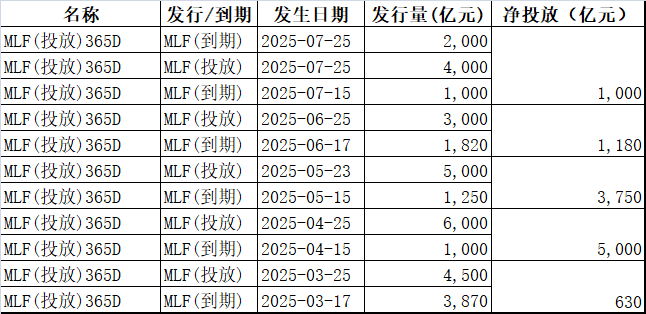
7月MLF延续净投放,继续展现适度宽松的货币政策取向
Cai Jing Wang· 2025-07-25 03:41
Core Viewpoint - The People's Bank of China (PBOC) is continuing its accommodative monetary policy by increasing the Medium-term Lending Facility (MLF) operations, indicating a commitment to maintain liquidity in the financial system amid various market pressures [1][2][4]. Group 1: MLF Operations and Liquidity Management - On July 25, the PBOC announced a 400 billion yuan MLF operation with a one-year term, marking a net injection of 100 billion yuan for July, continuing a trend of increased MLF operations for the fifth consecutive month [1][2]. - The central bank's actions are aimed at stabilizing market expectations and ensuring overall liquidity remains stable, especially during periods of significant financial obligations such as tax payments [2][3]. - The MLF net injection for the months of March to July was recorded at 630 billion, 5000 billion, 3750 billion, 1180 billion, and 1000 billion yuan respectively, reflecting a controlled approach to liquidity management [3]. Group 2: Future Challenges and Policy Outlook - The PBOC has indicated that it will maintain a moderately accommodative monetary policy, especially as the government debt supply is expected to peak in August and September, which may increase pressure on banks [4]. - The average net financing scale during this peak period could reach 1.5 to 1.6 trillion yuan per month, leading to heightened demand for stable funding from banks [4]. - The central bank may utilize various liquidity management tools, including Open Market Operations (OMO), MLF, and reverse repos, and may also consider measures such as government bond purchases and reserve requirement ratio cuts to ensure liquidity stability [4].
7月中期流动性净投放总规模达3000亿元 央行延续数量型工具操作强度
Xin Hua Cai Jing· 2025-07-25 03:12
Group 1 - The People's Bank of China (PBOC) conducted a 7-day reverse repurchase operation of 789.3 billion yuan and a Medium-term Lending Facility (MLF) operation of 400 billion yuan, resulting in a net injection of 801.8 billion yuan into the market after accounting for maturing operations [1] - In July, the total net liquidity injection reached 300 billion yuan, which is comparable to the previous month's 318 billion yuan, indicating a stable liquidity environment [1] - The chief macro analyst at Dongfang Jincheng noted that the continuous net liquidity injection is driven by the rapid issuance of government bonds and accelerated credit growth, necessitating supportive monetary policy [1] Group 2 - The PBOC's deputy governor emphasized the commitment to implementing a moderately loose monetary policy and improving the effectiveness of financial services to the real economy [2] - Analysts expect the PBOC to continue using liquidity management tools such as reverse repos and MLF to maintain a reasonable level of liquidity in the banking system [2] - There is an anticipation of potential long-term liquidity injections through government bond transactions to support bond issuance and enhance banks' lending capabilities, thereby bolstering support for the real economy [2]
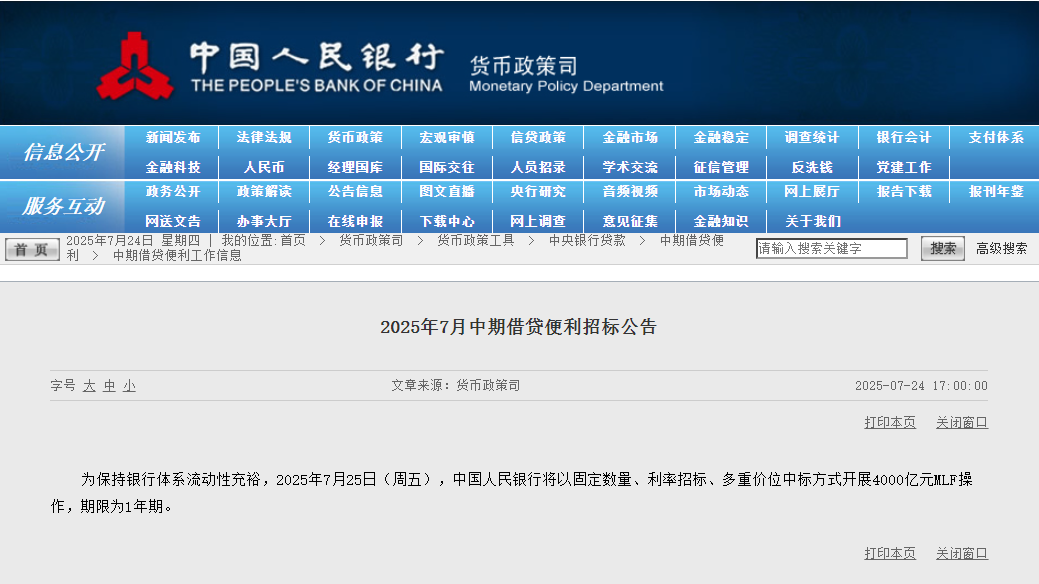
4000亿元!央行最新动作,连续五个月加量续作
券商中国· 2025-07-24 13:22
央行副行长邹澜近日在国新办新闻发布会上强调,央行将进一步落实好适度宽松的货币政策。在总量方面,把 握好政策实施的力度和节奏,保持流动性充裕。 民生银行首席经济学家温彬预计,在支持内需提振及外部掣肘减轻的背景下,预计央行仍将通过质押式逆回 购、MLF、买断式逆回购等中短期流动性管理工具,推动银行体系流动性处于合理充裕状态,延续"适度宽 松"基调。 责编:战术恒 排版:汪云鹏 校对:王朝全 为保持银行体系流动性充裕,人民银行7月24日发布公告称,在7月25日央行将以固定数量、利率招标、多 重价位中标方式开展4000亿元中期借贷便利(MLF)操作,期限为1年期。鉴于本月有3000亿元MLF到期, 本次MLF操作意味着央行在7月MLF净投放1000亿元,为央行连续第五个月对MLF加量续作。 考虑到本月央行已实现2000亿元买断式逆回购净投放,综合来看,央行在7月中期流动性净投放规模达 到3000亿元,继续展现央行适度宽松的货币政策取向。 自去年10月央行启用买断式逆回购以来,货币政策操作对MLF的依赖逐步降低。今年3月,MLF改为采用固定 数量、利率招标、多重价位中标方式开展操作,政策属性完全退出,回归流动性投放工具 ...
4000亿!央行,明日操作
Zheng Quan Shi Bao· 2025-07-24 11:31
Core Viewpoint - The People's Bank of China (PBOC) is continuing its trend of increasing medium-term lending facility (MLF) operations to maintain liquidity in the banking system, with a net injection of 1000 billion yuan in July, marking the fifth consecutive month of increased MLF operations [1][4]. Group 1: MLF Operations - On July 25, the PBOC will conduct a 4000 billion yuan MLF operation with a one-year term, following the maturity of 3000 billion yuan MLF this month, resulting in a net injection of 1000 billion yuan [1]. - The MLF operations have shifted to a fixed quantity, interest rate bidding, and multiple price bidding approach since March, indicating a reduced reliance on MLF as a monetary policy tool and a focus on liquidity provision [4]. - The MLF is expected to become a primary channel for medium-term liquidity provision, helping alleviate pressure on banks' net interest margins [4]. Group 2: Monetary Policy Stance - The PBOC is committed to maintaining an appropriately accommodative monetary policy, ensuring ample liquidity in the banking system [5]. - The central bank has successfully implemented a net injection of 2000 billion yuan through reverse repos this month, contributing to a total net liquidity injection of 3000 billion yuan in July [4]. - The PBOC's liquidity toolkit is becoming more robust and well-distributed in terms of maturity, with various tools available for different time frames, including long-term reserve requirement ratio cuts and government bond transactions [4].
4000亿!央行,明日操作!
证券时报· 2025-07-24 11:25
Core Viewpoint - The People's Bank of China (PBOC) is continuing its trend of increasing liquidity in the banking system through a series of monetary policy tools, including the Medium-term Lending Facility (MLF), to maintain a stable and adequate liquidity environment [1][4][5]. Group 1: MLF Operations - On July 25, the PBOC will conduct a 400 billion yuan MLF operation with a one-year term, resulting in a net injection of 100 billion yuan for July, marking the fifth consecutive month of increased MLF operations [1]. - The MLF has shifted to a fixed quantity, interest rate bidding, and multiple price bidding method since March, indicating a reduced reliance on MLF as a monetary policy tool and focusing on liquidity provision [4]. - The MLF is expected to become a primary channel for medium-term liquidity provision, alleviating pressure on banks' net interest margins, as it offers stability and predictability for financial institutions [4]. Group 2: Overall Monetary Policy - The PBOC has achieved a net injection of 300 billion yuan in liquidity for July, combining 200 billion yuan from reverse repos, reflecting a continued moderate easing stance in monetary policy [4]. - The central bank aims to maintain a reasonable and adequate liquidity state through various tools, including pledged repos, MLF, and reverse repos, to support domestic demand and mitigate external pressures [5]. - The PBOC's liquidity toolbox is becoming more robust and well-distributed in terms of maturity, with long-term, medium-term, and short-term tools available to manage liquidity effectively [4].
聚焦重点群体 推动学习教育走深走实
Jin Rong Shi Bao· 2025-07-22 02:40
在警示教育中筑牢廉洁防线。认真剖析典型违规案例,开展"以案四说"典型案例剖析交流,引导关键岗 位党员领导干部以案为鉴,做到警钟长鸣。组织召开"加强作风建设 争做央行先锋"青年廉政教育座谈 会,参会年轻干部代表通过说纪明纪,进一步深入学习领会中央八项规定及其实施细则精神。丰富拓展 警示教育载体,召开专题警示教育会,市分行党委书记结合金融领域及中国人民银行系统典型违纪违法 案例,给新提拔干部、年轻干部、关键岗位干部等重点对象上警示教育廉政党课。辖内各级党组织组织 重点群体干部到廉政教育基地、法院、纪念馆等开展实地廉政教育,引导干部坚决守住底线红线。从严 筑牢廉政防控堤坝,市分行党委主要领导对5名新提拔干部开展任前集体谈话,督促党员领导干部系好 廉洁从政"第一粒扣子"。举办"我与行长面对面"活动,通过面对面对话交流引领青年干部树立正确的世 界观、人生观、价值观。 在真查实改中推动作风转变。自觉检视查摆问题,通过发送征求意见表、设立专用信箱邮箱热线、召开 进一步关心关爱青年工作专题座谈会等方式,广泛征求服务对象、职工群众对党委班子的意见建议,确 保问题找准找实。组织市分行机关各党支部对照"两个问题清单"、基层"四风" ...
“一增一减”看支持实体经济质效
Jing Ji Ri Bao· 2025-07-21 22:01
Group 1 - The financial data for the first half of the year shows a trend of "one increase and one decrease," with total financing increasing while financing costs are decreasing [1] - By the end of June, the stock of social financing increased by 8.9% year-on-year, M2 money supply grew by 8.3%, and RMB loans rose by 7.1%, indicating reasonable growth in financial totals [1] - The average interest rates for newly issued corporate loans, personal housing loans, and corporate credit bonds have all declined, reflecting the effectiveness of financial support for the real economy [1] Group 2 - The government has implemented a moderately loose monetary policy, characterized by ample liquidity and low comprehensive financing costs [2] - In May, a package of financial support measures was introduced to boost market confidence and stabilize social expectations, resulting in a continued low level of loan interest rates [2] - The People's Bank of China has increased and optimized the quotas for certain tools, enhancing support for technology innovation and small enterprises, with specific allocations for various sectors [2] Group 3 - The moderately loose monetary policy is expected to continue, with the effects of previously implemented policies still to be fully realized [3] - Financial totals are anticipated to maintain reasonable growth, with structural monetary policy tools focusing on key areas such as technology innovation and consumption [3] - The principles of "focusing on key areas, being reasonable and moderate, and having both advances and retreats" will guide the use of structural monetary policy tools [3]
中国LPR连续两月“按兵不动”
Zhong Guo Xin Wen Wang· 2025-07-21 07:00
Core Viewpoint - The People's Bank of China has maintained the Loan Prime Rate (LPR) for both 1-year and 5-year terms at 3.0% and 3.5% respectively, for two consecutive months, aligning with market expectations due to unchanged policy rates since May [1] Group 1: LPR and Monetary Policy - The 1-year LPR remains at 3.0% and the 5-year LPR at 3.5%, reflecting stability in the current monetary policy environment [1] - Analysts suggest that the unchanged LPR is strategic, allowing for better alignment with upcoming counter-cyclical measures aimed at supporting the real economy and stabilizing the banking system [1][2] Group 2: Economic Outlook - Recent macroeconomic data indicates that China's economic growth rate and internal momentum in Q2 exceeded market expectations, providing a solid foundation for achieving annual targets [1] - There is an expectation of further interest rate cuts in the second half of the year to stimulate domestic demand and counteract external uncertainties, with potential impacts on LPR adjustments [2]
南方中债0-3年农发行债券指数A,南方中债0-3年农发行债券指数C: 南方中债0-3年农发行债券指数证券投资基金2025年第2季度报告
Zheng Quan Zhi Xing· 2025-07-21 02:19
南方中债 0-3 年农发行债券指数证券 投资基金 2025 年第 2 季度报告 基金管理人:南方基金管理股份有限公司 基金托管人:中国邮政储蓄银行股份有限公司 送出日期:2025 年 7 月 21 日 南方中债 0-3 年农发行债券指数证券投资基金 2025 年第 2 季度报告 §1 重要提示 基金管理人的董事会及董事保证本报告所载资料不存在虚假记载、误导性陈述或重大遗 漏,并对其内容的真实性、准确性和完整性承担个别及连带责任。 基金托管人中国邮政储蓄银行股份有限公司根据本基金合同规定,于 2025 年 7 月 17 日 复核了本报告中的财务指标、净值表现和投资组合报告等内容,保证复核内容不存在虚假记 载、误导性陈述或者重大遗漏。 基金管理人承诺以诚实信用、勤勉尽责的原则管理和运用基金资产,但不保证基金一定 盈利。 基金的过往业绩并不代表其未来表现。投资有风险,投资者在作出投资决策前应仔细阅 读本基金的招募说明书。 本报告中财务资料未经审计。 本报告期自 2025 年 4 月 1 日起至 6 月 30 日止。 §2 基金产品概况 基金简称 南方中债 0-3 年农发行债券指数 | | | 交易代码 021565 ...
