
7天逆回购

Search documents
跨境电商退运税收优惠延期,周大福拟年后上调价格 | 财经日日评
吴晓波频道· 2026-02-11 00:20
Monetary Policy and Economic Outlook - The central bank conducted a 3,114 billion yuan 7-day reverse repurchase operation, with a net injection of 2,059 billion yuan, indicating a proactive approach to manage liquidity ahead of the Spring Festival [2] - The central bank is expected to accelerate interest rate cuts and reserve requirement ratio reductions due to ongoing economic challenges, with January's manufacturing PMI falling into contraction territory [3] Logistics and Economic Activity - The total social logistics in China reached 368.2 trillion yuan, growing by 5.1% year-on-year, with logistics costs as a percentage of GDP decreasing to 13.9% [4] - Industrial logistics contributed significantly to growth, with high-tech manufacturing logistics demand increasing over 9%, particularly in industrial robots and new energy vehicles [4][5] Cross-Border E-Commerce Policies - The Ministry of Finance extended tax incentives for cross-border e-commerce export return goods until the end of 2027, with the 2025 export-import scale reaching 2.75 trillion yuan, a 69.7% increase since 2020 [6] - The policy aims to alleviate financial burdens on businesses facing challenges due to international market conditions [6] Ride-Hailing Industry Regulation - The Ministry of Transport held discussions with Gaode Dache regarding management issues and pricing practices, emphasizing the need for improved operational safety and compliance [8][9] - The regulatory focus aims to foster a transparent and fair competitive environment in the ride-hailing market [9] Corporate Financing and Investment Trends - Alphabet plans to issue a rare 100-year bond, marking a significant move in corporate financing amidst substantial capital expenditures aimed at AI development [10][11] - Microsoft faced a downgrade in ratings due to concerns over capital expenditures and the performance of its AI products, despite a majority of analysts still recommending the stock [12][13] Gold Market Dynamics - Chow Tai Fook plans to raise gold product prices by 15%-30% due to rising international and domestic market factors, marking its fourth price adjustment in a year [14][15] - The shift in consumer demand from gold jewelry to investment products reflects changing market dynamics, with leading brands innovating to add value beyond weight [15]






一周流动性观察 | 春节临近取现需求上升 央行呵护信号显著 资金面大概率维持平稳
Xin Hua Cai Jing· 2026-02-02 09:08
Group 1 - The People's Bank of China (PBOC) conducted a 750 billion yuan reverse repurchase operation with a rate of 1.40%, maintaining the previous level, resulting in a net withdrawal of 755 billion yuan due to 1,505 billion yuan of reverse repos maturing on the same day [1] - In the previous week, the PBOC's reverse repos totaled a net injection of 5,805 billion yuan, with 2,000 billion yuan of Medium-term Lending Facility (MLF) maturing on Monday and 1,500 billion yuan of 1-month treasury cash deposits conducted by the Ministry of Finance on Wednesday [1] - The overall overnight funding rate increased compared to December 2022, with R001 and DR001 average monthly rates rising by 4.7 and 5.5 basis points to 1.41% and 1.34%, respectively [1] Group 2 - According to analysts, the stability in the funding environment in January was supported by the PBOC's relatively generous liquidity provision, releasing a total of 1 trillion yuan in medium- and long-term funds, equivalent to a 0.5 percentage point reserve requirement cut [2] - The upcoming week will see a total of 17,615 billion yuan in 7-day reverse repos maturing, with an expected increase in cash withdrawal demand as the Spring Festival approaches [2] - Analysts expect the PBOC to maintain a loose monetary policy, potentially using various tools such as 7-day or 14-day reverse repos to stabilize liquidity before and after the Spring Festival [3] Group 3 - The PBOC's clear supportive stance on liquidity is expected to continue, with anticipated liquidity injections of around 30,000 to 35,000 billion yuan before the Spring Festival, aiming to ensure a stable funding environment [3] - The issuance of government bonds is expected to remain high to meet funding needs for key projects, which may introduce additional liquidity pressures [3] - Despite potential short-term tightening, the overall funding environment is expected to remain stable, with reduced volatility in both DR007 and DR001 compared to previous years [3]
流动性周报1月第3期:宏观资金均衡偏松,ETF继续大幅净流出-20260128
Guohai Securities· 2026-01-28 10:33
Group 1 - The macro liquidity environment is balanced and slightly loose, with the central bank conducting a net injection of 229.5 billion yuan through 7-day reverse repos [5][12][14] - Short-term interest rates have decreased, with the average weekly DR007 down by 1.63 basis points to 1.494%, while long-term rates, such as the 10-year government bond yield, fell by 2.24 basis points to 1.837% [12][13] - The supply side of the stock market shows structural differentiation, with a significant rebound in equity fund issuance and high levels of margin financing remaining stable [14][15] Group 2 - The net outflow of stock ETFs reached 333.12 billion yuan, continuing a downward trend from the previous week [16][21] - The net inflow of broad-based ETFs was primarily seen in indices like CSI 2000 and STAR 200, while significant outflows occurred in CSI 1000 and CSI 300 [16][21] - The financing net inflow was notably high in sectors such as non-ferrous metals and non-bank financials, while sectors like electronics and computers experienced net outflows [20][22] Group 3 - The demand side of the stock market shows a reduction in pressure, with total equity financing dropping to 5.681 billion yuan, significantly lower than the previous week's 111.342 billion yuan [22][23] - The scale of locked-up shares released this week was 59.55 billion yuan, slightly up from 52.42 billion yuan the previous week, with the computer and coal industries seeing the highest release values [23][24] - The net reduction in holdings by major shareholders decreased to 14.508 billion yuan from 20.449 billion yuan the previous week, with significant reductions in the electronics and machinery sectors [23][30]
未知机构:广发非银20260122新闻及公告整理一本日行情今日上证-20260123
未知机构· 2026-01-23 02:25
Summary of Key Points from Conference Call Records Industry Overview - The stock market performance on January 22, 2026, showed the Shanghai Composite Index at 4122.58 points, up 0.14%, the Shenzhen Component Index at 14327.05 points, up 0.50%, and the ChiNext Index at 3328.65 points, up 1.01% [1] - The securities index increased by 0.17%, while the insurance index decreased by 1.71% [1] - The total trading volume for stocks was 26,917.32 billion yuan, with the SW Securities II industry accounting for 296.32 billion yuan, representing 1.10% of the total trading volume [1] - The margin trading balance was reported at 27,211.52 billion yuan [1] - The yield on ten-year government bonds was calculated at 1.8425% [1] Company Announcements - **CITIC Securities**: The company’s wholly-owned subsidiary, CITIC Securities International, plans to issue a total of 670 million USD in medium-term notes, guaranteed by CITIC Securities International [1] - **Huaxi Securities**: The company will list its publicly issued corporate bonds (first phase) for professional investors on the Shenzhen Stock Exchange starting January 23, 2026, with a total issuance of 2 billion yuan and a coupon rate of 1.95% for a 3-year term [2] - **GF Securities**: The company will pay interest on its perpetual subordinated bonds (first phase) starting January 26, 2026, with a total issuance of 2 billion yuan and a coupon rate of 3.15% for a term of 5+N years [2] - **Guojin Securities**: The company will begin paying interest on its corporate bonds (first phase) starting January 29, 2026, with a total issuance of 1.5 billion yuan and a coupon rate of 2.83% for a 3-year term [2] - **Yongan Futures**: A shareholder, Zhejiang Dongfang, holding 11.43% of the company, plans to reduce its stake by up to 3% of the total share capital through centralized bidding and block trading starting February 24, 2026 [3] Important News - The People's Bank of China conducted a 2,102 billion yuan reverse repurchase operation at a fixed rate of 1.40%, with 1,793 billion yuan of 7-day reverse repos maturing, resulting in a net cash injection of 309 billion yuan [4] - The central bank will conduct a 9,000 billion yuan MLF operation on January 23, 2026, with a one-year term [5] - The central bank is promoting the internationalization of the renminbi and supporting the construction of Shanghai as an international financial center while enhancing Hong Kong's status [5]
现代中央银行系列(一):政策利率演变与货币政策工具盘点
Changjiang Securities· 2026-01-06 06:18
1. Report Industry Investment Rating No information provided in the content. 2. Core Viewpoints of the Report - The construction of the "modern central bank" system depends on the improvement of the "dual - pillar" of monetary policy and macro - prudential management policy. This report focuses on the formation and evolution of China's policy interest rate system and systematically reviews the development and application of various monetary policy tools, aiming to establish a theoretical and practical framework for subsequent analysis of the interest rate transmission mechanism [2][7][21]. - The current policy interest rate of the central bank has shifted to the short - end, with the 7 - day reverse repurchase rate becoming the main policy interest rate, and the Medium - term Lending Facility (MLF) rate fading out of the policy interest rate sequence [8][24][28]. - The central bank's monetary policy toolbox is diverse, and the innovation of monetary policy has obvious stage divisions. Since 2024, there have been changes in the central bank's thinking on quantity - price operations and expected management of monetary policy [9]. - Since the end of 2024, the monetary policy has changed from "prudent" to "moderately loose", and in 2026, it continues to be set as such, with more emphasis on "flexibility and efficiency" [10][135]. 3. Summary According to Relevant Catalogs Introduction - "Building a modern central bank system" is an important part of "establishing a modern fiscal and financial system". Since its proposal, the central bank has carried out reforms in multiple directions, including the short - end concentration of policy interest rates, the introduction of new open - market operation tools, and the launch of targeted structural monetary policy tools. The regulatory authorities have also given clear expectations for future reform directions [17][19]. - The report series is launched to comprehensively sort out and interpret policy reforms, and the first report focuses on the review and direction deduction of monetary policy tools and policy interest rates [19][21]. Interest Rate System Framework: Starting from Policy Interest Rates Policy Interest Rate Latest Changes: Focusing on the Short - End - China's current interest rate system is divided into three levels: the central bank's policy interest rate (currently the 7 - day reverse repurchase rate), market benchmark interest rates (including the deposit - type financial institution pledged repurchase rate, treasury bond yield, and loan prime rate), and diverse market interest rates in the money, bond, and deposit - loan markets [8][24]. - In 2024, during the process of deepening interest rate marketization reform, the central bank clearly defined the 7 - day reverse repurchase rate as the main policy interest rate. The MLF rate has faded out of the policy interest rate sequence, with adjustments in its operation time and bidding method [28][29]. Policy Interest Rate Review: Retrospect of the Development of 7 - Day Reverse Repurchase and MLF - Policy interest rates have evolved from multiple co - existing rates to the 7 - day reverse repurchase rate. Before 2015, there were many types of policy interest rates. Around 2020, the central bank established a framework with the open - market operation rate as the short - term policy interest rate and the MLF rate as the medium - term policy interest rate. From 2024 - 2025, the 7 - day reverse repurchase rate became the only policy interest rate [37][39][40]. - The 7 - day reverse repurchase has evolved from sporadic use to the most core policy interest rate. It originated in 1998, with low - frequency use from 1999 - 2007 and a suspension from 2008 - 2011. Since 2016, it has become a regular operation, and since 2020, the 7 - day term has been the main one, with its policy attribute continuously enhanced [42][46][47]. - The MLF was created in September 2014 to hedge the decline in foreign exchange reserves. Its term has been unified to 1 - year, and its scale has increased significantly. Around 2020, its operation rate independently assumed the function of the medium - term policy interest rate. Currently, it has withdrawn from the policy interest rate position and returned to its function of liquidity injection [59][63][68]. Monetary Policy Toolbox Inventory Deposit Reserves: A Long - Term Liquidity Adjustment Tool for the Banking System - The system framework of deposit reserves has been continuously improved, with the scope of the reserve base expanding and the deposit reserve ratio system undergoing multiple reforms, including the implementation of a differential deposit reserve ratio system, targeted reserve requirement cuts, and the establishment of a "three - tier and two - preference" framework, which is now simplified to a "three - tier" framework [79][80][85]. - The central bank has adjusted the deposit reserve ratio in multiple stages according to the macro - economic situation, and the reserve assessment method has changed from the point - in - time method to the average method. The central bank has also adjusted the reserve interest rate multiple times [90][94][95]. Buy - out Reverse Repurchase: Created in October 2024 to Provide Medium - and Short - Term Liquidity - The buy - out reverse repurchase is different from the traditional pledged reverse repurchase in terms of bond ownership and bidding method. Its operation has become more transparent, with a monthly rhythm of providing different - term liquidity support at different times. It has become an important channel for the central bank to inject liquidity [98][100][101]. Treasury Bond Trading: Launched in 2024 to Release Medium - and Long - Term Liquidity - Treasury bond trading was launched in August 2024, suspended in January 2025, and restarted in October 2025. It can supplement the medium - and long - term liquidity of the banking system, and the central bank's trading of treasury bonds has an impact on its balance sheet [107][110]. Other Monetary Policy Tools Overview - The central bank's monetary policy toolbox is rich, including open - market operation tools (such as central bank bills, central bank bill swaps, etc.), central bank lending tools (such as rediscount and re - loans), and innovative tools (such as standing lending facilities, pledged supplementary loans, etc.). Some tools have faded out after fulfilling their historical missions [115][117]. Current Monetary Policy Orientation: "Moderately Loose" and "Flexible and Efficient" - Since the end of 2024, the monetary policy has changed from "prudent" to "moderately loose", and in 2026, it continues to emphasize "flexibility and efficiency". The "moderately loose" policy is necessary for economic recovery and coordination with fiscal policy [10][135]. - "Flexible and efficient" implies precise implementation of policies, especially considering the limited space for reserve requirement cuts and interest rate cuts. The Federal Reserve's three interest rate cuts in 2025 have opened up policy space for domestic interest rate cuts. Although the domestic deposit reserve ratio has limited downward space, there is still room for reform, and the use of diversified liquidity injection tools can replace reserve requirement cuts to some extent [137][139][141].
2026年投资展望系列之十一:2026资金面,“低波”或是常态
HUAXI Securities· 2026-01-04 14:06
Group 1: 2025 Financial Environment - In 2025, the financial environment was characterized by a "low wave" state, with a stable overall trend under a moderately loose monetary policy[1] - The year can be divided into two phases: Phase one saw long-term interest rates decline rapidly, while Phase two experienced a return to reasonable interest rate levels[1] - The central bank's approach included a pause in government bond trading to maintain a cautious liquidity supply, leading to a tight balance in the financial market[1] Group 2: Changes in Monetary Framework - The reduction in financial volatility was attributed to changes in the interest rate transmission system, with the OMO rate established as the core policy rate[2] - The monetary policy framework evolved to a more refined operation, allowing for quick stabilization of short-term funding fluctuations[2] - The new framework includes short-term 7-day reverse repos for daily liquidity adjustments and medium to long-term funding through 3- and 6-month reverse repos, MLF, and government bond transactions[2] Group 3: 2026 Financial Outlook - For 2026, the expectation is that the "low wave" state will likely continue, with a focus on maintaining a moderately loose monetary policy to support growth[3] - The demand for financing and consumer willingness remain subdued, with residential short-term loans decreasing by CNY 732.8 billion and long-term loans at a decade low[3] - The central bank is expected to continue using 7-day and 14-day reverse repos for daily liquidity management, alongside a combination of reverse repos, MLF, and government bond transactions for medium to long-term funding[3] Group 4: Short-term Challenges - Despite a stable financial outlook, there are short-term challenges that could disrupt this stability, including fiscal pressures and the impact of new stock offerings on liquidity[4] - The government is likely to increase bond issuance in early 2026, which may create additional liquidity pressures in the market[4] - The trend of increased demand for funds due to new stock offerings has been observed, with significant fluctuations in overnight funding rates during these periods[4]
央行四季度例会延续适度宽松货币政策,加大逆周期和跨周期调节力度
Xin Lang Cai Jing· 2026-01-04 09:04
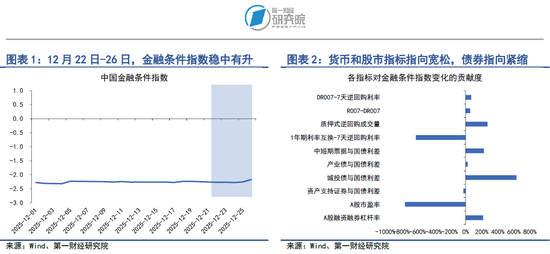
Financial Condition Index Overview - The average daily index of China's financial conditions from December 22 to December 26, 2025, was -2.25, remaining stable compared to the previous week. The index has decreased by 0.87 over the year [1][4][28] - The components of the index indicate a loose monetary and stock market, while the bond market shows signs of tightening. The central bank maintained stable monetary supply, and market liquidity was orderly with low interest rates [1][4][28] Monetary Market - The interbank market maintained stable liquidity, with an average pledged repo transaction volume of 8.48 trillion yuan, consistent with the previous week. However, there was a noticeable decline on December 26, dropping from 8.54 trillion yuan to 7.89 trillion yuan [6][30] - Major money market rates saw an increase, with overnight repo rates averaging 1.35% and 1.26%, reflecting slight changes compared to the previous week [6][30] Central Bank Monetary Policy - The People's Bank of China (PBOC) released key policy signals during the fourth quarter monetary policy committee meeting, emphasizing the need for continued moderate monetary policy and enhanced counter-cyclical adjustments [2][9][35] - The meeting highlighted the importance of integrating incremental and stock policies to effectively manage monetary policy, focusing on both short-term and long-term economic stability [3][10][36] Bond Market - The total issuance of bonds from December 22 to December 26 was 1.64 trillion yuan, a decrease of 317.94 billion yuan from the previous week, while net financing increased by 50.77 billion yuan to 235.05 billion yuan [12][38] - Government bonds saw a net financing of 266.02 billion yuan, while non-financial enterprises also achieved net financing, indicating a mixed performance across sectors [12][39] Stock Market - A-share financing totaled 29.09 billion yuan during the week, an increase of 19.19 billion yuan compared to the previous week, with total financing for the year exceeding 1.07 trillion yuan [20][46] - Major A-share indices experienced gains, with the Shanghai Composite Index rising by 1.87%, and the ChiNext Index increasing by 3.85%. Year-to-date, the Shanghai Composite Index has risen by 18.26% [22][48]
一周流动性观察 | 跨年扰动来临 资金宽松的格局大概率不会改变
Xin Hua Cai Jing· 2025-12-29 08:25
Group 1 - The People's Bank of China (PBOC) conducted a 7-day reverse repurchase operation of 482.3 billion yuan at an interest rate of 1.40%, maintaining the previous rate, resulting in a net injection of 415 billion yuan after 67.3 billion yuan of reverse repos matured [1] - In the previous week, the net withdrawal from 7-day reverse repos was 34.8 billion yuan, while the PBOC conducted a 1-year Medium-term Lending Facility (MLF) operation of 400 billion yuan, exceeding the previous amount by 100 billion yuan [1] - The average rate of DR001 is expected to drop below 1.3% for the month, indicating a continued loose monetary environment despite potential year-end disturbances [2] Group 2 - The PBOC's monetary policy committee emphasized the need for continued moderate easing and enhanced counter-cyclical and cross-cyclical adjustments to support stable economic growth and reasonable price recovery [3] - Analysts predict that the first quarter of 2026 will see a path of easing through reserve requirement ratio (RRR) cuts and structural interest rate reductions, with a potential RRR cut of 50 basis points releasing approximately 1 trillion yuan in liquidity [3] - The focus of monetary policy will shift towards ensuring the smooth transmission of interest rates and adjusting the relationships between various asset rates, aiming for an overall moderate easing goal [3]
调控年末流动性,时隔三个月央行重启14天逆回购
Di Yi Cai Jing· 2025-12-18 08:24
Core Viewpoint - The central bank is expected to increase the volume of Medium-term Lending Facility (MLF) and conduct a certain scale of government bond transactions in December to inject medium- and long-term liquidity into the market [1][7]. Group 1: Market Liquidity Management - The central bank resumed the 14-day reverse repurchase agreement after three months, conducting operations of 883 billion yuan for 7-day and 1,000 billion yuan for 14-day reverse repos on December 18, maintaining the interest rate at 1.40% [1]. - The market's focus on potential tightening of liquidity has increased, with the overnight repo rate (DR001) stabilizing around 1.27% after briefly dropping below 1.3% [1][5]. - Analysts believe that the central bank's continuous liquidity injections are aimed at countering potential tightening risks, resulting in a relatively loose liquidity environment [1][3]. Group 2: Year-End Liquidity Dynamics - As the year-end approaches, the central bank's actions are influenced by increased liquidity disturbances due to factors like bank assessments, fiscal revenue, and resident withdrawals [2][3]. - The central bank's operations are designed to smooth out liquidity fluctuations and maintain a stable market environment, with the 14-day reverse repo directly addressing the funding needs over the New Year holiday [2][4]. - The central bank is expected to continue using both 7-day and 14-day reverse repos to effectively control short-term liquidity fluctuations [4]. Group 3: Interest Rate Trends - The overnight funding rate has shown a downward trend, with DR001 averaging below 1.3% recently, indicating a shift from the previous stable low rate environment [5]. - The weighted average rates for DR007 have remained above the policy interest rate, reflecting ongoing liquidity management efforts [5]. - The SHIBOR rates for overnight and 7-day terms have decreased, while the 14-day SHIBOR has increased, indicating mixed signals in the short-term funding market [5]. Group 4: Future Outlook - Analysts predict that the central bank will continue to utilize various liquidity tools to enhance the precision and effectiveness of liquidity management as the year-end approaches [6][7]. - The central bank's focus will remain on creating a stable financial environment for the real economy, ensuring that liquidity tools effectively smooth short-term fluctuations and guide reasonable interest rates [7].
流动性和机构行为周度观察:税期扰动或阻碍隔夜资金利率下行-20251215
Changjiang Securities· 2025-12-15 04:45
1. Report Industry Investment Rating No information provided in the content. 2. Core View of the Report From December 8 - 12, 2025, the central bank's 7 - day reverse repurchase had a small net capital injection, and the 6M repurchase in December had a net injection of 20 billion yuan. The government bond net payment scale decreased, the inter - bank bond market leverage ratio increased on average, and the median duration of medium - long - term and short - term interest - style pure bond funds changed. Tax - period disturbances may hinder the decline of overnight funding rates [2][7]. 3. Summary by Relevant Catalogs 3.1 Funds - **Central Bank Operations**: From December 8 - 12, 2025, the central bank's 7 - day reverse repurchase had a net injection of 470 million yuan. In December, the 6M repurchase had a net injection of 20 billion yuan. From December 15 - 19, 7 - day reverse repurchases worth 66.85 billion yuan will mature, 40 billion yuan of 6M repurchases will mature, and 60 billion yuan will be issued. The decrease in net repurchase injection in December may be due to banks' preference for 1 - year policy tools [6]. - **Funding Rates**: From December 8 - 12, 2025, the average values of DR001 and R001 decreased by 1.2 and 0.7 basis points respectively compared to December 1 - 5. The average values of DR007 and R007 increased by 1.1 and 0.6 basis points respectively. The overnight rate DR001 dropped below 1.30%. However, due to the tax - period payment disturbance after December 15, overnight funding rates may face volatility [7]. - **Government Bond Net Financing**: From December 8 - 14, 2025, the government bond net payment scale was about 1.48 billion yuan, 17.18 billion yuan less than December 1 - 7. From December 15 - 21, the expected net payment scale is - 8.394 billion yuan [7]. 3.2 Inter - bank Certificates of Deposit - **Yield and Curve**: As of December 12, 2025, the 1M and 3M inter - bank certificate of deposit yields were 1.6150%, up 3.6 and 0.0 basis points respectively from December 5. The 1Y yield was 1.6600%, up 0.5 basis points from November 28. The decline in certificate of deposit rates was hindered by weak bond market sentiment and limited impact of marginal changes in funding on pricing [8]. - **Net Financing**: From December 8 - 14, 2025, the net financing of inter - bank certificates of deposit was about - 12.06 billion yuan. From December 15 - 21, the expected maturity repayment amount is 106.29 billion yuan, with high roll - over pressure [8]. 3.3 Institutional Behavior - **Leverage Ratio**: From December 8 - 12, 2025, the average leverage ratio of the inter - bank bond market was 107.63%, up from 107.56% in December 1 - 5 [9]. - **Bond Fund Duration**: On December 12, 2025, the median duration of medium - long - term interest - style pure bond funds increased by 0.44 years week - on - week, reaching the 92.6% quantile since early 2022. The median duration of short - term interest - style pure bond funds decreased by 0.30 years week - on - week, at the 18.2% quantile [9].