
贷款市场报价利率(LPR)

Search documents
东海证券晨会纪要-20260323
Donghai Securities· 2026-03-23 02:26
Group 1: Key Recommendations - The report provides a comprehensive analysis of the "Wash Path" in the context of the U.S. reserve framework, highlighting the transition from a scarce reserve framework to an ample reserve framework post-2008 financial crisis [5][6][7] - The "Wash Path" aims to return to a scarce reserve framework, allowing the Federal Reserve to control reserve supply through open market operations, thus flexibly managing the federal funds rate [7][8] - The report outlines a three-step process under the "Wash Path": interest rate cuts, easing bank regulations, and balance sheet reduction, with a focus on promoting technological advancements and increasing bank lending [8][10] Group 2: Market Overview - Global equity markets experienced a general decline, while Hong Kong stocks rose; major commodity futures such as gold, oil, aluminum, and copper saw price drops [11] - The report notes a significant supply gap in the oil market, potentially exceeding 10 million barrels per day, due to ongoing tensions in the Middle East, which could impact downstream demand for other commodities [12] - The domestic equity market showed mixed performance, with financial and consumer sectors leading, while the industrial sector faced declines; the average daily trading volume was 21,972 billion yuan [12][19] Group 3: Economic Indicators - The latest Loan Prime Rate (LPR) remained unchanged for ten consecutive months, with the one-year LPR at 3.00% and the five-year LPR at 3.50% [15] - The report highlights the People's Bank of China's commitment to maintaining a moderately loose monetary policy to ensure liquidity and balance between short-term and long-term economic health [16] - The report indicates that the U.S. Treasury yields have shown upward trends, with the 2-year yield rising to 3.88% and the 10-year yield to 4.39% [24]
最新LPR公布!
证券时报· 2026-03-20 03:26
Core Viewpoint - The Loan Prime Rate (LPR) for one year is set at 3.0% and for five years or more at 3.5%, effective until the next announcement [1]. Group 1: LPR Announcement - The People's Bank of China announced the LPR for March 20, 2026, with the one-year LPR at 3.0% and the five-year LPR at 3.5% [1]. - This marks the 10th consecutive month that the LPR has remained unchanged since June 2025 [4].

期待降息力度更大些
经济观察报· 2026-03-13 06:01
Group 1 - The core viewpoint of the article emphasizes the need for stronger monetary policy actions, particularly interest rate cuts, to stimulate economic recovery and address the financial pressures faced by households and businesses [2][4]. - The People's Bank of China has indicated a commitment to maintaining a moderately loose monetary policy, with expectations for further interest rate cuts to support economic stability and growth [2][3]. - Despite nominal financing costs decreasing, the actual financing costs remain high due to factors like negative growth in producer prices, leading to a decline in corporate profits that outpaces the reduction in financing costs [3][4]. Group 2 - The average return on assets for listed companies is projected to decline to 2.7% from 2022 to 2025, which may deter investment due to insufficient future return expectations [4]. - Household debt, particularly from mortgages, is a significant constraint on domestic demand, with three-quarters of household debt attributed to housing loans, exacerbating the reluctance to consume [4][5]. - A substantial interest rate cut could lower the cost of existing and new loans, improve corporate financial conditions, and enhance investment willingness, thereby stimulating consumption [5][6]. Group 3 - Implementing significant interest rate cuts poses challenges for the banking sector, particularly regarding net interest margin pressures due to the lag in adjusting deposit costs compared to loan rates [6]. - Solutions may include adjusting the reserve requirement ratio to inject low-cost liquidity into the banking system, allowing banks to pass on benefits to the real economy [6].

年内降息降准还有一定空间
Xin Lang Cai Jing· 2026-02-25 22:05
Core Viewpoint - The Loan Prime Rate (LPR) in China remains unchanged for the ninth consecutive month, with the 1-year LPR at 3% and the 5-year LPR at 3.5%, aligning with market expectations [2][3]. Group 1: LPR Stability - The stability of the LPR is attributed to the unchanged policy interest rates, particularly the central bank's 7-day reverse repurchase rate, which serves as a pricing basis for the LPR [2]. - Despite a slight decline in major medium to long-term market interest rates, the net interest margin of commercial banks is at a historical low, reducing the incentive for banks to lower the LPR [2][3]. Group 2: Economic Context - The current low level of interest rates diminishes the urgency for a decrease in the LPR, with the weighted average interest rate for new corporate loans at approximately 3.2%, down about 20 basis points year-on-year, and personal housing loans at 3.1%, roughly stable compared to the previous year [3]. - The macroeconomic environment is supported by strong exports and rapid development in high-tech manufacturing, allowing the economy to withstand external pressures and achieve growth targets [3]. Group 3: Future Policy Outlook - The central economic work conference emphasizes the integration of existing policies and the need for counter-cyclical adjustments, indicating potential for future interest rate cuts [4]. - The People's Bank of China has indicated that there is still room for adjustments in the reserve requirement ratio and policy rates, with the current average reserve requirement ratio at 6.3% [4]. - The urgency for domestic interest rate cuts is low, but future actions may depend on the recovery of credit demand and the performance of financial data in the first quarter [5].
LPR为何连续9个月“按兵不动”?
Zhong Guo Jing Ying Bao· 2026-02-24 15:00
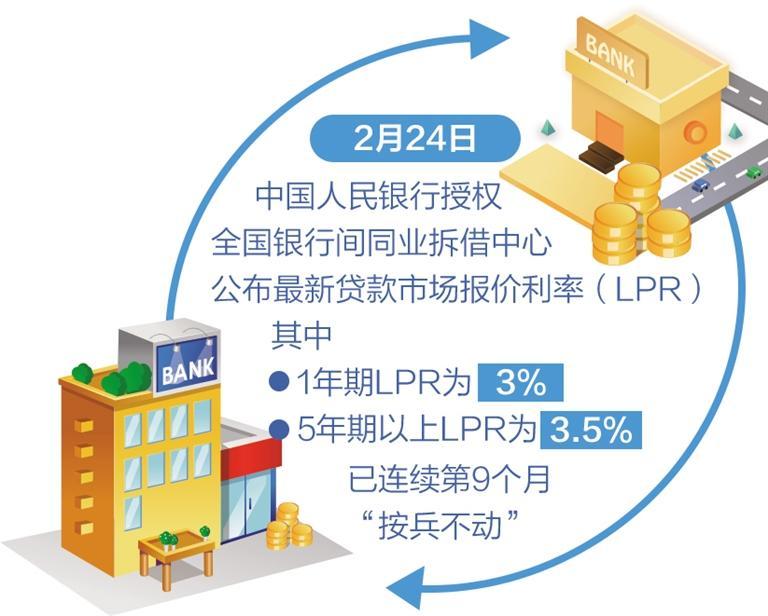
Group 1 - The Loan Prime Rate (LPR) has remained unchanged for the ninth consecutive month, with the 1-year LPR at 3.0% and the 5-year LPR at 3.5%, influenced by stable policy rates, pressure on banks' net interest margins, and a cautious monetary policy approach [1] - The core anchor for LPR pricing, the 7-day reverse repurchase rate, has remained stable since February, indicating no changes in the pricing foundation for LPR [1] - The commercial banks' net interest margin is at a historical low of 1.42%, which reduces the incentive for banks to lower their lending rates [1] Group 2 - The weighted average interest rates for new corporate loans and new personal housing loans are both around 3.1%, marking a historical low [2] - External uncertainties, particularly from the U.S. imposing tariffs, may lead to increased policy adjustments, with potential for comprehensive interest rate cuts in the second quarter of 2026 [2] - The current low inflation provides room for a relatively loose monetary policy, and the continuation of the U.S. Federal Reserve's rate-cutting cycle alleviates external pressures [2] Group 3 - The implementation of a series of significant policies since 2025 requires further release of their effects, with a focus on optimizing existing policies in 2026 [3] - A potential decrease in LPR is anticipated, although the expected reduction may be modest, ranging from 5 to 10 basis points [3]
马年首期LPR维持不变,货币政策进入观察期
Jin Rong Jie· 2026-02-24 12:27
Core Viewpoint - The Loan Prime Rate (LPR) remains stable for the ninth consecutive month, with the one-year rate at 3.0% and the five-year rate at 3.5%, reflecting a solid pricing foundation and macroeconomic resilience [1][2]. Group 1: LPR Stability - The LPR's stability was anticipated by the market, as the Medium-term Lending Facility (MLF) rate remained unchanged, which directly influences the LPR's pricing mechanism [2]. - The macroeconomic environment shows resilience, with strong exports and growth in high-tech manufacturing, supporting the current monetary policy stance [2]. Group 2: Banking Sector Challenges - The net interest margin for commercial banks is at a historical low of 1.42%, below the threshold for stable operations, limiting the motivation for banks to lower LPR quotes [3]. - The average weighted interest rate for general loans has decreased to 3.55%, with corporate loans at approximately 3.2% and personal housing loans at about 3.1%, indicating that financing costs are already low [3]. Group 3: External and Policy Considerations - The external environment is expected to improve, with the U.S. Federal Reserve likely to continue its rate cuts, reducing the pressure from the U.S.-China interest rate differential [4]. - There is still room for a reduction in the reserve requirement ratio, currently at about 6.3%, which could facilitate future LPR adjustments [4]. - The current monetary policy is in a "consolidation phase" after previous aggressive measures, with a focus on maintaining low financing costs rather than further reductions [4].
中金所多个2602合约完成交割,节后首日LPR维持不变
Jin Rong Jie· 2026-02-24 09:44
Group 1 - The China Financial Futures Exchange announced the settlement prices for various stock index futures and options contracts on February 24, with the IF2602 contract settling at 4711.15 points, IC2602 at 8401.00 points, IM2602 at 8310.75 points, and IH2602 at 3043.03 points [1] - The last trading day for stock index futures contracts is the third Friday of the expiration month, with the settlement date coinciding with the last trading day, using a cash settlement method [1] - The settlement prices are calculated based on the arithmetic average of the underlying index over the last two hours of the final trading day, rounded to two decimal places [1] Group 2 - February 24 marked the first trading day for A-shares after the Spring Festival holiday, with trading resuming on the Shanghai, Shenzhen, and Beijing stock exchanges [2] - The People's Bank of China authorized the National Interbank Funding Center to announce the latest Loan Market Quote Rate (LPR), with the 1-year LPR remaining at 3.0% and the 5-year LPR at 3.5%, both unchanged [2]
开工第一天,最新LPR公布
Nan Fang Du Shi Bao· 2026-02-24 07:47
Core Viewpoint - The Loan Prime Rate (LPR) remains unchanged at 3.0% for the 1-year term and 3.5% for the 5-year term, reflecting stability in the monetary policy environment and expectations for economic growth in 2025 [1][3]. Group 1: LPR Stability - The LPR has not changed since June 2025, attributed to strong export performance and rapid development in high-tech manufacturing sectors [1]. - The stability of the LPR aligns with market expectations, as the central bank's 7-day reverse repurchase rate has remained stable, indicating no changes in the pricing basis for LPR [3]. Group 2: Economic Indicators - The net interest margin for commercial banks has stabilized at a historical low of 1.42%, reducing the incentive for banks to lower LPR quotes [3]. - High-frequency data suggests that exports will remain strong into the first quarter of 2026, supporting the current monetary policy stance [3]. Group 3: Future Monetary Policy - The People's Bank of China (PBOC) has indicated that the current monetary policy is in an observation phase, with potential for a comprehensive interest rate cut in the second quarter of 2026 to stimulate consumption and investment [5]. - There is an expectation for significant downward adjustments in the 5-year LPR to stabilize the real estate market and encourage housing demand [5].
最新LPR发布,如何理解?
Xin Lang Cai Jing· 2026-02-24 07:07
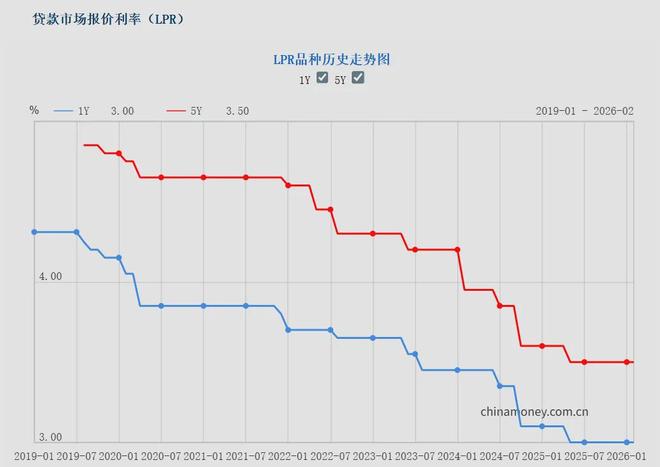
Core Viewpoint - The Loan Prime Rate (LPR) in China remains unchanged for February 2026, with the 1-year LPR at 3.0% and the 5-year LPR at 3.5%, reflecting market expectations and stable policy rates [1][6]. Group 1: LPR and Monetary Policy - The LPR has remained stable for nine consecutive months, influenced by unchanged pricing foundations and low existing interest rates [1][6]. - The People's Bank of China (PBOC) has maintained a stable policy rate, indicating no significant changes in the LPR's pricing basis [1][6]. - The recent slight decline in major mid-to-long-term market interest rates, including the yield on 1-year AAA-rated interbank certificates of deposit, is attributed to liquidity injections before the Spring Festival [1][6]. Group 2: Financing Costs and Economic Impact - The average corporate loan interest rate was approximately 3.2% in January 2026, down 2.4 percentage points from the peak in late 2018, indicating a low financing cost environment [2][7]. - The low financing costs reflect a relatively ample credit supply and the effectiveness of financial policies in benefiting the real economy, which helps reduce burdens on enterprises [2][7]. - The PBOC has introduced structural monetary policies to support key sectors like technology innovation and small enterprises, aiming to maintain economic growth despite external pressures [2][7]. Group 3: Future Economic Outlook - Analysts believe the current period is one of policy observation, with low financing costs and a need for banks to restore interest margins, reducing the urgency for further rate cuts [3][8]. - The uncertainty in the international macroeconomic environment, particularly regarding U.S. trade policies, may exert downward pressure on China's macroeconomic performance in the second quarter of 2026 [3][8]. - The potential for counter-cyclical policy adjustments may arise if the negative impacts of high U.S. tariffs on global trade and Chinese exports become more pronounced [3][8].
2月LPR报价出炉:1年期LPR为3.0% 5年期以上LPR为3.5%
Zhong Guo Xin Wen Wang· 2026-02-24 06:24
Core Viewpoint - The People's Bank of China has announced the Loan Prime Rate (LPR) for February 24, 2026, with the 1-year LPR set at 3.0% and the 5-year LPR at 3.5%, effective until the next announcement [1] Group 1 - The 1-year LPR is established at 3.0% [1] - The 5-year LPR is set at 3.5% [1] - These rates will remain in effect until the next LPR release [1]