
公司治理

Search documents
京东安联财险两高管任职获批,张李利履新广东分公司副总经理
Nan Fang Du Shi Bao· 2025-09-12 12:27
Core Viewpoint - The recent appointments of Li Liyan and Zhang Lili at JD Allianz Property Insurance Co., Ltd. aim to enhance corporate governance and regional business management structure [2][5]. Company Background - JD Allianz Property Insurance, originally established as Allianz Insurance Company's Guangzhou branch in 2003, became an independent legal entity in 2010 and was renamed in 2019 [5][6]. - The company has expanded its business coverage to key regions including Guangdong, Shanghai, Beijing, and Sichuan [6]. Management Team - The management team is characterized by a significant trend towards youth, with many core members being born in the 1980s and 1990s, and a high proportion of executives having foreign enterprise experience [6][7]. - The current core management structure consists of one general manager and three deputy general managers, each with diverse backgrounds and responsibilities [7][8]. Business Growth and Financial Performance - The company's insurance business revenue grew from 1.241 billion to 6.396 billion from 2018 to 2024, with a notable increase in profitability in 2023 and 2024, achieving net profits of 30 million and 86 million respectively, marking a 184.4% year-on-year growth in 2024 [8][9]. - The growth in business is closely linked to the 2018 equity changes and capital increase, which boosted the registered capital from 805 million to 1.61 billion [8]. Product Offering - The product portfolio shows a strong influence from shareholders, with the return shipping insurance being a strategic pillar, experiencing a 64.4% growth in 2024, although it has shown a significant decline in average premium rates from 1.07% in 2023 to 0.36% in 2024 [9][10]. Shareholder Structure - As of June 2025, the major shareholders include Allianz (China) Insurance Holding Co., Ltd. with 53.33%, JD.com with 33%, and others holding smaller stakes [10].

最新!信托公司管理办法正式发布!
Jing Ji Guan Cha Bao· 2025-09-12 11:44
Core Viewpoint - The Financial Regulatory Bureau has revised the "Trust Company Management Measures" to enhance the trust industry by focusing on its core responsibilities, deepening reforms, and effectively preventing risks [1][2]. Group 1: Main Revisions - The revised measures emphasize the core business of trust companies, adjusting their business scope to focus on asset service trusts, asset management trusts, and public welfare trusts, while breaking the rigid repayment model [7][8]. - The measures aim to strengthen corporate governance by integrating party building with corporate governance, enhancing shareholder behavior management, and establishing internal assessment mechanisms [7][9]. - Risk prevention is prioritized, with a focus on compliance management and operational risk, requiring comprehensive risk management throughout the trust business process [7][10]. Group 2: Business Scope Adjustments - The business scope has been narrowed to three main areas: asset service trusts, asset management trusts, and public welfare trusts, while eliminating unrelated intermediary businesses [8]. - New provisions allow trust companies to apply for liquidity support loans from the Trust Industry Guarantee Fund Company and to issue bonds directed at shareholders and related parties [8]. Group 3: Corporate Governance Requirements - Trust companies are required to establish a specialized committee for the protection of the rights of clients and beneficiaries, led by independent directors [9]. - There are enhanced requirements for managing shareholder behavior and related transactions, including regular evaluations and reporting of violations [9]. Group 4: Risk Management and Internal Controls - Trust companies must strengthen internal controls and risk management, ensuring that risk preferences align with risk management capabilities [10][11]. - The measures specify requirements for the entire trust business process, including documentation, risk disclosure, and asset management [10]. Group 5: Recovery and Disposal Arrangements - The revised measures enhance the enforceability and operability of recovery and disposal plans, allowing trust companies to seek liquidity support and issue bonds [12]. Group 6: Rectification of Existing Trust Businesses - Trust companies are required to identify and rectify existing businesses in accordance with the new measures, with progress monitored by the Financial Regulatory Bureau [13].
中国黄金集团黄金珠宝股份有限公司 第二届董事会第十一次 会议决议公告
Zhong Guo Zheng Quan Bao - Zhong Zheng Wang· 2025-09-11 22:36
Group 1 - The company held its 11th meeting of the 2nd Board of Directors on September 11, 2025, with all 9 directors present, complying with legal and regulatory requirements [2][4]. - The Board approved the proposal to cancel the Supervisory Board and amend the Articles of Association, transferring the Supervisory Board's powers to the Audit Committee of the Board [3][5]. - The proposal to revise the "Rules of Procedure for Shareholders' Meetings" and related systems was also approved, aligning with the latest legal requirements [6][8]. Group 2 - The Board decided to rename and revise the rules of the specialized committees, including changing the Audit Committee to the Audit and Risk Committee and the Strategy Committee to the Strategy and ESG Committee [10][11]. - A new "Board Authorization Management Measures" was proposed to enhance corporate governance and operational mechanisms [12][13]. - The company plans to hold the 2025 Second Extraordinary General Meeting of Shareholders on September 29, 2025, to review related proposals [14][15]. Group 3 - The company will disclose detailed information regarding the amendments to the Articles of Association and the rules of the shareholders' meeting on the Shanghai Stock Exchange website [5][8]. - The meeting will utilize a combination of on-site and online voting methods for shareholders [19][20]. - Shareholders must register to attend the meeting, with specific procedures outlined for both corporate and individual shareholders [25][28].

江苏汉邦科技股份有限公司第二届董事会第一次会议决议公告
Shang Hai Zheng Quan Bao· 2025-09-11 18:50
Group 1 - The company held its second board meeting on September 11, 2025, where all nine directors attended and agreed to waive the notice period for the meeting [2][3] - Zhang Dabin was elected as the chairman of the second board of directors with unanimous approval [3][6] - The board established several specialized committees, including the audit committee, nomination committee, compensation and assessment committee, and strategy committee, with a term of three years [4][26] Group 2 - The board approved the appointment of Zhang Dabin as the general manager (CEO) of the company, effective immediately [4][27] - The board appointed Tang Yefeng as the secretary of the board, with a term aligned with the board's term [8][28] - The company appointed several vice presidents, including Li Shengying, Tang Yefeng, Jin Xinliang, Liu Genshui, and Yan Zhong, with the same term as the board [11][27] Group 3 - The board approved the appointment of Gu Bin as the financial director, effective immediately [14][27] - The company appointed Xie Yuxin as the securities affairs representative, with a term aligned with the board's term [17][28] - The board approved the addition and revision of certain governance systems to enhance operational standards and protect shareholder rights [19][50]
凌云光(688400)披露2025年半年度持续督导报告,9月11日股价上涨5.42%
Sou Hu Cai Jing· 2025-09-11 14:25
Core Insights - Lingyun Optoelectronics (688400) reported a closing price of 40.87 yuan on September 11, 2025, with a market capitalization of 18.84 billion yuan, reflecting a 5.42% increase from the previous trading day [1] - The company achieved a revenue of 1.368 billion yuan in the first half of 2025, representing a year-on-year growth of 25.73%, while net profit reached 96.08 million yuan, up 10.10% year-on-year [1] - Research and development expenses accounted for 15.96% of total revenue, with a total of 827 patents held by the company [1] Company Governance and Risks - The company's governance, internal control, and information disclosure systems are effectively implemented, with no violations or issues requiring statements from the sponsor [1] - Risks identified include goodwill impairment from the acquisition of JAI, technological development lag, talent loss, and technology leakage [1] - Operational risks involve intensified market competition, increased management difficulties, and merger integration risks [1] - Financial risks primarily consist of accounts receivable, inventory, exchange rate fluctuations, and goodwill impairment risks [1] - The use of raised funds is compliant, and there are no pledges or freezes on shares held by the controlling shareholder and related parties, although some executives have reduced their holdings due to personal financial needs [1]

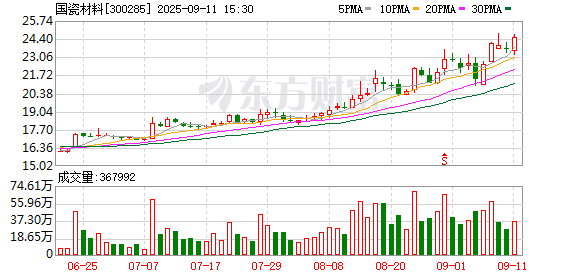
关联股东既当“裁判员”又当“计票员”?国瓷材料股东会程序违规收罚单 董秘被点名担责
Mei Ri Jing Ji Xin Wen· 2025-09-11 13:53
Core Viewpoint - The governance issues of Guocera Materials have been highlighted due to violations during shareholder meetings, specifically regarding related party transactions and the voting process [2][3][4]. Group 1: Governance Violations - The first violation involves related shareholders not abstaining from voting on related party transactions during shareholder meetings, which undermines the interests of non-related shareholders [4][6]. - The second violation pertains to the counting of votes, where some meetings lacked legal and shareholder representatives, and related shareholders acted as vote counters, violating established rules [4][6]. Group 2: Regulatory Actions - The Shandong Securities Regulatory Bureau and Shenzhen Stock Exchange issued administrative measures against Guocera Materials and its Secretary of the Board, Xu Shaomei, for these governance failures [6][7]. - Xu Shaomei has been held responsible and is required to submit a written rectification report within 30 days, with the violations recorded in the securities market integrity database [6][7]. Group 3: Company Response - Guocera Materials has acknowledged the issues raised and committed to rectifying them, emphasizing that the regulatory measures will not affect its normal business operations [7][8]. - The company has recently held a temporary shareholder meeting to revise governance rules, including the management of related transactions [7].

东兴证券2025年第一次临时股东大会将审议多项重要议案
Xin Lang Cai Jing· 2025-09-10 12:56
Core Viewpoint - The extraordinary general meeting of Dongxing Securities Co., Ltd. is set to discuss twelve significant proposals, including amendments to company governance structures and management systems [1][2]. Group 1: Governance Structure Amendments - The meeting will consider a proposal to abolish the supervisory board, transferring its responsibilities to the audit committee of the board of directors [2]. - Multiple amendments to the company's articles of association and various governance rules are proposed to enhance compliance with the Company Law and improve operational efficiency [2]. Group 2: External Guarantee and Compensation Management - The draft for the external guarantee management system outlines the conditions, scope, approval procedures, and disclosure requirements for external guarantees, emphasizing unified management and risk control [3]. - The compensation management draft for directors and supervisors establishes different compensation structures based on the type of director, detailing payment methods and adjustments [3]. Group 3: Appointment of Accounting Firm - The proposal to appoint KPMG Huazhen as the accounting firm for the fiscal year 2025 includes an audit fee of 1.32 million yuan for financial statements and 250,000 yuan for internal controls, with a one-year engagement period [4]. - Any changes in audit scope or content that lead to increased fees will require authorization from the shareholders' meeting [4].

同花顺紧急叫停减持背后:一场“让渡机会”争议下的信任修复战
Xin Lang Zheng Quan· 2025-09-10 10:10
Core Viewpoint - The sudden announcement by the chairman of Tonghuashun, Yi Zheng, to terminate a share reduction plan after just three days has raised concerns about corporate governance and market trust, despite the plan being within regulatory frameworks [1] Group 1: Share Reduction Plan - Yi Zheng proposed a plan to reduce 1.3831 million shares, which was met with skepticism from investors, leading to a 4.95% drop in stock price the following day [1] - The share reduction was based on shares acquired at a low price of 73 yuan per share in 2022, resulting in a floating profit of 395% [1] - The rapid reversal of the reduction plan has diminished the certainty of information disclosure, impacting investor confidence [1] Group 2: Market Trust and Governance - The incident is viewed as a significant challenge to the company's governance image and market trust, highlighting the importance of consistency between shareholder actions and communications [1] - To restore market trust, the company needs to enhance governance transparency and demonstrate business resilience, particularly in the commercialization of AI technology [1] - The quick turnaround from announcement to cancellation has raised concerns about the reliability of future shareholder actions and the overall cost of market speculation [1]

2025年公司治理国际研讨会在北京召开
Zheng Quan Ri Bao Wang· 2025-09-07 13:13
Core Insights - The 2025 China Listed Company Governance Index (CCGINK) and the Green Governance (ESG) Index (CGGINK) were released, indicating a slight increase in governance quality but highlighting areas needing improvement [1][2] - The average governance index for listed companies in 2025 is 64.94, a marginal increase from 64.87 in the previous year, suggesting a slowing improvement rate [1] - The average ESG index for listed companies in 2025 is 59.10, showing a more significant increase of 1.06 from 58.04 in 2024, indicating a faster growth rate in green governance [2][3] Governance Index Summary - The governance evaluation sample includes 5,368 companies, with 3,045 from the main board, 1,359 from the ChiNext board, 581 from the Sci-Tech Innovation board, 262 from the Beijing Stock Exchange, and 121 financial institutions [1] - Private-controlled companies continue to outperform state-controlled companies in governance quality, while companies without actual controllers exhibit higher governance levels [1] - The board governance has improved, but the effectiveness of compliance in actual supervision remains a concern [1] ESG Index Summary - The ESG evaluation sample consists of 2,469 companies, with 1,687 from the main board, 397 from the ChiNext board, 234 from the Sci-Tech Innovation board, 37 from the Beijing Stock Exchange, and 114 financial institutions [2] - The highest dimension in the ESG index is the responsibility dimension, followed by effectiveness, while the governance structure and mechanism dimensions are relatively lower [2] Recommendations for Governance Improvement - Establish a mechanism to connect the supervisory responsibilities of audit committees to prevent governance risks during "supervision gaps" [2] - Leverage the advantages of companies without actual controllers to create a corresponding responsibility system [2] - Utilize digital tools to enhance governance activities, reduce costs, and improve effectiveness [2] - Encourage institutional investors to participate in governance, maximizing their role as "active shareholders" [2] Recommendations for ESG Improvement - Gradually implement mandatory disclosure of ESG information to form a Chinese standard system for green governance [3] - Strengthen the top-level design of green governance to upgrade its structure and mechanisms [3] - Promote the transformation of financial institutions towards green governance to enhance green finance [3]
给股东画了 8.5万亿大饼,马斯克能拿走 1 万亿吗?
Xin Lang Cai Jing· 2025-09-07 09:15
Core Viewpoint - The article discusses Elon Musk's ambitious new compensation plan for Tesla, which is essentially a high-stakes wager on the company's future performance and market value, raising questions about corporate governance and shareholder trust [3][34]. Group 1: Compensation Plan Details - Musk's new "2025 Performance Award Plan" is a wager that requires him to meet two conditions: achieving a company market value of $2 trillion and ultimately $8.5 trillion, which translates to creating nearly $7.5 trillion in shareholder value with a compound annual growth rate of 22.7% [8][10][11]. - The operational targets include achieving an adjusted EBITDA of $400 billion, delivering 20 million vehicles, activating 1 million Full Self-Driving (FSD) users, delivering 1 million humanoid robots, and operating a fleet of 1 million autonomous taxis [12][13][14][15][16]. Group 2: Legal and Governance Context - The plan is partly a response to a previous legal ruling that invalidated a $50 billion compensation package due to procedural flaws in its approval process, highlighting the influence of a small shareholder in the legal outcome [18][22]. - Following this, Musk moved Tesla's registration from Delaware to Texas, implementing a "poison pill" clause that requires shareholders to own at least 3% of shares to sue the board, effectively raising the barrier for legal challenges [26][27]. Group 3: Shareholder Implications - The board has framed the compensation plan as a gamble where if Musk fails, he receives nothing, while shareholders could see their investments grow by up to 670% if he succeeds, albeit at the cost of a 12% dilution of their shares [28][30]. - The vote on this plan transcends financial implications, representing a choice between traditional corporate governance and Musk's vision for the future of Tesla, which is heavily tied to AI and robotics [32][39]. Group 4: Strategic Outcomes - The plan signifies Musk's consolidation of power, as the move to Texas and the new bylaws effectively shield him from small shareholder challenges, allowing him to pursue his strategic vision without significant oversight [35][36]. - The approval of the plan also indicates shareholder endorsement of Musk's shift from an automotive company to an AI and robotics platform, suggesting a new valuation paradigm based on futuristic ambitions rather than traditional profit metrics [38][39].

