
AI芯片

Search documents
登顶第一!A股新历史时刻!
Ge Long Hui A P P· 2025-08-22 11:10
Group 1 - The A-share electronic sector has reached a market capitalization of 11.54 trillion yuan, surpassing the banking sector for the first time in history, indicating a shift in the growth engine of the Chinese stock market towards technology-driven companies [2] - On August 22, major A-share indices rose significantly, with the Shanghai Composite Index up 1.45% to 3825 points, marking a ten-year high, and the Shenzhen Component Index rising 2.07% [3] - The semiconductor industry chain, particularly in chips, packaging, and AI applications, experienced a comprehensive surge, with significant trading volumes and heightened market sentiment [3][4] Group 2 - The strongest performers included the China AI 50 index, which rose by 5.31%, and various segments of the semiconductor industry, with notable gains in storage chips and advanced packaging [4] - The market rally was triggered by DeepSeek's announcement of its new chip architecture, which has led to increased speculation about the acceleration of domestic computing power autonomy [5][6] - The AI chip sector has seen substantial price increases, with companies like XinYiseng and Zhongji Xuchuang experiencing remarkable stock price growth, reflecting the booming demand for AI-related technologies [7][10] Group 3 - Companies like Cambrian and Haiguang Information have reported significant revenue growth, with Cambrian's revenue reaching 1.111 billion yuan, a year-on-year increase of 4230.22%, and Haiguang's revenue at 5.464 billion yuan, up 45.21% [14][16] - The overall A-share market is increasingly focused on technology growth, with substantial market opportunities in AI computing hardware, robotics, and semiconductor sectors [17] - The global AI chip market is projected to reach $92 billion by 2025, with China's market expected to reach 141.2 billion yuan, indicating a strong growth trajectory for domestic AI chip manufacturers [17][18] Group 4 - The urgency for domestic computing power replacement is rising, with expectations of rapid growth in domestic demand for computing power, potentially generating significant market opportunities [20] - Despite the potential for long-term investment opportunities in the domestic computing power industry chain, caution is advised due to the significant short-term price increases in many related stocks [21]


半导体板块全线走强,28位基金经理发生任职变动
Sou Hu Cai Jing· 2025-08-22 10:28
Market Performance - On August 22, all three major A-share indices closed higher, with the Shanghai Composite Index rising by 1.45% to 3825.76 points, the Shenzhen Component Index increasing by 2.07% to 12166.06 points, and the ChiNext Index gaining 3.36% to 2682.55 points [1] Fund Manager Changes - In the past 30 days (July 23 to August 22), 495 fund managers have left their positions across various funds, with 17 announcements made on August 22 alone. The reasons for these changes include job transitions, personal reasons, and product expirations [3][4] - Notable fund managers who left include Cheng Tao, who managed multiple funds and left due to job changes, and Liang Chaoyi, who left for personal reasons [4][6] Fund Manager Performance - Yi Fangfei, a current fund manager at Bank of China Fund, manages assets totaling 30.371 billion yuan, with the highest return of 35.49% achieved during his tenure on the Zhongyin Fengrun Regular Open Bond Fund [4] - Wu Xiao from China Merchants Fund has managed assets of 9.232 billion yuan, with a notable return of 145.96% on the Guotou Ruijin Ruiying Mixed Fund during his tenure [5] Fund Research Activity - In the last month, Bosera Fund conducted the most company research, engaging with 68 listed companies, followed by Penghua Fund with 65 and Huaxia Fund with 63 [8] - The chemical products industry was the most researched sector, with 288 instances, followed by the chemical pharmaceuticals sector with 246 instances [8] Recent Company Focus - In the past week (August 15 to August 22), Baiya Co., a company in the disposable personal hygiene products sector, was the most researched, with 65 fund institutions participating in the research [9][10] - Other companies receiving significant attention include Kaili Medical and Ziguang Guowei, with 55 and 54 fund institutions respectively [10]
天普股份: AI芯片初创企业中昊芯英创始人杨龚轶凡将成公司实际控制人
Xin Lang Cai Jing· 2025-08-22 09:57
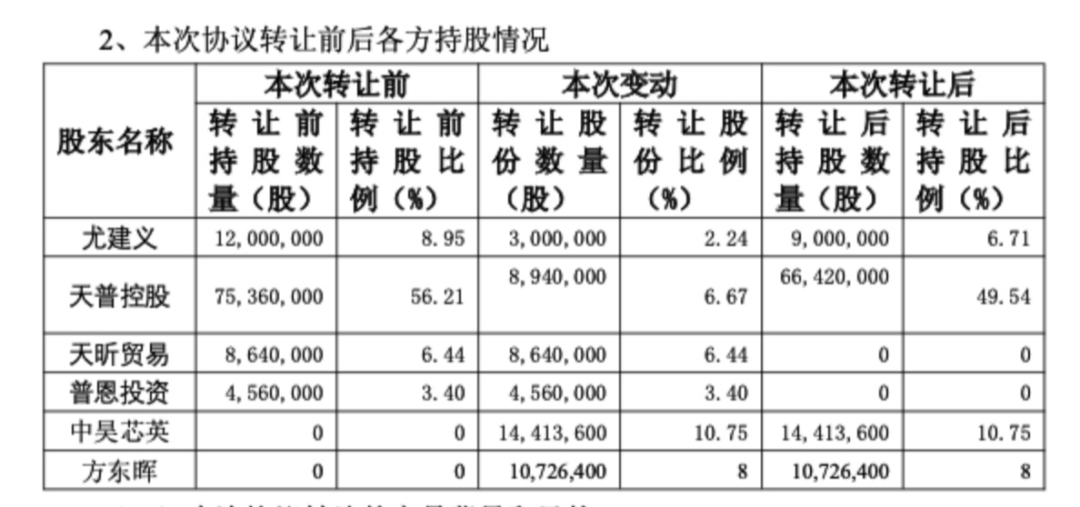
Group 1 - Tianpu Co., Ltd. announced that its controlling shareholder Tianpu Holdings, Tianxing Trading, and You Jianyi plan to transfer a total of 10.75% of the company's shares to Zhonghao Xinying through a negotiated transfer [1] - Upon completion of the share transfer, Zhonghao Xinying and Hainan Xinfan will collectively hold 50.01% of Tianpu Holdings, making Yang Gongyifan the actual controller of Tianpu Co., Ltd. [1] - Zhonghao Xinying is a star startup in the AI chip industry, with its founder Yang Gongyifan being a core member of the Google TPU architecture AI chip development team [1] Group 2 - Zhonghao Xinying primarily engages in the design and research of TPU architecture AI chips, with its products already utilized in the construction of computing power data centers [1] - Tianpu Co., Ltd. is an automotive parts manufacturer, with main products including automotive engine accessory system hoses and assemblies, automotive fuel system hoses and assemblies, automotive air conditioning system hoses and assemblies, and molded products [1] - Tianpu Co., Ltd. was listed on the Shanghai Stock Exchange main board in August 2020 [1]

涨停!AI芯片准独角兽创始人拟入主
Zhong Guo Ji Jin Bao· 2025-08-22 08:53
Core Viewpoint - The founder of Zhonghao Xinying, Yang Gongyifan, plans to take control of Tianpu Co., Ltd. through a share transfer agreement, which will result in Zhonghao Xinying and Hainan Xinfan holding a combined 50.01% stake in Tianpu Holdings, making Yang the actual controller of Tianpu Co., Ltd. [1][5] Group 1: Share Transfer Details - Tianpu Holdings, Tianxing Trading, and You Jianyi intend to transfer a total of 10.75% of Tianpu Co., Ltd.'s shares to Zhonghao Xinying [1][3] - Following the transfer, You Jianyi will hold 6.71%, Tianpu Holdings will hold 49.54%, and Zhonghao Xinying will hold 10.75% of the shares [4] - The transfer will trigger a mandatory tender offer, requiring Zhonghao Xinying to make an offer to all public shareholders [5] Group 2: Company Background and Financials - Zhonghao Xinying is recognized as a "star enterprise" with core technology in TPU architecture AI chips and has achieved mass production [2] - Tianpu Co., Ltd. specializes in the research, production, and sales of polymer materials for automotive fluid pipeline systems and sealing system components [7] - Tianpu Co., Ltd. reported revenues of 348 million yuan, 342 million yuan, and 81 million yuan for 2023, 2024, and Q1 2025, respectively, with net profits of 31 million yuan, 33 million yuan, and 9 million yuan [7] Group 3: Market Reaction and Future Plans - Following the announcement, Tianpu Co., Ltd. experienced a trading halt and subsequently opened with a limit-up on August 22, closing at 29.30 yuan per share, with a market capitalization of 3.929 billion yuan [2] - Zhonghao Xinying aims to leverage its chip development expertise to enhance Tianpu Co., Ltd.'s operational efficiency and long-term growth [10] - Zhonghao Xinying has committed to completing an IPO by 2026, with backing from other listed companies [11][14]
涨停!AI芯片准独角兽创始人拟入主
中国基金报· 2025-08-22 08:52
Core Viewpoint - The founder of Zhonghao Xinying, Yang Gongyifan, plans to take control of Tianpu Co., Ltd. through a share transfer, which will result in Zhonghao Xinying and Hainan Xinfan holding a combined 50.01% stake in Tianpu Co., making Yang the actual controller of the company [2][4]. Summary by Sections Share Transfer Details - On August 21, Tianpu Co. announced that its controlling shareholders would transfer a total of 10.75% of shares to Zhonghao Xinying via an agreement. If completed, Yang Gongyifan will become the actual controller of Tianpu Co. [2][5]. - The share transfer is part of a larger capital increase plan, where Zhonghao Xinying and Hainan Xinfan will also invest in Tianpu Holdings, with Yang controlling the company through these entities [6]. Company Background - Tianpu Co. specializes in the research, production, and sales of polymer materials for automotive fluid pipeline systems and sealing system components, positioning itself as a leading player in the domestic automotive rubber hose industry [9]. Financial Performance - Tianpu Co.'s revenue for 2023, 2024, and the first quarter of 2025 is reported to be 348 million yuan, 342 million yuan, and 81 million yuan, respectively, with net profits of 31 million yuan, 33 million yuan, and 9 million yuan [9]. Market Reaction - Following the announcement of the share transfer, Tianpu Co. was suspended from trading on August 15 and resumed trading on August 22, opening with a limit-up at 29.30 yuan per share, resulting in a market capitalization of 3.929 billion yuan [2][3]. Strategic Implications - Zhonghao Xinying aims to leverage its core technology in chip development and industry resources to enhance Tianpu Co.'s operational efficiency and promote long-term growth [11]. - The share transfer agreement includes performance commitments, ensuring that Tianpu Co.'s existing business maintains positive net profits post-acquisition [11].

史诗级,暴涨
Zhong Guo Ji Jin Bao· 2025-08-22 08:07
Market Overview - The Shanghai Composite Index reached 3800 points, marking a ten-year high, with the ChiNext Index rising over 3% and the STAR Market Index soaring more than 8% [3] - A total of 2803 stocks rose, with 79 hitting the daily limit up, while 2396 stocks declined [3][4] - The total trading volume was approximately 25,788.42 billion, with a total of 5426 stocks traded [4] Sector Performance - Financial stocks, led by brokerages, showed strong performance, with Everbright Securities and Xinda Securities hitting the daily limit up, and Zhinancai rising over 10% to a new high [5] - The semiconductor sector experienced a collective surge, with stocks like Cambrian and Zhaoyi Innovation hitting the daily limit up, and SMIC rising over 10% [7] Key Stocks - Notable performers in the financial sector included: - Everbright Securities (601788) up 10.01% at 20.78 - Xinda Securities (601059) up 6.6% at 19.72 - GF Securities (000776) up 7.27% at 22.42 [6] - In the semiconductor sector, key stocks included: - Cambrian (288526) up 20% at 1243.20 - Zhaoyi Innovation (603986) up 10% at 150.88 [8] Catalysts for Semiconductor Surge - The surge in the semiconductor sector is attributed to two main factors: 1. The update of the DeepSeek model to version V3.1, which is expected to support FP8 precision and domestic chips, indicating a boost for the domestic computing power sector [9] 2. Nvidia's halt in the production of the H20 chip, leading to increased investor confidence in Chinese AI chip manufacturers as alternative suppliers [10]



史诗级,暴涨
中国基金报· 2025-08-22 07:59
Core Viewpoint - The semiconductor sector experienced a significant surge, with the Shanghai Composite Index reaching a ten-year high at 3800 points, and the STAR Market 50 Index rising over 8% on August 22 [1][3]. Market Performance - On August 22, the Shanghai Composite Index closed at 3825.76, up 1.45%, while the Shenzhen Component Index rose 2.07% to 12166.06 [4]. - A total of 2803 stocks increased in value, with 79 stocks hitting the daily limit up, while 2396 stocks declined [5]. Semiconductor Sector Highlights - The semiconductor stocks collectively surged, with notable gains in companies like Cambrian and Zhaoyi Innovation, and SMIC rising over 10% [7]. - Cambrian's stock price is now just 220.75 CNY away from the closing price of Kweichow Moutai, the highest-valued stock in China [7]. Key Drivers of Semiconductor Surge - The surge in semiconductor stocks is attributed to two main factors: 1. The update of the DeepSeek model to version V3.1, which is expected to support FP8 precision and domestic chips [10]. 2. NVIDIA's halt in the production of the H20 chip, leading to increased investor confidence in Chinese AI chip manufacturers as alternative suppliers [11]. Notable Stock Performances - Cambrian-U (SH:688256) saw a price increase of 20% to 1243.20 CNY, with a trading volume of 14.1161 million shares and a total transaction value of 16.489 billion CNY [8]. - Other semiconductor stocks, such as Chengdu Huami and Haiguang Information, also experienced a 20% increase [9]. Conclusion - The semiconductor sector's robust performance reflects a combination of domestic advancements in chip technology and shifts in global supply chains, positioning Chinese companies favorably in the market [11].

A股收评:三大指数齐涨,沪指涨破3800点续创十年新高,科创50指数大涨8.59%,AI芯片、半导体大爆发!超2800股上涨,成交2.58万亿放量1185亿
Ge Long Hui· 2025-08-22 07:46
(责任编辑:宋政 HN002) 【免责声明】本文仅代表作者本人观点,与和讯网无关。和讯网站对文中陈述、观点判断保持中立,不对所包含内容 的准确性、可靠性或完整性提供任何明示或暗示的保证。请读者仅作参考,并请自行承担全部责任。邮箱: news_center@staff.hexun.com 格隆汇8月22日|A股主要指数今日集体走高,沪指突破3800点续创十年新高;截至收盘,沪指涨1.45% 报3825点,深证成指涨2.07%,创业板指涨3.36%,科创50指数涨8.59%创逾3年新高。全天成交额2.58万 亿元,较前一交易日增量1185亿元,全市场超2800股上涨。 | 上证指数 | 深证成指 | 北证50 | | --- | --- | --- | | 3825.76 | 12166.06 | 1600.28 | | +54.66 +1.45% +246.30 +2.07% +10.88 +0.68% | | | | 科创50 | 创业板指 | 万得全A | | 1247.86 | | 2682.55 6060.82 | | +98.71 +8.59% +87.09 +3.36% +97.83 +1.64% ...
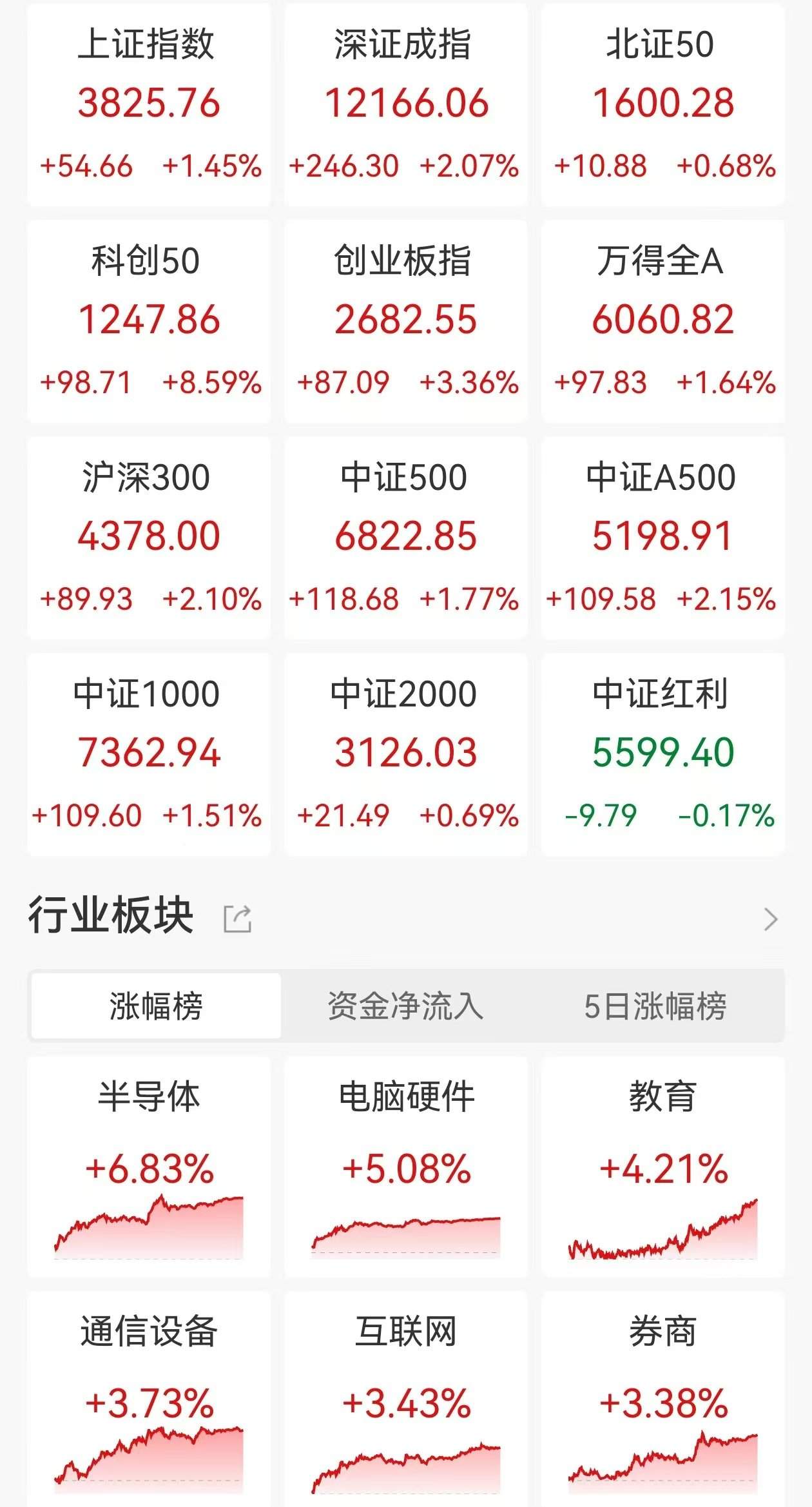
A股收评:沪指涨破3800点续创十年新高,科创50涨8.59%,AI芯片爆发!超2800股上涨,成交2.58万亿放量1185亿
Sou Hu Cai Jing· 2025-08-22 07:38
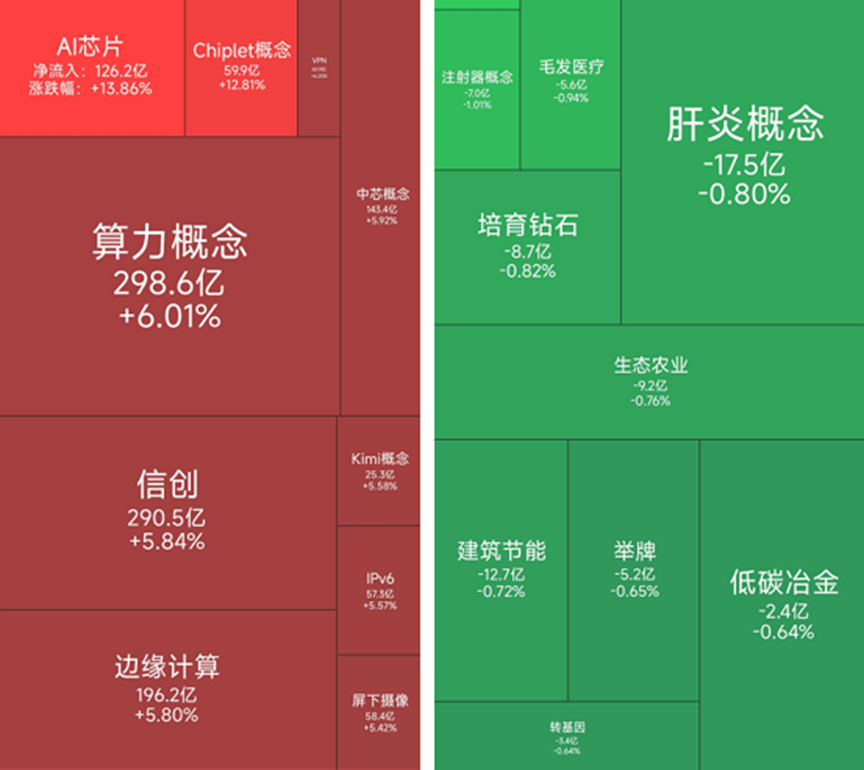
盘面上,英伟达暂停H20芯片生产,AI芯片、半导体及存储芯片板块爆发,寒武纪、盛美上海及海光信 息等多股20%涨停;多模态AI板块走高,昆仑万维20%涨停;CPO概念活跃,方正科技涨停;券商概念 午后走强,光大证券、信达证券涨停;IPv6、电子化学品及算力概念等涨幅居前。另外,幽门螺杆菌概 念下挫,济民健康跌停;燃气、页岩气板块走低,云南能投领跌;生态农业、化肥行业、乳业及银行等 板块跌幅居前。(格隆汇) | 上证指数 | 深证成指 | 北证50 | | --- | --- | --- | | 3825.76 | 12166.06 | 1600.28 | | +54.66 +1.45% +246.30 +2.07% +10.88 +0.68% | | | | 科创50 | 创业板指 | 万得全A | | 1247.86 | 2682.55 | 6060.82 | | +98.71 +8.59% +87.09 +3.36% +97.83 +1.64% | | | | 沪深300 | 中证500 | 中证A500 | | 4378.00 | 6822.85 | 5198.91 | | +89.93 +2.10% ...
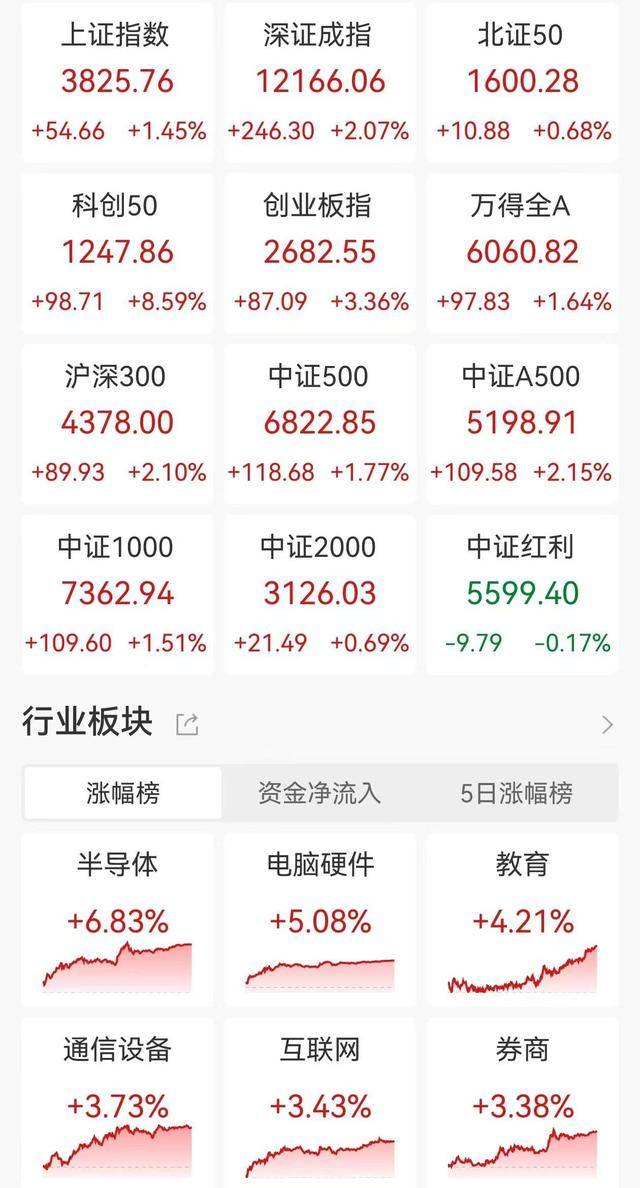
深成指涨幅扩大至2%
Mei Ri Jing Ji Xin Wen· 2025-08-22 07:04
Group 1 - The Shenzhen Component Index increased by 2%, while the Shanghai Composite Index rose by 1.36% and the ChiNext Index surged by 3.29% [1] - Sectors such as AI chips, Chiplet concepts, and VPNs showed significant gains, leading the market [1] - More than 2,603 stocks in the two markets experienced an increase [1]