一价定律

Search documents
大宗商品是个巨大的盘丝洞,牵一发而动全身
对冲研投· 2026-03-22 04:08
Group 1 - The article emphasizes that the narrative surrounding the Iran conflict in the commodity market is predominantly focused on oil prices, but it also highlights the significant impact on other commodities, particularly fertilizers and natural gas [3][4]. - Fertilizers are crucial for global food supply, with synthetic fertilizers supporting approximately half of the world's population. A complete halt in synthetic fertilizer production could only sustain about 4 billion people, while the current global population exceeds 8 billion [4][5]. - Natural gas is a core raw material for fertilizer production, with approximately 36 mmBTU of natural gas required to produce one ton of ammonia, which is then converted into urea, the most widely used nitrogen fertilizer [5][7]. Group 2 - Fertilizer plants are typically located near abundant and cheap natural gas supplies, such as in the Middle East and Russia. The transportation costs of natural gas are prohibitively high, making local production more economical [7]. - The closure of the Strait of Hormuz would severely disrupt the fertilizer market, as there are no strategic reserves for fertilizers, unlike oil. Approximately 45% of urea and 20% of ammonia are exported from countries along the Persian Gulf [7][8]. - The article discusses the limited alternatives for fertilizer supply, with China being a key player. If China resumes exports, prices may decrease; otherwise, they could rise to the next cost level [8][9]. Group 3 - Farmers in major agricultural countries like the US, Australia, India, and Thailand face tough choices due to fertilizer shortages, which could impact crop yields and food prices, thereby influencing inflation [9]. - The article outlines four potential responses from farmers: reducing fertilizer use, switching to crops that require less nitrogen, mixing different fertilizers, or ceasing cultivation altogether [9]. - The article also highlights the differences in the natural gas market compared to oil, noting that natural gas lacks a unified global price due to high transportation costs, leading to fragmented regional markets [12][13]. Group 4 - The attack on the Shah gas field in the UAE, a significant source of sulfur, could further impact fertilizer production, as sulfur is a key ingredient in sulfuric acid used in fertilizers [19]. - The article suggests that the complexities of the commodity market mean that disruptions in one area can have cascading effects on others, illustrating the interconnectedness of global supply chains [21].


银行理财周度跟踪:理财掘金商业航天打新,“套利+”捕捉高确定性收益
HWABAO SECURITIES· 2026-02-11 12:24
Investment Rating - The report does not explicitly provide an investment rating for the industry or specific companies [1]. Core Insights - The report highlights the increasing focus on bank wealth management products, particularly in the context of commercial aerospace investments and the introduction of new "arbitrage+" strategies aimed at capturing high certainty returns [4][10]. - The performance of cash management products remains stable, with a near 7-day annualized yield of 1.28%, while money market funds saw a slight increase to 1.17% [13][15]. - The report notes a rise in the net loss ratio of bank wealth management products to 0.96%, indicating a potential increase in redemption pressure if the credit spread continues to widen [21][24]. Summary by Sections 1. Industry Innovation Dynamics - Ningyin Wealth Management successfully participated in the IPO of "Electric Science Blue Sky," which saw a first-day closing increase of 596%, with six of its products included in the allocation [10]. - Su Yin Wealth Management launched the "arbitrage+" series of wealth management products, focusing on short holding periods of 45 and 100 days, utilizing pricing discrepancies across various markets to generate returns [12]. 2. Yield Performance - Cash management products recorded a near 7-day annualized yield of 1.28%, remaining stable compared to the previous week, while money market funds increased to 1.17% [13][15]. - The yields of pure fixed income and fixed income+ products generally declined, influenced by various market factors including weaker PMI data and increased risk aversion [16][18]. 3. Net Loss Ratio Tracking - The net loss ratio for bank wealth management products increased to 0.96%, up by 0.38 percentage points, with a widening credit spread of 0.06 basis points [21][24].
银行理财周度跟踪(2026.2.2-2026.2.8):理财掘金商业航天打新,“套利+”捕捉高确定性收益-20260211
HWABAO SECURITIES· 2026-02-11 10:35
Investment Rating - The report does not explicitly provide an investment rating for the industry or specific companies [1]. Core Insights - The report highlights the increasing focus on bank wealth management products, particularly in the context of commercial aerospace investments and the introduction of new "arbitrage+" strategies aimed at capturing high certainty returns [4][10]. - The performance of cash management products remains stable, with a near 7-day annualized yield of 1.28%, while money market funds saw a slight increase to 1.17% [13][15]. - The report notes a rise in the net loss ratio of bank wealth management products to 0.96%, indicating a potential increase in redemption pressure if the credit spread continues to widen [21][24]. Summary by Sections 1. Industry Innovation Dynamics - Ningyin Wealth Management successfully participated in the IPO of "Electric Science Blue Sky," which saw a first-day closing increase of 596%, with six of its products included in the allocation [10]. - Su Yin Wealth Management launched the "arbitrage+" series of wealth management products, focusing on short holding periods of 45 and 100 days, utilizing pricing discrepancies across various markets to generate returns [12]. 2. Yield Performance - Cash management products recorded a near 7-day annualized yield of 1.28%, remaining stable compared to the previous week, while money market funds increased to 1.17% [13][15]. - The yields of pure fixed income and fixed income+ products generally declined, influenced by various market factors including weaker PMI data and increased risk aversion [16][18]. 3. Net Loss Ratio Tracking - The net loss ratio for bank wealth management products increased to 0.96%, up by 0.38 percentage points, with a widening credit spread observed [21][24].
中金:用麦当劳算汇率是误导
中金点睛· 2026-01-14 00:08
Core Viewpoint - The article argues that the Chinese yuan is not significantly undervalued, challenging the notion that the price of a Big Mac in China compared to the U.S. indicates a misalignment in exchange rates. It emphasizes that using such simplistic comparisons can be misleading due to various economic factors that influence currency valuation [3][5][24]. Group 1: Theoretical Framework - The concept of absolute purchasing power parity (PPP) is introduced, which suggests that identical goods should have the same price when adjusted for exchange rates. This is based on the law of one price [3][7]. - The article highlights three main flaws in using the law of one price to assess exchange rates: it applies only to tradable goods, the conditions for its validity are rarely met, and it overlooks the significant impact of asset prices on exchange rates [4][8][24]. Group 2: Non-Tradable Goods and Price Composition - A significant portion of the costs associated with a Big Mac in China is derived from non-tradable goods, such as labor and rent, which constitute over 70% of its price. This makes it inappropriate to use the Big Mac as a benchmark for tradable goods [12][24]. - The article provides specific data showing that labor accounts for 45.6% of the Big Mac's price, while rent and electricity contribute 4.6% and 5.1%, respectively [12][24]. Group 3: Income Levels and Price Disparities - The article discusses the Balassa-Samuelson effect, which explains that higher-income countries tend to have higher absolute price levels due to greater productivity in tradable sectors, leading to increased wages in non-tradable sectors as well [9][24]. - It notes that even when comparing similar products, prices in high-income countries are generally higher than in low-income countries, which contradicts the absolute PPP theory [9][10]. Group 4: Capital Flows and Market Expectations - The article emphasizes that capital flows and market expectations play a more significant role in determining exchange rates than commodity prices, especially in a global economy where foreign exchange transactions far exceed trade volumes [22][24]. - It contrasts the classical view of exchange rate determination with a Keynesian perspective, which suggests that exchange rates do not necessarily converge to a single equilibrium value and can be influenced by speculative capital movements [23][24].


AH溢价逼近十年新低!收窄交易近尾声后市怎么走?
Xin Lang Cai Jing· 2025-09-30 06:01
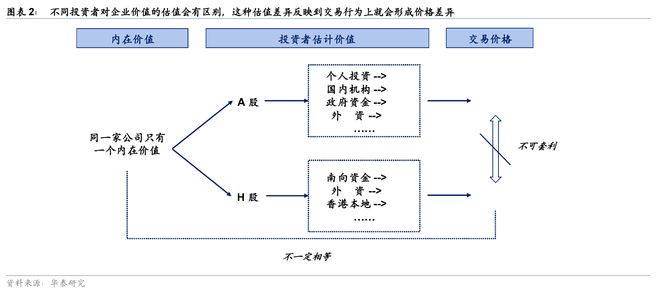
Core Viewpoint - The recent decline in the AH premium index, approaching a 10-year low, has raised concerns among investors regarding the significant price differences of the same companies listed in both A-shares and H-shares markets [1][3]. Group 1: AH Premium Performance - The AH premium index has dropped from 134 in May to 117, marking the lowest level since 2018, leading to widespread market confusion about the reasons behind this decline [1][3]. - Historical data indicates that the AH premium does not exhibit a tendency for short-term rapid mean reversion, with average premiums varying significantly over different periods [3][4]. Group 2: Fundamental Reasons for AH Premium - The fundamental reason for the AH premium lies in the differing valuations by investors in the two markets, as there is no sufficient arbitrage mechanism allowing for easy conversion between A-shares and H-shares [4][6]. - The differences in investor structure and trading systems between the two markets contribute to the observed price discrepancies, with foreign capital playing a larger role in the H-share market [6][7]. Group 3: Quantitative Analysis of Factors - The impact of dividend tax on the price difference is estimated to be around 5%, contrary to the common belief of 25%, indicating a more nuanced understanding of the factors affecting the AH premium [7][10]. - A comprehensive analysis suggests that the long-term theoretical center for the AH price difference may be around 26% to 27%, but this is subject to significant variability due to the lack of effective short-term theoretical centers [10][12]. Group 4: Future Outlook on AH Premium - The current trading dynamics suggest that while the AH premium may remain low, it does not guarantee a reversal opportunity, as external factors like the strength of the US dollar and market trends play a crucial role [10][12]. - Predictions indicate that if the US dollar weakens and the Hang Seng Index valuation rises, the AH premium could potentially decline further to below 15% [10][12]. Group 5: Investment Strategy - In investment decisions, it is essential to consider both capital gains and dividend returns, with capital gains being significantly more impactful than dividend yields [11][12]. - The assessment of AH premium trends is critical for stock selection between A-shares and H-shares, as the dividend yield advantage of H-shares may not compensate for capital gains from A-shares if the AH premium expands [12][13].
交易成本节约与中国式统一大市场|宏观经济
清华金融评论· 2025-06-27 13:54
Group 1 - The core viewpoint is that building a unified market in China is essential for modernizing the economy, and reducing transaction costs is key to achieving this goal [2][5][6] - Transaction costs are identified as the main barrier to market unification, with administrative divisions and local protectionism being significant contributors [2][5][6] - The concept of a unified market is linked to economic efficiency, emphasizing the importance of specialization and division of labor to enhance productivity [4][5] Group 2 - The article highlights that the transition from a planned economy to a market economy has shifted the role of local governments from direct producers to indirect tax collectors, impacting transaction costs [10] - It suggests that the focus of reducing transaction costs should shift from downstream product markets to upstream factor markets in the context of building a unified market [9][10] - The relationship between central and local governments is crucial in addressing transaction costs, as local governments often create barriers that hinder market integration [8][10]