
下一代互联网入口

Search documents
又一巨头加入红包大战,大厂撒钱已达75亿
Sou Hu Cai Jing· 2026-02-13 12:26
Core Viewpoint - JD.com is strategically positioning itself in the upcoming "next-generation internet entry" competition by focusing on direct consumer needs rather than following the trend of AI-driven applications, investing 30 billion yuan in a unique approach to the Chinese New Year shopping season [1][6]. Group 1: JD.com's Strategy - JD.com will launch the "Moon Black Wind High" Super Festival on February 16, offering a total of 3 billion yuan in red envelopes and physical rewards, focusing solely on e-commerce without complex tasks or waiting for promotional broadcasts [3][5]. - The promotional strategy includes direct discounts on popular products like iPhones and Moutai, emphasizing a straightforward "buy or not" approach compared to competitors' AI-driven user engagement tactics [3][6]. Group 2: Competitive Landscape - The competition has split into two distinct paths: one focusing on AI entry points and the other on immediate consumer purchases, with JD.com opting for the latter to build consumer trust rather than just attention [6][9]. - Major competitors like Alibaba, Tencent, ByteDance, and Baidu have collectively invested over 4.5 billion yuan in AI-related red envelope initiatives, while JD.com aims to capture the immediate market with its 30 billion yuan investment [9]. Group 3: Operational Confidence - JD.com demonstrates confidence in its supply chain capabilities, utilizing over 3,600 warehouses to predict and meet regional consumer demand during the peak shopping season [6]. - An additional 1.3 billion yuan is allocated to support delivery personnel and customer service staff during the holiday, ensuring operational continuity and employee welfare [6].



突传利好,央企巨头10亿重金入局,AI眼镜多股涨停
2 1 Shi Ji Jing Ji Bao Dao· 2026-01-06 10:12
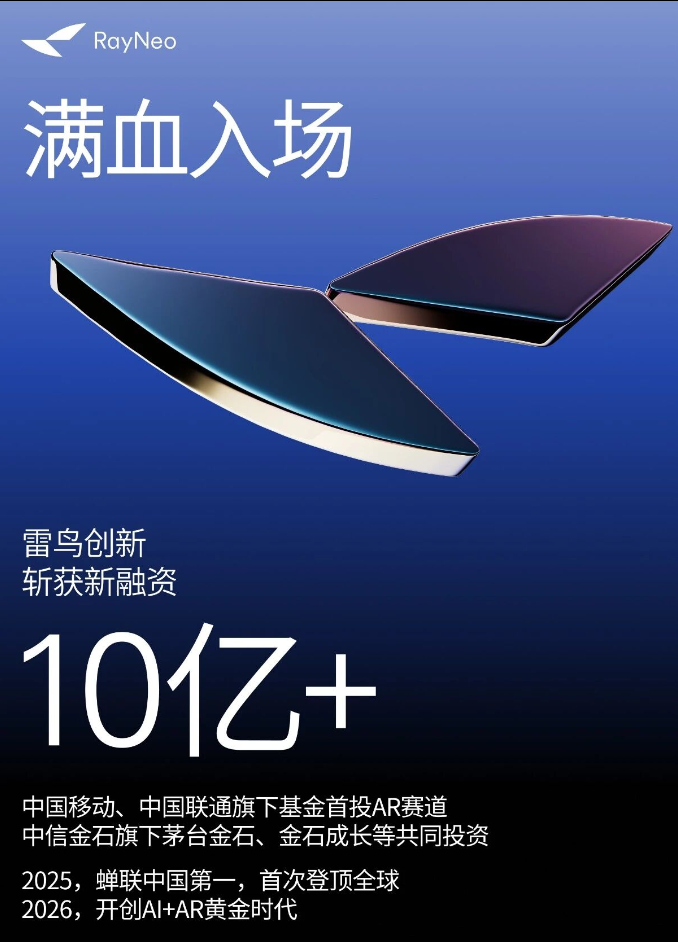
Core Insights - The AI glasses sector is experiencing significant developments, highlighted by Thunderbird Innovation's completion of over 1 billion yuan in C+ round financing, led by China Mobile and CITIC Jinshi, with participation from China Unicom's fund [1][6] - Despite rumors of ByteDance's AI glasses entering the shipping phase being denied, the enthusiasm in the capital market has surged, with the AI glasses index rising over 3.5% on January 5 [3][12] Financing and Market Activity - Thunderbird Innovation's financing sets a record for single financing in the AI+AR glasses sector in 2025, marking a strategic entry by telecom operators that could reshape the industry landscape [6][10] - The capital market's response was robust, with stocks like Lianjian Optoelectronics and Su Da Weige hitting their daily limit up, reflecting high investor interest [3][10] Technological Advancements - The entry of telecom operators is expected to enhance industry confidence and accelerate the adoption of smart glasses, with a focus on eSIM communication modules and edge computing capabilities [8][12] - Thunderbird Innovation plans to showcase its X3Pro Project eSIM at CES 2026, which integrates eSIM and 4G support, allowing the glasses to function independently from smartphones [12] Market Potential and Consumer Trends - The demand for innovative pricing models such as "contract glasses" aligns well with telecom operators' distribution channels, potentially lowering the barrier for consumer adoption [8][12] - The upcoming national subsidy policy for consumer electronics in 2026, which includes smart glasses, is expected to further stimulate market growth [13] Industry Challenges - Despite the potential, the AI glasses industry faces challenges related to weight, battery life, and functionality, which need to be addressed for broader market penetration [13]
突传利好,央企巨头10亿重金入局,AI眼镜多股涨停
21世纪经济报道· 2026-01-06 10:10
Core Viewpoint - The article highlights the significant investment activity in the AI glasses sector, particularly focusing on the recent C+ round financing of Thunderbird Innovation, which raised over 1 billion yuan, indicating strong market interest and confidence in the industry [1][9]. Financing and Market Activity - Thunderbird Innovation completed a C+ round financing of over 1 billion yuan, led by China Mobile Chain Long Fund and CITIC Jinshi, with participation from China Unicom's Lianchuang Innovation Fund [1]. - The financing was initially planned to raise 300-400 million yuan but ended up being 2-3 times oversubscribed, reflecting the capital market's enthusiasm for industry leaders [9]. - Following the financing announcement, the AI glasses index surged over 3.5%, with several stocks, including Lianjian Optoelectronics and Sudavige, hitting their daily limit [3][4]. Industry Trends and Operator Involvement - The entry of telecom operators into the AI glasses market is expected to reshape the industry landscape, focusing on eSIM communication modules and edge computing capabilities [6]. - Operators are likely to offer not just smartphones but also smart glasses and related services, which could lower the barriers for consumer adoption [6]. - The involvement of telecom operators is anticipated to enhance confidence in the supply chain and accelerate the deployment and scaling of smart glasses [6]. Technological Advancements - The competition for the next generation of internet access is intensifying, with smart glasses seen as a potential new computing terminal [11]. - Thunderbird Innovation plans to showcase its X3 Pro Project eSIM at CES 2026, which will allow the device to function independently of smartphones, integrating eSIM and 4G capabilities [11]. - The trend towards resource concentration in the AR sector is evident, with multiple companies securing significant funding to support technological advancements [11]. Market Potential and Consumer Demand - The AI glasses market is expected to benefit from government subsidies, with smart glasses included in the national subsidy program, offering 15% off the price with a cap of 500 yuan per unit [12]. - Consumer interest in innovative purchasing models, such as "buying glasses with phone plans," aligns well with telecom operators' distribution strengths [6]. - The industry is projected to grow as leading companies actively position themselves in the smart glasses market, driven by both technological innovation and favorable policies [12].

豆包抢入口,捅了马蜂窝
Hua Er Jie Jian Wen· 2025-12-05 04:02
Core Insights - The "Doubao Phone" has decided to temporarily withdraw its capability to operate financial apps, citing the need for "prudent adjustments" to align technology development with industry ecology [1][2] - The launch of the Doubao AI Assistant, which allows cross-application operations, has faced significant backlash from major apps like WeChat and Taobao, indicating a conflict between AI developers and existing app ecosystems [3][4] Group 1: Doubao Phone and AI Assistant - Doubao's announcement on December 5 highlights a shift in strategy to ensure safe AI operations, particularly in financial applications [1][2] - The Doubao AI Assistant, launched on December 1, was initially well-received, leading to a surge in demand and price inflation for the associated smartphone [2][3] - Users reported issues with the AI Assistant causing abnormal logouts from WeChat and other apps, raising concerns about security and operational integrity [3][4] Group 2: Industry Response and Implications - Major apps like WeChat and Taobao have implemented measures to block the Doubao AI Assistant, reflecting a defensive stance against third-party AI operations [4][5] - The situation underscores the challenges faced by third-party AI agents in gaining system-level permissions and accessing user data, which are tightly controlled by smartphone manufacturers [5][6] - High-profile firms like Xiaomi are highlighted as having a competitive advantage due to their integrated AI systems and established ecosystems, which are difficult for new entrants to disrupt [6][7] Group 3: Future of AI and App Ecosystems - The conflict initiated by Doubao reveals a broader struggle for control over AI as a new entry point in the digital landscape, potentially reshaping user interactions with applications [7][8] - The need for third-party app authorization poses significant barriers for AI agents, as existing apps are likely to maintain strict security measures to protect user data [9][10] - The ongoing evolution of AI agents is seen as a pivotal moment in the tech industry, with major players vying for dominance in a rapidly changing environment [10]
