两化转型

Search documents
57个重大项目签约 协议投资1305亿元
Guang Zhou Ri Bao· 2026-02-26 02:19
Core Insights - The Guangzhou High-Quality Development Conference announced 57 major signed projects with a total investment of 130.5 billion yuan, covering 21 industrial sectors including intelligent equipment, artificial intelligence, and new energy [1] Group 1: Manufacturing Industry - Among the 57 major signed projects, there are four significant investment projects in the manufacturing sector, highlighting Guangzhou's commitment to prioritizing industry and strengthening its advanced manufacturing base [2] - The investment plan includes 10 billion yuan for a series of projects by the China Shipbuilding Group in the shipbuilding and marine engineering sector, reinforcing Guangzhou's advantages in this industry [2] - Two AI chip and high-end integrated circuit board projects in Huangpu District are set to attract investments of 10 billion yuan each, aiming to elevate the semiconductor and integrated circuit industry [2] Group 2: Emerging Future Industries - The signed projects demonstrate Guangzhou's strong commitment to developing emerging future industries, particularly in the new energy and storage sectors, with the establishment of a lithium battery recycling industrial base in Huadu [3] - In the biopharmaceutical and health sector, a project in Baiyun District aims to enhance the biopharmaceutical industry cluster, contributing to Guangzhou's goal of becoming a global hub for biopharmaceutical innovation [3] - Nearly 20% of the projects focus on artificial intelligence, robotics, and embodied intelligence, indicating a significant push towards innovation-driven industrial transformation [3] Group 3: Modern Service Industry - The project list includes a significant investment of 50 billion yuan in modern financial services, aimed at providing robust support for industrial integration and development [4] - A logistics and supply chain project in Nansha District, with a total investment of 2.4 billion yuan, aims to leverage geographical advantages to enhance the food supply chain and production center linking Guangdong and Macau [4] - The Wanyuan (Conghua) Science and Technology City project will integrate various functions to promote the development of biomedicine and medical beauty [5]
广州市举办2026年企业家新春交流活动
Guang Zhou Ri Bao· 2026-02-26 01:48
Group 1 - The event held in Guangzhou on February 25 aims to enhance communication between entrepreneurs and experts in technology and education, promoting high-quality development in line with the directives from Xi Jinping [2] - Guangzhou's government emphasizes collaboration with businesses, focusing on the integration of manufacturing and service industries to accelerate development and achieve new performance milestones [2] - The city plans to act as a strategic partner for enterprises, fostering innovation, providing financial support, and improving the business environment to ensure sustainable growth for companies [2][3] Group 2 - Entrepreneurs and industry representatives express confidence in Guangzhou's solid industrial foundation, resource aggregation, and favorable business environment, viewing it as a prime location for investment and development [3] - The event was attended by various stakeholders, including central institutions, state-owned enterprises, foreign companies, and financial institutions, highlighting the collaborative spirit among different sectors [3]
【媒体解读】广州先进制造业强市蓝图出炉
Guang Zhou Ri Bao· 2026-01-12 01:44
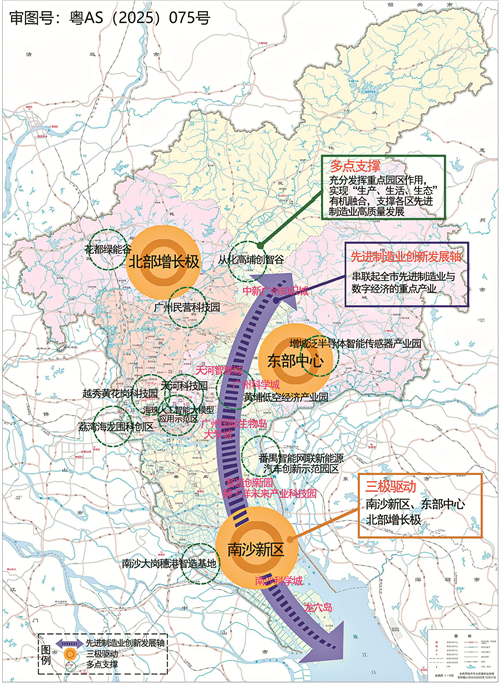
Core Viewpoint - Guangzhou aims to become a world-class advanced manufacturing hub by 2035, with a target to double its industrial added value [2][3]. Group 1: Strategic Goals - The plan outlines four strategic positions: a world-class advanced manufacturing base, a global innovation center for manufacturing, a benchmark city for digital and physical integration, and a model city for new-type industrialization [2][3]. - By 2030, significant progress is expected in building a modern industrial system, with a new structure characterized by trillion-yuan driving forces, hundred-billion-yuan leaps, and overall efficiency improvements [3]. Group 2: Industry Development Plans - The "12218" modern industrial system will be established, focusing on the integration of advanced manufacturing and modern services, as well as the digital and green transformation of industries [4]. - Key industry clusters will be developed, including six emerging pillar industries and five strategic leading industries, with a focus on creating a trillion-yuan "Smart Vehicle City" and achieving significant growth in biomedicine, smart construction, and rail transportation industries [4][10]. Group 3: Future Industries - Future industries driven by cutting-edge technologies will be prioritized, including embodied intelligence, smart unmanned systems, and quantum technology, with a goal of achieving exponential growth in these sectors within 5 to 10 years [5][6]. - High-energy innovation platforms will be established to accelerate the transformation and industrialization of technological innovations [6]. Group 4: Spatial Layout - The spatial layout for advanced manufacturing will be structured around an "axis, three poles, and multiple points" model, integrating key manufacturing resources and trends [7][8]. - The three poles will focus on the Nansha New Area, Eastern Center, and Northern Growth Pole, enhancing the resilience of the industrial chain and promoting high-end, intelligent, and green development [9]. Group 5: Industry Categories - Six emerging pillar industries include smart connected vehicles, ultra-high-definition and new display technologies, biomedicine and health, green petrochemicals and new materials, software and internet, and intelligent equipment and robotics [10]. - Five strategic leading industries encompass artificial intelligence, semiconductors and integrated circuits, new energy and storage, low-altitude economy and aerospace, and biomanufacturing [10]. - Four characteristic advantageous industries include fashion consumer goods, rail transportation, marine engineering, and smart construction [11].

广州发布加快建设先进制造业强市规划
Zheng Quan Shi Bao· 2026-01-08 18:12
Core Viewpoint - Guangzhou aims to become a strong advanced manufacturing city by 2030, achieving significant progress in modern industrial system construction and enhancing overall industrial efficiency, forming a new pattern driven by trillions, supported by hundreds of billions, and elevated by tens of billions [1] Group 1: Key Industrial Directions - The plan emphasizes the integration of advanced manufacturing and modern services, as well as the dual transformation of industrial digitization and greening [2] - It aims to cultivate 15 strategic industrial clusters and develop six emerging pillar industries, including smart connected new energy vehicles, ultra-high-definition and new display technologies, biomedicine and health, green petrochemicals and new materials, software and the internet, and intelligent equipment and robotics [2] - The plan also focuses on five strategic leading industries such as artificial intelligence, semiconductors and integrated circuits, new energy and new energy storage, low-altitude economy and aerospace, and biomanufacturing [2] Group 2: Automotive Manufacturing Example - During the 14th Five-Year Plan period, Guangzhou produced 2.25 million smart connected new energy vehicles, highlighting the city's traditional strength in the automotive sector [3] - The plan encourages traditional car manufacturers to transition to smart connected new energy vehicles, focusing on the development of next-generation modular high-performance vehicle platforms and breakthroughs in common energy-saving technologies [3] - It aims to establish a complete industrial chain for key components such as power batteries, drive motors, and fuel cell systems, achieving leading advantages in the fields of "three electrics," sensors, and specialized chips [3] Group 3: Greater Bay Area Collaboration - The plan emphasizes the collaborative construction of a world-class manufacturing cluster in the Guangdong-Hong Kong-Macao Greater Bay Area [3] - It promotes the development of the Guangzhou-Shenzhen-Hong Kong-Macao Science and Technology Innovation Corridor and participation in high-end electronic information manufacturing and advanced equipment manufacturing industry belts [3] - The plan aims to deepen comprehensive cooperation with Hong Kong and Macao, establishing various cooperative industrial parks and enhancing the synergy between Guangzhou and Foshan [3]
广州发布 加快建设先进制造业强市规划
Zheng Quan Shi Bao· 2026-01-08 18:04
Core Viewpoint - Guangzhou aims to become a strong advanced manufacturing city by 2030, achieving significant progress in modern industrial system construction and enhancing overall industrial efficiency, with a new structure driven by trillions, supported by hundreds of billions, and elevating to billions [1] Group 1: Key Industry Directions - The plan promotes the integration of advanced manufacturing and modern services, as well as the dual transformation of industrial digitization and greening, accelerating new industrialization [2] - It aims to cultivate and strengthen 15 strategic industrial clusters, focusing on six emerging pillar industries including smart connected new energy vehicles, ultra-high-definition and new displays, biomedicine and health, green petrochemicals and new materials, software and the internet, and intelligent equipment and robotics [2] - The plan also emphasizes the development of five strategic leading industries such as artificial intelligence, semiconductors and integrated circuits, new energy and new energy storage, low-altitude economy and aerospace, and biomanufacturing [2] Group 2: Automotive Manufacturing Example - During the 14th Five-Year Plan period, Guangzhou produced 2.25 million smart connected new energy vehicles, with a focus on transforming traditional car manufacturers towards smart connected new energy [3] - The plan includes the development of a new generation of modular high-performance vehicle platforms and breakthroughs in common energy-saving technologies such as integrated design of electric vehicle chassis and lightweight structures [3] - It aims to establish a complete industrial chain for key components like power batteries, drive motors, and fuel cell systems, achieving leading advantages in the fields of "three electrics" and sensors [3] Group 3: Greater Bay Area Collaboration - The plan emphasizes the collaborative construction of world-class manufacturing clusters in the Guangdong-Hong Kong-Macao Greater Bay Area [3] - It promotes the development of the Guangzhou-Shenzhen-Hong Kong-Macao Science and Technology Innovation Corridor and deep participation in high-end electronic information manufacturing and advanced equipment manufacturing industry belts [3] - Continuous deepening of comprehensive cooperation with Hong Kong and Macao is highlighted, along with the establishment of various cooperative industrial parks [3]
广州发布!
Zheng Quan Shi Bao· 2026-01-08 10:39
Core Insights - Guangzhou aims to become a strong advanced manufacturing city by 2030, achieving significant progress in modern industrial system construction and enhancing overall industrial efficiency, forming a new pattern driven by trillions, supported by hundreds of billions, and elevating to hundreds of millions [1] Group 1: Key Industrial Directions - The plan emphasizes the integration of advanced manufacturing and modern services, promoting digital and green transformation, and accelerating new industrialization [2] - It aims to cultivate 15 strategic industrial clusters and develop six emerging pillar industries, including smart connected new energy vehicles, ultra-high-definition and new displays, biomedicine and health, green petrochemicals and new materials, software and the internet, and intelligent equipment and robotics [2] - The plan also focuses on five strategic leading industries such as artificial intelligence, semiconductors and integrated circuits, new energy and new energy storage, low-altitude economy and aerospace, and biomanufacturing [2] Group 2: Automotive Manufacturing Focus - During the 14th Five-Year Plan, Guangzhou produced 2.25 million smart connected new energy vehicles, with a focus on transforming traditional car manufacturers towards smart connected new energy [3] - The plan includes developing a new generation of modular high-performance vehicle platforms and advancing key technologies in electric vehicle chassis design, energy management, and safety technology [3] - It supports the establishment of innovation platforms that integrate new energy vehicles with smart energy and intelligent transportation, and aims to accelerate the development and industrialization of smart connected new energy vehicle technologies [3] Group 3: Regional Collaboration and Development - The Guangdong-Hong Kong-Macao Greater Bay Area Development Plan emphasizes innovation-driven development and aims to enhance advanced manufacturing by cultivating world-class industrial clusters [4] - The plan includes five major projects, including the collaborative construction of world-class manufacturing clusters in the Greater Bay Area and the development of high-end electronic information manufacturing and advanced equipment manufacturing industrial belts [4] - It promotes deep cooperation between Guangzhou and Hong Kong/Macao, establishing various cooperative industrial parks and enhancing regional collaboration in advanced manufacturing [4]
广州发布!
证券时报· 2026-01-08 10:35
Core Viewpoint - Guangzhou aims to become a strong advanced manufacturing city by 2030, achieving significant progress in modern industrial system construction and enhancing overall industrial efficiency, forming a new pattern driven by trillions, supported by hundreds of billions, and elevated by tens of billions [1] Group 1: Key Industrial Directions - The plan promotes the integration of advanced manufacturing and modern services, as well as the dual transformation of industrial digitization and greening, accelerating new industrialization [2] - It aims to cultivate 15 strategic industrial clusters and develop six emerging pillar industries, including smart connected new energy vehicles, ultra-high-definition and new displays, biomedicine and health, green petrochemicals and new materials, software and the internet, and intelligent equipment and robotics [2] - The plan also focuses on five strategic leading industries such as artificial intelligence, semiconductors and integrated circuits, new energy and new energy storage, low-altitude economy and aerospace, and biomanufacturing [2] Group 2: Automotive Manufacturing Example - During the 14th Five-Year Plan, Guangzhou produced a total of 2.25 million smart connected new energy vehicles, emphasizing the transition of traditional car manufacturers to smart connected new energy [3] - The plan includes developing a new generation of modular high-performance vehicle platforms and advancing key technologies in electric vehicle chassis design, energy management, and safety technology [3] - It supports the establishment of innovation platforms that integrate new energy vehicles with smart energy and intelligent transportation, aiming for breakthroughs in smart connected vehicle technology and industrialization [3] Group 3: Regional Collaboration and Development - The Guangdong-Hong Kong-Macao Greater Bay Area Development Plan emphasizes the implementation of an innovation-driven development strategy and the acceleration of advanced manufacturing [4] - The plan outlines five major projects, including the collaborative construction of world-class manufacturing clusters in the Greater Bay Area [4] - It aims to deepen cooperation between Guangzhou, Hong Kong, and Macao, establishing various cooperative industrial parks and enhancing regional industrial collaboration [5]
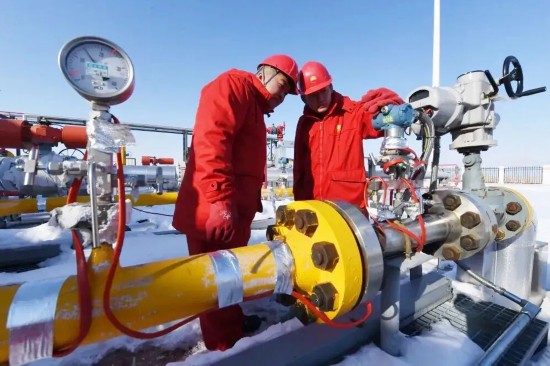
吉林油田天然气压降工程累计创效1.22亿元
Ren Min Wang· 2025-12-30 07:13
Core Insights - Jilin Oilfield has significantly reduced natural gas consumption in its self-operated area, achieving a decrease of 12.19 million cubic meters year-on-year in 2025, and a substantial reduction of 75 million cubic meters compared to the end of the 13th Five-Year Plan, resulting in cumulative benefits of 122 million yuan over five years [1][3]. Group 1: Consumption Reduction Strategies - Since the beginning of the 14th Five-Year Plan, Jilin Oilfield has focused on both increasing reserves and production while reducing costs and improving efficiency, placing gas management at the core of cost control [3]. - The company has implemented a "Natural Gas Consumption Assessment Plan," establishing 43 measures to reduce gas consumption, creating a proactive atmosphere for cost reduction across various departments [3][5]. - Continuous monitoring and dynamic management of energy efficiency indicators have been established to identify and enhance potential efficiency measures [3]. Group 2: Technological Innovations - Jilin Oilfield has adopted a combination of technical skills to enhance efficiency, including optimizing system parameters and coordinating production directives to improve gas-saving skills [3]. - The company has added 432 cold-injection and seasonal cold-injection wells, extending the cold-injection cycle by over 10 days for some wells, which reduces self-consumption by 25,000 cubic meters daily [3]. - Projects utilizing waste heat from wastewater and other clean energy initiatives have been successfully implemented, increasing daily gas-saving capacity by 30,000 cubic meters [3]. Group 3: Smart Monitoring and Future Plans - The company has leveraged the results of its "two transformations" by enhancing online monitoring through an intelligent platform, which helps identify and address energy consumption anomalies [5]. - Future plans include a commitment to deepen the natural gas reduction project with a focus on technological innovation and management optimization to enhance overall energy efficiency [5].
探寻“广州屏”成长秘籍:新型显示产业已成城市新支柱
Nan Fang Du Shi Bao· 2025-03-25 12:36
Group 1 - The core focus of the article is on the growth of the new display industry in Guangzhou, which has become a new pillar industry for the city, highlighted by the "12218" modern industrial system that includes "ultra-high-definition and new display" as one of its six emerging pillar industries [3][4] - Visionox Technology Co., Ltd. (视源电子) has evolved from a hardware manufacturer to a leader in both hardware and software, achieving revenue exceeding 22 billion RMB in 2024, starting from an initial investment of 14,000 RMB [4][5] - The integration of manufacturing and service industries, as well as the digital and green transformation, is a key direction for the development of companies like Visionox, which has invested 2 billion RMB in building an intelligent manufacturing base [4][8] Group 2 - Aoxin Electronics Co., Ltd. (奥松电子) has become a national "specialized and innovative" small giant, establishing a full industrial chain from chip design to application, and is constructing an advanced MEMS chip IDM industrial base [8][9] - The company has seen significant growth in orders and production capacity, expanding its production lines and workforce as it successfully transitioned from laboratory to industrialization [9][11] - The relationship between companies and cities is described as a symbiotic ecosystem, emphasizing the importance of R&D investment and collaboration between industry and academia for sustained innovation [11] Group 3 - Guangdong Xin Semiconductor Technology Co., Ltd. (粤芯) is a high-tech innovation enterprise that has rapidly established a 12-inch chip production platform, marking a significant breakthrough in Guangzhou's integrated circuit manufacturing [12][13] - The company has achieved mass production in just 18 months and aims to produce 80,000 12-inch wafers per month once all phases are completed, addressing the chip demand in the Greater Bay Area [13][14] - The development of the artificial intelligence industry is seen as a major market opportunity for the semiconductor sector, with plans for AI edge chip applications in various fields such as robotics and automotive [14]