两新补贴政策

Search documents
崔东树:2025年新能源车表现相对较强 北方地区纯电动占比提升明显
智通财经网· 2026-02-02 09:27
Core Viewpoint - The performance of new energy vehicles (NEVs) is expected to be strong in 2025, particularly for pure electric and plug-in hybrid vehicles, while traditional fuel vehicles still hold significant demand in certain regions [1][8]. Regional Market Trends Analysis - In 2025, the market share of NEVs in northern regions is projected to increase significantly, with pure electric vehicles showing notable growth [1][8]. - Traditional fuel vehicles still account for about 60% of the market in central and northern regions, while in eastern plains, especially southern areas, NEVs have reached over 50% market share [1][8]. - The overall vehicle market is experiencing a "north strong, south weak" trend, with northern markets, particularly in Northeast and Central Yellow River regions, showing robust growth [2][3]. Policy Impact on Regional Structure - The "Two New" policy is promoting consumer demand for passenger vehicles, leading to a unique market growth pattern with strong retail from September to December 2025 [1][4]. - Subsidy policies are favoring mid-to-low-end economic vehicles, reflecting a fair policy approach that benefits A00 and A0 class electric vehicles in regions like North and Northeast [1][4]. Vehicle Class Market Structure Changes - The SUV segment is experiencing strong growth, particularly in the central and western regions, while the eastern regions show relatively weaker demand for SUVs [7][10]. - The market structure is shifting towards larger vehicles, with C-class models and large SUVs performing well in major cities like Beijing, Shanghai, and Guangdong [1][7]. Brand Structure Changes in the Vehicle Market - The market is seeing a shift in brand preferences, with economic vehicles benefiting significantly from government subsidies, which are aimed at promoting lower-end models [10][11].

【乘联分会论坛】2025年12月乘用车区域市场流向分析
乘联分会· 2026-02-02 08:35
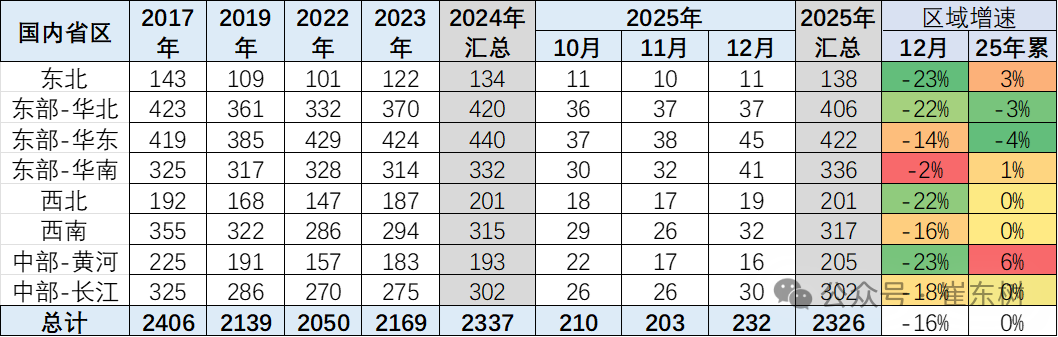
Core Viewpoint - The article discusses the structural changes in the Chinese automotive market driven by economic development, government policies, and regional performance, highlighting a significant divergence in market growth across different regions, particularly between northern and southern China [2][4]. Regional Market Analysis - The Chinese automotive market is experiencing a "north strong, south weak" trend, with northern regions, especially Northeast and Northwest, showing robust growth, while southern regions lag behind [3][5]. - In December 2025, the market share of northern regions decreased by 7.3 percentage points compared to the previous year, indicating a complex market structure influenced by subsidy policies [3][4]. - The overall retail volume in 2025 is projected to reach 2,337 billion, with a notable increase in A00 and A0 class electric vehicles in northern regions due to government subsidies [2][3]. Policy Impact on Market Structure - The "Two New" subsidy policy has significantly benefited low-end and economic vehicles, promoting the growth of A00 and A0 class electric vehicles, particularly in the North and Northeast regions [2][5]. - The subsidy policies have led to a notable increase in the market share of electric vehicles, with northern regions showing a 4.9 percentage point increase in market share compared to 2022 [4][5]. Vehicle Class Market Structure Changes - The SUV segment is experiencing strong growth, particularly in the central and western regions, while the demand for sedans is more pronounced in the eastern regions [7][8]. - The market share of SUVs in the western regions is significantly higher due to geographical factors, with a strong demand for SUVs in mountainous and hilly areas [7][8]. New Energy Vehicle Structure Analysis - By 2025, the penetration rate of new energy vehicles is expected to increase, with pure electric vehicles showing significant growth, especially in northern regions [8][9]. - In regions like Hainan and Guangxi, the market share of new energy vehicles is approaching 60%, indicating a strong growth trend [9][10]. Brand Structure Changes in the Automotive Market - The article indicates that the brand structure within the automotive market is evolving, with a focus on economic vehicles benefiting from government subsidies, while high-end vehicles face challenges in sustaining growth [10][11].
政策周观察第62期:两新补贴落地
Huachuang Securities· 2026-01-05 08:21
Consumption Policy Changes - The first batch of funds for the "Two New" subsidy program has been set at 62.5 billion yuan for this year, with a planned 81 billion yuan for 2025[2] - Subsidies for home appliances will focus on six product categories, with a 15% subsidy on the selling price for energy-efficient products, capped at 1,500 yuan per item[2] - The digital product subsidy has been expanded to include smartphones, tablets, smartwatches, smart glasses, and smart home products[3] Automotive Subsidy Adjustments - For scrapping and replacing vehicles, subsidies for new energy vehicles will be 12% of the sales price, with a maximum of 20,000 yuan, while for fuel vehicles, it will be 10% with a cap of 15,000 yuan[3] - The replacement subsidy for new energy vehicles will be 8% of the sales price, capped at 15,000 yuan, and for fuel vehicles, it will be 6% with a cap of 13,000 yuan[3] Investment Initiatives - The National Development and Reform Commission has announced an early release of investment plans totaling approximately 295 billion yuan, aimed at accelerating fund allocation and usage[4] - Major infrastructure projects approved or authorized have a total investment exceeding 400 billion yuan, including transportation and water resource projects[4] Risk Considerations - There are risks associated with the timely update of policies, which could affect the implementation of the subsidy programs[5]
【乘联分会论坛】2025年7月乘用车区域市场流向分析
乘联分会· 2025-09-01 08:36
Core Viewpoint - The article discusses the structural changes in the Chinese automotive market, highlighting the divergence between northern and southern regions, the impact of government subsidies on vehicle types, and the acceleration of new energy vehicle adoption, particularly in northern provinces [2][4][6]. Regional Market Trends Analysis - The northern automotive market is showing strength, with a 0.9 percentage point increase in market share in July 2025 compared to the previous year, and a 5.6 percentage point increase compared to 2022 [4][5]. - The northeastern region has been experiencing continuous growth, maintaining a high market share of 5.9% in July 2025 [4]. - In contrast, southern regions, particularly East China, are seeing significant declines in market performance, with notable drops in market share [4][6]. Policy Impact on Regional Structure - Government subsidies are favoring mid-range and economic vehicles, leading to a recovery in the economy segment, particularly in northern regions [2][6]. - The A00 and A0 class electric vehicles are benefiting the most from these subsidies, indicating a fair policy approach that promotes the adoption of small electric vehicles [2][6]. New Energy Market Structure Analysis - The penetration of new energy vehicles is increasing, with significant growth in plug-in hybrid models in northern provinces, showcasing their advantages in colder climates [2][9]. - In July 2025, the share of new energy vehicles in regions like Hainan and Guangxi reached around 60%, indicating strong growth [10]. - The overall market for new energy vehicles is robust, with traditional fuel vehicles still holding a significant share in the northern and midwestern regions, while eastern regions are seeing a higher proportion of new energy vehicles [9][10].